
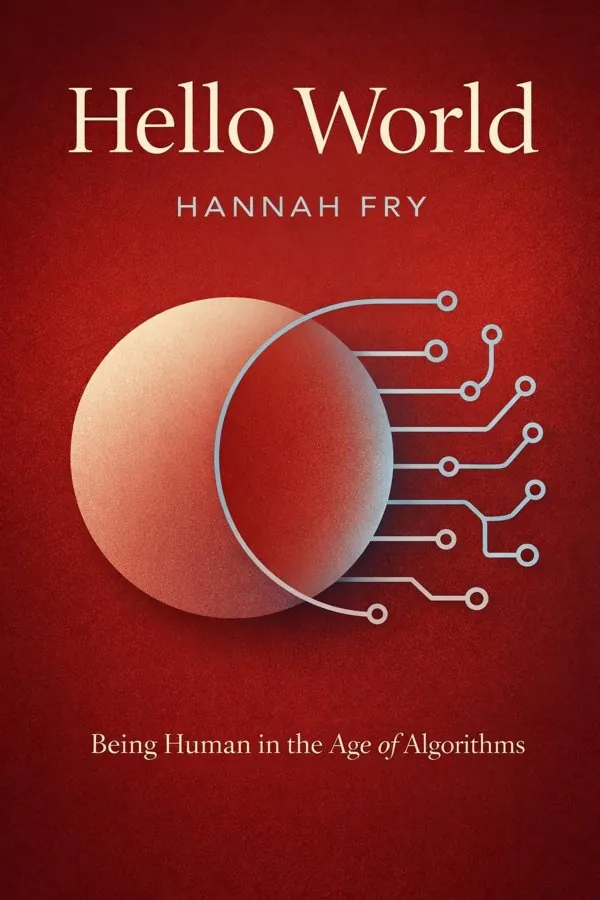
Hello World: Being Human in the Age of Algorithms: Summary & Key Insights
by Hannah Fry
 10 min9 chaptersAudio available
Key Takeaways from Hello World: Being Human in the Age of Algorithms
The moment an algorithm makes a decision about a human life, it stops being a technical curiosity and becomes an instrument of power.
Every algorithm begins with data, but data is not a mirror of the world.
A courtroom may seem like an ideal place for algorithmic assistance: high stakes, large volumes of information, and a demand for consistency.
Nowhere is the promise of algorithms more hopeful than in medicine.
When a human driver makes a mistake, we often call it an accident.
What Is Hello World: Being Human in the Age of Algorithms About?
Hello World: Being Human in the Age of Algorithms by Hannah Fry is a ai_ml book spanning 8 pages. Algorithms do not simply help us choose songs, map routes, or filter spam. Increasingly, they influence who gets hired, who receives medical treatment, how police patrol neighborhoods, what art gets created, and even whom we date. In Hello World, mathematician Hannah Fry takes readers inside this hidden infrastructure of modern life and asks a crucial question: when should we trust machines, and when should we insist on human judgment? With warmth, wit, and rigor, Fry explores the places where algorithmic systems perform brilliantly, the places where they fail, and the gray zone in between where their decisions carry real human consequences. What makes this book especially valuable is Fry’s ability to explain complex technical ideas without oversimplifying them. Drawing on mathematics, case studies, and real-world controversies, she shows that algorithms are neither magical nor evil. They are tools built by people, trained on imperfect data, and deployed inside unequal institutions. As a mathematician, broadcaster, and expert in patterns of human behavior, Fry is uniquely qualified to guide readers through this terrain. The result is an eye-opening, balanced look at how to stay human in a world increasingly shaped by code.
This FizzRead summary covers all 9 key chapters of Hello World: Being Human in the Age of Algorithms in approximately 10 minutes, distilling the most important ideas, arguments, and takeaways from Hannah Fry's work. Also available as an audio summary and Key Quotes Podcast.
Hello World: Being Human in the Age of Algorithms
Algorithms do not simply help us choose songs, map routes, or filter spam. Increasingly, they influence who gets hired, who receives medical treatment, how police patrol neighborhoods, what art gets created, and even whom we date. In Hello World, mathematician Hannah Fry takes readers inside this hidden infrastructure of modern life and asks a crucial question: when should we trust machines, and when should we insist on human judgment? With warmth, wit, and rigor, Fry explores the places where algorithmic systems perform brilliantly, the places where they fail, and the gray zone in between where their decisions carry real human consequences.
What makes this book especially valuable is Fry’s ability to explain complex technical ideas without oversimplifying them. Drawing on mathematics, case studies, and real-world controversies, she shows that algorithms are neither magical nor evil. They are tools built by people, trained on imperfect data, and deployed inside unequal institutions. As a mathematician, broadcaster, and expert in patterns of human behavior, Fry is uniquely qualified to guide readers through this terrain. The result is an eye-opening, balanced look at how to stay human in a world increasingly shaped by code.
Who Should Read Hello World: Being Human in the Age of Algorithms?
This book is perfect for anyone interested in ai_ml and looking to gain actionable insights in a short read. Whether you're a student, professional, or lifelong learner, the key ideas from Hello World: Being Human in the Age of Algorithms by Hannah Fry will help you think differently.
- ✓Readers who enjoy ai_ml and want practical takeaways
- ✓Professionals looking to apply new ideas to their work and life
- ✓Anyone who wants the core insights of Hello World: Being Human in the Age of Algorithms in just 10 minutes
Want the full summary?
Get instant access to this book summary and 100K+ more with Fizz Moment.
Get Free SummaryAvailable on App Store • Free to download
Key Chapters
The moment an algorithm makes a decision about a human life, it stops being a technical curiosity and becomes an instrument of power. That is one of Hannah Fry’s central insights. Algorithms do not exist in a vacuum: they are embedded in schools, hospitals, courts, governments, businesses, and digital platforms. Once installed, they can quietly shape outcomes at massive scale, often with an authority that feels objective simply because it comes from a machine.
Fry shows that this power is often invisible. A recommendation engine can influence what news you see. A hiring filter can decide which resumes are read by a person. A risk-scoring system can affect bail, parole, or insurance decisions. In each case, the algorithm does not merely describe reality; it helps create it. And because many of these systems are difficult to inspect, people affected by them may not even know they are being judged.
The key issue is not whether power should exist, but how it should be exercised. Human decision-makers can be inconsistent, emotional, and biased. Algorithms can be fast, scalable, and consistent. But consistency is not the same as fairness, and opacity is not the same as wisdom. Fry argues that we must ask who designed the system, what goals it optimizes, what data it uses, and who is accountable when it harms people.
A practical example is automated screening in public services. If a local authority uses software to prioritize cases, the design of that software can determine who receives attention first. Small design choices can produce enormous social consequences.
Actionable takeaway: whenever an algorithm affects important outcomes, look past the technology and ask the power questions: who benefits, who is judged, who is excluded, and who can challenge the decision?
Every algorithm begins with data, but data is not a mirror of the world. It is a record of what was measured, how it was measured, and what the people collecting it considered worth tracking. Fry emphasizes that the phrase data-driven often sounds reassuring, as if numbers automatically produce truth. In reality, data carries all the flaws, omissions, and biases of the systems that generate it.
This matters because algorithms learn from patterns in past data. If historical records reflect discrimination, underreporting, or unequal access, the algorithm may absorb those patterns and present them as neutral conclusions. A hiring model trained on past employees may favor candidates who resemble the company’s previous workforce. A predictive policing system fed arrest data may send more police to neighborhoods that were already over-policed, reinforcing a cycle that appears mathematically justified.
Fry also points out that datasets are often incomplete in ways that matter deeply. Medical studies may underrepresent certain populations. Consumer data may be rich for affluent users but sparse for the poor. Human behavior is messy, contextual, and dynamic, while datasets are snapshots shaped by administrative convenience.
At the same time, Fry does not reject data. Good data can reveal hidden trends, improve forecasting, and support better decisions than intuition alone. In medicine, for example, large datasets can help detect subtle patterns that doctors might miss. The challenge is to treat data as evidence, not destiny.
Actionable takeaway: before trusting any algorithmic result, ask what data went into it, what is missing, and whether the underlying records reflect reality or merely the habits and blind spots of the institution that produced them.
A courtroom may seem like an ideal place for algorithmic assistance: high stakes, large volumes of information, and a demand for consistency. Yet Fry uses the justice system to show why not every important decision can be reduced to calculation. Risk assessment tools promise to estimate the likelihood that someone will reoffend, fail to appear in court, or violate parole. On paper, this sounds sensible. In practice, it raises uncomfortable questions about fairness, transparency, and moral responsibility.
Algorithms can outperform human judges in certain narrow tasks. Humans are famously inconsistent: decisions can vary depending on fatigue, mood, or even time of day. A statistical tool may identify patterns across thousands of cases and remove some arbitrariness. But Fry shows that the real issue is not prediction alone. Justice is not just about what is likely to happen; it is also about what ought to matter.
Suppose a model uses factors such as employment history, neighborhood, or prior contact with police. These may improve predictive accuracy, but they also risk importing structural inequality into legal decisions. A person may be judged not purely for what they did, but for correlations associated with people like them. Moreover, defendants often cannot challenge a system they do not understand, especially if the software is proprietary.
Fry’s argument is not that algorithms have no place in justice. They can help identify patterns, flag anomalies, and support procedural consistency. But they should not replace human accountability in decisions that involve liberty, dignity, and moral judgment.
Actionable takeaway: in legal and disciplinary settings, support systems that use algorithms as advisory tools rather than final arbiters, and insist on transparency, appeal rights, and meaningful human oversight.
Nowhere is the promise of algorithms more hopeful than in medicine. Machines can process huge volumes of data, detect subtle anomalies in scans, and identify patterns invisible to the naked eye. Fry explores this domain to show that algorithms can save lives, improve diagnoses, and support overstretched health systems. But she also warns that health care is not a purely technical problem. It is a profoundly human one.
In areas such as image recognition, machine learning can rival or sometimes exceed specialists in spotting disease markers. Algorithms can flag tumors, predict complications, and help physicians prioritize urgent cases. This can be transformative in systems where time, attention, and expertise are scarce. A machine does not get tired at the end of a long shift, and it can compare today’s case against millions of prior examples.
Yet medicine is not only about detecting patterns. Patients do not arrive as clean datasets. They bring symptoms, fears, family histories, communication barriers, and personal values. Two patients with the same diagnosis may need different treatment plans because their lives are different. Fry highlights that algorithms are powerful when tasks are well-defined, but less reliable when context, ambiguity, and empathy matter.
There are also dangers in overconfidence. A model trained on one population may perform badly on another. Clinicians may become too trusting of automated outputs or ignore useful warnings because of alert fatigue. The best outcomes often emerge when humans and machines complement each other.
Actionable takeaway: support the use of algorithms in health care where they enhance detection and efficiency, but preserve the clinician’s role in interpretation, communication, and patient-centered decision-making.
When a human driver makes a mistake, we often call it an accident. When a driverless car makes a mistake, we call it a design failure. Fry uses autonomous vehicles to reveal a difficult truth about algorithms: the more we ask machines to act in the world, the more we must encode our values into systems that cannot truly understand them.
Self-driving technology is built on an appealing promise. Human drivers are distracted, impatient, drunk, tired, and error-prone. Machines, by contrast, can react faster, monitor continuously, and potentially reduce the enormous human toll of traffic accidents. From a statistical perspective, even imperfect autonomous vehicles could eventually outperform average humans.
But edge cases expose the complexity. Roads are chaotic social spaces filled with ambiguity: a cyclist swerves, a child runs after a ball, lane markings disappear, weather degrades visibility, and pedestrians make informal eye contact with drivers. These moments require interpretation, not just detection. They also raise ethical dilemmas. How should a car behave if every available action carries risk? Who is responsible when harm occurs: the manufacturer, the programmer, the owner, or the machine?
Fry’s point is not to dramatize rare trolley-problem scenarios, but to show that real-world automation depends on countless hidden judgments. Safety thresholds, acceptable risk levels, and response priorities are all human choices disguised as engineering parameters.
For users, policymakers, and developers, the lesson is humility. Autonomous systems may improve safety overall, but public trust depends on transparent standards, realistic expectations, and robust accountability when things go wrong.
Actionable takeaway: evaluate automation not by whether it is perfect, but by whether its risks, responsibilities, and limitations are openly understood and responsibly governed.
Predicting crime sounds like the ultimate technological breakthrough: use historical data to prevent harm before it happens. But Fry shows that in policing, prediction can easily become a feedback loop. If police are repeatedly sent to the same neighborhoods because historical data suggests higher crime risk, they will naturally detect more offenses there, generating more data that appears to confirm the original prediction. The algorithm then looks accurate while simply amplifying existing patterns of attention.
This is one of the clearest examples of how algorithmic systems can mistake institutional behavior for objective reality. Arrest data does not equal crime data. It reflects where police looked, whom they stopped, and which behaviors were criminalized or prioritized. Communities that have long been over-surveilled will often appear more dangerous in the dataset, even when actual patterns are more complex.
Fry does not deny that data analysis can help allocate resources or detect trends. Used carefully, quantitative methods can support crime prevention and better planning. But the danger lies in treating outputs as neutral facts rather than products of a social system with unequal histories. The result can be a veneer of scientific legitimacy over practices that deserve scrutiny.
This insight extends beyond policing. Any system that predicts future behavior from past records can end up hardening inequality if the past was already unfair. Prediction is not just observation; it changes what happens next.
Actionable takeaway: be wary of algorithmic systems that claim to forecast human behavior in public policy. Demand evidence that they are measuring the right thing, not merely reproducing patterns created by earlier bias and surveillance.
If an algorithm can compose music, generate paintings, or write poetry, what becomes of human creativity? Fry approaches this question with curiosity rather than panic. Her answer is refreshing: machine-made art forces us to clarify what we value in creativity, but it does not make human expression obsolete.
Algorithms can imitate styles, recombine influences, and produce outputs that seem surprisingly original. In some settings, they can assist artists by generating ideas, accelerating experimentation, or opening unexpected aesthetic paths. A composer might use software to explore harmonic possibilities. A visual artist might collaborate with generative tools to discover forms they would not have invented alone. In this sense, algorithms can become instruments rather than rivals.
Yet Fry points out that art is not only about the final product. It is also about intention, context, interpretation, and the human story behind the work. A song can move us not simply because of its pattern, but because we sense what it means for another person to have made it. We care about struggle, perspective, and lived experience. Even when machine-generated work is technically impressive, people still ask: who is speaking here, and why?
The rise of algorithmic creativity therefore reveals something important about being human. We do not merely consume outputs; we seek connection, meaning, and authorship. The machine may broaden what is possible, but it does not eliminate the value of human sensibility.
Actionable takeaway: use creative AI as a tool for exploration and collaboration, but stay focused on the distinctly human elements of art: intention, judgment, emotional truth, and the stories we tell through making.
Modern dating platforms promise something extraordinary: that enough data, enough preferences, and enough pattern recognition can guide us toward romantic success. Fry examines this world to show both the power and the absurdity of trying to optimize love. Algorithms can be excellent at matching based on measurable signals. But relationships are shaped by far more than compatibility scores.
Dating systems work by translating people into profiles, behaviors, and probabilities. They observe who messages whom, which photos attract attention, how often people reply, and what kinds of traits correlate with successful matches. This can produce useful recommendations and widen the pool of potential partners. For many people, especially those with limited opportunities to meet others, this can be genuinely life-changing.
But Fry reminds us that the qualities that sustain relationships are often the hardest to quantify. Timing matters. So do vulnerability, chemistry, shared growth, humor, and the strange unpredictability of attraction. Algorithms can optimize for engagement, response rates, or similarity, yet still miss the deeper complexities of human connection. They may also nudge behavior in unhelpful ways, encouraging people to present themselves strategically rather than honestly.
There is a broader lesson here: not every meaningful part of life becomes wiser when turned into a ranking problem. Some forms of uncertainty are not bugs to eliminate but conditions of being human.
Actionable takeaway: use dating algorithms as helpful filters, not as authorities on your emotional future. Let them expand your options, but rely on real conversation, observation, and lived experience to decide what kind of relationship actually fits your life.
One of Fry’s most important conclusions is that the real choice is rarely human or machine. In practice, the most successful systems are hybrids that combine computational strength with human judgment. Algorithms excel at scale, speed, consistency, and pattern recognition. Humans excel at context, empathy, ethical reasoning, and adapting when the rules break down.
The trouble comes when institutions imagine that automation removes the need for human involvement. Sometimes people are taken out of the loop entirely. In other cases, they remain in the loop only symbolically, expected to approve decisions they do not understand or cannot realistically challenge. This creates the illusion of accountability without its substance.
A better approach designs the partnership intentionally. In medicine, an algorithm might flag suspicious scans while clinicians interpret results and speak with patients. In hiring, software might organize applications, but trained reviewers should audit for unfair exclusions and make final decisions. In public services, automated tools might identify cases requiring attention, while human staff provide discretion, explanation, and appeal.
Fry’s broader message is that technology should fit human institutions, not the other way around. We should ask what task is being automated, what humans are expected to contribute, and how disagreement between person and machine is resolved. Good design treats this as a social question as much as a technical one.
Actionable takeaway: whenever a system includes automation, define the human role clearly. Make sure people can understand, question, and override algorithmic outputs when context or ethics demand it.
All Chapters in Hello World: Being Human in the Age of Algorithms
About the Author
Hannah Fry is a British mathematician, writer, professor, and broadcaster celebrated for her ability to explain complex scientific ideas in vivid, engaging ways. She has worked at University College London, where her research has explored the mathematics of human behavior, patterns in social systems, and the practical uses of data. Fry is also well known for bringing mathematics and technology to broad audiences through books, public lectures, podcasts, and BBC documentaries. Her work often sits at the intersection of numbers and everyday life, revealing how mathematical thinking can illuminate everything from cities and relationships to risk and decision-making. In Hello World, she draws on both academic expertise and storytelling skill to explore how algorithms are reshaping society and what that means for human judgment, fairness, and responsibility.
Get This Summary in Your Preferred Format
Read or listen to the Hello World: Being Human in the Age of Algorithms summary by Hannah Fry anytime, anywhere. FizzRead offers multiple formats so you can learn on your terms — all free.
Available formats: App · Audio · PDF · EPUB — All included free with FizzRead
Download Hello World: Being Human in the Age of Algorithms PDF and EPUB Summary
Key Quotes from Hello World: Being Human in the Age of Algorithms
“The moment an algorithm makes a decision about a human life, it stops being a technical curiosity and becomes an instrument of power.”
“Every algorithm begins with data, but data is not a mirror of the world.”
“A courtroom may seem like an ideal place for algorithmic assistance: high stakes, large volumes of information, and a demand for consistency.”
“Nowhere is the promise of algorithms more hopeful than in medicine.”
“When a human driver makes a mistake, we often call it an accident.”
Frequently Asked Questions about Hello World: Being Human in the Age of Algorithms
Hello World: Being Human in the Age of Algorithms by Hannah Fry is a ai_ml book that explores key ideas across 9 chapters. Algorithms do not simply help us choose songs, map routes, or filter spam. Increasingly, they influence who gets hired, who receives medical treatment, how police patrol neighborhoods, what art gets created, and even whom we date. In Hello World, mathematician Hannah Fry takes readers inside this hidden infrastructure of modern life and asks a crucial question: when should we trust machines, and when should we insist on human judgment? With warmth, wit, and rigor, Fry explores the places where algorithmic systems perform brilliantly, the places where they fail, and the gray zone in between where their decisions carry real human consequences. What makes this book especially valuable is Fry’s ability to explain complex technical ideas without oversimplifying them. Drawing on mathematics, case studies, and real-world controversies, she shows that algorithms are neither magical nor evil. They are tools built by people, trained on imperfect data, and deployed inside unequal institutions. As a mathematician, broadcaster, and expert in patterns of human behavior, Fry is uniquely qualified to guide readers through this terrain. The result is an eye-opening, balanced look at how to stay human in a world increasingly shaped by code.
More by Hannah Fry
You Might Also Like
Life 3.0
Max Tegmark
10 min
Superintelligence
Nick Bostrom
10 min
TensorFlow in Action
Thushan Ganegedara
10 min
AI Made Simple: A Beginner’s Guide to Generative AI, ChatGPT, and the Future of Work
Rajeev Kapur
10 min
AI Snake Oil
Arvind Narayanan, Sayash Kapoor
10 min
AI Superpowers: China, Silicon Valley, and the New World Order
Kai-Fu Lee
10 minBrowse by Category
Ready to read Hello World: Being Human in the Age of Algorithms?
Get the full summary and 100K+ more books with Fizz Moment.