
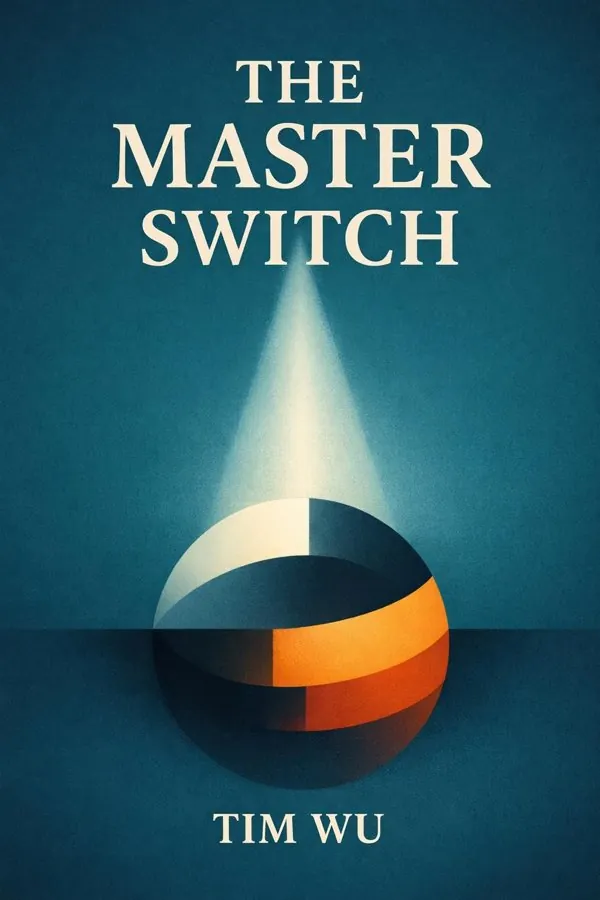
The Master Switch: The Rise and Fall of Information Empires: Summary & Key Insights
by Tim Wu
 10 min7 chaptersAudio available
What Is The Master Switch: The Rise and Fall of Information Empires About?
The Master Switch: The Rise and Fall of Information Empires by Tim Wu is a digital_culture book spanning 7 pages. In this influential work, Tim Wu explores the cyclical nature of information industries, from the telephone and radio to film, television, and the Internet. He argues that each new communications technology begins as an open and innovative medium but eventually becomes dominated by monopolistic powers that seek to control information flow. Wu introduces the concept of the 'Cycle'—the recurring pattern of openness followed by consolidation—and warns that the Internet may be heading toward the same fate as its predecessors unless society intervenes to preserve its openness.
This FizzRead summary covers all 7 key chapters of The Master Switch: The Rise and Fall of Information Empires in approximately 10 minutes, distilling the most important ideas, arguments, and takeaways from Tim Wu's work. Also available as an audio summary and Key Quotes Podcast.
The Master Switch: The Rise and Fall of Information Empires
In this influential work, Tim Wu explores the cyclical nature of information industries, from the telephone and radio to film, television, and the Internet. He argues that each new communications technology begins as an open and innovative medium but eventually becomes dominated by monopolistic powers that seek to control information flow. Wu introduces the concept of the 'Cycle'—the recurring pattern of openness followed by consolidation—and warns that the Internet may be heading toward the same fate as its predecessors unless society intervenes to preserve its openness.
Who Should Read The Master Switch: The Rise and Fall of Information Empires?
This book is perfect for anyone interested in digital_culture and looking to gain actionable insights in a short read. Whether you're a student, professional, or lifelong learner, the key ideas from The Master Switch: The Rise and Fall of Information Empires by Tim Wu will help you think differently.
- ✓Readers who enjoy digital_culture and want practical takeaways
- ✓Professionals looking to apply new ideas to their work and life
- ✓Anyone who wants the core insights of The Master Switch: The Rise and Fall of Information Empires in just 10 minutes
Want the full summary?
Get instant access to this book summary and 100K+ more with Fizz Moment.
Get Free SummaryAvailable on App Store • Free to download
Key Chapters
At the heart of *The Master Switch* lies what I call the Cycle—a recurring pattern in which every major information technology evolves from open to closed systems. It is not an accident, nor a conspiracy, but a consequence of human institutions seeking order and profit. The invention phase, full of experimentation and idealism, gives way to commercial consolidation. Visionaries and entrepreneurs overlap, and soon, competition is replaced by dominance.
At first, our technologies liberate us. The telephone seemed to promise universal connection; radio unleashed voices into the ether; film gave art to the masses; television brought the world into our homes; computers offered personal power; and the Internet united them all in a fabric of information exchange. But in each case, openness bred instability. Without structure, chaos reigns, and with chaos comes the opportunity for a controlling force—a single company or alliance—to bring ‘order.’
This pattern concerns not the technology itself but the institutions managing it. Alexander Graham Bell’s invention didn’t condemn humanity to monopoly; rather, the system that evolved around AT&T did. Monopoly often masquerades as efficiency—fewer voices, fewer standards, but more control. That control, however, comes at a cost: the limitation of creativity, the silencing of dissent, and the stifling of innovation.
When I examined every major medium, the same shape appeared. In the age of radio, pioneers built anarchic broadcasting networks, unlicensed and free. Then came RCA and government regulation, combining power to centralize the airwaves. Film followed suit with the rise of studio monopolies that dictated not only production but also distribution and exhibition, creating a controlled cultural pipeline. Television born in laboratories turned swiftly into a triopoly of major networks, fortified by government licensing and industrial interests.
The computer revolution followed the same dance: IBM emerged as a dominant intelligence empire, freezing innovation through standards and proprietary architecture. Finally, the Internet began as the most distributed system imaginable—a communication utopia born from public funding and ambition. Yet even now, consolidation threatens it, through platform monopolies, data control, and algorithmic domination by giants like Google, Amazon, Facebook, and Apple.
This is the Cycle—invention, openness, consolidation, closed empire, and disruption—and each turn is propelled by the same forces: profit, power, and human desire for control. Understanding this pattern isn’t a cure, but it’s a beginning. It reveals that freedom in communication never protects itself; it must be defended consciously and continually.
The story begins with the telephone, an instrument that seemed, at its birth, destined to abolish distance forever. Alexander Graham Bell’s invention was a marvel—a democratic device enabling any person to speak directly to another across miles of wire. The original phone networks were open, chaotic, and fiercely competitive. Independent operators laid their own lines, towns built local exchanges, and connection felt personal. It was messy, but it was free.
Then came Theodore Vail, a visionary of a different kind. As the driving force behind AT&T, Vail believed that communication required unity, not chaos. He introduced the idea of ‘One System, One Policy, Universal Service,’ transforming the telephone’s decentralized ecosystem into a controlled network. Efficiency and reliability improved, yes—but freedom disappeared. AT&T became one of the first great information empires.
Through strategic control of patents and infrastructure, AT&T eliminated competitors and harnessed government sympathy as a regulated monopoly. For decades, it stood as the gatekeeper of American communication—a centralized power that dictated how, when, and by whom the world could talk. The irony was striking: a technology designed for connection became one of the most isolated systems imaginable, locked behind corporate walls.
Yet even empires face decline. The antitrust movement, growing public frustration, and the logic of technological disruption eventually shattered AT&T’s dominance. But its legacy endures: the notion that monopolistic control ensures technical stability—a philosophy that later industries would embrace. From this episode, the Cycle took form: creative entrepreneurship gave birth to monopoly, which was later challenged by rebellion and innovation. The lesson is clear—control never justifies censorship, and efficiency never replaces freedom.
+ 5 more chapters — available in the FizzRead app
All Chapters in The Master Switch: The Rise and Fall of Information Empires
About the Author
Tim Wu is a professor at Columbia Law School and a policy advocate known for coining the term 'net neutrality.' His work focuses on antitrust, telecommunications, and technology policy. Wu has served in various governmental roles, including as a special assistant to the president for technology and competition policy in the Biden administration.
Get This Summary in Your Preferred Format
Read or listen to the The Master Switch: The Rise and Fall of Information Empires summary by Tim Wu anytime, anywhere. FizzRead offers multiple formats so you can learn on your terms — all free.
Available formats: App · Audio · PDF · EPUB — All included free with FizzRead
Download The Master Switch: The Rise and Fall of Information Empires PDF and EPUB Summary
Key Quotes from The Master Switch: The Rise and Fall of Information Empires
“At the heart of *The Master Switch* lies what I call the Cycle—a recurring pattern in which every major information technology evolves from open to closed systems.”
“The story begins with the telephone, an instrument that seemed, at its birth, destined to abolish distance forever.”
Frequently Asked Questions about The Master Switch: The Rise and Fall of Information Empires
The Master Switch: The Rise and Fall of Information Empires by Tim Wu is a digital_culture book that explores key ideas across 7 chapters. In this influential work, Tim Wu explores the cyclical nature of information industries, from the telephone and radio to film, television, and the Internet. He argues that each new communications technology begins as an open and innovative medium but eventually becomes dominated by monopolistic powers that seek to control information flow. Wu introduces the concept of the 'Cycle'—the recurring pattern of openness followed by consolidation—and warns that the Internet may be heading toward the same fate as its predecessors unless society intervenes to preserve its openness.
More by Tim Wu
You Might Also Like
An Ugly Truth: Inside Facebook’s Battle for Domination
Sheera Frenkel, Cecilia Kang
10 min
Cyber Citizens
Ian Goodfellow
10 min
Digital Minimalism: Choosing a Focused Life in a Noisy World
Cal Newport
10 min
E‑Books & Beyond
Various Authors
10 min
The Future of Media
Various Authors
10 min
This Is Why We Can't Have Nice Things
Whitney Phillips
10 minBrowse by Category
Ready to read The Master Switch: The Rise and Fall of Information Empires?
Get the full summary and 100K+ more books with Fizz Moment.