
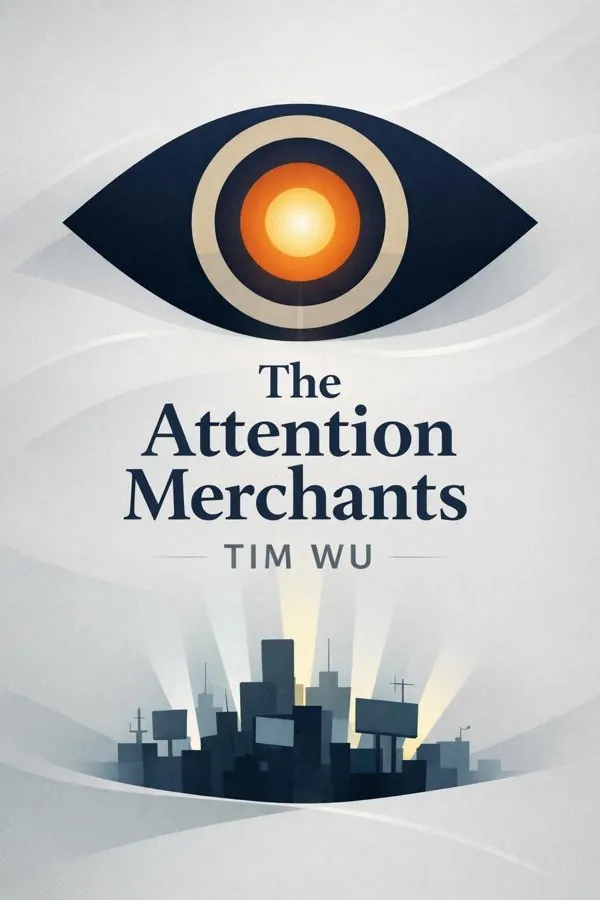
The Attention Merchants: The Epic Scramble to Get Inside Our Heads: Summary & Key Insights
by Tim Wu
 10 min10 chaptersAudio available
What Is The Attention Merchants: The Epic Scramble to Get Inside Our Heads About?
The Attention Merchants: The Epic Scramble to Get Inside Our Heads by Tim Wu is a economics book spanning 10 pages. A sweeping history of how businesses have captured and monetized human attention, from the rise of newspapers and radio to the age of social media. Tim Wu explores how attention has become one of the most valuable commodities in the modern economy, shaping culture, politics, and personal life.
This FizzRead summary covers all 10 key chapters of The Attention Merchants: The Epic Scramble to Get Inside Our Heads in approximately 10 minutes, distilling the most important ideas, arguments, and takeaways from Tim Wu's work. Also available as an audio summary and Key Quotes Podcast.
The Attention Merchants: The Epic Scramble to Get Inside Our Heads
A sweeping history of how businesses have captured and monetized human attention, from the rise of newspapers and radio to the age of social media. Tim Wu explores how attention has become one of the most valuable commodities in the modern economy, shaping culture, politics, and personal life.
Who Should Read The Attention Merchants: The Epic Scramble to Get Inside Our Heads?
This book is perfect for anyone interested in economics and looking to gain actionable insights in a short read. Whether you're a student, professional, or lifelong learner, the key ideas from The Attention Merchants: The Epic Scramble to Get Inside Our Heads by Tim Wu will help you think differently.
- ✓Readers who enjoy economics and want practical takeaways
- ✓Professionals looking to apply new ideas to their work and life
- ✓Anyone who wants the core insights of The Attention Merchants: The Epic Scramble to Get Inside Our Heads in just 10 minutes
Want the full summary?
Get instant access to this book summary and 100K+ more with Fizz Moment.
Get Free SummaryAvailable on App Store • Free to download
Key Chapters
The story begins in the nineteenth century, with the rise of the penny press. Newspaper entrepreneurs like Benjamin Day of *The Sun* in New York discovered a radical idea: sell the paper cheaply, or give it away, and make money not from readers but from advertisers eager to reach those readers. This inversion of value — where your attention, not your payment, was the real product — marked the genesis of the attention market.
For the first time, information and entertainment became vehicles for commercial messaging on a mass scale. A reader’s curiosity for the latest scandals or tragedies became the raw material that financed the news. The economic incentive distorted journalism, pushing it toward sensation and emotional draw. Yet it democratized access to news and built the first mass media audiences. The penny press didn’t just inform society; it redefined what it meant to consume information. Behind every shocking headline stood a business plan aimed at seizing the fleeting attention of the crowd.
This model, born in bustling urban centers, rapidly spread across industries. Advertisers realized that public interest could be manufactured; that print could channel desire. The age of attention selling had begun, and its techniques — repetition, emotional appeal, and spectacle — remain with us to this day.
Moving into the early twentieth century, new technologies offered richer forms of attention capture. Radio, then cinema, transformed passive reading into immersive sensory experience. For advertisers and content creators alike, this change represented a golden opportunity: to enter homes directly, to speak and sing and enchant.
Early radio was initially a community experiment, but commercial interests quickly saw its potential. Sponsored programs became standard, embedding advertising into the very rhythm of entertainment. Films, too, developed a grammar of emotional engagement — stories designed to hold spectators’ gaze and invite identification. What had once been physical crowds reading headlines turned into millions of individuals listening alone or sitting in darkened theaters. The attention merchants had learned to refine mass enchantment.
This period built the infrastructure of psychological persuasion. Techniques pioneered by Edward Bernays and others drew from Freud’s ideas about desire and subconscious motivation. Advertising no longer merely informed; it promised belonging, status, beauty, and happiness. The mass media age was born not through technological inevitability but through intentional design — a concerted effort to engineer demand and shape the cultural imagination.
+ 8 more chapters — available in the FizzRead app
All Chapters in The Attention Merchants: The Epic Scramble to Get Inside Our Heads
About the Author
Get This Summary in Your Preferred Format
Read or listen to the The Attention Merchants: The Epic Scramble to Get Inside Our Heads summary by Tim Wu anytime, anywhere. FizzRead offers multiple formats so you can learn on your terms — all free.
Available formats: App · Audio · PDF · EPUB — All included free with FizzRead
Download The Attention Merchants: The Epic Scramble to Get Inside Our Heads PDF and EPUB Summary
Key Quotes from The Attention Merchants: The Epic Scramble to Get Inside Our Heads
“The story begins in the nineteenth century, with the rise of the penny press.”
“Moving into the early twentieth century, new technologies offered richer forms of attention capture.”
Frequently Asked Questions about The Attention Merchants: The Epic Scramble to Get Inside Our Heads
The Attention Merchants: The Epic Scramble to Get Inside Our Heads by Tim Wu is a economics book that explores key ideas across 10 chapters. A sweeping history of how businesses have captured and monetized human attention, from the rise of newspapers and radio to the age of social media. Tim Wu explores how attention has become one of the most valuable commodities in the modern economy, shaping culture, politics, and personal life.
More by Tim Wu

You Might Also Like
Business Adventures
John Brooks
10 min
Nudge
Richard H. Thaler, Cass R. Sunstein
10 min
The Hitchhiker"s Guide to the Galaxy
Douglas Adams
10 minThe Muqaddimah
Ibn Khaldun
10 minThe Outsiders
William N. Thorndike
10 min
A Little History of Economics
Niall Kishtainy
10 minBrowse by Category
Ready to read The Attention Merchants: The Epic Scramble to Get Inside Our Heads?
Get the full summary and 100K+ more books with Fizz Moment.