
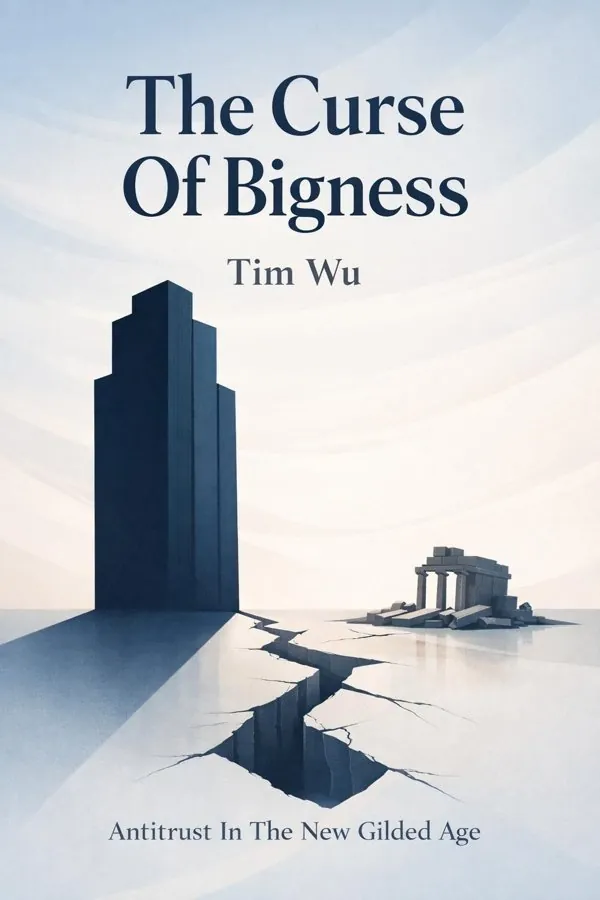
The Curse Of Bigness: Antitrust In The New Gilded Age: Summary & Key Insights
by Tim Wu
 10 min9 chaptersAudio available
Key Takeaways from The Curse Of Bigness: Antitrust In The New Gilded Age
Every era of extreme inequality tells a political story as well as an economic one.
A healthy democracy cannot remain indifferent to private empires.
Some dangers cannot be captured in a spreadsheet.
When a society forgets why a law exists, it begins to use that law against itself.
Monopoly has changed its clothing, not its character.
What Is The Curse Of Bigness: Antitrust In The New Gilded Age About?
The Curse Of Bigness: Antitrust In The New Gilded Age by Tim Wu is a economics book spanning 9 pages. In The Curse Of Bigness, Tim Wu makes a forceful case that monopoly power is not just an economic problem but a political and moral one. He argues that when too much power accumulates in a few corporations, markets become less competitive, citizens become less free, and democracy itself begins to weaken. Drawing a clear line between the monopolistic empires of the first Gilded Age and the dominance of today’s technology, finance, and communications giants, Wu shows that the United States has faced this danger before—and once developed the legal and political tools to resist it. What makes this book especially important is its insistence that antitrust should not be reduced to narrow questions of price. Wu revives an older American tradition, associated with Theodore Roosevelt and Louis Brandeis, that understood concentrated private power as a threat to self-government. As a Columbia Law professor, policy expert, and influential thinker on technology and media, Wu writes with both scholarly authority and public urgency. This is a concise but powerful book for anyone trying to understand why corporate concentration has become one of the defining issues of our age.
This FizzRead summary covers all 9 key chapters of The Curse Of Bigness: Antitrust In The New Gilded Age in approximately 10 minutes, distilling the most important ideas, arguments, and takeaways from Tim Wu's work. Also available as an audio summary and Key Quotes Podcast.
The Curse Of Bigness: Antitrust In The New Gilded Age
In The Curse Of Bigness, Tim Wu makes a forceful case that monopoly power is not just an economic problem but a political and moral one. He argues that when too much power accumulates in a few corporations, markets become less competitive, citizens become less free, and democracy itself begins to weaken. Drawing a clear line between the monopolistic empires of the first Gilded Age and the dominance of today’s technology, finance, and communications giants, Wu shows that the United States has faced this danger before—and once developed the legal and political tools to resist it.
What makes this book especially important is its insistence that antitrust should not be reduced to narrow questions of price. Wu revives an older American tradition, associated with Theodore Roosevelt and Louis Brandeis, that understood concentrated private power as a threat to self-government. As a Columbia Law professor, policy expert, and influential thinker on technology and media, Wu writes with both scholarly authority and public urgency. This is a concise but powerful book for anyone trying to understand why corporate concentration has become one of the defining issues of our age.
Who Should Read The Curse Of Bigness: Antitrust In The New Gilded Age?
This book is perfect for anyone interested in economics and looking to gain actionable insights in a short read. Whether you're a student, professional, or lifelong learner, the key ideas from The Curse Of Bigness: Antitrust In The New Gilded Age by Tim Wu will help you think differently.
- ✓Readers who enjoy economics and want practical takeaways
- ✓Professionals looking to apply new ideas to their work and life
- ✓Anyone who wants the core insights of The Curse Of Bigness: Antitrust In The New Gilded Age in just 10 minutes
Want the full summary?
Get instant access to this book summary and 100K+ more with Fizz Moment.
Get Free SummaryAvailable on App Store • Free to download
Key Chapters
Every era of extreme inequality tells a political story as well as an economic one. Tim Wu begins by looking back to the original Gilded Age, when the United States saw the rise of industrial titans such as Standard Oil, U.S. Steel, and the great railroad empires. These firms did not simply become successful businesses. They accumulated such vast control over transportation, energy, finance, and trade that they began to shape the conditions under which everyone else lived and worked. Competition weakened, smaller rivals disappeared, and political institutions became vulnerable to capture.
Wu uses this history to challenge the comforting idea that monopoly is just an unfortunate side effect of innovation. In the late nineteenth century, concentration emerged through mergers, coercive pricing, discriminatory access, and political influence. The result was not only economic distortion but a broad sense that democracy was being hollowed out by private empires. Farmers, workers, journalists, and reformers increasingly understood that the issue was not envy of success. It was fear of domination.
This historical lens matters because today’s economy often repeats the same pattern under modern branding. Platform dominance, vertical integration, preferential treatment, and acquisition of emerging competitors echo earlier monopolistic tactics, even if the industries look different. Wu’s point is that a society does not need to wait for absolute tyranny to recognize dangerous concentration. By the time a handful of firms become unavoidable gatekeepers, civic damage is already underway.
A practical way to apply this idea is to view market concentration as a warning signal, not a technical afterthought. When one or two firms mediate access to communication, retail, logistics, or data, ask not only whether prices are low, but whether freedom, resilience, and fair opportunity are shrinking. The takeaway: study history closely, because monopoly rarely announces itself as a threat until it has already become one.
A healthy democracy cannot remain indifferent to private empires. Wu highlights Theodore Roosevelt as a central figure who understood that antitrust enforcement was not mainly about punishing success but about preserving republican government. Roosevelt believed giant trusts had grown so powerful that they could intimidate rivals, influence lawmakers, and weaken public confidence in the rule of law. In his view, concentrated economic power eventually becomes concentrated political power.
This insight shaped a more muscular understanding of antitrust. Roosevelt did not assume every large firm was automatically illegitimate, but he rejected the idea that size alone deserved deference. He used the presidency to investigate and challenge dominant corporations, making clear that the state had a duty to ensure that no private actor could become stronger than the public institutions meant to govern society. Antitrust, in this tradition, was a constitutional safeguard as much as an economic policy.
Wu contrasts this mindset with modern regulatory hesitation. Today, policymakers often treat giant firms as inevitable outcomes of efficiency or innovation, especially in technology markets. Roosevelt would have asked a different question: even if a company is effective, does its scale place too much social power in too few hands? That question remains highly relevant when dominant firms control app stores, online advertising, cloud infrastructure, or social communication channels.
The practical application is straightforward. Citizens, regulators, and business leaders should evaluate large firms not only by productivity, but by the degree of dependency they create. If suppliers, workers, consumers, and even governments cannot function without a single platform or network, then that company’s influence exceeds normal market success. The actionable takeaway: judge concentration by its power over institutions and people, not merely by whether it offers popular products.
Some dangers cannot be captured in a spreadsheet. Wu draws heavily on Louis Brandeis, who offered one of the deepest critiques of monopoly in American history. Brandeis argued that the problem with bigness was not only higher prices or reduced output. It was that giant institutions distort human scale, suppress local enterprise, and create relationships of dependency incompatible with democratic citizenship. He believed that concentrated power erodes character by teaching people to submit rather than participate.
Brandeis’s perspective broadens the entire meaning of antitrust. Instead of focusing only on consumer welfare in a narrow economic sense, he asked what kind of society large corporations create. Do they leave room for independent producers, local decision-making, and dispersed opportunity? Or do they centralize authority so thoroughly that citizens become passive users inside systems they cannot influence? In Brandeis’s moral framework, markets are valuable partly because they distribute power. When they cease to do that, something fundamental is lost.
Wu uses this tradition to critique modern thinking that treats market concentration as acceptable so long as consumers receive convenience, low prices, or free digital services. That framework ignores hidden costs: weakened communities, reduced entrepreneurial pathways, vulnerable labor markets, and the rise of private systems that make public oversight difficult. A platform may feel efficient while quietly narrowing the conditions for autonomy.
In practical terms, Brandeis’s insight invites people to ask better questions of the firms they depend on. Does this company expand opportunity for others, or does it absorb and subordinate them? Does it support a pluralistic economy, or turn more actors into dependent contractors, sellers, or tenants? The takeaway: evaluate economic structures by whether they preserve independence, dignity, and democratic participation—not just short-term convenience.
When a society forgets why a law exists, it begins to use that law against itself. One of Wu’s most important arguments is that American antitrust policy lost its original purpose in the late twentieth century. A broader tradition that once targeted dangerous concentrations of private power was gradually replaced by the consumer welfare standard, associated most famously with Robert Bork and the Chicago School. Under this approach, antitrust focused primarily on whether a merger or business practice led to higher prices in the short run.
Wu argues that this was a profound narrowing of vision. It sidelined concerns about political influence, labor suppression, market structure, innovation barriers, and the civic dangers of concentrated control. It also fit poorly with digital markets, where services may appear cheap or free while firms extract value through data capture, predatory acquisitions, self-preferencing, and ecosystem lock-in. A monopoly no longer needs to raise sticker prices to reduce freedom and competition.
This legal shift helps explain why many dominant firms faced little serious challenge for decades. As long as consumer prices looked stable or falling, enforcers often ignored the broader effects of consolidation. Yet the real harms showed up elsewhere: small businesses became dependent on dominant intermediaries, workers faced fewer employers, startups were bought before they could mature, and public discourse itself became routed through private platforms.
The practical lesson is that metrics matter because they shape what institutions can see. If regulators, investors, and citizens measure only price, they will miss dependency, surveillance, exclusion, and political leverage. A more complete assessment should include barriers to entry, treatment of rivals, effects on workers, and influence over public life. The takeaway: reject overly narrow definitions of harm and restore a wider lens for judging market power.
Monopoly has changed its clothing, not its character. Wu argues that the modern economy has entered a new Gilded Age, defined not only by wealth inequality but by the return of highly concentrated corporate power. Today’s dominant firms often operate in technology, telecommunications, finance, logistics, and media rather than railroads or oil. Yet they perform a similar function: they become gatekeepers that control access to markets, audiences, infrastructure, and information.
What makes the new environment especially potent is the combination of network effects, data accumulation, and platform dependency. A search engine improves as more people use it. A social network becomes more valuable as friends, advertisers, and media all converge there. An online marketplace can privilege its own products while learning from third-party sellers. A mobile operating system can decide which apps exist and under what terms. These structures create self-reinforcing advantages that make dominance difficult to challenge even without old-fashioned price hikes.
Wu’s point is not that technology companies are identical to industrial trusts, but that their scale creates similar democratic concerns. When a few firms shape communication, commerce, and information flow, they exercise quasi-governmental power without equivalent accountability. They can decide visibility, access, and survival for other businesses while presenting themselves as neutral intermediaries.
A practical way to apply this idea is to pay attention to infrastructure-like roles in modern markets. If a company acts as a marketplace, distributor, host, advertiser, and regulator all at once, conflicts of interest are built into the model. Policymakers should consider structural remedies, interoperability, and merger scrutiny before dominance becomes irreversible. The takeaway: treat digital gatekeepers as concentrations of power, not just as innovative brands offering convenient services.
The damage of monopoly often appears first in places traditional analysis ignores. Wu emphasizes that concentrated economic power affects workers, suppliers, entrepreneurs, and citizens long before it shows up clearly in retail prices. When industries consolidate, workers may face fewer employers and weaker bargaining power. Suppliers may have to accept unfair terms from giant buyers. Startups may be forced to sell to incumbents or be shut out of distribution. Communities may lose locally rooted businesses that once circulated wealth more broadly.
This matters because monopoly is often defended with the language of efficiency. Large firms promise scale, convenience, and streamlined operations. But efficiency for whom, and at what cost? A dominant platform may simplify online commerce while taking increasing fees from merchants. A hospital merger may not immediately raise visible prices but can reduce patient choice and labor competition. A food or agriculture giant may lower transaction costs while making farmers more dependent and vulnerable.
Wu urges readers to understand concentration as a structural condition that redistributes power upward. The effects are cumulative. Fewer independent firms mean fewer decision centers, fewer paths for new entrants, and fewer checks on arbitrary treatment. Over time, this weakens the adaptive capacity of the economy itself. Diverse markets are often more resilient because they distribute risk and opportunity.
The practical implication is to look beyond the consumer role. Ask how a firm treats sellers, creators, workers, contractors, and complementors. If many groups depend on one company’s terms to survive, concentration is already reshaping economic life. The actionable takeaway: evaluate market health by the breadth of opportunity and bargaining power across the whole system, not by consumer convenience alone.
Sometimes monopoly is built not by crushing rivals in public, but by buying them before they mature. Wu points to modern case studies showing how concentration often advances through mergers, vertical integration, and strategic acquisition of potential competitors. Instead of waiting for a startup to become a full-fledged threat, dominant firms can purchase it early, neutralizing future competition while strengthening their own ecosystem. This pattern is especially common in technology markets, where incumbents have massive capital, user data, and distribution advantages.
The issue is not that every acquisition is harmful. Some mergers do create efficiencies or help products scale. Wu’s concern is with systematic underenforcement that treats acquisitions as benign even when they remove future competitive pressure. The result is a market in which innovation survives, but independence does not. Entrepreneurs build with the expectation of being absorbed rather than competing. Consumers still see new products, yet the underlying structure remains concentrated.
He also highlights how vertically integrated firms can play multiple roles at once: platform operator, market participant, distributor, and rule-maker. That combination creates conflicts of interest. A dominant marketplace can copy successful sellers. A platform can rank its own services above rivals. A telecommunications or media conglomerate can privilege affiliated content. Power expands through architecture as much as through ownership.
A practical application is stricter scrutiny of deals involving dominant firms, especially where the target could become a future rival or where the acquisition deepens control over adjacent markets. Investors, founders, and policymakers should understand that a dynamic economy needs exits, but it also needs independent challengers. The takeaway: judge mergers by their effect on future competition, not just present overlap or short-term price changes.
A republic can survive economic inequality more easily than it can survive concentrated private command over public life. Wu insists that antitrust must be understood as part of democratic self-preservation. Giant corporations do not merely lobby for favorable rules. They can shape the information environment, influence policy agendas, fund intellectual frameworks, and make governments hesitant to act. When political leaders begin to fear the reaction of major firms more than the needs of citizens, democracy has entered dangerous territory.
This political dimension was obvious to earlier antimonopolists, who saw trusts as rival centers of governance. Wu revives that tradition by arguing that antitrust law helps ensure that no private actor becomes so essential that it can evade accountability. This is especially urgent when dominant firms mediate speech, advertising, infrastructure, and cultural attention. Corporate concentration can create a form of soft sovereignty, where important rules are made privately yet affect millions.
The significance extends beyond elections. Democratic citizenship depends on a belief that institutions answer to the public, that opportunity is not reserved for insiders, and that no one is too big to challenge. Monopoly undermines those beliefs. It breeds cynicism, dependence, and resignation. Once people conclude that power is untouchable, democratic habits weaken.
In practice, this means antitrust should not be left solely to technical specialists speaking in narrow economic terms. Citizens, journalists, and lawmakers should debate concentration as a constitutional and civic issue. Public procurement, campaign finance transparency, tougher revolving-door rules, and stronger enforcement all reinforce this principle. The actionable takeaway: defend competition not just to improve markets, but to preserve the conditions of democratic accountability.
If monopoly is a structural problem, symbolic concern will never be enough. Wu ends with a call to revive antitrust enforcement in a serious, institution-building way. He argues that societies do not drift out of concentrated power; they confront it through law, politics, and public philosophy. That means stronger merger review, greater skepticism toward dominant platforms, willingness to break up firms when necessary, and a return to structural remedies rather than endless behavioral promises that are hard to monitor.
Wu’s proposed revival is not anti-business. It is pro-competition, pro-democracy, and pro-open markets. The goal is not to punish scale for its own sake, but to prevent concentrations that make markets closed, politics dependent, and innovation subordinate to incumbents. This includes updating enforcement for digital realities, where control over data, defaults, ecosystems, and distribution may matter more than posted prices. It also means rebuilding the intellectual confidence to say that some forms of bigness are simply too dangerous.
For readers, the relevance is immediate. Antitrust debates shape the future of technology, healthcare, media, agriculture, labor markets, and consumer choice. A stronger regime could create more room for startups, protect workers from monopsony power, reduce dependency on gatekeepers, and restore confidence that law still limits concentrated influence.
The practical takeaway is to support policies and leaders that treat competition as a public value. Ask whether regulators have the tools and courage to challenge dominant firms. Follow merger decisions. Recognize that decentralization is not nostalgia; it is a strategy for preserving freedom. The actionable takeaway: back structural reforms that disperse power before private dominance becomes politically irreversible.
All Chapters in The Curse Of Bigness: Antitrust In The New Gilded Age
About the Author
Tim Wu is a professor at Columbia Law School and one of the most influential thinkers on technology policy, media regulation, and antitrust in the United States. He is widely known for coining the term "net neutrality," a concept that helped shape global debates about how the internet should be governed. In addition to his academic work, Wu has served in public policy roles, including positions connected to the Federal Trade Commission and the White House, where he focused on competition and technology issues. His writing often examines how concentrated corporate power affects communication, innovation, and democratic life. With a rare ability to connect legal history, economic structure, and public policy, Wu has become a leading voice in the modern movement to rethink monopoly power.
Get This Summary in Your Preferred Format
Read or listen to the The Curse Of Bigness: Antitrust In The New Gilded Age summary by Tim Wu anytime, anywhere. FizzRead offers multiple formats so you can learn on your terms — all free.
Available formats: App · Audio · PDF · EPUB — All included free with FizzRead
Download The Curse Of Bigness: Antitrust In The New Gilded Age PDF and EPUB Summary
Key Quotes from The Curse Of Bigness: Antitrust In The New Gilded Age
“Every era of extreme inequality tells a political story as well as an economic one.”
“A healthy democracy cannot remain indifferent to private empires.”
“Some dangers cannot be captured in a spreadsheet.”
“When a society forgets why a law exists, it begins to use that law against itself.”
“Monopoly has changed its clothing, not its character.”
Frequently Asked Questions about The Curse Of Bigness: Antitrust In The New Gilded Age
The Curse Of Bigness: Antitrust In The New Gilded Age by Tim Wu is a economics book that explores key ideas across 9 chapters. In The Curse Of Bigness, Tim Wu makes a forceful case that monopoly power is not just an economic problem but a political and moral one. He argues that when too much power accumulates in a few corporations, markets become less competitive, citizens become less free, and democracy itself begins to weaken. Drawing a clear line between the monopolistic empires of the first Gilded Age and the dominance of today’s technology, finance, and communications giants, Wu shows that the United States has faced this danger before—and once developed the legal and political tools to resist it. What makes this book especially important is its insistence that antitrust should not be reduced to narrow questions of price. Wu revives an older American tradition, associated with Theodore Roosevelt and Louis Brandeis, that understood concentrated private power as a threat to self-government. As a Columbia Law professor, policy expert, and influential thinker on technology and media, Wu writes with both scholarly authority and public urgency. This is a concise but powerful book for anyone trying to understand why corporate concentration has become one of the defining issues of our age.
More by Tim Wu
You Might Also Like
Business Adventures
John Brooks
10 min
Nudge
Richard H. Thaler, Cass R. Sunstein
10 min
The Hitchhiker"s Guide to the Galaxy
Douglas Adams
10 minThe Muqaddimah
Ibn Khaldun
10 minThe Outsiders
William N. Thorndike
10 min
A Little History of Economics
Niall Kishtainy
10 minBrowse by Category
Ready to read The Curse Of Bigness: Antitrust In The New Gilded Age?
Get the full summary and 100K+ more books with Fizz Moment.