
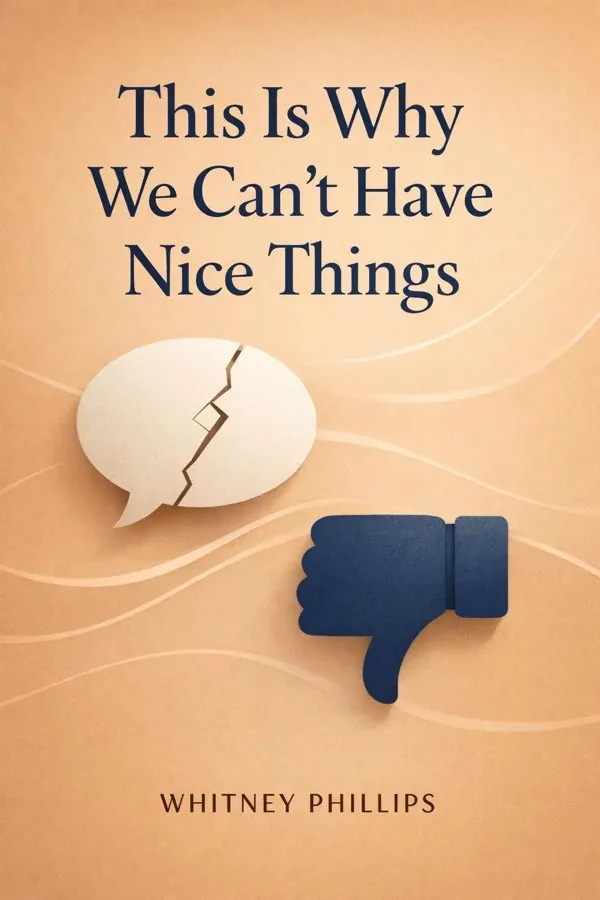
This Is Why We Can't Have Nice Things: Summary & Key Insights
 10 min9 chaptersAudio available
Key Takeaways from This Is Why We Can't Have Nice Things
A society learns little when it treats its worst behavior as someone else's problem.
The most powerful reward online is often not agreement, money, or status in any traditional sense, but attention.
Public exposure is often assumed to be a cure, but Phillips demonstrates that exposure can also become oxygen.
One of the most deceptive features of digital culture is how easily cruelty can hide behind a joke.
It is comforting to believe that trolling happens mainly because anonymous people feel free to behave badly, but Phillips shows that this explanation is far too simple.
What Is This Is Why We Can't Have Nice Things About?
This Is Why We Can't Have Nice Things by Whitney Phillips is a digital_culture book. What if internet trolling were not a fringe behavior practiced by a few malicious outsiders, but a disturbing reflection of mainstream culture itself? In This Is Why We Can't Have Nice Things, media scholar Whitney Phillips investigates trolling not simply as online mischief, but as a revealing symptom of how digital media, journalism, entertainment, and public discourse reward outrage, spectacle, and emotional manipulation. Rather than treating trolls as incomprehensible monsters, Phillips asks a harder and more important question: what social values, media incentives, and cultural habits make trolling possible, visible, and profitable? Drawing on years of immersive research into online communities, internet subcultures, and media reactions to them, Phillips offers an unusually nuanced account of trolling's logic, language, and appeal. Her work matters because it moves beyond easy moral panic. Instead of blaming the internet alone, she shows how trolling overlaps with dominant norms in politics, celebrity culture, and news coverage. The result is a book that helps readers make sense of digital cruelty without oversimplifying it. For anyone trying to understand online harassment, meme culture, or the ethics of attention in networked life, this book remains sharply relevant.
This FizzRead summary covers all 9 key chapters of This Is Why We Can't Have Nice Things in approximately 10 minutes, distilling the most important ideas, arguments, and takeaways from Whitney Phillips's work. Also available as an audio summary and Key Quotes Podcast.
This Is Why We Can't Have Nice Things
What if internet trolling were not a fringe behavior practiced by a few malicious outsiders, but a disturbing reflection of mainstream culture itself? In This Is Why We Can't Have Nice Things, media scholar Whitney Phillips investigates trolling not simply as online mischief, but as a revealing symptom of how digital media, journalism, entertainment, and public discourse reward outrage, spectacle, and emotional manipulation. Rather than treating trolls as incomprehensible monsters, Phillips asks a harder and more important question: what social values, media incentives, and cultural habits make trolling possible, visible, and profitable?
Drawing on years of immersive research into online communities, internet subcultures, and media reactions to them, Phillips offers an unusually nuanced account of trolling's logic, language, and appeal. Her work matters because it moves beyond easy moral panic. Instead of blaming the internet alone, she shows how trolling overlaps with dominant norms in politics, celebrity culture, and news coverage. The result is a book that helps readers make sense of digital cruelty without oversimplifying it. For anyone trying to understand online harassment, meme culture, or the ethics of attention in networked life, this book remains sharply relevant.
Who Should Read This Is Why We Can't Have Nice Things?
This book is perfect for anyone interested in digital_culture and looking to gain actionable insights in a short read. Whether you're a student, professional, or lifelong learner, the key ideas from This Is Why We Can't Have Nice Things by Whitney Phillips will help you think differently.
- ✓Readers who enjoy digital_culture and want practical takeaways
- ✓Professionals looking to apply new ideas to their work and life
- ✓Anyone who wants the core insights of This Is Why We Can't Have Nice Things in just 10 minutes
Want the full summary?
Get instant access to this book summary and 100K+ more with Fizz Moment.
Get Free SummaryAvailable on App Store • Free to download
Key Chapters
A society learns little when it treats its worst behavior as someone else's problem. One of Whitney Phillips' central insights is that trolling should not be dismissed as the activity of a small, alien group lurking at the edges of the internet. Instead, trolling often exaggerates values already present in mainstream culture: mockery as entertainment, emotional exploitation as spectacle, and attention as a prize worth pursuing at any cost.
Phillips argues that trolls are not entirely separate from the rest of us. They borrow from the same media environment that celebrates scandal, rewards provocation, and turns human suffering into clickable content. This is why trolling can feel so shocking and so familiar at the same time. The methods may be extreme, but the underlying logic often mirrors broader social habits. In that sense, trolling acts like a distorted cultural mirror, reflecting our own fascination with chaos, irony, humiliation, and virality.
This reframing matters because it shifts the conversation away from simple villain narratives. If trolling is tied to structural incentives and cultural norms, then solving the problem requires more than punishing bad actors. It means examining the systems that amplify them, including platforms, newsrooms, and audiences hungry for sensation.
A practical application is to analyze moments of online cruelty not only by asking who posted harmful content, but also by asking who amplified it, who profited from it, and what kinds of attention economy made it attractive in the first place. Parents, educators, journalists, and social media users can all use this framework to move from blame to diagnosis.
Actionable takeaway: when you encounter trolling, do not stop at condemning the troll; map the wider cultural and media ecosystem that turned the behavior into a visible and rewarding act.
The most powerful reward online is often not agreement, money, or status in any traditional sense, but attention. Phillips shows that trolling thrives in an environment where visibility itself has value. For trolls, provoking outrage, grief, confusion, or anger is often the point. The emotional response proves that they successfully shaped the conversation and controlled the terms of interaction.
This explains why trolling can seem irrational from the outside. Why invest time in offensive jokes, fake identities, coordinated harassment, or shock campaigns? Because in a networked media system, every response can become fuel. An angry reply, a news article, a viral screenshot, or a public condemnation may all extend the troll's reach. Trolling is therefore not just a form of expression; it is a strategy for hijacking attention flows.
Phillips is especially effective at showing how digital culture rewards this dynamic. Platforms privilege engagement. Audiences are drawn to conflict. Journalists often cover the most inflammatory incidents because those incidents are legible as news. In such conditions, trolls become skilled manipulators of public reaction.
This insight has practical importance for anyone managing digital spaces. Moderators, brands, educators, and ordinary users benefit from distinguishing between good-faith disagreement and bait designed to trigger amplification. Not every offensive statement should be elevated into a public event. Sometimes silence, removal, or private reporting is more effective than visible outrage.
At the same time, Phillips does not suggest ignoring harm when real people are targeted. The challenge is responding in ways that protect victims without rewarding the aggressor's desire for spectacle.
Actionable takeaway: before replying, sharing, or publicly denouncing inflammatory content, ask whether your response will reduce harm or simply increase the troll's audience and emotional payoff.
Public exposure is often assumed to be a cure, but Phillips demonstrates that exposure can also become oxygen. One of the book's most compelling arguments is that news media frequently intensify trolling by covering it in sensational, decontextualized ways. Journalists may intend to warn the public or condemn abusive behavior, yet their reporting can grant trolls exactly what they seek: reach, legitimacy, and a larger stage.
This happens when reporters frame trolling as shocking novelty, spotlight the most extreme provocations, or repeat offensive content for dramatic effect. Such coverage often strips behavior from its subcultural context and presents it as irresistible spectacle. In doing so, media outlets can unintentionally reward trolls' tactics and normalize the very patterns they criticize.
Phillips is not anti-journalism. Rather, she insists that journalists are participants in the circulation of attention, not neutral observers standing outside it. Reporting choices matter. Headlines, screenshots, quotes, and framing devices all influence whether coverage informs the public or reproduces harm.
This idea applies far beyond professional newsrooms. Influencers, streamers, podcast hosts, and social media commentators also act as media amplifiers. When they react dramatically to bad-faith content, they may convert fringe behavior into mainstream discourse. A small provocation can become a national story simply because influential intermediaries decide to perform outrage around it.
A practical way to use Phillips' insight is to adopt more disciplined habits of coverage and sharing: focus on patterns over personalities, protect targets rather than sensationalize attackers, and avoid repeating content solely because it is shocking. The most ethical reporting often deprives trolls of theatrical centrality.
Actionable takeaway: when discussing harmful online behavior, emphasize context, consequences, and victims' needs instead of turning the offender into the story's main attraction.
One of the most deceptive features of digital culture is how easily cruelty can hide behind a joke. Phillips explores the role of irony in trolling, showing that claims of humor, satire, or play often function as protective cover. Trolls may insist they are 'just kidding' or 'doing it for the lulz,' but that rhetorical move does not erase the emotional, social, or political effects of what they do.
Irony creates plausible deniability. If someone objects, the troll can accuse them of lacking humor, being overly sensitive, or misunderstanding internet culture. This maneuver shifts attention away from the harm and toward the target's reaction. It also allows participants to oscillate between seriousness and unseriousness depending on which stance benefits them in the moment.
Phillips helps readers see that this ambiguity is not incidental. It is part of the tactic. By blurring the line between play and abuse, trolls make accountability harder. Outsiders become confused about intent, bystanders hesitate to intervene, and media observers may describe obviously harmful behavior as mere edgy performance.
This insight is extremely useful in workplaces, schools, and online communities where problematic behavior is often defended as banter. A practical test is to focus less on proclaimed intent and more on effects, power, context, and repetition. If the same 'joke' consistently humiliates, threatens, excludes, or intimidates, irony is not an excuse; it is the delivery mechanism.
Recognizing this pattern can improve moderation policies and interpersonal boundaries. It helps communities respond to harm without getting trapped in endless debates over whether the offender truly meant it.
Actionable takeaway: evaluate provocative speech by its impact, context, and pattern of use, not just by the speaker's claim that it was only a joke.
It is comforting to believe that trolling happens mainly because anonymous people feel free to behave badly, but Phillips shows that this explanation is far too simple. While anonymity can reduce social restraint, it does not create trolling out of nowhere. The deeper drivers include cultural norms, platform structures, performative group dynamics, and media systems that reward transgression.
By challenging the anonymity myth, Phillips pushes readers toward a more sophisticated understanding of digital behavior. Many harmful acts online are performed semi-publicly, under stable pseudonyms, or even through identifiable accounts. What matters is not only whether a person is named, but whether the environment rewards cruelty, dehumanization, and spectacle. People often act destructively when they believe their audience will applaud them, their peers will support them, or institutions will fail to stop them.
This matters for policy and design. If leaders focus only on real-name systems, they may overlook more important interventions such as moderation standards, clearer community norms, friction against harassment, and better support for targets. Real-name requirements can also create new risks, especially for vulnerable users who depend on anonymity for safety, privacy, or political expression.
In everyday life, this idea helps individuals avoid shallow solutions. When a digital space becomes hostile, the problem may not be hidden identity alone. It may be permissive leadership, audience incentives, or a culture that celebrates domination and ridicule. Understanding those conditions allows for more effective change.
Phillips' broader point is that people do not merely reveal themselves online; they perform within systems that shape what kinds of performances are rewarded.
Actionable takeaway: when assessing online abuse, look beyond anonymity and examine the community norms, design choices, and audience rewards that make harmful conduct seem worthwhile.
The internet often gets described as a battle between fringe subcultures and respectable mainstream institutions, yet Phillips reveals that the boundary between the two is highly porous. Troll communities do not operate in isolation. They remix mass media, exploit public events, manipulate journalistic routines, and draw energy from popular entertainment formats. At the same time, mainstream media repeatedly borrow the aesthetics of irreverence, scandal, and virality that subcultures refine.
This mutual influence helps explain why trolling can spread so quickly. What begins in a niche forum may be designed specifically to trigger mainstream pickup. A tasteless hoax, coordinated prank, or weaponized meme can leap into public visibility when journalists, celebrities, or large social accounts react. Once that happens, the original subcultural act becomes part of national conversation.
Phillips' analysis is valuable because it discourages simplistic notions of contamination, where bad content supposedly invades an otherwise healthy public sphere. In reality, the mainstream often already contains the appetites that make such content appealing: fascination with the outrageous, a desire for quick emotional narratives, and a tendency to reward those who command attention.
This insight can be applied by anyone studying misinformation, meme politics, or digital activism. To understand how an online campaign grows, do not just trace where it started. Trace how it moved across audiences, how it was reframed at each stage, and why larger institutions found it useful or irresistible.
For educators and media professionals, this perspective encourages media literacy that goes beyond source-checking. It asks how cultural forms circulate and mutate when different communities encounter them.
Actionable takeaway: whenever fringe online content breaks into the mainstream, investigate the channels of amplification and the mainstream desires that helped it travel.
When people feel disgusted or frightened by online cruelty, the instinct is often to react with moral panic. Phillips argues that this response, while understandable, can interfere with serious understanding. Panic flattens complexity. It turns digital behavior into a story about monstrous outsiders, technological decline, or the corruption of youth, rather than examining the social mechanisms that actually sustain abuse.
The problem with panic is not that it condemns harm too strongly. The problem is that it usually condemns too vaguely. It treats trolling as evidence that the internet itself is rotten, or that a particular generation lacks values, without studying the specific cultures, incentives, and institutional failures involved. In that environment, easy villains replace useful explanations.
Phillips encourages a more analytical stance: neither glamorizing trolls nor reducing them to caricatures. This allows us to ask better questions. What kinds of performances are rewarded in a given platform environment? How do media institutions frame harmful acts? Why do certain audiences find transgression entertaining? Which groups are most exposed to harassment, and why? These questions produce knowledge instead of merely producing outrage.
Practically, this approach improves everything from research to parenting to organizational policy. Schools can address digital cruelty by teaching context and empathy rather than relying only on fear-based internet warnings. Workplaces can develop harassment responses grounded in evidence rather than public-relations panic. Researchers can avoid reproducing the mystique of trolling by describing mechanisms clearly.
The broader lesson is that understanding harm does not mean excusing it. In fact, careful analysis is often the precondition for reducing harm effectively.
Actionable takeaway: replace broad moral panic with specific inquiry by asking what systems, incentives, and cultural habits made a harmful online incident possible.
Not every harmful act should be met with maximum visibility. A major contribution of Phillips' book is the idea that ethical response online must be strategic, not just emotionally satisfying. Because trolls frequently seek attention, indiscriminate condemnation can backfire. Yet silence can also endanger targets when abuse is severe. The challenge is to respond in ways that reduce harm without feeding the performative economy of trolling.
Strategic restraint does not mean passivity. It means choosing interventions carefully. In some cases, the best response may be moderation, removal, blocking, documentation, and support for the target rather than public debate with the offender. In other cases, coordinated community standards and clear institutional consequences are necessary. The key is to avoid reflexively turning each incident into a spectacle that centers the troll's persona.
Phillips' framework is useful for community managers, journalists, teachers, and ordinary users because it emphasizes goals over impulses. Are you trying to protect someone? Deter future abuse? Inform the public? Hold an institution accountable? Different goals require different communication strategies. What feels righteous in the moment may not be the most effective choice.
This idea also applies to personal digital habits. Many users amplify destructive content because responding publicly feels morally necessary. But ethical communication often requires asking whether your intervention serves victims or merely dramatizes your own reaction.
A practical model is to prioritize targets over offenders: document evidence, report through proper channels, provide emotional and reputational support to those harmed, and share information only when doing so has a clear protective purpose.
Actionable takeaway: in moments of online abuse, let your response be guided by harm reduction and support for targets, not by the immediate temptation to publicly perform outrage.
Trolling is not just a problem of bad behavior; it is a method for exposing the contradictions within contemporary media culture. Phillips shows that digital networks promise openness, participation, and connection, yet they often reward manipulation, cruelty, and spectacle. Trolls exploit these contradictions with unsettling efficiency. They understand that the same systems built to maximize participation can also maximize disruption.
This is one reason the book remains so relevant. Trolling reveals a deeper tension at the heart of online life: platforms encourage people to speak constantly, react instantly, and chase visibility, while offering limited protection from the harms these incentives create. In such a system, emotional intensity becomes currency. Outrage circulates faster than nuance. Performance often overwhelms responsibility.
Phillips invites readers to see trolling as diagnostic. It tells us something about the cultural values embedded in our media habits. If humiliation spreads easily, what does that say about our appetite for entertainment? If harassment becomes news, what does that say about journalism's relationship to spectacle? If users feel pressure to constantly react, what does that say about participation as a norm?
This perspective can be applied broadly to digital citizenship. Instead of asking only how to eliminate trolls, we might ask how to build healthier communication environments: slower sharing norms, better moderation, stronger institutional ethics, more critical media literacy, and less dependence on outrage for engagement.
The strength of Phillips' analysis is that it turns an apparently niche subject into a wider critique of networked culture. Trolling matters because it reveals how our communication systems function when pushed to extremes.
Actionable takeaway: use troubling online incidents as opportunities to examine the deeper values and incentives built into the platforms, media practices, and participation norms you rely on every day.
All Chapters in This Is Why We Can't Have Nice Things
About the Author
Whitney Phillips is an American media scholar, writer, and researcher whose work focuses on internet culture, online trolling, media manipulation, and the ethics of digital communication. She is widely known for examining how fringe online behaviors intersect with mainstream journalism, politics, and public discourse. Rather than treating internet subcultures as isolated curiosities, Phillips studies how they reveal deeper truths about contemporary media systems and the attention economy. Her work combines academic rigor with cultural insight, making complex digital phenomena accessible to broader audiences. Through books, essays, and teaching, she has become an influential voice in conversations about online harassment, misinformation, and networked participation. This Is Why We Can't Have Nice Things helped establish her reputation as a leading interpreter of how digital culture shapes, distorts, and reflects public life.
Get This Summary in Your Preferred Format
Read or listen to the This Is Why We Can't Have Nice Things summary by Whitney Phillips anytime, anywhere. FizzRead offers multiple formats so you can learn on your terms — all free.
Available formats: App · Audio · PDF · EPUB — All included free with FizzRead
Download This Is Why We Can't Have Nice Things PDF and EPUB Summary
Key Quotes from This Is Why We Can't Have Nice Things
“A society learns little when it treats its worst behavior as someone else's problem.”
“The most powerful reward online is often not agreement, money, or status in any traditional sense, but attention.”
“Public exposure is often assumed to be a cure, but Phillips demonstrates that exposure can also become oxygen.”
“One of the most deceptive features of digital culture is how easily cruelty can hide behind a joke.”
“It is comforting to believe that trolling happens mainly because anonymous people feel free to behave badly, but Phillips shows that this explanation is far too simple.”
Frequently Asked Questions about This Is Why We Can't Have Nice Things
This Is Why We Can't Have Nice Things by Whitney Phillips is a digital_culture book that explores key ideas across 9 chapters. What if internet trolling were not a fringe behavior practiced by a few malicious outsiders, but a disturbing reflection of mainstream culture itself? In This Is Why We Can't Have Nice Things, media scholar Whitney Phillips investigates trolling not simply as online mischief, but as a revealing symptom of how digital media, journalism, entertainment, and public discourse reward outrage, spectacle, and emotional manipulation. Rather than treating trolls as incomprehensible monsters, Phillips asks a harder and more important question: what social values, media incentives, and cultural habits make trolling possible, visible, and profitable? Drawing on years of immersive research into online communities, internet subcultures, and media reactions to them, Phillips offers an unusually nuanced account of trolling's logic, language, and appeal. Her work matters because it moves beyond easy moral panic. Instead of blaming the internet alone, she shows how trolling overlaps with dominant norms in politics, celebrity culture, and news coverage. The result is a book that helps readers make sense of digital cruelty without oversimplifying it. For anyone trying to understand online harassment, meme culture, or the ethics of attention in networked life, this book remains sharply relevant.
You Might Also Like

An Ugly Truth: Inside Facebook’s Battle for Domination
Sheera Frenkel, Cecilia Kang
10 min
Cyber Citizens
Ian Goodfellow
10 min
Digital Minimalism: Choosing a Focused Life in a Noisy World
Cal Newport
10 min
E‑Books & Beyond
Various Authors
10 min
The Future of Media
Various Authors
10 min
A History of Fake Things on the Internet: When Misinformation Became Entertainment
Walter J. Scheirer
10 minBrowse by Category
Ready to read This Is Why We Can't Have Nice Things?
Get the full summary and 100K+ more books with Fizz Moment.