
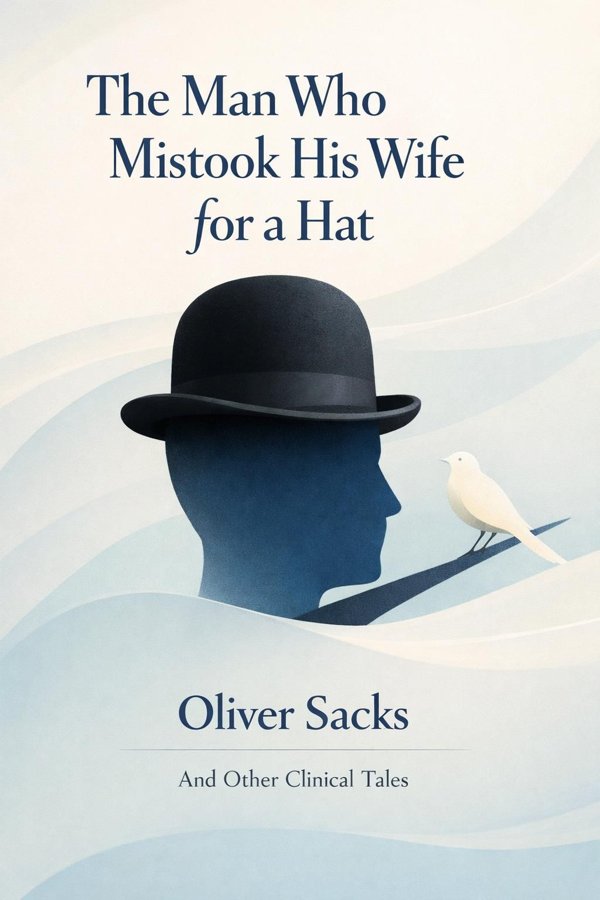
The Man Who Mistook His Wife for a Hat: And Other Clinical Tales: Summary & Key Insights
by Oliver Sacks
 10 min4 chaptersAudio available
What Is The Man Who Mistook His Wife for a Hat: And Other Clinical Tales About?
The Man Who Mistook His Wife for a Hat: And Other Clinical Tales by Oliver Sacks is a neuroscience book spanning 4 pages. A collection of fascinating case studies by neurologist Oliver Sacks, exploring the lives of patients with unusual neurological disorders. Through compassionate storytelling, Sacks reveals how the brain’s malfunctions can illuminate the nature of perception, identity, and humanity itself.
This FizzRead summary covers all 4 key chapters of The Man Who Mistook His Wife for a Hat: And Other Clinical Tales in approximately 10 minutes, distilling the most important ideas, arguments, and takeaways from Oliver Sacks's work. Also available as an audio summary and Key Quotes Podcast.
The Man Who Mistook His Wife for a Hat: And Other Clinical Tales
A collection of fascinating case studies by neurologist Oliver Sacks, exploring the lives of patients with unusual neurological disorders. Through compassionate storytelling, Sacks reveals how the brain’s malfunctions can illuminate the nature of perception, identity, and humanity itself.
Who Should Read The Man Who Mistook His Wife for a Hat: And Other Clinical Tales?
This book is perfect for anyone interested in neuroscience and looking to gain actionable insights in a short read. Whether you're a student, professional, or lifelong learner, the key ideas from The Man Who Mistook His Wife for a Hat: And Other Clinical Tales by Oliver Sacks will help you think differently.
- ✓Readers who enjoy neuroscience and want practical takeaways
- ✓Professionals looking to apply new ideas to their work and life
- ✓Anyone who wants the core insights of The Man Who Mistook His Wife for a Hat: And Other Clinical Tales in just 10 minutes
Want the full summary?
Get instant access to this book summary and 100K+ more with Fizz Moment.
Get Free SummaryAvailable on App Store • Free to download
Key Chapters
Loss, in neurology, is often the first reality we confront—a disappearance of function, a silence where once there was certainty. The first part of my book traces these absences through a series of cases that taught me how fragile, and how inventive, the human organism can be.
Dr. P., whose story opens the book, could see perfectly well but could not recognize the objects before him. When he looked at his wife, he saw patterns and contours but not the living person he had loved for decades. When he reached to take his hat, he instead grasped her head, mistaking her for an object. To me, this was not simply a defect of perception—it was a poetic distortion of reality. Dr. P. organized his world musically, singing his way through life’s routines, holding its chaos together through melody. In witnessing this, I realized that where vision failed, art sustained him. His story revealed how the brain’s fragmentation could be met with the unifying power of rhythm and imagination.
Then there was Jimmie, the Lost Mariner, whose memory stopped in 1945. Each time we met, he greeted me as if it were still that year, his face reflecting both surprise and boyish innocence. He could not form new memories, living perpetually in the present. But even in this fixed moment, he found a kind of fulfillment—in the constancy of liturgy, in acts of kindness, and in the rhythm of communal life. In him I saw that identity does not depend solely on memory but on the heart’s capacity to remain whole.
Across other stories of loss—patients who could speak no words though their minds teemed with thought, those who lost the sense of touch and thus seemed alienated from their own bodies—I discovered that neurological deficit often provokes a deeper struggle for meaning. A woman deprived of proprioception told me she felt like a ghost, until she consciously trained herself to live through vision and will. Her rediscovery of her own embodiment was not a cure, but a reinvention. In each of these patients, I found the paradox that loss can call forth profound creativity: when one faculty is extinguished, others rise to meet the gap, extending the boundaries of human adaptability.
If the first part of my book concerns absence, the second celebrates excess—the overflowing of neurological energy that transforms ordinary experience into something vivid, eccentric, or sublime. In these cases, the brain does not falter; it races ahead, sometimes with wild autonomy, producing a rich, chaotic symphony of impulses.
Take the case of Witty Ticcy Ray, a man possessed by Tourette’s syndrome. His body jerked and his words burst out unpredictably, yet within this tempest he lived with extraordinary vitality. As a jazz drummer, his tics became part of his musical phrasing, his rhythm inseparable from his condition. When treated with medication, he struggled: the calmness that came with chemical restraint dulled his artistry. In discussing his choice between control and creativity, I saw how neurological excess could be both torment and gift. Ray taught me that the goal of medicine is not merely suppression of symptoms, but balance—the art of negotiating between the freedom of one's neurology and the structure that daily life demands.
Other cases in this section—patients with temporal lobe epilepsy who experienced spiritual ecstasy, or obsessive energies that bordered on revelation—pushed me to consider the continuum between illness and vision. Could the seizures that brought rapture be an amplification of normal emotion, a kind of neurological poetry? These phenomena reminded me that our brains are not merely biological computers; they are instruments of passion, capable of profound aesthetic and moral feeling. In studying excess, I learned that health must sometimes accept the presence of intensity—that what we label abnormal may also be an exaggerated form of the human creative impulse.
+ 2 more chapters — available in the FizzRead app
All Chapters in The Man Who Mistook His Wife for a Hat: And Other Clinical Tales
About the Author
Oliver Sacks (1933–2015) was a British neurologist, naturalist, and author known for his empathetic and literary approach to clinical neurology. His works, including 'Awakenings' and 'The Man Who Mistook His Wife for a Hat,' brought the human side of neurological conditions to a wide audience.
Get This Summary in Your Preferred Format
Read or listen to the The Man Who Mistook His Wife for a Hat: And Other Clinical Tales summary by Oliver Sacks anytime, anywhere. FizzRead offers multiple formats so you can learn on your terms — all free.
Available formats: App · Audio · PDF · EPUB — All included free with FizzRead
Download The Man Who Mistook His Wife for a Hat: And Other Clinical Tales PDF and EPUB Summary
Key Quotes from The Man Who Mistook His Wife for a Hat: And Other Clinical Tales
“Loss, in neurology, is often the first reality we confront—a disappearance of function, a silence where once there was certainty.”
“If the first part of my book concerns absence, the second celebrates excess—the overflowing of neurological energy that transforms ordinary experience into something vivid, eccentric, or sublime.”
Frequently Asked Questions about The Man Who Mistook His Wife for a Hat: And Other Clinical Tales
The Man Who Mistook His Wife for a Hat: And Other Clinical Tales by Oliver Sacks is a neuroscience book that explores key ideas across 4 chapters. A collection of fascinating case studies by neurologist Oliver Sacks, exploring the lives of patients with unusual neurological disorders. Through compassionate storytelling, Sacks reveals how the brain’s malfunctions can illuminate the nature of perception, identity, and humanity itself.
More by Oliver Sacks
You Might Also Like
Anxious
Joseph LeDoux
10 min
Hallucinations
Oliver Sacks
10 min
The Biological Mind: How Brain, Body, and Environment Collaborate to Make Us Who We Are
Alan Jasanoff
10 min
The Feeling of Life Itself: Why Consciousness Is Widespread but Can't Be Computed
Christof Koch
10 min
The No-Nonsense Meditation Book
Steven Laureys
10 min
A General Theory of Love
Thomas Lewis, Fari Amini, Richard Lannon
10 minBrowse by Category
Ready to read The Man Who Mistook His Wife for a Hat: And Other Clinical Tales?
Get the full summary and 100K+ more books with Fizz Moment.