
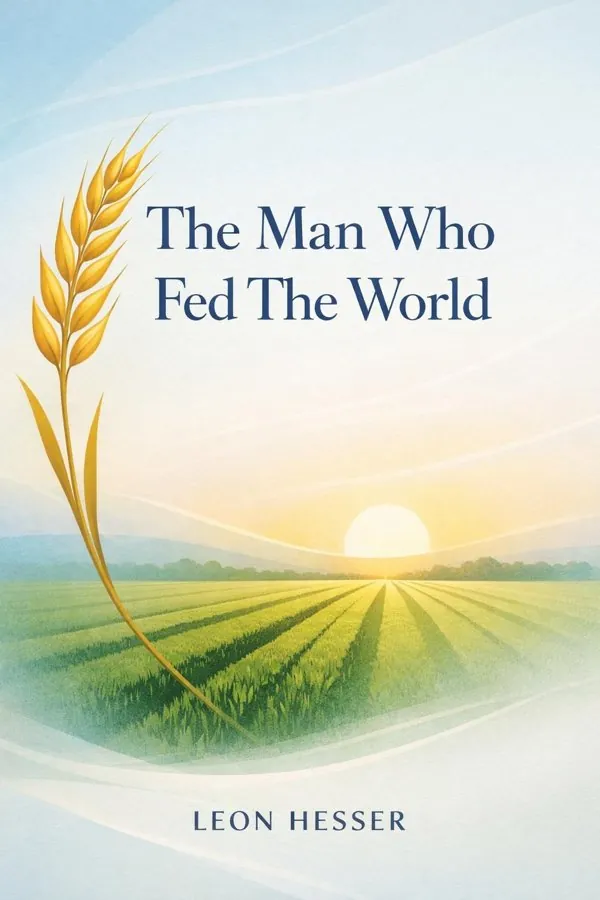
The Man Who Fed The World: Nobel Peace Prize Laureate Norman Borlaug and His Battle to End World Hunger: Summary & Key Insights
by Leon Hesser
 10 min9 chaptersAudio available
Key Takeaways from The Man Who Fed The World: Nobel Peace Prize Laureate Norman Borlaug and His Battle to End World Hunger
Great world-changing lives often begin in ordinary places.
Talent matters, but direction matters more.
Real breakthroughs often happen far from centers of prestige.
Nature does not negotiate, and that is why Borlaug’s scientific style mattered so much.
History can turn on whether food arrives in time.
What Is The Man Who Fed The World: Nobel Peace Prize Laureate Norman Borlaug and His Battle to End World Hunger About?
The Man Who Fed The World: Nobel Peace Prize Laureate Norman Borlaug and His Battle to End World Hunger by Leon Hesser is a biographies book spanning 6 pages. What does it look like when one person changes the fate of billions? In The Man Who Fed The World, Leon Hesser tells the remarkable story of Norman Borlaug, the agricultural scientist whose work helped avert mass famine and transformed global food production. This authorized biography follows Borlaug from his humble upbringing on an Iowa farm to his groundbreaking research in Mexico, India, and Pakistan, where he developed high-yield, disease-resistant wheat varieties that became central to the Green Revolution. But the book is about more than scientific success. It is a portrait of relentless moral urgency, showing how Borlaug combined research, fieldwork, political persuasion, and sheer persistence to confront one of humanity’s oldest problems: hunger. Hesser writes with unusual authority, having worked in international agricultural development and known the world Borlaug inhabited firsthand. That experience gives the biography both credibility and immediacy. The result is an inspiring and practical account of how innovation, courage, and service can create change on a global scale.
This FizzRead summary covers all 9 key chapters of The Man Who Fed The World: Nobel Peace Prize Laureate Norman Borlaug and His Battle to End World Hunger in approximately 10 minutes, distilling the most important ideas, arguments, and takeaways from Leon Hesser's work. Also available as an audio summary and Key Quotes Podcast.
The Man Who Fed The World: Nobel Peace Prize Laureate Norman Borlaug and His Battle to End World Hunger
What does it look like when one person changes the fate of billions? In The Man Who Fed The World, Leon Hesser tells the remarkable story of Norman Borlaug, the agricultural scientist whose work helped avert mass famine and transformed global food production. This authorized biography follows Borlaug from his humble upbringing on an Iowa farm to his groundbreaking research in Mexico, India, and Pakistan, where he developed high-yield, disease-resistant wheat varieties that became central to the Green Revolution. But the book is about more than scientific success. It is a portrait of relentless moral urgency, showing how Borlaug combined research, fieldwork, political persuasion, and sheer persistence to confront one of humanity’s oldest problems: hunger. Hesser writes with unusual authority, having worked in international agricultural development and known the world Borlaug inhabited firsthand. That experience gives the biography both credibility and immediacy. The result is an inspiring and practical account of how innovation, courage, and service can create change on a global scale.
Who Should Read The Man Who Fed The World: Nobel Peace Prize Laureate Norman Borlaug and His Battle to End World Hunger?
This book is perfect for anyone interested in biographies and looking to gain actionable insights in a short read. Whether you're a student, professional, or lifelong learner, the key ideas from The Man Who Fed The World: Nobel Peace Prize Laureate Norman Borlaug and His Battle to End World Hunger by Leon Hesser will help you think differently.
- ✓Readers who enjoy biographies and want practical takeaways
- ✓Professionals looking to apply new ideas to their work and life
- ✓Anyone who wants the core insights of The Man Who Fed The World: Nobel Peace Prize Laureate Norman Borlaug and His Battle to End World Hunger in just 10 minutes
Want the full summary?
Get instant access to this book summary and 100K+ more with Fizz Moment.
Get Free SummaryAvailable on App Store • Free to download
Key Chapters
Great world-changing lives often begin in ordinary places. Norman Borlaug’s story starts on a small farm near Cresco, Iowa, where hard work was not a slogan but a daily necessity. Growing up in a Norwegian American farming family, he learned lessons that stayed with him for life: food does not appear by magic, nature can be generous or brutal, and communities survive by helping one another. These early experiences gave Borlaug a practical understanding of agriculture that many later experts lacked. He did not approach farming as an abstract theory; he knew the stakes in real human terms.
Life on the farm also trained him in resilience. Weather, pests, market conditions, and physical labor taught him that progress rarely comes easily. The discipline of rural life shaped his attitude toward obstacles: problems were meant to be solved, not admired. Hesser shows that Borlaug’s later capacity to endure exhausting travel, bureaucratic resistance, and scientific setbacks was rooted in this upbringing. His values were equally important. Family, thrift, humility, and service became the moral framework for his career.
This background helps explain why Borlaug never became a detached academic. Even after earning global honors, he remained focused on farmers, harvests, and hunger. He could speak with presidents and Nobel committees, but he was most at home in fields, talking to growers about seed, soil, disease, and yield. His authority came not just from science, but from authenticity.
For modern readers, this chapter offers a useful reminder: foundational values matter. Expertise becomes more powerful when grounded in empathy, lived experience, and a clear sense of purpose. Actionable takeaway: reflect on your own formative experiences and identify the values or skills that could become the basis of meaningful long-term work.
Talent matters, but direction matters more. Borlaug’s years at the University of Minnesota transformed a hardworking farm boy into a scientist with a mission. During the Great Depression, he worked multiple jobs to stay in school, an experience that deepened his respect for discipline and sharpened his determination. He initially studied forestry, but his interests gradually expanded toward plant pathology, genetics, and the science of crop improvement. This was not a smooth or preplanned ascent. It was a process of discovery in which effort, mentorship, and exposure to urgent problems shaped his future.
One of the key insights from this period is that Borlaug’s intellectual development was tied to real-world challenges. He was not drawn to science for prestige alone. He saw it as a practical tool for reducing suffering. The scientific method gave him a language for attacking hunger systematically: identify the problem, test solutions, measure results, revise, and persist. Hesser emphasizes that Borlaug’s education was not merely academic training. It was where he found a way to connect knowledge with service.
This phase of his life also highlights the importance of interdisciplinary thinking. Borlaug combined elements of agriculture, biology, environmental understanding, and field experimentation. That combination later became essential to his success. He was able to move fluidly between laboratory science and on-the-ground agricultural practice, which made his work unusually effective.
For readers today, Borlaug’s academic journey shows that a career can emerge from following meaningful problems rather than fixed titles. Education is most powerful when it equips you to solve urgent human needs. Actionable takeaway: instead of asking only what subject interests you, ask what problem you want to spend your life helping solve, then build the skills to address it.
Real breakthroughs often happen far from centers of prestige. When Borlaug went to Mexico in the 1940s as part of a Rockefeller Foundation agricultural program, he entered a setting where crop failure and low productivity were not theoretical concerns but national emergencies. Mexican wheat production was being devastated by rust disease, poor seed quality, and weak farming systems. Many scientists would have treated this as a limited technical assignment. Borlaug saw it as a chance to prove that science could dramatically raise food production.
His work in Mexico became revolutionary because he refused to separate research from application. He developed disease-resistant wheat through relentless field breeding and experimentation, but he also paid attention to local growing conditions, farmer needs, and the urgency of scaling results. One of his most important innovations was the use of shuttle breeding, growing crops in different ecological zones within the same year. This sped up selection, improved adaptability, and challenged accepted assumptions in agricultural science. It was a practical, time-saving, high-impact method rooted in experimentation rather than tradition.
Hesser shows that Borlaug’s success in Mexico depended not just on technical skill but on stamina and stubbornness. He worked under difficult conditions, faced skepticism, and pushed through repeated setbacks. Yet the payoff was enormous: Mexico moved toward wheat self-sufficiency, and Borlaug created a model that could be adapted elsewhere.
This chapter offers a lesson for innovators in any field. Progress rarely comes from elegant ideas alone. It comes from testing, iteration, and a willingness to work where the need is greatest. Actionable takeaway: if you are trying to solve a hard problem, shorten the distance between theory and practice by testing your ideas directly in the environments where they must succeed.
Nature does not negotiate, and that is why Borlaug’s scientific style mattered so much. Wheat rust, a destructive fungal disease, threatened harvests on a massive scale and had the power to wipe out food supplies for entire populations. Borlaug understood that incremental adjustments would not be enough. He needed wheat varieties that could resist disease while also producing dramatically higher yields. This was a difficult balancing act, because improving one trait often weakened another. The challenge demanded persistence, large-scale breeding work, and a tolerance for failure.
Borlaug’s approach was intensely empirical. He crossed thousands of wheat lines, observed outcomes in different conditions, and selected plants that combined disease resistance, responsiveness to fertilizer, and strong yield potential. He also helped develop semi-dwarf wheat varieties whose shorter stalks could support heavier grain heads without collapsing. This was crucial. Traditional wheat often lodged, or fell over, when heavily fertilized, limiting productivity. By solving that problem, Borlaug unlocked the possibility of much larger harvests.
What makes this achievement especially important is that it was not a single discovery but a system of improvements working together. Genetics, disease resistance, fertilizer response, and adaptation to local climates all had to align. Hesser presents Borlaug not as a lone genius chasing one magic answer, but as a practical scientist assembling a powerful package of solutions.
For readers, this illustrates an essential principle: major results usually come from solving a chain of linked problems, not from hunting one perfect fix. In business, health, education, or technology, bottlenecks often interact. Actionable takeaway: map the full system behind the challenge you face and identify which combination of small but critical improvements could produce a breakthrough.
History can turn on whether food arrives in time. Borlaug’s work reached its most dramatic moment when India and Pakistan, facing severe food shortages and the threat of catastrophic famine, adopted the improved wheat varieties developed in Mexico. In the 1960s, many experts predicted mass starvation in South Asia. Population growth was rising quickly, agricultural productivity lagged behind, and pessimism was widespread. Borlaug rejected the fatalism. He believed famine was not inevitable if governments, scientists, and farmers moved fast enough.
The Green Revolution in South Asia was not simply about importing new seeds. It required coordinated action: seed multiplication, fertilizer supply, irrigation support, extension services, transport logistics, and political commitment. Borlaug played a crucial role not only as a scientist but as an advocate and persuader. He worked directly with officials and farmers, pushing through delays and skepticism with urgency. The result was extraordinary. Wheat harvests rose sharply, countries once dependent on imports moved toward self-sufficiency, and millions of lives were likely saved.
Hesser makes clear that this was one of the great humanitarian achievements of the twentieth century. It demonstrated that science, when linked to implementation, can alter the trajectory of entire nations. It also challenged elite assumptions that poor countries were doomed to hunger because of population pressure alone.
For modern readers, this episode shows that scale matters. A good idea becomes transformative only when institutions, infrastructure, and political will help it reach people. Actionable takeaway: when you identify a solution that works, think beyond invention and ask what systems, partnerships, and distribution channels are needed to deliver it at meaningful scale.
One of the most striking features of Borlaug’s character was his impatience with delay when human lives were at stake. Hesser portrays him as someone who could be blunt, forceful, and even confrontational if he believed officials or institutions were moving too slowly. This trait was not always comfortable for those around him, but it was often necessary. In moments of looming food crisis, endless meetings and cautious paperwork can become a form of moral failure.
Borlaug’s urgency was especially evident during efforts to bring improved wheat to India and Pakistan. He had to overcome administrative hurdles, political suspicion, logistical chaos, and entrenched habits. Seeds needed to be transported, tested, distributed, and planted quickly. Fertilizer and irrigation had to support the new varieties. Each delay increased the risk of human suffering. Borlaug understood that timing is a central part of problem-solving. A technically correct solution that arrives too late can still be a disaster.
This idea has broad relevance. In public health, climate adaptation, education reform, and disaster response, the gap between knowing what works and actually doing it can cost lives and opportunities. Borlaug’s example shows the value of combining evidence with execution. He did not merely produce data and hope others would act. He pushed, argued, organized, and insisted.
That does not mean recklessness is always wise. Urgency must still be informed by evidence. But Hesser’s portrait reminds us that some situations demand bold action rather than endless analysis. Actionable takeaway: if you are facing an urgent challenge, identify the most important next step, remove avoidable friction, and act decisively before delay becomes part of the problem.
Every large solution creates new questions. Borlaug’s achievements inspired admiration around the world, but they also generated criticism. The Green Revolution increased yields dramatically, yet some argued that it favored regions with better access to irrigation, fertilizer, and credit. Others worried about environmental effects, dependence on chemical inputs, reduced crop diversity, and the social consequences of uneven development. Hesser does not ignore these concerns, but he frames them within the scale of the crisis Borlaug confronted: widespread hunger and the genuine possibility of mass famine.
Borlaug’s own response to critics was direct. He believed that starving people could not wait for perfect systems. In his view, increased production was the first moral priority. Without food security, debates about long-term optimization become detached from reality. At the same time, the book suggests that criticism is not useless. It can push societies to improve agricultural development by making it more inclusive, sustainable, and locally responsive.
This tension is one of the most valuable parts of the biography. It encourages readers to think beyond simplistic narratives of heroes and villains. Borlaug was not promising a utopia. He was solving a deadly emergency with the best tools available, while later generations inherited the responsibility to manage the side effects and evolve the system further.
That lesson applies to innovation everywhere. The existence of tradeoffs does not mean a solution lacks value, but it does mean success must be evaluated honestly. Actionable takeaway: when pursuing progress, ask two questions at once: what urgent problem does this solve now, and what second-order effects must we monitor and improve over time?
Knowledge becomes transformative when it is animated by conscience. Borlaug was not content to be a successful researcher who published important findings and left implementation to others. He believed scientists had a duty to engage with the human consequences of their work. That is why he spent so much of his life traveling, advising governments, speaking publicly, and advocating for agricultural investment in poor countries. Hesser shows that Borlaug’s greatness came from this unusual fusion of technical expertise and moral commitment.
Borlaug repeatedly argued that food is a foundation of peace. Hunger breeds instability, conflict, migration, and despair. By helping nations feed themselves, agricultural development could reduce the pressures that lead to violence and social collapse. This idea helps explain why he received the Nobel Peace Prize. His contribution was not military or diplomatic in the traditional sense, yet it addressed one of the underlying causes of insecurity.
The book also illustrates that advocacy is often necessary to protect evidence-based solutions from ideology, neglect, or fashionable pessimism. Borlaug was willing to challenge environmental absolutists, complacent bureaucrats, and defeatist thinkers alike. He understood that truth alone does not automatically win. It must be communicated, defended, and connected to public action.
For readers in any profession, this is a powerful challenge. It is not enough to do good work privately if the problem requires public engagement. Whether in medicine, education, policy, or engineering, the people closest to real solutions may need to speak up more forcefully. Actionable takeaway: identify one area where your knowledge could help others more directly, and take a concrete step to share, advocate, or apply it beyond your immediate role.
Awards can close a career, but for Borlaug they became a platform to keep fighting. Winning the Nobel Peace Prize in 1970 brought him global recognition, yet Hesser makes clear that Borlaug did not interpret honor as arrival. He saw it as added responsibility. He continued working on crop improvement, supporting agricultural programs in developing countries, and warning world leaders that complacency could erase hard-won gains. Hunger, in his view, was never a problem solved once and for all.
This persistent sense of unfinished duty is central to Borlaug’s legacy. He understood that food security depends on continuous adaptation. New diseases emerge, populations grow, political systems shift, and environmental pressures intensify. What worked in one decade may need revision in the next. That is why he remained active late in life, encouraging innovation in Africa and defending the use of modern agricultural science to meet future demand.
Hesser presents Borlaug’s legacy not as a statue to admire, but as a standard to live up to. The biography asks readers to recognize how much was achieved through courage, discipline, and applied science, while also admitting how much remains to be done. Borlaug’s life becomes an argument against cynicism. One person, working with others and refusing to accept inevitability, can redirect history.
This final lesson is especially relevant in an age of overwhelming global problems. Lasting contribution often requires endurance beyond recognition, beyond applause, and beyond the first success. Actionable takeaway: define your work not by external validation but by the real-world problem you want to keep reducing, even after milestones are reached.
All Chapters in The Man Who Fed The World: Nobel Peace Prize Laureate Norman Borlaug and His Battle to End World Hunger
About the Author
Leon Hesser was an American author, editor, and international agricultural development specialist known for writing about food security and humanitarian progress. He spent much of his career working in global development, including service with the U.S. Agency for International Development, where he was closely involved with agricultural initiatives and international cooperation. That experience gave him a practical understanding of the scientific, political, and human dimensions of hunger. Hesser was especially well positioned to write about Norman Borlaug because he understood both the technical world of crop improvement and the broader global stakes of agricultural policy. His work reflects a strong belief that applied science, ethical leadership, and international collaboration can improve lives on a massive scale.
Get This Summary in Your Preferred Format
Read or listen to the The Man Who Fed The World: Nobel Peace Prize Laureate Norman Borlaug and His Battle to End World Hunger summary by Leon Hesser anytime, anywhere. FizzRead offers multiple formats so you can learn on your terms — all free.
Available formats: App · Audio · PDF · EPUB — All included free with FizzRead
Download The Man Who Fed The World: Nobel Peace Prize Laureate Norman Borlaug and His Battle to End World Hunger PDF and EPUB Summary
Key Quotes from The Man Who Fed The World: Nobel Peace Prize Laureate Norman Borlaug and His Battle to End World Hunger
“Great world-changing lives often begin in ordinary places.”
“Talent matters, but direction matters more.”
“Real breakthroughs often happen far from centers of prestige.”
“Nature does not negotiate, and that is why Borlaug’s scientific style mattered so much.”
“History can turn on whether food arrives in time.”
Frequently Asked Questions about The Man Who Fed The World: Nobel Peace Prize Laureate Norman Borlaug and His Battle to End World Hunger
The Man Who Fed The World: Nobel Peace Prize Laureate Norman Borlaug and His Battle to End World Hunger by Leon Hesser is a biographies book that explores key ideas across 9 chapters. What does it look like when one person changes the fate of billions? In The Man Who Fed The World, Leon Hesser tells the remarkable story of Norman Borlaug, the agricultural scientist whose work helped avert mass famine and transformed global food production. This authorized biography follows Borlaug from his humble upbringing on an Iowa farm to his groundbreaking research in Mexico, India, and Pakistan, where he developed high-yield, disease-resistant wheat varieties that became central to the Green Revolution. But the book is about more than scientific success. It is a portrait of relentless moral urgency, showing how Borlaug combined research, fieldwork, political persuasion, and sheer persistence to confront one of humanity’s oldest problems: hunger. Hesser writes with unusual authority, having worked in international agricultural development and known the world Borlaug inhabited firsthand. That experience gives the biography both credibility and immediacy. The result is an inspiring and practical account of how innovation, courage, and service can create change on a global scale.
You Might Also Like

An American Marriage
Tayari Jones
10 min
Benjamin Franklin: An American Life
Walter Isaacson
10 min
I Know Why The Caged Bird Sings
Maya Angelou
10 min
Long Walk to Freedom
Nelson Mandela
10 min
Persepolis
Marjane Satrapi
10 min
Surely You're Joking, Mr. Feynman!
Richard P. Feynman
10 minBrowse by Category
Ready to read The Man Who Fed The World: Nobel Peace Prize Laureate Norman Borlaug and His Battle to End World Hunger?
Get the full summary and 100K+ more books with Fizz Moment.