
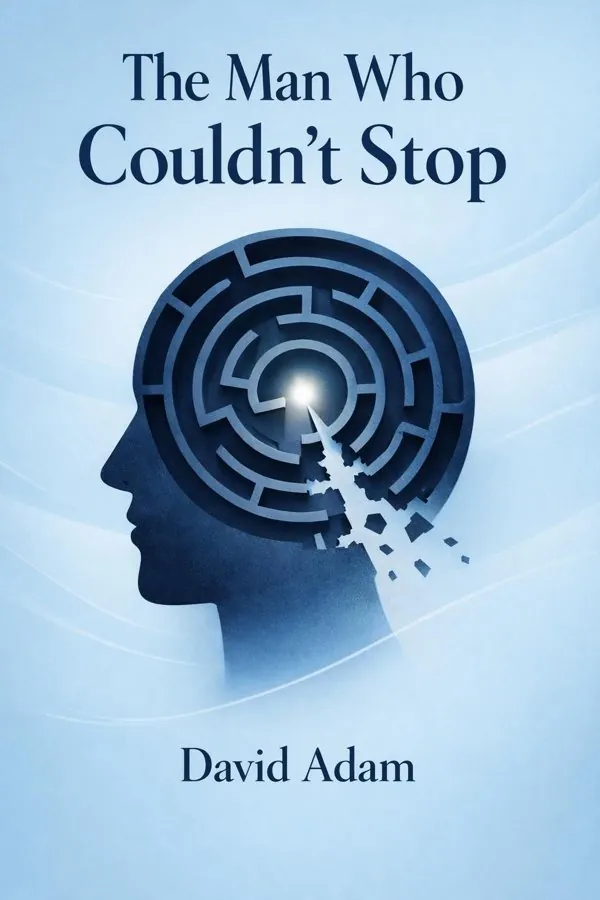
The Man Who Couldn't Stop: OCD and the True Story of a Life Lost in Thought: Summary & Key Insights
by David Adam
 10 min7 chaptersAudio available
What Is The Man Who Couldn't Stop: OCD and the True Story of a Life Lost in Thought About?
The Man Who Couldn't Stop: OCD and the True Story of a Life Lost in Thought by David Adam is a mental_health book spanning 7 pages. A deeply personal and scientifically grounded exploration of obsessive-compulsive disorder (OCD), this book blends memoir and neuroscience to illuminate the nature of intrusive thoughts and compulsive behaviors. David Adam recounts his own struggles with OCD while examining the history, psychology, and treatment of the condition, offering insight into how the mind can turn against itself and how understanding can lead to recovery.
This FizzRead summary covers all 7 key chapters of The Man Who Couldn't Stop: OCD and the True Story of a Life Lost in Thought in approximately 10 minutes, distilling the most important ideas, arguments, and takeaways from David Adam's work. Also available as an audio summary and Key Quotes Podcast.
The Man Who Couldn't Stop: OCD and the True Story of a Life Lost in Thought
A deeply personal and scientifically grounded exploration of obsessive-compulsive disorder (OCD), this book blends memoir and neuroscience to illuminate the nature of intrusive thoughts and compulsive behaviors. David Adam recounts his own struggles with OCD while examining the history, psychology, and treatment of the condition, offering insight into how the mind can turn against itself and how understanding can lead to recovery.
Who Should Read The Man Who Couldn't Stop: OCD and the True Story of a Life Lost in Thought?
This book is perfect for anyone interested in mental_health and looking to gain actionable insights in a short read. Whether you're a student, professional, or lifelong learner, the key ideas from The Man Who Couldn't Stop: OCD and the True Story of a Life Lost in Thought by David Adam will help you think differently.
- ✓Readers who enjoy mental_health and want practical takeaways
- ✓Professionals looking to apply new ideas to their work and life
- ✓Anyone who wants the core insights of The Man Who Couldn't Stop: OCD and the True Story of a Life Lost in Thought in just 10 minutes
Want the full summary?
Get instant access to this book summary and 100K+ more with Fizz Moment.
Get Free SummaryAvailable on App Store • Free to download
Key Chapters
The first sign that my mind wasn’t playing by the usual rules came when I was a teenager. It began with a brief but piercing thought — what if I’ve contracted AIDS? The rational part of me knew this was absurd. I hadn’t done anything that could possibly expose me. But the thought wouldn’t leave. It stuck to me like a burr, growing more real with every attempt to banish it. That’s how intrusive thoughts work: the more you struggle against them, the more they sink their claws in.
At that age, OCD was not a term I understood. The world saw people with ‘quirks,’ those who washed their hands too often or arranged objects by color or symmetry. I didn’t fit that stereotype, so I did what many young people with mental illness do — I kept everything secret. I constructed elaborate private rituals to manage the overwhelming anxiety the obsessions caused. I checked, rehearsed, avoided, and rationalized. My mind became a self-built prison, and I was the only guard.
What I understand now, but couldn’t then, is that these early experiences were the foundation of a lifelong pattern: intrusive thoughts sparking panic, panic prompting compulsions, compulsions feeding the power of the obsessions in turn. In those teenage years, silence felt like safety, but it was also the very thing that allowed the disorder to root itself deeply in my life.
OCD is relentless. It colonizes your waking hours and steals sleep. It shapes how you move through the world, how you talk to others, what you dare to touch, and what you fear to imagine. For me, work became both refuge and torment. As a journalist, especially one covering science, I was surrounded by curiosity and fact — two weapons that could, in theory, fight irrational thoughts. Yet my own mind undermined that rationality daily. I could write about viruses one moment, and the next be convinced one had somehow entered my system.
Relationships suffered too. OCD isolates because it feeds on secrecy and shame. You fear to explain your thoughts, fearing judgment or misunderstanding. Those who love you might try to reassure you, but reassurance itself fuels the cycle. Each time someone says, ‘It’s fine, there’s nothing wrong,’ part of you believes it less, and seeks further proof. Life becomes a continuous search for certainty in a world that can’t provide it.
Professionally, OCD taught me paradoxical lessons. Writing and editing demanded focus, while OCD demanded endless attention to distraction. The two battled for control. Still, it was in the quiet moments between panic and deadline that I began to realize the disorder’s broader meaning: it was a distortion of something universal — the human capacity to think, to imagine, to anticipate danger. OCD is what happens when imagination goes rogue, when the line between thought and action blurs dangerously.
+ 5 more chapters — available in the FizzRead app
All Chapters in The Man Who Couldn't Stop: OCD and the True Story of a Life Lost in Thought
About the Author
David Adam is a British science writer and editor, formerly a writer and editor at Nature and The Guardian. He specializes in science communication and mental health topics, drawing on his own experiences with OCD to inform his work.
Get This Summary in Your Preferred Format
Read or listen to the The Man Who Couldn't Stop: OCD and the True Story of a Life Lost in Thought summary by David Adam anytime, anywhere. FizzRead offers multiple formats so you can learn on your terms — all free.
Available formats: App · Audio · PDF · EPUB — All included free with FizzRead
Download The Man Who Couldn't Stop: OCD and the True Story of a Life Lost in Thought PDF and EPUB Summary
Key Quotes from The Man Who Couldn't Stop: OCD and the True Story of a Life Lost in Thought
“The first sign that my mind wasn’t playing by the usual rules came when I was a teenager.”
“It colonizes your waking hours and steals sleep.”
Frequently Asked Questions about The Man Who Couldn't Stop: OCD and the True Story of a Life Lost in Thought
The Man Who Couldn't Stop: OCD and the True Story of a Life Lost in Thought by David Adam is a mental_health book that explores key ideas across 7 chapters. A deeply personal and scientifically grounded exploration of obsessive-compulsive disorder (OCD), this book blends memoir and neuroscience to illuminate the nature of intrusive thoughts and compulsive behaviors. David Adam recounts his own struggles with OCD while examining the history, psychology, and treatment of the condition, offering insight into how the mind can turn against itself and how understanding can lead to recovery.
You Might Also Like

Big Feelings: How to Be Okay When Things Are Not Okay
Liz Fosslien, Mollie West Duffy
10 min
Creative Arts Therapies Handbook: Art, Music and Dance Therapy Practices for Wellbeing
Susan I. Buchalter
10 min
Emotional First Aid: Healing Rejection, Guilt, Failure, and Other Everyday Hurts
Guy Winch
10 min
Lost Connections: Why You're Depressed and How to Find Hope
Johann Hari
10 min
No Time to Panic: How to Stop Worrying and Embrace Life
Matt Gutman
10 min
Overcoming Mobbing: A Recovery Guide for Workplace Aggression and Bullying
Maureen Duffy, Len Sperry
10 minBrowse by Category
Ready to read The Man Who Couldn't Stop: OCD and the True Story of a Life Lost in Thought?
Get the full summary and 100K+ more books with Fizz Moment.