
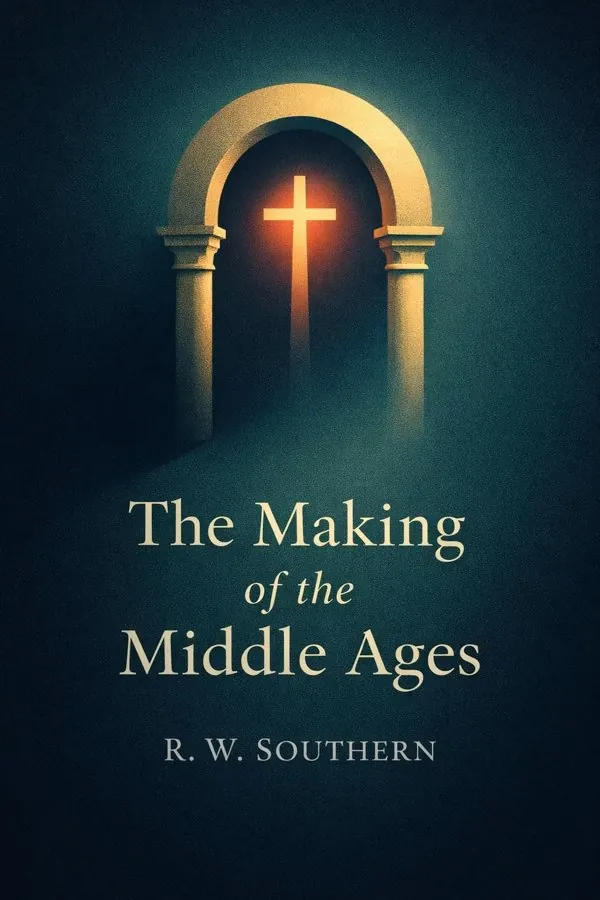
The Making of the Middle Ages: Summary & Key Insights
 10 min9 chaptersAudio available
Key Takeaways from The Making of the Middle Ages
Civilizations rarely disappear all at once; more often, they are absorbed, translated, and rebuilt in new forms.
When political order weakens, people look for institutions that can still organize life, preserve meaning, and provide trust.
Renewal often begins in communities that choose discipline over comfort.
States are not always built first through bureaucracy; sometimes they begin through loyalty, obligation, and negotiated authority.
Intellectual rebirth usually begins with preservation before innovation.
What Is The Making of the Middle Ages About?
The Making of the Middle Ages by R. W. Southern is a world_history book spanning 8 pages. The Making of the Middle Ages is one of the most influential modern studies of how medieval Europe came into being. In this classic work, R. W. Southern traces the long transformation of Western civilization from the ruins of the Roman world to the vibrant intellectual and institutional culture of the twelfth century. Rather than treating the Middle Ages as a dark interruption between antiquity and modernity, Southern shows it as a creative age in which new forms of politics, religion, education, and social order were patiently built. His focus is not only on kings and battles, but on monasteries, bishops, scholars, reformers, and ordinary habits of thought that made medieval life coherent. What makes the book enduring is Southern’s ability to connect large historical changes with the inner values that shaped them: discipline, hierarchy, salvation, learning, and personal devotion. As one of the twentieth century’s great medieval historians, Southern writes with authority, clarity, and interpretive depth. The result is a compact but powerful explanation of how Europe’s medieval foundations were laid—and why those foundations still matter.
This FizzRead summary covers all 9 key chapters of The Making of the Middle Ages in approximately 10 minutes, distilling the most important ideas, arguments, and takeaways from R. W. Southern's work. Also available as an audio summary and Key Quotes Podcast.
The Making of the Middle Ages
The Making of the Middle Ages is one of the most influential modern studies of how medieval Europe came into being. In this classic work, R. W. Southern traces the long transformation of Western civilization from the ruins of the Roman world to the vibrant intellectual and institutional culture of the twelfth century. Rather than treating the Middle Ages as a dark interruption between antiquity and modernity, Southern shows it as a creative age in which new forms of politics, religion, education, and social order were patiently built. His focus is not only on kings and battles, but on monasteries, bishops, scholars, reformers, and ordinary habits of thought that made medieval life coherent. What makes the book enduring is Southern’s ability to connect large historical changes with the inner values that shaped them: discipline, hierarchy, salvation, learning, and personal devotion. As one of the twentieth century’s great medieval historians, Southern writes with authority, clarity, and interpretive depth. The result is a compact but powerful explanation of how Europe’s medieval foundations were laid—and why those foundations still matter.
Who Should Read The Making of the Middle Ages?
This book is perfect for anyone interested in world_history and looking to gain actionable insights in a short read. Whether you're a student, professional, or lifelong learner, the key ideas from The Making of the Middle Ages by R. W. Southern will help you think differently.
- ✓Readers who enjoy world_history and want practical takeaways
- ✓Professionals looking to apply new ideas to their work and life
- ✓Anyone who wants the core insights of The Making of the Middle Ages in just 10 minutes
Want the full summary?
Get instant access to this book summary and 100K+ more with Fizz Moment.
Get Free SummaryAvailable on App Store • Free to download
Key Chapters
Civilizations rarely disappear all at once; more often, they are absorbed, translated, and rebuilt in new forms. One of Southern’s central insights is that the Middle Ages did not begin from a blank slate after the fall of the Western Roman Empire. The Roman world left behind habits of administration, law, language, religion, and public order that continued to shape European life long after imperial power collapsed in the West. Even when Roman institutions weakened, Roman ideas retained prestige. Bishops inherited civic responsibilities once held by imperial officials. Latin remained the language of worship, learning, and government. Concepts of authority, legal procedure, and universal order endured, even as they were adapted to very different conditions.
Southern’s point is not that medieval Europe was simply Rome in decline. Rather, the medieval world was created by selective continuity. New rulers, especially Germanic kings and local lords, governed populations that still thought within Roman categories. The Christian Church, deeply formed by the late Roman world, became the main guardian of continuity. In practical terms, this helps explain why medieval Europe could be fragmented politically yet still share common assumptions about law, hierarchy, and civilization.
A modern reader can apply this insight beyond medieval history. Institutions today also survive through adaptation rather than purity. Companies, nations, and communities often preserve their identity not by resisting change entirely, but by carrying forward core practices into new circumstances.
Actionable takeaway: When studying any major transition, ask not only what ended, but what endured and quietly shaped the future.
When political order weakens, people look for institutions that can still organize life, preserve meaning, and provide trust. Southern argues that after the breakdown of Roman imperial authority in the West, the Christian Church became exactly that institution. It did not merely offer spiritual comfort. It provided administration, education, charity, dispute resolution, and a shared moral vocabulary across regions that were otherwise divided by war, localism, and fragile kingship.
Bishops emerged as major figures not only because of their religious role, but because they were often among the few literate and organized leaders in a community. Monasteries preserved manuscripts, taught discipline, managed land, and served as centers of prayer and social stability. The papacy, though often politically constrained, represented the ideal of a universal authority transcending local fragmentation. Through dioceses, liturgy, canon law, and ecclesiastical hierarchy, the Church offered medieval Europe a durable structure that secular power alone could not supply.
Southern shows that the Church’s importance lay in its organizational genius as much as its theology. It translated Christian belief into institutions. That is why it shaped medieval society so deeply: it governed time through feast days, governed behavior through moral teaching, and governed aspiration through the promise of salvation. In many ways, it taught Europe how to think collectively.
This idea remains relevant. Institutions matter most when they combine ideals with practical systems. A mission without organization dissolves; organization without meaning becomes mechanical. The medieval Church endured because it fused both.
Actionable takeaway: To understand the strength of any institution, examine how well it connects belief, structure, and daily life.
Renewal often begins in communities that choose discipline over comfort. Southern treats monasticism as one of the great engines of medieval civilization because monasteries did far more than withdraw from the world. They created models of order, prayer, labor, study, and self-rule that influenced the whole of Western Christendom. In a violent and unstable age, the monastery represented a deliberate attempt to build a life governed by spiritual purpose and regular practice.
The Rule of Saint Benedict, with its balance of prayer, reading, obedience, and work, gave Western monasticism a durable framework. Monasteries became places where books were copied, land was managed, liturgy was refined, and young clergy were trained. Over time, reform movements such as Cluny renewed monastic life by insisting that spiritual seriousness had to be protected from worldly corruption and noble interference. Southern shows that these movements mattered not because monks ruled society directly, but because they supplied moral authority and institutional examples.
Monastic ideals also changed broader culture. The emphasis on discipline, routine, inward examination, and spiritual aspiration shaped clerical life and influenced lay devotion. Even secular rulers often sought legitimacy by associating themselves with monasteries or sponsoring reform. The monastery became a laboratory for the medieval imagination: a place where heaven’s order might be rehearsed on earth.
For modern readers, monasticism offers a lesson about the power of intentional environments. People become what their routines repeatedly train them to be. The medieval monastery succeeded because it turned values into daily habits.
Actionable takeaway: If you want lasting personal or institutional renewal, build a rule of life—clear routines that embody your deepest priorities.
States are not always built first through bureaucracy; sometimes they begin through loyalty, obligation, and negotiated authority. Southern explains that after Rome’s political structures weakened, medieval Europe developed new forms of power rooted less in centralized administration and more in personal relationships. Kingship survived, but often in fragile form. Local lords, warriors, bishops, and landholders formed a political world in which rule depended on allegiance, protection, inheritance, and custom.
This was not chaos in the simple sense. It was a different political logic. Authority became layered and local. A ruler’s power depended on the ability to secure loyalty from followers, reward service, and maintain peace among competing elites. Feudal relationships, though varied by region and often more complex than textbook definitions suggest, expressed a wider reality: medieval politics was deeply personal. Land, office, military service, and honor were tied together. Institutions existed, but they worked through human bonds rather than impersonal systems.
Southern’s analysis helps explain both the weakness and resilience of medieval government. Such a system could fracture easily, yet it also allowed order to exist where centralized states were impossible. Political stability came from networks of obligation rather than abstract citizenship. Over time, these local structures became the building blocks from which more durable kingdoms emerged.
The broader lesson is that formal authority alone is never enough. In workplaces, communities, and public life, relationships often sustain structures more than rules do. Systems become effective when trust and reciprocity make them livable.
Actionable takeaway: When evaluating leadership, look beyond titles and laws; ask what personal loyalties and obligations actually hold the system together.
Intellectual rebirth usually begins with preservation before innovation. Southern shows that medieval learning did not suddenly burst into life in the twelfth century; it was patiently conserved across centuries by clerics, monks, cathedral schools, and scholars who kept alive the tools of thought in difficult conditions. The early medieval world had fewer educational resources than late antiquity, but it never entirely lost the capacity for study. Grammar, biblical interpretation, liturgy, and the copying of texts maintained a fragile but crucial continuity with the classical and Christian past.
What changed over time was the confidence and scope of this learning. Cathedral schools became centers of more advanced teaching. Teachers began to systematize knowledge, compare authorities, and refine methods of argument. Latin learning created a transregional intellectual culture in which ideas could circulate beyond local boundaries. Southern emphasizes that learning in the Middle Ages was not merely decorative. It served the Church, law, administration, and theology. To read properly was to govern properly, preach properly, and believe properly.
This educational growth laid the foundations for scholastic inquiry and for the rise of universities. It also changed social possibility: the learned cleric could gain influence through intellect as well as birth. In that sense, medieval education gradually widened the sources of authority.
Modern readers can recognize a timeless pattern here. Progress depends on institutions that preserve knowledge during unstable times. Libraries, schools, archives, and teachers often matter most when their value seems least dramatic.
Actionable takeaway: Treat preservation as part of creativity—protecting knowledge today may be what makes tomorrow’s breakthroughs possible.
People living amid uncertainty often become deeply preoccupied with order. Southern argues that one of the defining features of medieval civilization was its determination to understand the world as a structured whole. Society, nature, the Church, and the cosmos were imagined not as random collections of individuals, but as hierarchies with meaningful places and purposes. This concern with order helped medieval people make sense of a world marked by violence, instability, and inequality.
The idea of order appeared everywhere. The Church ordered spiritual life through sacraments, ranks, and ritual time. Political life was organized through lordship, service, and inherited status. Intellectual life sought harmony among authorities, especially Scripture, Church teaching, and inherited wisdom. Even social divisions were often interpreted as part of a providential arrangement in which different groups performed different functions. This could justify inequality, but it also created expectations of mutual obligation. Lords were expected to protect, clergy to pray and teach, peasants to work and sustain society.
Southern is careful to show that medieval order was aspirational as much as real. The actual world was full of disorder, conflict, and contradiction. Yet the ideal of order mattered because it shaped reform efforts. People tried to improve institutions by bringing them closer to a vision of divinely grounded structure.
This insight remains useful. Every society tells itself a story about how order should work. Those stories shape laws, institutions, and moral expectations, even when reality falls short.
Actionable takeaway: To understand any culture, identify the model of order it prizes—and then compare that ideal with lived experience.
Large institutions endure only when they connect with inner life. Southern highlights a subtle but powerful shift in medieval religion: alongside public worship, collective ritual, and hierarchical authority, there grew an increasingly personal form of devotion. Medieval Christianity was never merely institutional. Over time, believers became more conscious of individual sin, conscience, repentance, and the direct demands of holiness upon the self.
This development appeared in many forms: confessional practices, devotional literature, saints’ lives, meditations on Christ’s humanity, and the moral examination encouraged by clergy and monastic writers. Reformers did not only want a more orderly Church; they wanted more serious Christians. The question became not simply whether society was Christian in name, but whether individuals were inwardly transformed. That concern helped reshape preaching, pastoral care, and religious discipline.
Southern shows that this emerging personal piety did not destroy communal religion. Instead, it deepened it. A sacramental Church still framed salvation, but within that framework, the inner person became more visible. Medieval people increasingly viewed spiritual life as something requiring self-scrutiny and deliberate response. This gave religious experience greater psychological intensity.
For modern readers, this is a reminder that historical change often occurs not only through institutions and laws, but through shifting expectations of the self. Cultures transform when people begin to ask different questions about responsibility, sincerity, and moral identity.
Actionable takeaway: When trying to understand a movement, ask how it reshapes the individual conscience, not just public behavior.
A civilization grows not only by preserving tradition, but by criticizing itself in the name of its highest ideals. Southern portrays medieval Europe as a world repeatedly renewed through reform. Church leaders, monks, scholars, and rulers did not passively inherit old structures; they examined corruption, disorder, and spiritual laxity, then sought to restore institutions to their proper purpose. Reform was therefore not marginal to medieval history. It was one of its most creative forces.
The Gregorian Reform is a major example. Efforts to free the Church from lay control, enforce clerical standards, and strengthen papal leadership transformed the relationship between spiritual and secular power. Monastic reforms aimed to recover discipline and purity. Educational reforms improved clerical competence. Legal reforms in canon law clarified authority and procedure. In each case, reformers looked backward to ideals while simultaneously creating something new. Their language was restoration, but their effect was transformation.
Southern’s treatment helps explain why the medieval world was dynamic rather than static. Institutions became stronger precisely because they were contested. Reform sharpened boundaries, clarified roles, and generated new intellectual and administrative tools. It also produced conflict, since any serious reform threatens established interests.
This pattern is highly recognizable today. Organizations often improve most when they return to first principles and ask whether current practices still reflect core values. Reform is difficult because it disrupts comfort, but without it, institutions drift.
Actionable takeaway: Use tradition as a standard for renewal—identify your founding purpose, then reform structures that no longer serve it.
Some ages do not invent a civilization from nothing; they bring into focus energies that have been building for generations. For Southern, the twelfth century represents a decisive moment in which many earlier medieval developments matured into a more expansive and self-confident culture. This period saw a remarkable growth in schools, theology, law, administration, urban life, and intellectual ambition. It was not a rejection of the earlier Middle Ages, but their culmination.
The so-called twelfth-century renaissance involved new methods of reasoning, broader engagement with inherited authorities, and a stronger belief that the world could be studied systematically. Cathedral schools flourished, legal thinking became more sophisticated, and theology developed greater analytical precision. At the same time, political institutions grew more complex, and ecclesiastical structures became more self-aware and internationally connected. Europe began to appear less like a fragile post-Roman survival and more like a civilization with clear institutions and intellectual momentum.
Southern’s great achievement is to show that this renaissance was prepared by centuries of slow construction: monastic discipline, clerical learning, reform movements, and the ordering work of the Church. The flowering of the twelfth century was possible because foundations had been laid.
That lesson travels well beyond medieval history. Visible success often depends on long periods of hidden preparation. Breakthroughs are usually the result of accumulated habits, institutions, and disciplined continuity.
Actionable takeaway: When aiming for major growth, invest patiently in foundations—renaissances are built long before they become visible.
All Chapters in The Making of the Middle Ages
About the Author
Sir Richard William Southern (1912–2001) was a distinguished British historian and one of the most influential medievalists of the twentieth century. Educated at Oxford, he became renowned for his ability to combine rigorous scholarship with graceful, accessible prose. Southern taught medieval history for many years and later served as President of St. John’s College, Oxford. His work focused especially on medieval thought, religion, institutions, and intellectual culture, and he helped reshape modern understanding of the Middle Ages as a dynamic and creative period rather than a merely transitional one. Among his best-known works are The Making of the Middle Ages and studies of Saint Anselm and medieval humanism. His scholarship remains widely read for its interpretive depth, clarity, and lasting historical insight.
Get This Summary in Your Preferred Format
Read or listen to the The Making of the Middle Ages summary by R. W. Southern anytime, anywhere. FizzRead offers multiple formats so you can learn on your terms — all free.
Available formats: App · Audio · PDF · EPUB — All included free with FizzRead
Download The Making of the Middle Ages PDF and EPUB Summary
Key Quotes from The Making of the Middle Ages
“Civilizations rarely disappear all at once; more often, they are absorbed, translated, and rebuilt in new forms.”
“When political order weakens, people look for institutions that can still organize life, preserve meaning, and provide trust.”
“Renewal often begins in communities that choose discipline over comfort.”
“States are not always built first through bureaucracy; sometimes they begin through loyalty, obligation, and negotiated authority.”
“Intellectual rebirth usually begins with preservation before innovation.”
Frequently Asked Questions about The Making of the Middle Ages
The Making of the Middle Ages by R. W. Southern is a world_history book that explores key ideas across 9 chapters. The Making of the Middle Ages is one of the most influential modern studies of how medieval Europe came into being. In this classic work, R. W. Southern traces the long transformation of Western civilization from the ruins of the Roman world to the vibrant intellectual and institutional culture of the twelfth century. Rather than treating the Middle Ages as a dark interruption between antiquity and modernity, Southern shows it as a creative age in which new forms of politics, religion, education, and social order were patiently built. His focus is not only on kings and battles, but on monasteries, bishops, scholars, reformers, and ordinary habits of thought that made medieval life coherent. What makes the book enduring is Southern’s ability to connect large historical changes with the inner values that shaped them: discipline, hierarchy, salvation, learning, and personal devotion. As one of the twentieth century’s great medieval historians, Southern writes with authority, clarity, and interpretive depth. The result is a compact but powerful explanation of how Europe’s medieval foundations were laid—and why those foundations still matter.
You Might Also Like
The Age of Capital
Eric Hobsbawm
10 min
The Gulag Archipelago
Aleksandr Solzhenitsyn
10 min
Jerusalem: The Biography
Simon Sebag Montefiore
10 min
The Anglo-Saxons
James Campbell
10 min
The Boer War
Thomas Pakenham
10 min
The Industrial Revolutionaries: The Making of the Modern World 1776–1914
Gavin Weightman
10 minBrowse by Category
Ready to read The Making of the Middle Ages?
Get the full summary and 100K+ more books with Fizz Moment.