
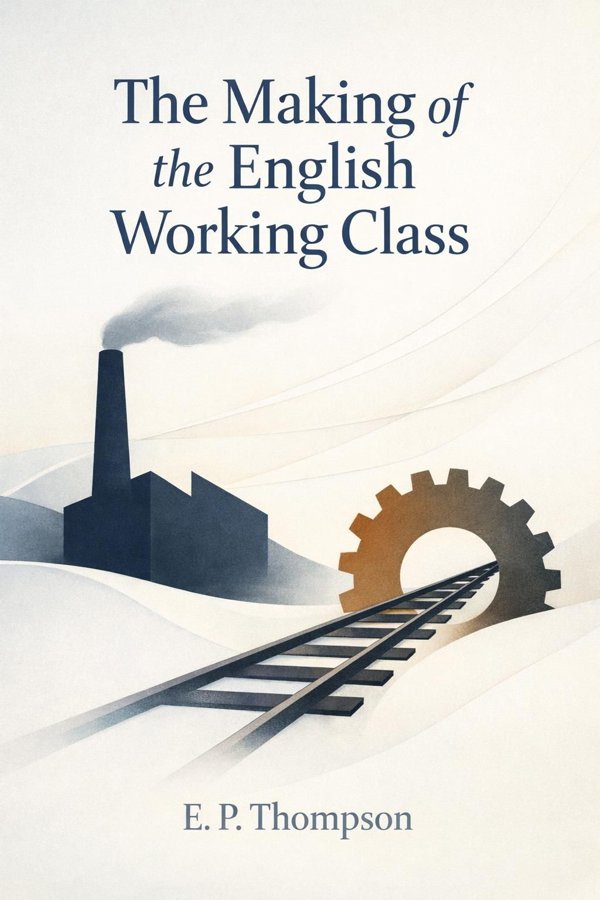
The Making of the English Working Class: Summary & Key Insights
 10 min9 chaptersAudio available
Key Takeaways from The Making of the English Working Class
A class does not appear the moment factories rise; it emerges when people begin to recognize shared experiences and common enemies.
Crowds are rarely irrational when viewed from their own standards of justice.
Belief can be a force of submission, but it can also become a training ground for resistance.
Industrialization was not only an economic transformation; it was an assault on rhythms, customs, and forms of independence that had structured everyday life.
Ideas travel fastest when they give ordinary people a language for grievances they already feel.
What Is The Making of the English Working Class About?
The Making of the English Working Class by E. P. Thompson is a world_history book spanning 11 pages. The Making of the English Working Class is one of the most influential works of modern social history. In this landmark study, E. P. Thompson examines how English working people between roughly 1780 and 1832 came to see themselves as a class with shared interests, grievances, traditions, and political aspirations. Rather than treating workers as passive victims of industrialization, Thompson shows them as active historical agents who resisted exploitation, built organizations, defended customary rights, and created new political cultures. The book ranges across workshops, mills, chapels, taverns, radical clubs, protest movements, and state repression, weaving together economic change with religion, popular customs, and political struggle. Its importance lies in its central claim: class is not simply produced by machines or wages, but formed through lived experience and collective action. Thompson’s authority comes from his extraordinary command of archival sources and his commitment to writing history from below. For anyone seeking to understand industrial capitalism, democratic protest, or the making of modern society, this book remains essential, challenging, and deeply human.
This FizzRead summary covers all 9 key chapters of The Making of the English Working Class in approximately 10 minutes, distilling the most important ideas, arguments, and takeaways from E. P. Thompson's work. Also available as an audio summary and Key Quotes Podcast.
The Making of the English Working Class
The Making of the English Working Class is one of the most influential works of modern social history. In this landmark study, E. P. Thompson examines how English working people between roughly 1780 and 1832 came to see themselves as a class with shared interests, grievances, traditions, and political aspirations. Rather than treating workers as passive victims of industrialization, Thompson shows them as active historical agents who resisted exploitation, built organizations, defended customary rights, and created new political cultures. The book ranges across workshops, mills, chapels, taverns, radical clubs, protest movements, and state repression, weaving together economic change with religion, popular customs, and political struggle. Its importance lies in its central claim: class is not simply produced by machines or wages, but formed through lived experience and collective action. Thompson’s authority comes from his extraordinary command of archival sources and his commitment to writing history from below. For anyone seeking to understand industrial capitalism, democratic protest, or the making of modern society, this book remains essential, challenging, and deeply human.
Who Should Read The Making of the English Working Class?
This book is perfect for anyone interested in world_history and looking to gain actionable insights in a short read. Whether you're a student, professional, or lifelong learner, the key ideas from The Making of the English Working Class by E. P. Thompson will help you think differently.
- ✓Readers who enjoy world_history and want practical takeaways
- ✓Professionals looking to apply new ideas to their work and life
- ✓Anyone who wants the core insights of The Making of the English Working Class in just 10 minutes
Want the full summary?
Get instant access to this book summary and 100K+ more with Fizz Moment.
Get Free SummaryAvailable on App Store • Free to download
Key Chapters
A class does not appear the moment factories rise; it emerges when people begin to recognize shared experiences and common enemies. This is the heart of Thompson’s argument. He rejects the idea that class is a fixed category determined automatically by occupation or income. Instead, class is a historical relationship formed through conflict, memory, and consciousness. Working people became a class not simply because they labored for wages, but because they lived through similar pressures, saw patterns of exploitation, and responded together.
Thompson shows that artisans, laborers, weavers, miners, and factory hands did not start with one ready-made identity. Their lives were shaped by older customs, local loyalties, religious beliefs, and regional traditions. But as enclosure, wage discipline, industrial restructuring, and political exclusion intensified, many of them began to connect their struggles. What mattered was the process through which separate grievances became collective awareness. A bread riot, a campaign for parliamentary reform, or a strike against wage cuts could all help people understand that their troubles were not private accidents but part of a wider social order.
This idea still matters today. Modern workers in delivery platforms, service industries, and precarious freelance jobs may appear fragmented, yet shared conditions can still produce solidarity when people name common problems. Thompson teaches us to look beyond labels and ask how collective identity is built in practice.
Actionable takeaway: When analyzing any social group, do not ask only what position people occupy; ask what shared experiences are teaching them about power, injustice, and common interest.
Crowds are rarely irrational when viewed from their own standards of justice. Thompson’s famous idea of the moral economy explains that pre-industrial and early industrial working people often judged economic life according to customary notions of fairness, obligation, and legitimate price. Food riots, market protests, and attacks on hoarders were not just eruptions of hunger. They were disciplined actions rooted in a belief that communities had rights and that rulers, merchants, and millers had duties.
In this older moral economy, bread was not treated as an ordinary commodity to be bought and sold without regard for social consequences. If grain dealers exported food during scarcity or drove up prices through speculation, crowds might intervene to restore what they believed was a just balance. Thompson insists that these protests were moral and political, not merely desperate. They reflected a collective understanding that the economy was embedded in social responsibility.
The importance of this argument goes beyond eighteenth-century England. It reminds us that markets are always judged against public values, whether the issue is rent, medicine, energy prices, or access to food. Even in modern societies that celebrate free markets, people continue to react strongly when basic necessities seem subject to profiteering.
Thompson helps readers see that economic conflicts often involve competing moral visions, not just supply and demand curves. Protest becomes intelligible once we recover the standards by which ordinary people measured justice.
Actionable takeaway: When evaluating public anger over prices or shortages, look for the moral expectations beneath the protest, because people often resist not only hardship but perceived violations of fairness.
Belief can be a force of submission, but it can also become a training ground for resistance. Thompson pays close attention to Methodism, dissenting Protestant traditions, and wider religious culture because they shaped the mentality of working people in powerful and sometimes contradictory ways. Religion offered consolation, discipline, literacy, fellowship, and moral seriousness. It taught habits of self-examination and endurance, yet it could also give language to dissent and strengthen communities outside elite control.
For many workers, chapel life provided more than spiritual comfort. It created meeting spaces, networks of trust, and traditions of mutual aid. Hymns, sermons, and Bible reading encouraged emotional intensity and ethical reflection. In some settings, this fostered obedience and acceptance of suffering; in others, it nurtured self-respect and independence from established authority. Thompson is especially interested in how religious traditions interacted with radical politics. A person formed by dissenting faith might learn to challenge hierarchy in both church and state.
This complexity is crucial. Thompson never reduces culture to economics. He shows that class formation was also emotional, moral, and intellectual. Religious habits influenced how people understood work, poverty, sin, justice, and community. The same movement could restrain revolt in one moment and prepare disciplined collective action in another.
In contemporary terms, social movements still draw energy from ethical traditions, faith communities, and institutions that build solidarity before overt politics begins. Cultural formation often precedes political organization.
Actionable takeaway: To understand how collective movements grow, study the institutions that shape values and relationships, because political action often depends on moral and communal foundations built over time.
Industrialization was not only an economic transformation; it was an assault on rhythms, customs, and forms of independence that had structured everyday life. Thompson challenges celebratory narratives of progress by showing what workers actually lost as factories, mechanization, and new labor discipline spread. The transition to industrial capitalism involved more than better production methods. It often meant the erosion of customary rights, control over work tempo, household economies, and the social world of artisanship.
For handloom weavers, small producers, and skilled craftsmen, the new order could feel catastrophic. Employers imposed stricter supervision, longer hours, lower bargaining power, and dependence on unstable markets. Time itself changed meaning. Instead of work being organized around task and season, labor was increasingly governed by the clock. Wages replaced older relationships, but often without security or dignity. Thompson emphasizes that many workers resisted not because they hated innovation in itself, but because they recognized how new systems concentrated power and undermined their autonomy.
This is one of the book’s most lasting insights: modernization is never neutral. Gains in productivity may coexist with losses in status, community, and control. That helps explain why people do not always welcome reforms that economists classify as efficient.
The argument resonates strongly in the age of automation, algorithmic management, and precarious labor. Technological change can still weaken workers when introduced without protection, participation, or justice.
Actionable takeaway: When assessing any new economic system or technology, ask not only what output it increases, but whose control, security, and way of life it diminishes in the process.
Ideas travel fastest when they give ordinary people a language for grievances they already feel. Thompson demonstrates how English radicalism drew energy from the American Revolution, the French Revolution, Paineite democracy, and local traditions of dissent. Radical politics did not descend from intellectuals onto passive workers. Rather, it circulated through pamphlets, taverns, debating societies, correspondence networks, and reform associations, where abstract principles became tools for interpreting everyday injustice.
The language of rights, liberty, and representation helped workers connect wage pressure, food prices, legal repression, and exclusion from political power. Jacobin and republican ideas were especially potent because they exposed the link between economic hardship and unrepresentative government. If Parliament served property and privilege, then poverty was not merely unfortunate; it was political. Thompson traces how these ideas spread among artisans and skilled workers who often became key organizers, printers, lecturers, and local leaders.
At the same time, radicalism was dangerous. The British state monitored meetings, prosecuted reformers, and framed dissent as sedition. Yet repression often confirmed the radicals’ belief that existing institutions were designed to silence the poor. Political consciousness deepened when people saw that peaceful demands for reform were met with fear and force.
This dynamic remains recognizable. Movements often grow when people discover a vocabulary that links isolated problems into a common critique of power. Political education matters because it helps transform frustration into coordinated purpose.
Actionable takeaway: If you want to understand or build a movement, pay attention to the ideas, texts, and meeting places that help scattered grievances become a shared political worldview.
When people break machines, they are often making an argument about power. Thompson’s treatment of the Luddites is one of the book’s most important corrective interventions. He rejects the simplistic image of Luddites as backward workers irrationally opposed to technology. Instead, he shows that machine-breaking was frequently a targeted, organized, and intelligible response to employers who used new machinery to cut wages, destroy customary standards, or bypass skilled labor protections.
The key point is that workers were not attacking innovation in the abstract. They were protesting the social relations embedded in its use. In trades where customary regulation had once set expectations around prices, apprenticeship, quality, and skill, employers could use machinery to break old bargains and centralize control. Luddite action, then, was a form of industrial negotiation under conditions where legal and political channels were weak or closed.
Thompson places these protests within a wider pattern of collective action shaped by local codes, leadership structures, and strategic choices. The Luddites often issued warnings, selected specific targets, and operated with community support. Their actions were political because they confronted an emerging system that treated labor as disposable and tradition as obstruction.
This insight is highly relevant in the twenty-first century. Resistance to automation or digital systems is not always fear of progress; it may reflect justified concern over deskilling, surveillance, or lost bargaining power.
Actionable takeaway: Before dismissing resistance to technological change as irrational, examine whether people are objecting to the tool itself or to the unequal power arrangements introduced alongside it.
The first builders of working-class politics were often not the poorest laborers but skilled artisans whose independence was under threat. Thompson gives special attention to shoemakers, printers, tailors, weavers, and other craftsmen because they occupied a crucial social position. They possessed literacy, trade pride, workshop culture, and traditions of debate, yet they increasingly faced insecurity as industrial capitalism advanced. This made them especially receptive to radical politics and collective organization.
Artisans mattered because they could connect thought and action. Their work often required training and self-respect, which encouraged a sense of status that clashed with worsening dependence. Many participated in reading circles, chapel communities, corresponding societies, and reform campaigns. They wrote pamphlets, attended lectures, preserved memories of older rights, and helped define what was being lost under the new order. In Thompson’s account, they became carriers of political language and institutional memory.
This does not mean the working class was simply an artisan creation. Rather, artisans were among the earliest groups able to articulate broader grievances in public form. Their decline made them politically generative. As their traditional world came under pressure, they turned their skills, sociability, and cultural resources toward collective struggle.
The broader lesson is that movements often depend on intermediate groups with enough capacity to organize and enough pressure to radicalize. Social leadership does not always come from the most marginalized alone; it often emerges where threatened status meets communicative ability.
Actionable takeaway: When studying social change, identify which groups possess both organizing resources and a strong sense of loss, because they frequently become the first effective leaders of broader resistance.
States often try to crush dissent, but repression can also teach people who holds power and whose voices count. Thompson traces how measures such as the Combination Acts, prosecutions for sedition, surveillance of reformers, and violent suppression of assembly shaped the making of the working class. When workers were denied legal avenues for association and representation, they learned through experience that the political system defended property more readily than justice.
The Combination Acts made trade union activity illegal, forcing workers to organize under threat. Peterloo in 1819 became a defining moment: peaceful demonstrators demanding reform were met with cavalry violence, turning a local event into a national symbol of class rule. Such episodes mattered not only because they injured or killed people, but because they clarified relationships. Repression exposed the state not as neutral referee but as an active participant in preserving hierarchy.
Thompson’s argument is subtle. Repression did not automatically create solidarity; it could also create fear, fragmentation, and defeat. But when communities remembered injustice collectively, martyrs, trials, and massacres became part of political identity. Working-class institutions, newspapers, unions, and reform campaigns often grew through these shared memories.
This remains a familiar pattern. Attempts to silence organizing can reveal structural bias and strengthen commitment, especially when repression is visible and morally shocking. Public memory can turn defeat into durable consciousness.
Actionable takeaway: To understand how solidarity forms, examine not only victories but also moments of repression, because shared experiences of injustice often become the emotional glue of collective identity.
A class becomes durable when it builds places, habits, and organizations that outlast any single protest. Thompson shows that the English working class did not emerge only through riots, strikes, and moments of crisis. It also took shape through friendly societies, trade unions, reform clubs, reading groups, chapels, newspapers, and educational associations. These institutions transformed fleeting anger into lasting collective capacity.
Such organizations performed practical functions. They offered mutual aid during illness or unemployment, spread political information, preserved networks across towns and trades, and trained people in procedure, debate, and leadership. They also created a social world in which workers could see themselves as part of something larger than the workplace or neighborhood. Institution-building was therefore cultural as much as organizational. It formed habits of cooperation, memory, and discipline.
Thompson’s larger point is that class consciousness requires infrastructure. People do not sustain shared identity on sentiment alone. They need spaces where experiences are interpreted, grievances are discussed, and collective strategies are rehearsed. This helps explain why Chartism and later labor politics could emerge from earlier traditions rather than from nowhere.
The lesson is relevant far beyond nineteenth-century England. Modern movements that rely only on viral attention often fade quickly, while those that create durable membership structures, educational spaces, and mutual support tend to endure. Lasting power grows from organized relationships.
Actionable takeaway: If you want collective action to survive beyond a moment of outrage, invest in institutions that educate, connect, and materially support participants over the long term.
All Chapters in The Making of the English Working Class
About the Author
Edward Palmer Thompson (1924–1993) was a British historian, writer, socialist, and public intellectual whose work transformed the study of class and popular politics. Educated at Cambridge and shaped by wartime service as well as postwar left-wing activism, he became one of the central figures of the British New Left. Thompson is best known for The Making of the English Working Class, a landmark work that pioneered “history from below” by focusing on the experiences, culture, and agency of ordinary people. He also wrote influential studies of William Morris, eighteenth-century law and society, and political dissent. Beyond academia, Thompson was active in peace campaigns and democratic socialist debates. His legacy endures in social history, labor studies, and the wider effort to recover the voices of those often excluded from traditional historical narratives.
Get This Summary in Your Preferred Format
Read or listen to the The Making of the English Working Class summary by E. P. Thompson anytime, anywhere. FizzRead offers multiple formats so you can learn on your terms — all free.
Available formats: App · Audio · PDF · EPUB — All included free with FizzRead
Download The Making of the English Working Class PDF and EPUB Summary
Key Quotes from The Making of the English Working Class
“A class does not appear the moment factories rise; it emerges when people begin to recognize shared experiences and common enemies.”
“Crowds are rarely irrational when viewed from their own standards of justice.”
“Belief can be a force of submission, but it can also become a training ground for resistance.”
“Industrialization was not only an economic transformation; it was an assault on rhythms, customs, and forms of independence that had structured everyday life.”
“Ideas travel fastest when they give ordinary people a language for grievances they already feel.”
Frequently Asked Questions about The Making of the English Working Class
The Making of the English Working Class by E. P. Thompson is a world_history book that explores key ideas across 9 chapters. The Making of the English Working Class is one of the most influential works of modern social history. In this landmark study, E. P. Thompson examines how English working people between roughly 1780 and 1832 came to see themselves as a class with shared interests, grievances, traditions, and political aspirations. Rather than treating workers as passive victims of industrialization, Thompson shows them as active historical agents who resisted exploitation, built organizations, defended customary rights, and created new political cultures. The book ranges across workshops, mills, chapels, taverns, radical clubs, protest movements, and state repression, weaving together economic change with religion, popular customs, and political struggle. Its importance lies in its central claim: class is not simply produced by machines or wages, but formed through lived experience and collective action. Thompson’s authority comes from his extraordinary command of archival sources and his commitment to writing history from below. For anyone seeking to understand industrial capitalism, democratic protest, or the making of modern society, this book remains essential, challenging, and deeply human.
You Might Also Like
The Age of Capital
Eric Hobsbawm
10 min
The Gulag Archipelago
Aleksandr Solzhenitsyn
10 min
Jerusalem: The Biography
Simon Sebag Montefiore
10 min
The Anglo-Saxons
James Campbell
10 min
The Boer War
Thomas Pakenham
10 min
The Industrial Revolutionaries: The Making of the Modern World 1776–1914
Gavin Weightman
10 minBrowse by Category
Ready to read The Making of the English Working Class?
Get the full summary and 100K+ more books with Fizz Moment.