
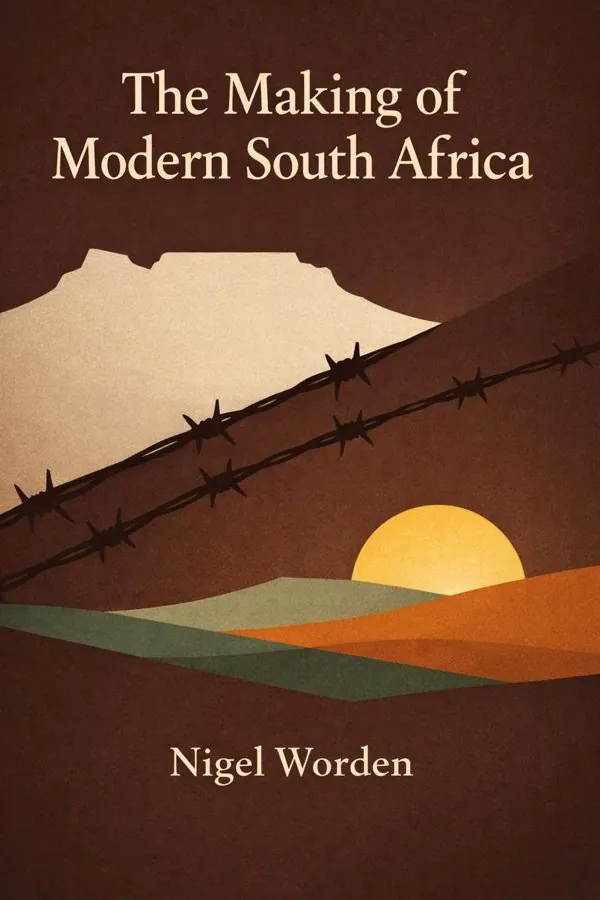
The Making of Modern South Africa: Conquest, Apartheid, Democracy: Summary & Key Insights
by Nigel Worden
 10 min9 chaptersAudio available
Key Takeaways from The Making of Modern South Africa: Conquest, Apartheid, Democracy
Long before Dutch or British settlement, the region was home to diverse societies with different economies, political structures, and cultural practices.
Colonial domination often begins with something that appears limited, commercial, or temporary.
A change of imperial rulers does not necessarily mean a change in the logic of domination.
Economic modernization does not automatically produce social justice; in South Africa, it often did the opposite.
Political unification can hide profound exclusion.
What Is The Making of Modern South Africa: Conquest, Apartheid, Democracy About?
The Making of Modern South Africa: Conquest, Apartheid, Democracy by Nigel Worden is a world_history book spanning 11 pages. Nigel Worden’s The Making of Modern South Africa: Conquest, Apartheid, Democracy is a clear, penetrating history of how South Africa was shaped by conquest, racial domination, economic transformation, and political struggle. Covering the period from precolonial societies to the democratic era, the book shows that modern South Africa did not emerge suddenly in 1994. It was built over centuries through land dispossession, colonial expansion, industrial capitalism, segregation, apartheid, resistance, and negotiation. What makes this book especially valuable is its refusal to treat race, class, labor, and state power as separate stories. Instead, Worden reveals how they interacted to create one of the modern world’s most unequal and politically contested societies. The book matters because South Africa’s history offers more than a national case study: it is a powerful lens on empire, violence, nationalism, memory, and democratic transition. Worden, a distinguished South African historian and professor emeritus at the University of Cape Town, writes with scholarly authority while remaining accessible to general readers, making this an essential introduction to the country’s past and present.
This FizzRead summary covers all 9 key chapters of The Making of Modern South Africa: Conquest, Apartheid, Democracy in approximately 10 minutes, distilling the most important ideas, arguments, and takeaways from Nigel Worden's work. Also available as an audio summary and Key Quotes Podcast.
The Making of Modern South Africa: Conquest, Apartheid, Democracy
Nigel Worden’s The Making of Modern South Africa: Conquest, Apartheid, Democracy is a clear, penetrating history of how South Africa was shaped by conquest, racial domination, economic transformation, and political struggle. Covering the period from precolonial societies to the democratic era, the book shows that modern South Africa did not emerge suddenly in 1994. It was built over centuries through land dispossession, colonial expansion, industrial capitalism, segregation, apartheid, resistance, and negotiation. What makes this book especially valuable is its refusal to treat race, class, labor, and state power as separate stories. Instead, Worden reveals how they interacted to create one of the modern world’s most unequal and politically contested societies. The book matters because South Africa’s history offers more than a national case study: it is a powerful lens on empire, violence, nationalism, memory, and democratic transition. Worden, a distinguished South African historian and professor emeritus at the University of Cape Town, writes with scholarly authority while remaining accessible to general readers, making this an essential introduction to the country’s past and present.
Who Should Read The Making of Modern South Africa: Conquest, Apartheid, Democracy?
This book is perfect for anyone interested in world_history and looking to gain actionable insights in a short read. Whether you're a student, professional, or lifelong learner, the key ideas from The Making of Modern South Africa: Conquest, Apartheid, Democracy by Nigel Worden will help you think differently.
- ✓Readers who enjoy world_history and want practical takeaways
- ✓Professionals looking to apply new ideas to their work and life
- ✓Anyone who wants the core insights of The Making of Modern South Africa: Conquest, Apartheid, Democracy in just 10 minutes
Want the full summary?
Get instant access to this book summary and 100K+ more with Fizz Moment.
Get Free SummaryAvailable on App Store • Free to download
Key Chapters
A country’s history does not begin when Europeans arrive, and one of Nigel Worden’s most important interventions is to restore depth and complexity to South Africa before colonization. Long before Dutch or British settlement, the region was home to diverse societies with different economies, political structures, and cultural practices. San hunter-gatherer communities lived through mobility, ecological knowledge, and flexible social organization. Khoekhoe pastoralists developed systems of herding, exchange, and territorial use. Further east and north, African farming communities built chiefdoms, cultivated crops, raised cattle, traded regionally, and formed political networks that were far from static.
This matters because colonial narratives often portrayed South Africa as an empty or underused land waiting to be developed. Worden shows how false and politically useful that myth was. The land was already inhabited, contested, and meaningfully organized. Communities adapted to drought, migration, conflict, and trade long before colonists imposed new boundaries. Understanding this precolonial complexity helps explain why conquest was so disruptive: colonization did not create society from nothing, but rather violently reshaped existing ones.
A practical way to apply this insight is to question any historical story that begins with outside "discovery." In classrooms, policy debates, or public memory, ask whose history is being treated as the starting point and whose is being erased. In South Africa’s case, modern conflicts over land, belonging, and identity become clearer when seen against these much older histories of settlement and movement.
Actionable takeaway: whenever you study a colonial society, begin by examining the indigenous worlds that existed before conquest, because that is where the deeper historical story starts.
Colonial domination often begins with something that appears limited, commercial, or temporary. Worden shows that the Dutch settlement at the Cape in 1652 was initially intended by the Dutch East India Company as a refreshment station for ships traveling between Europe and Asia. Yet even a small trading post required land, labor, and control. As settlers expanded agriculture and livestock farming, they pressed into territories used by Khoekhoe communities, transforming commercial footholds into systems of dispossession.
This expansion was not inevitable in a simple sense, but it followed a recognizable logic. Settlers needed food supplies, then farms, then workers, then military protection, then legal structures to secure their gains. Slavery became central to the Cape economy, with enslaved people brought from East Africa, Madagascar, India, and Southeast Asia. The colony was therefore shaped not only by European migration but also by forced labor, racial hierarchy, and cultural mixing. The roots of later South African inequality lay partly in this early colonial world.
Worden’s account is useful beyond South Africa because it demonstrates how empires often grow incrementally. A port, a fort, a company charter, or a labor shortage can evolve into a full colonial order. The lesson applies when studying global history, development projects, or modern extractive ventures: control is often justified as practical necessity before it becomes permanent domination.
Readers can use this insight to think more critically about the language of “settlement,” “frontier,” or “development.” Such terms can hide coercion and dispossession. Looking beneath them reveals how power accumulates.
Actionable takeaway: when an institution claims it is only creating limited access or temporary control, examine what forms of land, labor, and authority that control may expand into over time.
A change of imperial rulers does not necessarily mean a change in the logic of domination. When Britain took control of the Cape in the late eighteenth and early nineteenth centuries, South Africa entered a new phase of colonial transformation. Worden explains that British rule introduced administrative reforms, new legal frameworks, and stronger imperial integration, but it also intensified conflict over land, labor, and sovereignty. The abolition of slavery in the 1830s changed labor relations without ending inequality, and many settlers sought to preserve racial and economic control through other means.
British expansion generated wars along the eastern frontier and transformed relations with African polities. At the same time, the Great Trek carried Boer communities inland, where they established republics and confronted African societies already occupying and organizing those regions. This produced not a simple conflict between British and Boer interests, but a wider contest involving African kingdoms, settler republics, imperial forces, and labor-hungry colonial economies.
Worden helps readers see that state formation in South Africa was forged through overlapping sovereignties and repeated violence. British colonialism was not merely a civilizing project or a bureaucratic adjustment. It reordered power and territory while embedding race more deeply in law and governance. For modern readers, this is a reminder that liberal language and coercive practice often coexist. Reform from above can expand rights for some while tightening control over others.
In practical terms, this chapter encourages readers to examine who benefits from legal reform and who remains excluded. A system can appear more modern and more humane while still preserving structural domination.
Actionable takeaway: do not judge a political transition only by its new institutions; ask how power over land, labor, and mobility is actually redistributed.
Economic modernization does not automatically produce social justice; in South Africa, it often did the opposite. The discovery of diamonds in Kimberley and gold on the Witwatersrand transformed the region in the late nineteenth century. Worden shows that industrialization created enormous demand for labor, capital, transport, and state coordination. Mines required a disciplined, cheap, and controllable workforce, and this economic imperative pushed racial segregation into more organized and far-reaching forms.
African workers were drawn, pressured, and sometimes coerced into labor migration systems that separated them from land and family life. Pass laws, compound systems, taxation, and restrictions on movement helped mine owners and the state regulate labor supply. White workers, meanwhile, often sought protection through job color bars and political mobilization. Industrial capitalism therefore did not weaken racial hierarchy. It reengineered it to suit new economic needs.
This is one of the book’s most powerful arguments: segregation was not simply a set of prejudices floating above society. It was tied to material interests. Race was used to structure wages, residence, education, and political rights in ways that served both state builders and industrial employers. Understanding this connection helps explain why inequality proved so durable.
This insight can be applied broadly when assessing modern economies. Ask how labor markets are organized, who bears the cost of mobility, and which groups are excluded from full citizenship while remaining economically essential. Economic growth can coexist with highly unequal systems of control.
Actionable takeaway: whenever a society celebrates development or industrial expansion, look closely at who performs the labor, under what conditions, and which legal mechanisms keep that workforce subordinate.
Political unification can hide profound exclusion. The formation of the Union of South Africa in 1910 is often presented as a milestone in state building, but Worden makes clear that it was a union designed primarily to reconcile white political interests after the South African War, not to create an inclusive nation. British colonies and former Boer republics were brought together under one state, yet the Black majority was largely excluded from meaningful political power.
This constitutional settlement institutionalized white supremacy at the national level. While there were regional variations in franchise arrangements, the broad direction was unmistakable: political rights were narrowed, African land ownership was restricted, and racial segregation became more deeply embedded in policy. Measures such as the 1913 Natives Land Act were especially significant, confining African landholding to limited reserves and pushing many into wage labor. The result was a state that tied territorial dispossession to political exclusion.
Worden’s treatment helps readers understand that the nation-state is never neutral by default. Who is included in its founding bargain matters enormously. South Africa’s Union created administrative coherence for whites while intensifying fragmentation and dependency for Black South Africans. This shaped later struggles for representation, citizenship, and land justice.
In present-day terms, the lesson is relevant whenever constitutions, peace deals, or elite settlements are celebrated as national breakthroughs. We should ask whether they broaden democracy or simply stabilize power among dominant groups. A state can be formally unified while socially divided and morally compromised.
Actionable takeaway: when evaluating any political settlement, identify whose interests were reconciled, whose rights were deferred, and which inequalities were built into the new order from the start.
Apartheid was not merely an attitude of racial prejudice; it was a highly organized political project. Worden shows that after the National Party came to power in 1948, segregation was sharpened, codified, and expanded into a comprehensive system of rule. Apartheid classified people by race, regulated where they could live, whom they could marry, what education they could receive, and what political rights they could claim. Through laws governing population registration, group areas, pass controls, and separate development, the state sought to remake society along rigid racial lines.
The ideology behind apartheid claimed that different racial groups should develop separately, but this was deeply deceptive. In reality, Black South Africans were denied equal citizenship while still being used as labor in mines, farms, factories, and households. The so-called homelands or Bantustans were presented as autonomous ethnic territories, yet they functioned largely as instruments for denying political rights and offloading social costs. Apartheid depended on bureaucracy, policing, propaganda, and planning as much as on open violence.
Worden’s analysis reminds us that injustice often operates through paperwork as well as force. Classification systems, zoning laws, and educational policy can become tools of domination when backed by state power. This makes apartheid an essential case study in how modern governments can use administrative efficiency in profoundly immoral ways.
Readers can apply this lesson by becoming more alert to how official categories shape real life. Seemingly technical policies can determine access to housing, schooling, mobility, and dignity.
Actionable takeaway: whenever a government presents unequal treatment as orderly administration or cultural protection, examine whether the policy is actually preserving hierarchy under the language of management.
Oppression rarely goes uncontested, and one of the strengths of Worden’s book is that it treats resistance as varied, evolving, and deeply rooted. South African opposition to segregation and apartheid did not come from a single organization or ideology. It emerged through African political movements, labor struggles, rural revolts, women’s protests, community organizing, church activism, student mobilization, and armed resistance. The African National Congress, Pan Africanist Congress, trade unions, civic groups, and many local formations all played roles at different moments.
Worden emphasizes that resistance changed as conditions changed. Earlier petitions and constitutional appeals gave way, in some contexts, to mass protest and later to underground organization and international solidarity campaigns. The Sharpeville massacre in 1960 and the Soweto uprising in 1976 became turning points, exposing both the brutality of the state and the resilience of those who opposed it. Repression was severe, including banning orders, detentions, torture, censorship, and exile, but the state never fully extinguished dissent.
This history matters because it challenges simplified stories of liberation. Major political transitions are usually the product of many overlapping pressures, not one heroic act. It also shows that resistance depends on organization, memory, and the ability to adapt strategically.
For readers today, the practical lesson is that meaningful social change often requires alliances across class, generation, geography, and ideology. Symbolic outrage alone is not enough; durable movements need institutions, leadership, and tactics suited to changing realities.
Actionable takeaway: if you want to understand or support a movement for justice, study not only its ideals but also the networks, strategies, and sacrifices that sustain it over time.
Systems that appear immovable can weaken from several directions at once. Worden explains that apartheid entered deep crisis in the 1970s and 1980s because its political logic and economic foundations were increasingly unstable. Urbanization, labor unrest, international sanctions, armed conflict in the region, township uprisings, and mounting global condemnation all placed the regime under pressure. At the same time, the economy required a more skilled and stable Black workforce than classic apartheid structures had allowed. The state faced a growing contradiction between racial control and economic adaptation.
The government tried to manage this crisis through limited reforms, repression, and emergency powers. Yet these measures did not restore legitimacy. Instead, they revealed that apartheid could neither fully modernize nor maintain old forms of domination without escalating violence and isolation. Mass democratic movements inside South Africa, together with external solidarity and diplomatic pressure, made the system more costly to sustain.
Worden’s account is especially helpful because it avoids overly neat explanations. Apartheid did not fall because one side suddenly became moral or because one event changed everything. It unraveled through cumulative strain, strategic resistance, and hard political calculation. The lesson is relevant for understanding other authoritarian systems: collapse often comes when ruling structures can no longer align coercion, ideology, and economic viability.
This perspective encourages readers to think in systems rather than headlines. Social orders endure when institutions, incentives, and beliefs reinforce one another; they weaken when those connections break down.
Actionable takeaway: when analyzing a powerful regime, look for the points where economic pressures, political legitimacy, and organized resistance begin to pull it apart simultaneously.
The end of apartheid was a historic victory, but Worden insists that political liberation did not erase the burdens of history. The negotiations that led to the 1994 democratic transition produced a new constitutional order built on universal citizenship, human rights, and electoral legitimacy. This was an extraordinary achievement in a society long structured by legalized racism. Yet the democratic state inherited entrenched inequalities in land ownership, wealth distribution, education, housing, and employment.
Worden shows that post-apartheid South Africa must be understood through both hope and constraint. The transition avoided large-scale civil war, created representative institutions, and transformed the legal basis of the state. But democratization did not automatically resolve poverty or dismantle the economic legacies of colonialism and apartheid. Expectations were immense, while state capacity, fiscal limits, and global economic pressures shaped what could be done. The result was a democracy marked by real political freedom alongside persistent social injustice.
This final perspective is one of the book’s most sobering and useful contributions. It reminds readers that ending formal oppression is not the same as building substantive equality. Constitutions matter, elections matter, and rights matter, but they must be matched by long-term transformation in everyday life.
The lesson can be applied to any post-conflict or post-authoritarian society. Celebrate political breakthroughs, but do not confuse them with completed justice. Historical damage accumulates over centuries and cannot be reversed overnight.
Actionable takeaway: evaluate democracy not only by whether people can vote, but also by whether they gain meaningful access to land, education, safety, opportunity, and dignity.
All Chapters in The Making of Modern South Africa: Conquest, Apartheid, Democracy
About the Author
Nigel Worden is a South African historian and professor emeritus at the University of Cape Town. He is widely recognized for his scholarship on the Cape Colony, slavery, colonial society, and the historical roots of apartheid and inequality in South Africa. Over the course of his academic career, he has written and taught extensively on how political power, labor systems, race, and social change shaped the country’s development. Worden is especially respected for making complex historical debates accessible to students and general readers without sacrificing analytical depth. His work often bridges social, economic, and political history, which is why The Making of Modern South Africa has become a widely used introduction to the subject. He remains an important voice in the study of South African history.
Get This Summary in Your Preferred Format
Read or listen to the The Making of Modern South Africa: Conquest, Apartheid, Democracy summary by Nigel Worden anytime, anywhere. FizzRead offers multiple formats so you can learn on your terms — all free.
Available formats: App · Audio · PDF · EPUB — All included free with FizzRead
Download The Making of Modern South Africa: Conquest, Apartheid, Democracy PDF and EPUB Summary
Key Quotes from The Making of Modern South Africa: Conquest, Apartheid, Democracy
“A country’s history does not begin when Europeans arrive, and one of Nigel Worden’s most important interventions is to restore depth and complexity to South Africa before colonization.”
“Colonial domination often begins with something that appears limited, commercial, or temporary.”
“A change of imperial rulers does not necessarily mean a change in the logic of domination.”
“Economic modernization does not automatically produce social justice; in South Africa, it often did the opposite.”
“Political unification can hide profound exclusion.”
Frequently Asked Questions about The Making of Modern South Africa: Conquest, Apartheid, Democracy
The Making of Modern South Africa: Conquest, Apartheid, Democracy by Nigel Worden is a world_history book that explores key ideas across 9 chapters. Nigel Worden’s The Making of Modern South Africa: Conquest, Apartheid, Democracy is a clear, penetrating history of how South Africa was shaped by conquest, racial domination, economic transformation, and political struggle. Covering the period from precolonial societies to the democratic era, the book shows that modern South Africa did not emerge suddenly in 1994. It was built over centuries through land dispossession, colonial expansion, industrial capitalism, segregation, apartheid, resistance, and negotiation. What makes this book especially valuable is its refusal to treat race, class, labor, and state power as separate stories. Instead, Worden reveals how they interacted to create one of the modern world’s most unequal and politically contested societies. The book matters because South Africa’s history offers more than a national case study: it is a powerful lens on empire, violence, nationalism, memory, and democratic transition. Worden, a distinguished South African historian and professor emeritus at the University of Cape Town, writes with scholarly authority while remaining accessible to general readers, making this an essential introduction to the country’s past and present.
You Might Also Like
The Age of Capital
Eric Hobsbawm
10 min
The Gulag Archipelago
Aleksandr Solzhenitsyn
10 min
Jerusalem: The Biography
Simon Sebag Montefiore
10 min
The Anglo-Saxons
James Campbell
10 min
The Boer War
Thomas Pakenham
10 min
The Industrial Revolutionaries: The Making of the Modern World 1776–1914
Gavin Weightman
10 minBrowse by Category
Ready to read The Making of Modern South Africa: Conquest, Apartheid, Democracy?
Get the full summary and 100K+ more books with Fizz Moment.