
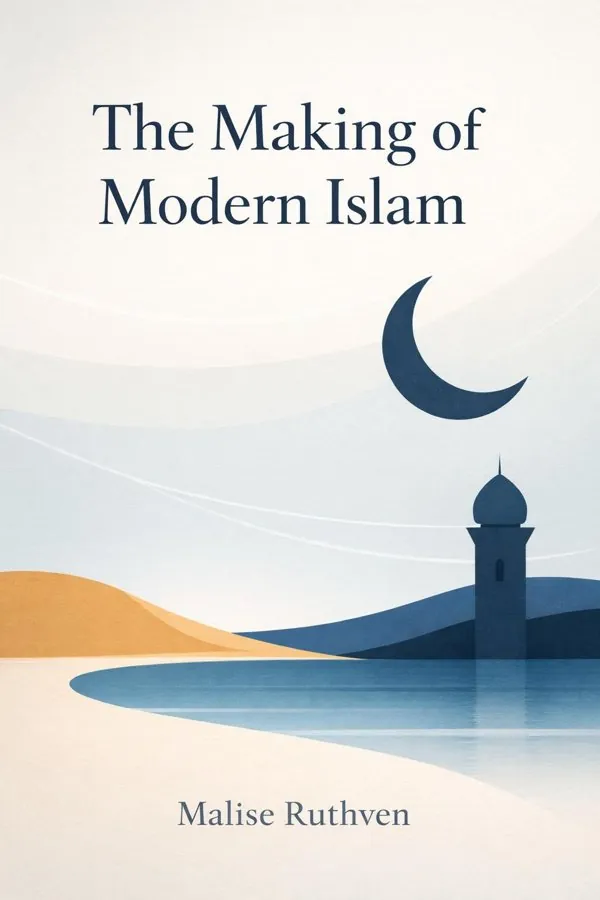
The Making Of Modern Islam: Various Essays: Summary & Key Insights
 10 min10 chaptersAudio available
Key Takeaways from The Making Of Modern Islam: Various Essays
Every modern argument inside Islam carries the echo of an older question: who has the authority to interpret revelation in changing circumstances?
Colonialism did more than conquer territory; it altered the intellectual and political grammar through which Muslim societies understood themselves.
One of Ruthven’s most useful insights is that reform and revival often emerge from the same sense of crisis.
Modern nationalism forced Muslims to ask a difficult question: is political loyalty owed primarily to the religious community or to the territorial nation-state?
A faith tradition changes when the state takes charge of defining, regulating, or instrumentalizing it.
What Is The Making Of Modern Islam: Various Essays About?
The Making Of Modern Islam: Various Essays by Malise Ruthven is a civilization book spanning 11 pages. The Making Of Modern Islam: Various Essays is Malise Ruthven’s thoughtful exploration of how Islam became one of the central forces in modern global history. Rather than treating Islam as a fixed creed or a monolithic civilization, Ruthven presents it as a dynamic tradition shaped by revelation, empire, intellectual debate, colonial disruption, nationalism, and the pressures of modern statehood. Across these essays, he traces how Muslim societies have wrestled with questions that remain urgent today: How should faith relate to politics? What happens when inherited traditions confront secular institutions, capitalism, and global media? And why do reform, revival, and conflict so often emerge together? What makes this book especially valuable is Ruthven’s ability to combine historical depth with contemporary relevance. He does not reduce modern Islam to extremism, nor does he romanticize the past. Instead, he maps the competing visions that have shaped Muslim responses to modernity, from reformist scholarship to Islamist activism and diasporic identity. As a respected British writer and scholar of religion and the Middle East, Ruthven brings nuance, balance, and wide-ranging knowledge to a subject too often discussed in slogans.
This FizzRead summary covers all 10 key chapters of The Making Of Modern Islam: Various Essays in approximately 10 minutes, distilling the most important ideas, arguments, and takeaways from Malise Ruthven's work. Also available as an audio summary and Key Quotes Podcast.
The Making Of Modern Islam: Various Essays
The Making Of Modern Islam: Various Essays is Malise Ruthven’s thoughtful exploration of how Islam became one of the central forces in modern global history. Rather than treating Islam as a fixed creed or a monolithic civilization, Ruthven presents it as a dynamic tradition shaped by revelation, empire, intellectual debate, colonial disruption, nationalism, and the pressures of modern statehood. Across these essays, he traces how Muslim societies have wrestled with questions that remain urgent today: How should faith relate to politics? What happens when inherited traditions confront secular institutions, capitalism, and global media? And why do reform, revival, and conflict so often emerge together?
What makes this book especially valuable is Ruthven’s ability to combine historical depth with contemporary relevance. He does not reduce modern Islam to extremism, nor does he romanticize the past. Instead, he maps the competing visions that have shaped Muslim responses to modernity, from reformist scholarship to Islamist activism and diasporic identity. As a respected British writer and scholar of religion and the Middle East, Ruthven brings nuance, balance, and wide-ranging knowledge to a subject too often discussed in slogans.
Who Should Read The Making Of Modern Islam: Various Essays?
This book is perfect for anyone interested in civilization and looking to gain actionable insights in a short read. Whether you're a student, professional, or lifelong learner, the key ideas from The Making Of Modern Islam: Various Essays by Malise Ruthven will help you think differently.
- ✓Readers who enjoy civilization and want practical takeaways
- ✓Professionals looking to apply new ideas to their work and life
- ✓Anyone who wants the core insights of The Making Of Modern Islam: Various Essays in just 10 minutes
Want the full summary?
Get instant access to this book summary and 100K+ more with Fizz Moment.
Get Free SummaryAvailable on App Store • Free to download
Key Chapters
Every modern argument inside Islam carries the echo of an older question: who has the authority to interpret revelation in changing circumstances? Ruthven begins from the premise that modern Islam cannot be understood without returning to its formative centuries. Islam emerged in seventh-century Arabia not simply as a spiritual creed, but as a moral, legal, and communal order. The Qur’an offered revelation, but Muslim civilization also developed interpretive traditions through jurisprudence, theology, and political practice. Over time, scholars, rulers, mystics, and merchants all helped define what it meant to live Islamically.
This historical background matters because many contemporary conflicts are really disputes over continuity and change. Debates about democracy, women’s rights, Islamic law, and the legitimacy of modern states are not new in substance; they are newer versions of old tensions between text and interpretation, power and piety, stability and reform. For example, when modern reformers call for ijtihad, or renewed independent reasoning, they are appealing to resources from within Islamic tradition, not importing a purely foreign model. Likewise, when conservatives defend inherited schools of law, they are preserving structures that once protected communal continuity.
A practical application of this insight is to stop reading Muslim societies only through today’s headlines. Questions about sectarianism, legal reform, or religious authority become clearer when seen against the long development of Sunni and Shi‘i institutions, caliphal politics, and scholarly consensus. Ruthven shows that modern Islam is not a break from history but a continuation of argument within history.
Actionable takeaway: whenever you encounter a contemporary controversy in Islam, ask what earlier theological, legal, or political tradition it is extending, resisting, or reinterpreting.
Colonialism did more than conquer territory; it altered the intellectual and political grammar through which Muslim societies understood themselves. Ruthven emphasizes that European imperial expansion disrupted long-standing balances between rulers, scholars, merchants, and religious institutions. Colonial powers often weakened local economies, imposed new legal systems, redrew borders, and privileged administrative rationality over inherited authority. As a result, Muslim communities faced not only foreign domination but a crisis of legitimacy in their own institutions.
This helps explain why anti-colonial struggle and religious revival became so closely linked. When British, French, Dutch, and Russian imperial systems encroached on Muslim lands, they did not simply defeat armies; they delegitimized old elites and recast knowledge itself. Western science, bureaucracy, and education came to appear both powerful and threatening. In places such as Egypt, India, Algeria, and the Ottoman domains, Muslim intellectuals had to decide whether to imitate, resist, or selectively adopt European models. Some embraced reform in education and law. Others saw that accommodation risked surrendering cultural sovereignty.
The effects remain visible today. Many postcolonial states inherited centralizing institutions, arbitrary borders, and secular legal codes layered unevenly over religious traditions. These structures often created tension between official modernity and popular religious identity. Current debates over sharia, constitutional identity, and national authenticity often make little sense unless one sees them as responses to colonial reshaping.
In practical terms, Ruthven encourages readers to avoid simplistic explanations that blame all present problems either on Islam itself or solely on the West. Colonialism was neither the whole story nor a minor episode; it was a transformative encounter that accelerated internal debate and politicized religious identity.
Actionable takeaway: when studying any modern Muslim society, look closely at its colonial history, because institutions, borders, and cultural anxieties often originate there.
One of Ruthven’s most useful insights is that reform and revival often emerge from the same sense of crisis. When Muslim thinkers perceive decline, foreign domination, or moral drift, they do not all move in a single direction. Some call for purification, arguing that Muslims must return to the Qur’an and the example of the Prophet. Others call for reinterpretation, insisting that Islam contains the flexibility needed to meet modern conditions. In practice, these tendencies frequently overlap.
Reformist figures such as Jamal al-Din al-Afghani and Muhammad Abduh believed Muslim societies could recover strength by reconnecting reason, ethics, and revelation. They did not necessarily reject modern science or institutions; instead, they sought an Islamic basis for engaging them. Revivalist movements, by contrast, often stressed doctrinal clarity, moral discipline, and opposition to innovations they considered corrupting. Yet revival itself could be modern in style, using print culture, organization, and mass education to reshape religious life.
Ruthven shows that these efforts should not be reduced to “moderate” versus “extreme.” Both reformists and revivalists are trying to answer the same fundamental question: how can Muslims remain faithful while confronting a transformed world? Consider practical examples. A reformist school may revise curricula to include modern subjects alongside Islamic studies. A revivalist movement may mobilize charity networks, stricter ritual observance, and grassroots preaching to rebuild communal identity. Both are responses to fragmentation and uncertainty.
For readers today, this distinction matters because media narratives often portray Islamic movements as irrational reactions to modernity. Ruthven instead reveals them as structured, often intellectually serious attempts to negotiate modern change from within tradition.
Actionable takeaway: when evaluating an Islamic movement, ask not only what it rejects, but what social problem it believes it is solving and what vision of renewal it offers.
Modern nationalism forced Muslims to ask a difficult question: is political loyalty owed primarily to the religious community or to the territorial nation-state? Ruthven explains that premodern Islam imagined belonging differently from modern nationalism. Muslims certainly lived under dynasties, empires, and local loyalties, but the idea of a sovereign nation defined by borders, citizenship, and mass political identity was largely imported through the modern era. As Ottoman structures weakened and colonial powers expanded, nationalism became a powerful organizing idea from Egypt to Turkey to South Asia.
This shift had enormous consequences. Nationalism could mobilize anti-colonial resistance and provide a language of self-determination, but it also fragmented the broader sense of Muslim unity. Arab nationalism, Turkish republicanism, Pakistani nationhood, and Iranian state identity each proposed different ways of relating Islam to modern political belonging. In some contexts, religion was subordinated to national modernization; in others, Islam became a core marker of national authenticity.
A practical example is the contrast between secular nationalist projects and religiously inflected ones. Kemalist Turkey aimed to create a modern nation by placing religion under state control and privileging secular citizenship. Pakistan, by contrast, was founded in part on Muslim political distinction, yet still struggled to define how Islamic principles should structure governance. These examples show that nationalism does not eliminate religion; it recasts it.
Ruthven’s broader point is that identity in the modern Muslim world is layered rather than singular. People may be simultaneously Muslim, Arab, Turkish, Indonesian, British, or French, and tensions arise when these identities are politicized against each other.
Actionable takeaway: when thinking about politics in Muslim societies, treat religion and nationalism as interacting frameworks, not as separate or mutually exclusive forces.
A faith tradition changes when the state takes charge of defining, regulating, or instrumentalizing it. Ruthven pays close attention to the modern state because it transformed not just politics but religion itself. In many Muslim societies, rulers once shared authority with jurists, local notables, endowments, and autonomous educational institutions. The modern centralized state, however, absorbed functions previously dispersed across society. It took control of law, schooling, taxation, religious endowments, and public morality. In doing so, it redefined what counted as official Islam.
This matters because many current disputes are less about abstract theology than about who governs religion. Ministries of religion, state-appointed clerics, codified family law, and state surveillance of mosques all create a new environment in which faith is bureaucratically managed. Some governments deploy Islam to legitimize rule, presenting themselves as guardians of authentic religion. Others try to privatize or contain Islam, especially where secular nationalism dominates. In both cases, the state is not neutral.
Examples abound. In Egypt, state institutions sought to supervise religious discourse while opposition movements claimed greater authenticity. In Saudi Arabia, political authority historically relied on a particular religious alliance. In Iran after 1979, religious authority itself became foundational to the state. Each model produces different tensions among piety, dissent, and legitimacy.
Ruthven helps readers see that “Islam and the state” is not a single issue but a spectrum of arrangements. Whether religion is co-opted, marginalized, or constitutionalized, its meaning changes when filtered through modern institutions.
Actionable takeaway: to understand religion in public life, examine who funds clerics, controls education, enforces law, and defines orthodoxy; these institutional details often matter more than ideology alone.
Modernization is often presented as a neutral process of progress, but Ruthven shows that in Muslim societies it frequently arrived as a culturally loaded project. Railways, schools, legal codes, bureaucracies, and military reforms did not simply improve efficiency; they also carried assumptions about authority, gender, rationality, and the public role of religion. Secularism, meanwhile, was never one universal formula. It could mean the separation of mosque and state, state control of religion, or the marginalization of religious language from public life.
These shifts generated deep ambivalence. Many Muslims welcomed scientific advancement, literacy, medicine, and administrative reform. Yet modernization often appeared tied to Western dominance and elite imitation. This produced a recurring split between urban reformers who embraced secular tools and populations who experienced such reforms as an assault on inherited norms. The result was not a clean transition from tradition to modernity, but a contested hybrid landscape.
A practical example is family law and education. Expanding female education could create greater opportunity while also provoking resistance if linked to broader fears about moral dislocation. Likewise, codified legal systems might promise equal administration but weaken local juristic traditions that had once mediated social life. Ruthven’s point is not that modernization failed, but that it always involved trade-offs and unequal power.
For contemporary readers, this helps explain why secularism in many Muslim-majority societies remains emotionally charged. It is not merely a philosophical principle; it is bound up with memory, class, legitimacy, and historical humiliation.
Actionable takeaway: when assessing modernization debates, distinguish between practical reforms people may support and the ideological packages that make those reforms feel either emancipatory or alienating.
Islamism is best understood not as a sudden eruption of fanaticism but as a modern political response to failed secular promises. Ruthven treats Islamist movements seriously as products of their historical context. Many arose where nationalism, socialism, monarchy, or military rule failed to deliver justice, dignity, or participation. In such settings, Islamism offered more than slogans. It proposed a moral vocabulary, a social network, and an alternative basis for legitimacy.
This explains why Islamist movements have taken many forms. Some focus on gradual social reform through preaching, welfare, education, and electoral politics. Others become revolutionary, believing corrupt regimes can be changed only through confrontation. Their common claim is that Islam should shape public order, not merely private devotion. Yet Ruthven also highlights the internal diversity and contradictions of Islamism. A movement that promises justice may become authoritarian once in power. A call for authenticity may overlook pluralism within the Muslim tradition itself.
Consider the practical appeal of Islamist organizations in places where the state is absent or distrusted. A group that runs clinics, schools, and charities can gain credibility long before it wins elections. At the same time, a rhetoric of purity can intensify polarization by casting political opponents as enemies of religion. Ruthven’s analysis helps readers move beyond stereotypes by asking why these movements attract followers and how their moral language functions.
The key lesson is that political Islam is not an aberration outside modern history. It is one of the ways modern Muslims have tried to reconnect governance, ethics, and communal belonging under conditions of crisis.
Actionable takeaway: to understand Islamist movements, examine the social grievances, governance failures, and moral aspirations that make their message persuasive.
Globalization does not dissolve religion; it often amplifies it by multiplying the ways believers imagine community. Ruthven notes that modern Islam has been reshaped by print, broadcasting, migration, and digital media. Earlier religious authority depended heavily on local scholars, institutions, and face-to-face transmission. But new media technologies allow ideas, fatwas, sermons, grievances, and symbols to circulate instantly across borders. A crisis in one country can become a shared emotional event for Muslims elsewhere.
This new environment has democratized access to religious discourse while also fragmenting authority. Satellite television preachers, online activists, transnational charities, and social media influencers compete with traditional scholars. This can empower ordinary believers, especially younger generations seeking answers beyond local structures. But it can also produce confusion, superficial certainty, and the rapid spread of polemics. Global media reward dramatic narratives, and religion often gets compressed into identity performance or outrage.
Practical examples are everywhere. A student in London can follow a scholar in Cairo, a movement in Istanbul, and a debate in Jakarta all in the same day. Diasporic Muslims build transnational solidarities around Palestine, Kashmir, or anti-Islamophobia campaigns. At the same time, algorithmic media can intensify sectarian or ideological echo chambers. Ruthven’s insight is that modern Islamic consciousness is no longer primarily national or local; it is increasingly networked.
This affects politics, theology, and everyday religious life. It changes how people learn, whom they trust, and how they imagine the global ummah. Yet increased connection does not automatically create unity; it can generate competition among rival visions of Islam.
Actionable takeaway: be critical about where religious and political information comes from, and balance global voices with grounded local knowledge and credible scholarship.
Few issues expose the struggle over modern Islam more clearly than gender. Ruthven treats debates about women, family, sexuality, and public roles not as peripheral controversies but as central battlegrounds where societies negotiate authority, morality, and identity. Questions about veiling, education, marriage, inheritance, and work become symbols of much larger disputes: who interprets religion, what counts as progress, and how communities defend themselves against cultural domination.
What makes these debates so charged is that both reformers and traditionalists often claim to be protecting dignity. Reform-minded Muslims may argue that justice within Islam requires rethinking patriarchal interpretations and recovering ethical principles of equality and consultation. More conservative voices may respond that rapid gender reform imports Western assumptions and destabilizes family structures. Ruthven shows that neither side operates in a vacuum. Colonial regimes often used the language of women’s liberation to portray Muslim societies as backward, which made gender reform politically suspect even when internal critics raised it sincerely.
Real-world applications of this insight can be seen in legal reform and education policy. Expanding women’s literacy and professional participation can transform economic life and public debate, yet family law often remains a site of fierce contestation because it symbolizes the moral core of the community. Likewise, religiously grounded feminist readings of scripture seek change from within the tradition rather than through external rejection.
Ruthven’s broader contribution is to show that gender in modern Islam is not a simple clash between religion and freedom. It is a multidimensional argument about authenticity, justice, and social order.
Actionable takeaway: approach gender debates in Muslim contexts with historical sensitivity, and ask whose interests are served by each interpretation of religion, law, and custom.
When Islam becomes part of Western public life, it changes both Muslim identity and the societies in which Muslims live. Ruthven explores Islam in the West not as a marginal afterthought, but as a major chapter in modern Islamic development. Migration, exile, education, and globalization have created Muslim communities across Europe and North America whose experiences differ sharply from those of majority-Muslim societies. Here, Islam must often function without inherited state backing, dominant culture, or unquestioned social authority.
This situation produces both challenge and creativity. Muslims in Western settings confront Islamophobia, integration debates, generational divides, and pressure to define themselves in public. But they also develop new forms of religious organization, interfaith engagement, legal adaptation, and civic participation. Questions that may have been settled by custom elsewhere must be actively debated: how should Islamic law operate in secular democracies? What institutions can train credible local leadership? How can believers preserve faith while fully belonging as citizens?
Practical examples include mosque-building controversies, halal regulation, Islamic schools, chaplaincy, and Muslim participation in democratic politics. Second-generation Muslims often reinterpret inherited identities through the language of rights, ethics, and pluralism. Women and young professionals may claim greater voice in community institutions than they would have had in more traditional settings. In this sense, Islam in the West is not merely transplanted; it is being remade.
Ruthven suggests that these developments matter globally. Diasporic Muslims often influence debates in their countries of origin and contribute to new theological conversations about minority citizenship, pluralism, and modern ethics.
Actionable takeaway: see Western Muslim communities not only through the lens of conflict, but as laboratories where new forms of Islamic thought and practice are emerging.
All Chapters in The Making Of Modern Islam: Various Essays
About the Author
Malise Ruthven is a British writer, journalist, and scholar best known for his work on religion, Islam, and the modern Middle East. Educated at Cambridge, he has written extensively for major publications and has built a reputation for explaining complex religious and political subjects with clarity and balance. Ruthven’s books and essays often focus on how faith traditions interact with power, modernity, and historical change. He is especially respected for approaching Islam with nuance, resisting both romantic simplification and sensationalist caricature. Drawing on historical insight, field knowledge, and a strong comparative perspective, Ruthven has become an important voice for readers seeking a deeper understanding of contemporary Islamic thought, politics, and culture.
Get This Summary in Your Preferred Format
Read or listen to the The Making Of Modern Islam: Various Essays summary by Malise Ruthven anytime, anywhere. FizzRead offers multiple formats so you can learn on your terms — all free.
Available formats: App · Audio · PDF · EPUB — All included free with FizzRead
Download The Making Of Modern Islam: Various Essays PDF and EPUB Summary
Key Quotes from The Making Of Modern Islam: Various Essays
“Every modern argument inside Islam carries the echo of an older question: who has the authority to interpret revelation in changing circumstances?”
“Colonialism did more than conquer territory; it altered the intellectual and political grammar through which Muslim societies understood themselves.”
“One of Ruthven’s most useful insights is that reform and revival often emerge from the same sense of crisis.”
“Modern nationalism forced Muslims to ask a difficult question: is political loyalty owed primarily to the religious community or to the territorial nation-state?”
“A faith tradition changes when the state takes charge of defining, regulating, or instrumentalizing it.”
Frequently Asked Questions about The Making Of Modern Islam: Various Essays
The Making Of Modern Islam: Various Essays by Malise Ruthven is a civilization book that explores key ideas across 10 chapters. The Making Of Modern Islam: Various Essays is Malise Ruthven’s thoughtful exploration of how Islam became one of the central forces in modern global history. Rather than treating Islam as a fixed creed or a monolithic civilization, Ruthven presents it as a dynamic tradition shaped by revelation, empire, intellectual debate, colonial disruption, nationalism, and the pressures of modern statehood. Across these essays, he traces how Muslim societies have wrestled with questions that remain urgent today: How should faith relate to politics? What happens when inherited traditions confront secular institutions, capitalism, and global media? And why do reform, revival, and conflict so often emerge together? What makes this book especially valuable is Ruthven’s ability to combine historical depth with contemporary relevance. He does not reduce modern Islam to extremism, nor does he romanticize the past. Instead, he maps the competing visions that have shaped Muslim responses to modernity, from reformist scholarship to Islamist activism and diasporic identity. As a respected British writer and scholar of religion and the Middle East, Ruthven brings nuance, balance, and wide-ranging knowledge to a subject too often discussed in slogans.
You Might Also Like
The Structure of Scientific Revolutions
Thomas S. Kuhn
10 min
Genius
Harold Bloom
10 min
A Cultural History of the Medieval Age
Various Editors
10 min
A History of God: The 4,000-Year Quest of Judaism, Christianity and Islam
Karen Armstrong
10 min
A History of the World in 10½ Chapters
Julian Barnes
10 min
A Short History of Progress
Ronald Wright
10 minBrowse by Category
Ready to read The Making Of Modern Islam: Various Essays?
Get the full summary and 100K+ more books with Fizz Moment.