
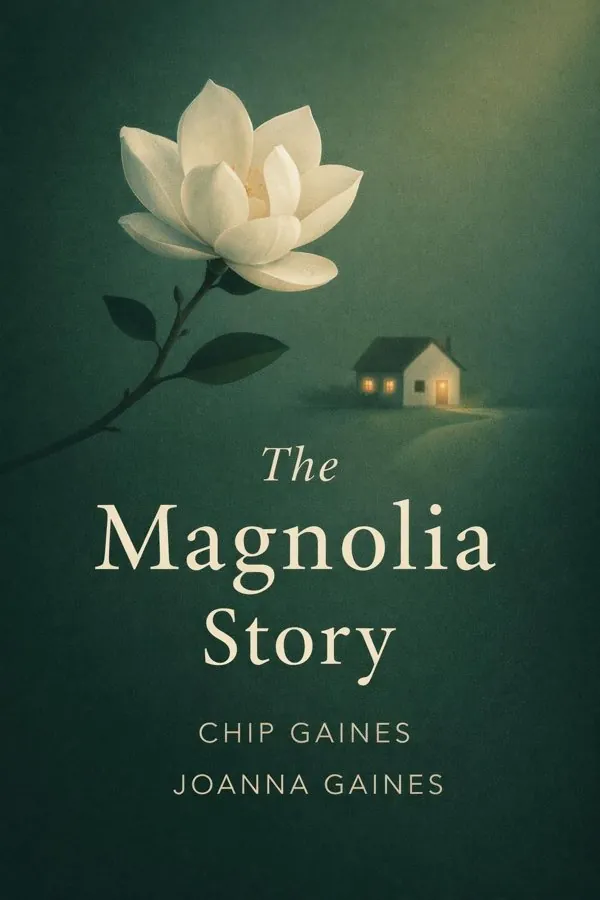
The Magnolia Story: Summary & Key Insights
 10 min9 chaptersAudio available
Key Takeaways from The Magnolia Story
A meaningful life often begins long before visible success, in the quiet lessons of childhood.
Energy can create momentum, but without discipline it can just as easily create chaos.
The strongest partnerships are not built on sameness, but on complementary strengths handled with respect.
Love is tested less by grand moments than by ordinary pressure.
Before there is a brand, there are often years of trial, embarrassment, and learning in public.
What Is The Magnolia Story About?
The Magnolia Story by Chip Gaines, Joanna Gaines is a biographies book spanning 11 pages. The Magnolia Story is more than a celebrity memoir. It is the behind-the-scenes account of how Chip and Joanna Gaines built a life, a marriage, a family, and eventually a business empire by combining risk-taking, hard work, creativity, and faith. Best known as the hosts of HGTV’s Fixer Upper, the Gaineses use this book to show that their success did not begin with television fame. It began with modest dreams, financial stress, mismatched personalities, failed plans, and a willingness to keep moving forward anyway. The book traces Joanna’s quiet, design-centered upbringing and Chip’s energetic entrepreneurial instincts, then follows their partnership through early businesses, house flipping, parenting, and the growth of Magnolia in Waco, Texas. What makes the memoir resonate is its honesty: they do not present success as a straight line, but as a messy process shaped by trust, sacrifice, and persistence. Their authority comes not only from building a recognizable brand, but from having lived every stage of the journey themselves. For readers interested in business, marriage, creativity, or purpose-driven work, this story offers both inspiration and practical perspective.
This FizzRead summary covers all 9 key chapters of The Magnolia Story in approximately 10 minutes, distilling the most important ideas, arguments, and takeaways from Chip Gaines, Joanna Gaines's work. Also available as an audio summary and Key Quotes Podcast.
The Magnolia Story
The Magnolia Story is more than a celebrity memoir. It is the behind-the-scenes account of how Chip and Joanna Gaines built a life, a marriage, a family, and eventually a business empire by combining risk-taking, hard work, creativity, and faith. Best known as the hosts of HGTV’s Fixer Upper, the Gaineses use this book to show that their success did not begin with television fame. It began with modest dreams, financial stress, mismatched personalities, failed plans, and a willingness to keep moving forward anyway. The book traces Joanna’s quiet, design-centered upbringing and Chip’s energetic entrepreneurial instincts, then follows their partnership through early businesses, house flipping, parenting, and the growth of Magnolia in Waco, Texas. What makes the memoir resonate is its honesty: they do not present success as a straight line, but as a messy process shaped by trust, sacrifice, and persistence. Their authority comes not only from building a recognizable brand, but from having lived every stage of the journey themselves. For readers interested in business, marriage, creativity, or purpose-driven work, this story offers both inspiration and practical perspective.
Who Should Read The Magnolia Story?
This book is perfect for anyone interested in biographies and looking to gain actionable insights in a short read. Whether you're a student, professional, or lifelong learner, the key ideas from The Magnolia Story by Chip Gaines, Joanna Gaines will help you think differently.
- ✓Readers who enjoy biographies and want practical takeaways
- ✓Professionals looking to apply new ideas to their work and life
- ✓Anyone who wants the core insights of The Magnolia Story in just 10 minutes
Want the full summary?
Get instant access to this book summary and 100K+ more with Fizz Moment.
Get Free SummaryAvailable on App Store • Free to download
Key Chapters
A meaningful life often begins long before visible success, in the quiet lessons of childhood. One of the most important ideas in The Magnolia Story is that both Joanna and Chip were formed by very different early experiences, and those backgrounds later became strengths rather than limitations. Joanna grew up navigating identity, family expectations, and a deep sense of sensitivity shaped by her parents’ sacrifices and values. Her mother’s Korean heritage and her father’s discipline helped her develop humility, emotional awareness, and appreciation for beauty and belonging. Chip, by contrast, grew up full of motion, confidence, and hustle. He sold things, started side ventures, and learned early that effort could create opportunity.
What matters is not that they had perfect beginnings, but that their upbringings gave them inner tools. Joanna developed taste, intuition, and a desire to create welcoming spaces. Chip developed boldness, optimism, and a tolerance for uncertainty. Those traits later became foundational to their business and partnership. The memoir suggests that personal history is not baggage to hide; it is often the source of the perspective others eventually value most.
This idea has practical application for anyone trying to build something meaningful. Instead of imitating someone else’s path, you can ask what your own life has prepared you to notice, solve, or create. A person raised in financial hardship may become excellent at resourcefulness. Someone who felt out of place may become especially gifted at building community.
Actionable takeaway: make a list of three traits your upbringing gave you, then identify one way each trait could become an asset in your work, relationships, or creative projects.
Energy can create momentum, but without discipline it can just as easily create chaos. Chip’s early story illustrates a powerful truth: entrepreneurial instinct is valuable, yet raw ambition must eventually mature. Long before Magnolia became a household name, Chip was already experimenting with business ideas. He hustled, bought and sold things, and chased opportunity with unusual confidence. He had the gift of movement. He was rarely paralyzed by fear, and that willingness to act helped open doors throughout his life.
But The Magnolia Story does not romanticize ambition on its own. The same adventurous streak that made Chip effective also led to impulsive choices, financial stress, and moments when enthusiasm outpaced planning. One reason the Gaineses became successful together is that Joanna balanced his appetite for risk with caution, design clarity, and a stronger feel for sustainability. The book shows that entrepreneurship is not just about starting; it is about learning how to channel instinct into responsible action.
This lesson is useful for founders, freelancers, and anyone full of ideas. Many people wait too long to begin because they want certainty. Others begin quickly but fail to create systems, budgets, or clear priorities. The healthiest approach sits in the middle: act boldly, then refine intentionally. Practical examples include testing a new business idea on a small scale, creating monthly financial reviews, or asking a more detail-oriented partner to challenge assumptions before major decisions.
Actionable takeaway: identify one area where you are acting on excitement alone, then add one form of discipline to support it, such as a budget, timeline, or accountability partner.
The strongest partnerships are not built on sameness, but on complementary strengths handled with respect. When Chip and Joanna met, their connection was immediate, yet their personalities were clearly different. Joanna was more reserved, thoughtful, and visually driven. Chip was spontaneous, loud, and relentlessly optimistic. In many relationships, those differences become sources of constant friction. In The Magnolia Story, they become part of the reason their marriage and business work.
The memoir shows that compatibility is not about never clashing. It is about learning how to interpret each other accurately. Joanna’s caution was not negativity; it was discernment. Chip’s risk-taking was not carelessness at its best; it was courage and initiative. As they grew together, they learned that each person often carried what the other lacked. This helped them make stronger decisions in business and endure pressure in marriage. Their story challenges the common assumption that a good partnership should feel effortless. Instead, they show that growth often comes from negotiating difference with humility.
In practical terms, this idea applies to marriages, friendships, and business teams. A visionary needs an operator. A creative person may need someone who loves process. A cautious person may need someone willing to go first. The important work is naming those differences clearly and using them intentionally rather than treating them as defects. Regular conversations about strengths, fears, and decision-making styles can prevent many conflicts from hardening into resentment.
Actionable takeaway: have one candid conversation with a partner, spouse, or colleague about the strengths each of you brings, and agree on one situation where each person should take the lead.
Love is tested less by grand moments than by ordinary pressure. One of the most relatable sections of The Magnolia Story is the account of Chip and Joanna’s early marriage, when they were trying to build a life without financial stability, predictable plans, or clear proof that their efforts would pay off. Their relationship unfolded in the middle of business experiments, fixer-uppers, debt, stress, and the daily demands of beginning a family. The book makes clear that commitment is not proven once; it is practiced repeatedly.
What gives this idea weight is that the Gaineses do not present struggle as a detour from real life. Struggle was real life. They had to make decisions with incomplete information, trust each other when outcomes were unclear, and keep choosing unity over blame. Their marriage deepened not because life became easy, but because difficulty forced them to clarify priorities. Family, faith, and shared purpose mattered more than appearances or perfect timing.
This lesson is especially useful in a culture that often associates successful relationships with smoothness. In reality, many strong marriages are forged in seasons of inconvenience, sacrifice, and repeated course correction. Practical applications include creating shared values before making major financial decisions, checking in regularly during stressful periods, and resisting the urge to treat your partner as the problem when external pressures rise.
Actionable takeaway: write down the three values you want to protect most in your closest relationship, and use them as a filter for your next big decision instead of relying only on comfort or short-term gain.
Before there is a brand, there are often years of trial, embarrassment, and learning in public. The Magnolia Story traces the Gaineses through early ventures that were far less polished than the Magnolia many people know today. They experimented with retail, renovation, real estate, and house flipping while trying to understand what they were actually best at. Some efforts worked better than others. Some ideas had to be abandoned. Some opportunities looked promising but did not align with the life they wanted.
The deeper lesson is that business identity rarely appears fully formed. It emerges through iteration. Joanna slowly recognized that design was not just a hobby but a gift with real value. Chip discovered that his instinct for deals and momentum could support something bigger when paired with a long-term vision. Their early ventures gave them practical knowledge about customers, timing, cash flow, branding, and resilience. Failure was not wasted effort; it was instruction.
For readers building any kind of project, this is enormously useful. Too many people expect their first version to be their final version. In reality, most worthwhile work improves through repeated testing. You may begin with a side business, freelance service, local store, or creative offering that looks modest from the outside. The point is not to look impressive immediately. The point is to keep learning what fits your strengths and serves people well.
Actionable takeaway: review one current project and ask three questions: what is working, what keeps draining energy, and what customer need are you uniquely equipped to meet? Use the answers to simplify your next step.
A lasting brand is rarely built by chasing trends alone; it grows by expressing a clear point of view over time. The development of Magnolia shows how Chip and Joanna gradually turned a collection of skills and experiences into a recognizable identity. Joanna’s design philosophy centered on warmth, simplicity, restoration, and making people feel at home. Chip brought vision, sales instinct, and a willingness to build infrastructure around that aesthetic. Together, they created more than beautiful spaces. They built an emotional promise.
The memoir highlights that Magnolia did not become meaningful because it was flashy. It became meaningful because it was consistent. Their work reflected values people could feel: family, welcome, authenticity, and hope through transformation. Renovating homes became symbolic of something larger. Neglected spaces could become places of beauty again. That message resonated with audiences because it connected design to human experience.
This idea matters for entrepreneurs, creators, and professionals in any field. People respond not only to what you sell, but to the story and experience surrounding it. A strong brand is the repeated expression of what you believe matters. In practical terms, that means defining the emotional effect you want your work to have, making sure your decisions match that effect, and resisting opportunities that dilute your core identity. Consistency builds trust.
Actionable takeaway: describe your work in one sentence that includes not just what you do, but how you want people to feel after interacting with it. Then use that sentence to guide future decisions.
When circumstances are unstable, people reveal what they trust most. In The Magnolia Story, faith is not presented as decoration added after success. It is shown as the foundation that steadied Chip and Joanna through uncertainty, disappointment, and sudden opportunity. Again and again, they faced moments where logic alone did not offer reassurance: financial strain, business setbacks, parenting pressures, and the possibility of stepping into public life. Their faith gave them a framework for surrender, patience, and courage.
Importantly, the book does not suggest that faith removes difficulty. Instead, it reframes difficulty. Rather than treating every setback as evidence that they were failing, they learned to see detours as part of a larger process. Faith helped them hold ambitions with open hands. It also helped them evaluate success differently. The goal was not only growth, fame, or money, but obedience to a calling and care for family and community.
This principle can apply even for readers who are not religious in the same way. Everyone needs an anchor beyond immediate results. Without one, every obstacle feels catastrophic and every achievement becomes addictive. Whether that anchor is faith, a moral vision, or a deeply held purpose, it allows people to take risks without letting outcomes define their worth. Practical examples include setting values-based goals, pausing to reflect before major decisions, and measuring success by integrity as much as achievement.
Actionable takeaway: define one belief or core value that should remain non-negotiable when work becomes stressful, and write one decision rule that protects it.
What looks like an overnight breakthrough is often the result of years spent becoming ready. The arrival of Fixer Upper is one of the most dramatic turning points in The Magnolia Story, yet the memoir makes clear that television success did not appear out of nowhere. By the time producers noticed them, Chip and Joanna had already been renovating homes, serving clients, refining their dynamic, and building a distinctive style. The opportunity mattered, but so did the preparation behind it.
Another important lesson is that authenticity became an advantage. They were not polished performers trying to play roles. Their chemistry, humor, disagreements, values, and design philosophy were already real. Audiences responded because what they saw on screen reflected an actual way of working and living. In a media culture often shaped by performance, that genuineness stood out.
This idea is relevant for anyone waiting for a big break. External opportunities are unpredictable, but preparation is not. You can develop your craft, clarify your voice, build a body of work, and strengthen your character before recognition arrives. When an opening does come, authenticity often travels farther than imitation. In practical terms, this might mean documenting your work consistently, improving your communication skills, or saying no to opportunities that require you to become someone unrecognizable.
Actionable takeaway: choose one future opportunity you hope for, then list the three capabilities or habits you need to strengthen now so that you will be ready if it arrives.
Success expands influence, but it also multiplies pressure. As Fixer Upper grew, Chip and Joanna had to navigate a reality many readers find fascinating but also cautionary: public visibility can distort a person’s life if inner priorities are not kept clear. The book explores how attention, expectations, and growing business demands affected their time, privacy, and family rhythms. What had once been a local, hands-on life in Waco suddenly carried national visibility.
Their response highlights a central message of the memoir: external growth must be governed by internal boundaries. The Gaineses repeatedly return to the importance of protecting family life, staying grounded in their values, and remembering that popularity is not the same as purpose. Public affirmation can be energizing, but it can also tempt people to overextend, perform, or chase expansion for its own sake. The memoir suggests that success is safest when anchored to a life you would still want without applause.
This is useful not only for public figures but for anyone with increasing responsibility. Career advancement, social media visibility, or business growth can all create subtle drift. You begin saying yes too often, neglecting relationships, or letting your identity depend on output. Practical safeguards include setting limits on work hours, preserving family rituals, delegating responsibilities, and regularly asking whether growth is still serving what matters most.
Actionable takeaway: identify one boundary that would protect your deepest priorities as your responsibilities increase, and put it into practice this week before urgency erases your intention.
All Chapters in The Magnolia Story
About the Authors
Chip Gaines and Joanna Gaines are American entrepreneurs, authors, and television personalities best known for transforming the home renovation world through Fixer Upper. Based in Waco, Texas, they co-founded Magnolia, a lifestyle brand that grew from a small business into a widely recognized name in design, retail, media, and hospitality. Chip is known for his humor, charisma, and entrepreneurial boldness, while Joanna is celebrated for her design sensibility, storytelling, and ability to create spaces that feel warm and timeless. Together, they have written bestselling books and built a loyal following through their emphasis on family, faith, authenticity, and community. Their work resonates because it combines practical creativity with a deeply personal vision of home, restoration, and meaningful living.
Get This Summary in Your Preferred Format
Read or listen to the The Magnolia Story summary by Chip Gaines, Joanna Gaines anytime, anywhere. FizzRead offers multiple formats so you can learn on your terms — all free.
Available formats: App · Audio · PDF · EPUB — All included free with FizzRead
Download The Magnolia Story PDF and EPUB Summary
Key Quotes from The Magnolia Story
“A meaningful life often begins long before visible success, in the quiet lessons of childhood.”
“Energy can create momentum, but without discipline it can just as easily create chaos.”
“The strongest partnerships are not built on sameness, but on complementary strengths handled with respect.”
“Love is tested less by grand moments than by ordinary pressure.”
“Before there is a brand, there are often years of trial, embarrassment, and learning in public.”
Frequently Asked Questions about The Magnolia Story
The Magnolia Story by Chip Gaines, Joanna Gaines is a biographies book that explores key ideas across 9 chapters. The Magnolia Story is more than a celebrity memoir. It is the behind-the-scenes account of how Chip and Joanna Gaines built a life, a marriage, a family, and eventually a business empire by combining risk-taking, hard work, creativity, and faith. Best known as the hosts of HGTV’s Fixer Upper, the Gaineses use this book to show that their success did not begin with television fame. It began with modest dreams, financial stress, mismatched personalities, failed plans, and a willingness to keep moving forward anyway. The book traces Joanna’s quiet, design-centered upbringing and Chip’s energetic entrepreneurial instincts, then follows their partnership through early businesses, house flipping, parenting, and the growth of Magnolia in Waco, Texas. What makes the memoir resonate is its honesty: they do not present success as a straight line, but as a messy process shaped by trust, sacrifice, and persistence. Their authority comes not only from building a recognizable brand, but from having lived every stage of the journey themselves. For readers interested in business, marriage, creativity, or purpose-driven work, this story offers both inspiration and practical perspective.
You Might Also Like

An American Marriage
Tayari Jones
10 min
Benjamin Franklin: An American Life
Walter Isaacson
10 min
I Know Why The Caged Bird Sings
Maya Angelou
10 min
Long Walk to Freedom
Nelson Mandela
10 min
Persepolis
Marjane Satrapi
10 min
Surely You're Joking, Mr. Feynman!
Richard P. Feynman
10 minBrowse by Category
Ready to read The Magnolia Story?
Get the full summary and 100K+ more books with Fizz Moment.