
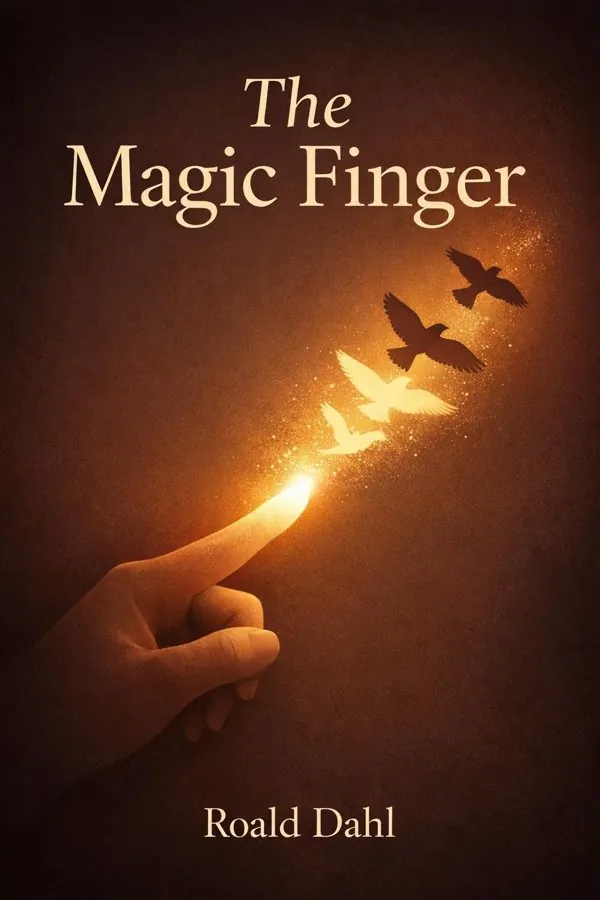
The Magic Finger: Summary & Key Insights
by Roald Dahl
 10 min9 chaptersAudio available
Key Takeaways from The Magic Finger
The unnamed narrator is only eight years old, yet she carries within her a force that adults neither understand nor control.
One of Roald Dahl’s sharpest insights is that people can become blind to cruelty when it is wrapped in routine.
Stories about justice often rely on punishment, but The Magic Finger does something more interesting: it turns punishment into forced perspective.
Empathy becomes most powerful when it crosses the boundary between “us” and “them.
People rarely change when they are comfortable, and The Magic Finger makes that truth impossible to ignore.
What Is The Magic Finger About?
The Magic Finger by Roald Dahl is a classics book spanning 5 pages. What if a child’s anger could instantly remake the world around her? In The Magic Finger, Roald Dahl takes that deliciously unsettling idea and turns it into one of his sharpest, shortest moral fables. The story follows an eight-year-old girl who cannot always control a mysterious force in her finger. Whenever she becomes truly furious, the “Magic Finger” leaps out and punishes whoever has stirred her sense of injustice. When her neighbors, the Gregg family, continue their casual hobby of shooting ducks, the girl’s outrage sets in motion a strange transformation that forces them to experience life from the birds’ point of view. Though brief and playful, the book carries surprising emotional weight. It explores cruelty, empathy, power, revenge, and the possibility of change, all through Dahl’s trademark blend of humor, exaggeration, and moral clarity. Dahl was one of the great masters of children’s literature, known for stories that trusted young readers to handle darkness, absurdity, and big ethical questions. The Magic Finger matters because it speaks directly to a feeling many children know well: the frustration of seeing something wrong and wishing, with all their heart, that the world would set it right.
This FizzRead summary covers all 9 key chapters of The Magic Finger in approximately 10 minutes, distilling the most important ideas, arguments, and takeaways from Roald Dahl's work. Also available as an audio summary and Key Quotes Podcast.
The Magic Finger
What if a child’s anger could instantly remake the world around her? In The Magic Finger, Roald Dahl takes that deliciously unsettling idea and turns it into one of his sharpest, shortest moral fables. The story follows an eight-year-old girl who cannot always control a mysterious force in her finger. Whenever she becomes truly furious, the “Magic Finger” leaps out and punishes whoever has stirred her sense of injustice. When her neighbors, the Gregg family, continue their casual hobby of shooting ducks, the girl’s outrage sets in motion a strange transformation that forces them to experience life from the birds’ point of view.
Though brief and playful, the book carries surprising emotional weight. It explores cruelty, empathy, power, revenge, and the possibility of change, all through Dahl’s trademark blend of humor, exaggeration, and moral clarity. Dahl was one of the great masters of children’s literature, known for stories that trusted young readers to handle darkness, absurdity, and big ethical questions. The Magic Finger matters because it speaks directly to a feeling many children know well: the frustration of seeing something wrong and wishing, with all their heart, that the world would set it right.
Who Should Read The Magic Finger?
This book is perfect for anyone interested in classics and looking to gain actionable insights in a short read. Whether you're a student, professional, or lifelong learner, the key ideas from The Magic Finger by Roald Dahl will help you think differently.
- ✓Readers who enjoy classics and want practical takeaways
- ✓Professionals looking to apply new ideas to their work and life
- ✓Anyone who wants the core insights of The Magic Finger in just 10 minutes
Want the full summary?
Get instant access to this book summary and 100K+ more with Fizz Moment.
Get Free SummaryAvailable on App Store • Free to download
Key Chapters
Anger in childhood is often dismissed as something small, but The Magic Finger begins with the startling suggestion that a child’s moral outrage can be powerful enough to change reality. The unnamed narrator is only eight years old, yet she carries within her a force that adults neither understand nor control. Her “magic finger” appears whenever she becomes deeply upset, especially when she witnesses unfairness or cruelty. Dahl uses this power not merely as a fantasy device, but as a symbol of the emotional intensity children feel when the world violates their sense of right and wrong.
What makes this idea compelling is that the girl is not wicked or malicious by nature. She is observant, sensitive, and imaginative. Her problem is not that she feels too much, but that her emotions erupt in unpredictable ways. This gives the story an emotional honesty that many children recognize. Adults may think children overreact, but from a child’s point of view, injustice can feel enormous. Dahl validates that feeling while also showing that emotional power needs direction.
In real life, children and adults alike may not possess literal magic, but anger still has consequences. A sharp word can alter a friendship; a protest can shift public opinion; a moment of courage can stop someone from being mistreated. The lesson is not to suppress strong feelings, but to recognize them and channel them wisely.
A practical way to apply this idea is to treat anger as information. Ask what exactly feels wrong, who is being harmed, and what response would be fair rather than impulsive. The actionable takeaway: when strong emotions rise, pause long enough to turn outrage into a purposeful response instead of a reckless reaction.
One of Roald Dahl’s sharpest insights is that people can become blind to cruelty when it is wrapped in routine. The Gregg family do not see themselves as villains. To them, hunting ducks is a pleasurable family activity, an ordinary pastime, even a point of pride. They prepare their guns, head outdoors, and speak about their success as though there were nothing morally troubling in turning living creatures into targets. That casual attitude is exactly what provokes the narrator’s deepest anger.
Dahl’s genius lies in showing how wrongdoing often survives not through dramatic evil, but through habit and social approval. The Greggs are not presented as monsters in a fairy-tale sense. They are recognizable people who have simply stopped asking whether their behavior is justifiable. That makes the story more powerful, because it mirrors everyday life. Harmful actions often continue because communities call them tradition, entertainment, convenience, or “just the way things are.”
This idea stretches beyond hunting. A child excluded from games at school, an animal mistreated for amusement, or a worker ignored and disrespected in a workplace can all become victims of normalized behavior. People may participate without reflection simply because others do. The story invites readers to reexamine accepted habits and ask whether custom should excuse harm.
A useful application is to question routines that involve suffering, humiliation, or carelessness. Instead of asking only, “Is this common?” ask, “Is this kind?” That simple shift can uncover ethical blind spots in family traditions, school culture, or social behavior.
The actionable takeaway: the next time something seems normal, take a second look and ask whether normality is hiding needless cruelty.
Stories about justice often rely on punishment, but The Magic Finger does something more interesting: it turns punishment into forced perspective. When the narrator’s magic strikes the Gregg family, they do not simply suffer random misfortune. They are transformed in a way that makes them vulnerable, frightened, and exposed to the very dangers they once imposed on ducks. In other words, the magic is not just revenge. It is education delivered through experience.
This distinction matters. Mere punishment may create fear, resentment, or temporary compliance. Perspective, however, can create understanding. By placing the Greggs in a position where they must confront what it feels like to be prey, Dahl dramatizes a moral truth: people often grasp the consequences of their actions only when they can imagine themselves on the receiving end. The transformation is fantastical, but its emotional logic is very real.
In everyday life, this principle appears whenever role reversal deepens empathy. A manager who has to perform frontline work may become more respectful of employees. A child teased by others may change after being excluded. A person who experiences vulnerability firsthand often gains new moral clarity. Literature itself works this way by allowing readers to inhabit other minds and bodies.
The practical application is to build perspective before harm escalates. Ask someone to describe how an action affects them. Encourage role-play in classrooms. Use stories to help children imagine life from another creature’s or person’s point of view. These methods can do gently what the magic finger does dramatically.
The actionable takeaway: before judging your behavior as harmless, imagine living through its consequences from the other side.
Empathy becomes most powerful when it crosses the boundary between “us” and “them.” In The Magic Finger, Dahl asks readers not only to feel for another person, but to imagine the inner lives of animals. The ducks in the story are not decorations in the landscape or moving targets in the sky. They are families with homes, vulnerabilities, and a right to exist without terror. By flipping the balance of power, Dahl makes the Greggs—and the reader—consider what hunting looks like from the ducks’ point of view.
This is one of the book’s most quietly radical achievements. Children’s literature often grants animals personality, but Dahl uses that device to sharpen an ethical challenge. If animals can fear, seek safety, protect their young, and suffer violence, then treating them as objects becomes harder to defend. The ducks’ perspective reframes the entire conflict. What had seemed like sport becomes persecution. What had looked like harmless recreation becomes an invasion of a living community.
This idea has clear modern applications. Children who learn to observe animals as sentient beings often become more thoughtful and compassionate overall. Watching birds build nests, caring for a pet responsibly, or discussing wildlife conservation can all help develop empathy beyond the human sphere. The lesson also broadens into environmental awareness: when humans act as if nature exists solely for our use, damage follows.
A practical exercise is simple: when encountering an animal, ask what it might need to feel safe. Food, shelter, space, and freedom from fear are not just human concerns. Such questions nurture habits of care.
The actionable takeaway: practice imagining life from the viewpoint of a vulnerable creature, because empathy grows when we stop seeing other beings as background to our own desires.
People rarely change when they are comfortable, and The Magic Finger makes that truth impossible to ignore. The Gregg family do not stop hunting because someone politely asks them to reconsider. They change only after their own security is shaken. Once they experience fear and helplessness firsthand, their moral imagination awakens. Dahl suggests that lasting transformation often starts when familiar assumptions are disrupted.
This can sound harsh, but it reflects real human behavior. We tend to defend our habits until those habits become costly or emotionally impossible to maintain. The Greggs had every chance to listen before the magic struck, but they ignored the narrator’s objections because they could afford to. Their comfort insulated them from the suffering of the ducks. The transformation strips away that insulation.
The lesson applies widely. A student may not stop mocking others until they feel social rejection themselves. A community may ignore pollution until the consequences affect their own health. A family may overlook a member’s feelings until conflict forces honest conversation. Discomfort is not always pleasant, but it can be clarifying. It breaks the illusion that our actions have no serious impact.
That said, Dahl’s story also implies a hopeful point: discomfort need not destroy us. It can teach us. The Greggs are given a chance to become better, not simply to be punished forever. Their fear opens the door to moral growth.
A practical application is to take criticism seriously before life delivers a harsher lesson. If someone tells you that your behavior causes harm, treat that discomfort as valuable information rather than as an attack.
The actionable takeaway: don’t wait for a dramatic shock to force change—let smaller moments of discomfort guide you toward better choices now.
At first glance, The Magic Finger may seem like a straightforward revenge fantasy: cruel hunters upset a child, so magical consequences fall upon them. But Dahl complicates that reading. The story raises a subtle question: when does retaliation become justice, and when does it go too far? The narrator’s power is driven by anger, yet the result is not meaningless destruction. The magic creates a moral mirror. It gives the Greggs a chance to understand what they have done and to choose differently.
This tension between justice and revenge gives the story its bite. Revenge seeks satisfaction for the injured party. Justice aims at restoration, accountability, or changed behavior. In the book, the outcome matters more than the shock. The Greggs’ transformation is significant because it leads to remorse and reform. If the magic had only caused suffering, the story would feel darker and emptier. Instead, Dahl leaves space for redemption.
This distinction is useful in daily life. Suppose a friend embarrasses you in public. Revenge might mean humiliating them in return. Justice might mean confronting the issue, explaining the hurt, and seeking a change in behavior. In schools, families, and workplaces, fair consequences should teach and repair where possible, not merely retaliate. That is especially important when children are learning what accountability looks like.
A practical test is to ask: does my response aim to improve the situation, or just to make someone else suffer as I did? That question helps separate a corrective response from a vindictive one.
The actionable takeaway: when you feel wronged, choose a response that increases understanding and accountability rather than one that simply spreads pain.
Adults often underestimate how quickly children detect inconsistency, and The Magic Finger thrives on that gap. The young narrator sees what the adults around her either excuse or ignore: it is absurd to claim respectability while taking pleasure in harming defenseless creatures. Her outrage arises partly because she has not yet learned the adult habit of smoothing over moral contradictions with polite language. In that sense, her perspective is not immature. It is piercingly clear.
Dahl frequently writes children as truth-tellers who perceive what adults rationalize away. Here, the narrator notices that the Greggs’ normal, neighborly appearance does not make their actions innocent. This is one reason the story remains memorable. It reflects a child’s sharp ethical instinct before social conditioning teaches compromise, denial, or indifference.
There is an important application here for parents, teachers, and leaders. When children object strongly to something, it is worth asking whether they have noticed a genuine ethical problem rather than assuming they are being dramatic. A child may question why people are kind to pets but cruel to wildlife, or why fairness is preached but not practiced. Those questions can be uncomfortable because they expose hypocrisy.
Encouraging such observations can strengthen moral development. Discussions about stories, news, and everyday events help children learn how to articulate fairness, compassion, and consistency. Adults benefit too, because children often reveal truths that habit has blurred.
A practical approach is to invite honest questions rather than shutting them down. Ask, “Why does this seem unfair to you?” and listen seriously.
The actionable takeaway: pay attention when a child points out a contradiction, because moral clarity often arrives in a voice adults are tempted to dismiss.
Sometimes imagination can teach a moral lesson more effectively than realism. The Magic Finger uses impossible events—sudden magical punishment, transformed bodies, role reversal between humans and birds—to make an ethical truth emotionally vivid. Rather than delivering a sermon against cruelty, Dahl creates a scenario so strange and memorable that readers feel the lesson rather than merely hearing it.
This is one of fantasy’s great strengths. A realistic lecture on animal welfare might inform readers, but it may not stay in the mind. A family waking up with tiny wings and facing the fear they once inflicted on ducks is unforgettable. The exaggerated setup cuts through defensiveness. Readers can engage with the absurdity, laugh at the weirdness, and still absorb the serious message beneath it.
The principle applies beyond literature. Teachers often use stories, role-play, or metaphor because abstract ideas become easier to grasp when dramatized. A child may understand bullying more deeply after acting out a scene or reading a tale that mirrors exclusion in symbolic form. Adults too are moved by films, novels, and fables that bypass argument and reach the imagination.
Dahl’s method also respects young readers. He does not flatten ethics into simplistic rules. Instead, he creates a vivid imaginative world where readers can draw conclusions for themselves. That active engagement strengthens the lesson.
A practical application is to use storytelling when discussing difficult topics with children. If direct instruction feels dry or confrontational, a well-chosen story can open reflection with less resistance.
The actionable takeaway: when trying to understand or teach a difficult moral issue, turn to stories and imagination—they often reach the heart before the mind catches up.
The most enduring children’s stories do not merely expose wrongdoing; they leave room for people to become better. That is why mercy matters in The Magic Finger. The Gregg family are confronted, frightened, and humbled, but they are not treated as permanently lost. Once they understand the suffering they caused, they are able to change. This possibility of moral renewal is what keeps the story from becoming cruel itself.
Dahl is often remembered for his sharp punishments and gleeful comeuppance, yet here he balances severity with grace. The magic does not exist only to condemn. It exists to awaken conscience. That difference matters deeply. A world in which no one can change is bleak. A world in which wrongdoing has consequences but transformation remains possible is morally serious without being hopeless.
This idea has strong practical value. In families, schools, and communities, accountability works best when it includes a path forward. If a child behaves badly, the goal is not simply to shame them but to help them understand the harm, make amends, and choose differently next time. The same is true for adults. Apology, repair, and changed conduct are more constructive than endless condemnation.
Mercy does not erase responsibility. The Greggs still must face what they have done. But mercy ensures that the story’s final note is not fear, but growth. Readers come away believing that empathy can be learned, even by those who resisted it.
The actionable takeaway: whenever you hold someone accountable, leave room for sincere change—justice is strongest when it makes redemption possible.
All Chapters in The Magic Finger
About the Author
Roald Dahl (1916–1990) was one of the most influential children’s authors of the modern era. Born in Wales to Norwegian parents, he first gained attention as a writer of short stories before becoming famous worldwide for his children’s books. His most beloved titles include Charlie and the Chocolate Factory, Matilda, The BFG, James and the Giant Peach, and Fantastic Mr. Fox. Dahl’s writing is known for its inventive plots, dark comedy, memorable villains, and strong sympathy for children facing unfair or foolish adults. He had a rare talent for blending fantasy with emotional truth, creating stories that were both entertaining and morally resonant. Decades after their publication, his books remain widely read for their wit, imagination, and unmistakable storytelling voice.
Get This Summary in Your Preferred Format
Read or listen to the The Magic Finger summary by Roald Dahl anytime, anywhere. FizzRead offers multiple formats so you can learn on your terms — all free.
Available formats: App · Audio · PDF · EPUB — All included free with FizzRead
Download The Magic Finger PDF and EPUB Summary
Key Quotes from The Magic Finger
“Anger in childhood is often dismissed as something small, but The Magic Finger begins with the startling suggestion that a child’s moral outrage can be powerful enough to change reality.”
“One of Roald Dahl’s sharpest insights is that people can become blind to cruelty when it is wrapped in routine.”
“Stories about justice often rely on punishment, but The Magic Finger does something more interesting: it turns punishment into forced perspective.”
“Empathy becomes most powerful when it crosses the boundary between “us” and “them.”
“People rarely change when they are comfortable, and The Magic Finger makes that truth impossible to ignore.”
Frequently Asked Questions about The Magic Finger
The Magic Finger by Roald Dahl is a classics book that explores key ideas across 9 chapters. What if a child’s anger could instantly remake the world around her? In The Magic Finger, Roald Dahl takes that deliciously unsettling idea and turns it into one of his sharpest, shortest moral fables. The story follows an eight-year-old girl who cannot always control a mysterious force in her finger. Whenever she becomes truly furious, the “Magic Finger” leaps out and punishes whoever has stirred her sense of injustice. When her neighbors, the Gregg family, continue their casual hobby of shooting ducks, the girl’s outrage sets in motion a strange transformation that forces them to experience life from the birds’ point of view. Though brief and playful, the book carries surprising emotional weight. It explores cruelty, empathy, power, revenge, and the possibility of change, all through Dahl’s trademark blend of humor, exaggeration, and moral clarity. Dahl was one of the great masters of children’s literature, known for stories that trusted young readers to handle darkness, absurdity, and big ethical questions. The Magic Finger matters because it speaks directly to a feeling many children know well: the frustration of seeing something wrong and wishing, with all their heart, that the world would set it right.
More by Roald Dahl

You Might Also Like




Browse by Category
Ready to read The Magic Finger?
Get the full summary and 100K+ more books with Fizz Moment.