
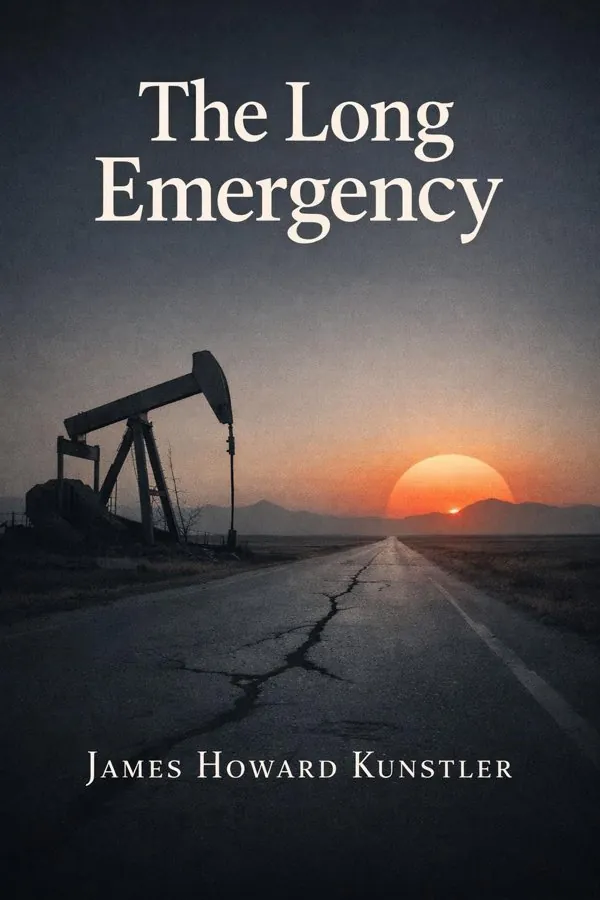
The Long Emergency: Surviving the Converging Catastrophes of the Twenty-First Century: Summary & Key Insights
 10 min6 chaptersAudio available
What Is The Long Emergency: Surviving the Converging Catastrophes of the Twenty-First Century About?
The Long Emergency: Surviving the Converging Catastrophes of the Twenty-First Century by James Howard Kunstler is a environment book spanning 6 pages. In this provocative work, James Howard Kunstler explores the impending challenges humanity faces as the age of cheap fossil fuels comes to an end. He argues that industrial civilization, built on the assumption of endless energy growth, is unsustainable. The book examines the potential social, economic, and political upheavals that may follow the decline of oil production, urging readers to rethink modern life and prepare for a more localized, resilient future.
This FizzRead summary covers all 6 key chapters of The Long Emergency: Surviving the Converging Catastrophes of the Twenty-First Century in approximately 10 minutes, distilling the most important ideas, arguments, and takeaways from James Howard Kunstler's work. Also available as an audio summary and Key Quotes Podcast.
The Long Emergency: Surviving the Converging Catastrophes of the Twenty-First Century
In this provocative work, James Howard Kunstler explores the impending challenges humanity faces as the age of cheap fossil fuels comes to an end. He argues that industrial civilization, built on the assumption of endless energy growth, is unsustainable. The book examines the potential social, economic, and political upheavals that may follow the decline of oil production, urging readers to rethink modern life and prepare for a more localized, resilient future.
Who Should Read The Long Emergency: Surviving the Converging Catastrophes of the Twenty-First Century?
This book is perfect for anyone interested in environment and looking to gain actionable insights in a short read. Whether you're a student, professional, or lifelong learner, the key ideas from The Long Emergency: Surviving the Converging Catastrophes of the Twenty-First Century by James Howard Kunstler will help you think differently.
- ✓Readers who enjoy environment and want practical takeaways
- ✓Professionals looking to apply new ideas to their work and life
- ✓Anyone who wants the core insights of The Long Emergency: Surviving the Converging Catastrophes of the Twenty-First Century in just 10 minutes
Want the full summary?
Get instant access to this book summary and 100K+ more with Fizz Moment.
Get Free SummaryAvailable on App Store • Free to download
Key Chapters
To understand the crisis before us, we must first retrace the steps that led us here. Modern industrial civilization emerged under the intoxicating promise of abundant, cheap energy. From coal to oil, each discovery unlocked new levels of economic and technological expansion. By the late nineteenth century, petroleum had become the lifeblood of progress—fuelling the automobile, aviation, plastic, and chemical industries—all of which transformed daily life. The embrace of oil created a civilization of speed, mobility, and consumption unlike anything in human history.
Yet from the start, this arrangement contained a fatal flaw. Everything we built assumed that such energy would be infinite. Cities expanded outward rather than upward, birthing vast suburbs connected by highways. Food production industrialized, dependent on petroleum for fertilizers, machinery, and global transport. The world economy globalized, creating an intricate web of supply chains utterly reliant on cheap energy.
World War II cemented oil’s dominance, as military and industrial might converged under its power. Following the war, America entered the golden age of automobiles, suburban homes, and limitless growth. Behind the scenes, however, the petroleum foundation of this prosperity was finite. As energy became the invisible currency of civilization, we lost sight of its fragility. We came to believe progress itself was immune to physical limits. History, however, tells another story: every great civilization flourishes on the resources it can command—and falters when those resources wane. The age of oil will be no exception.
At the center of The Long Emergency lies a sobering idea: global oil production will not rise indefinitely. Geology sets limits, and we are approaching them. The concept of “peak oil” originated with the geologist M. King Hubbert, who predicted that U.S. oil production would peak in the early 1970s—a forecast that proved tragically accurate. What follows a peak is not sudden depletion, but a gradual and irreversible decline. The consequences ripple through every layer of society.
Oil is not merely a commodity—it is the foundation of modern life. Everything from food to medicine, manufacturing, and transportation depends on it. As production slows while demand continues, the system begins to unravel. Economies based on perpetual growth will confront contraction; globalized trade will falter as transport costs rise; developing nations that rely on cheap imports will face scarcity.
Throughout my research, I found that denial runs deep. Politicians, corporations, and the public all prefer to believe that technology or market forces will somehow ‘replace’ oil. But geology is impervious to optimism. Once the easy, light crude is gone, what remains is difficult to extract—deepwater deposits, tar sands, shale oil—each requiring more energy to produce than before. Eventually, the net gain disappears.
This is the reckoning that defines the Long Emergency: not a sudden apocalypse but a long descent where the old order slowly ceases to function. It is the moment humanity must confront the end of the fossil-fueled fantasy and rediscover survival in a world governed by energy scarcity.
+ 4 more chapters — available in the FizzRead app
All Chapters in The Long Emergency: Surviving the Converging Catastrophes of the Twenty-First Century
About the Author
James Howard Kunstler is an American author, social critic, and public speaker known for his writings on urban development, energy, and culture. He is the author of several books, including 'The Geography of Nowhere' and 'Home from Nowhere', which critique suburban sprawl and advocate for sustainable community design.
Get This Summary in Your Preferred Format
Read or listen to the The Long Emergency: Surviving the Converging Catastrophes of the Twenty-First Century summary by James Howard Kunstler anytime, anywhere. FizzRead offers multiple formats so you can learn on your terms — all free.
Available formats: App · Audio · PDF · EPUB — All included free with FizzRead
Download The Long Emergency: Surviving the Converging Catastrophes of the Twenty-First Century PDF and EPUB Summary
Key Quotes from The Long Emergency: Surviving the Converging Catastrophes of the Twenty-First Century
“To understand the crisis before us, we must first retrace the steps that led us here.”
“At the center of The Long Emergency lies a sobering idea: global oil production will not rise indefinitely.”
Frequently Asked Questions about The Long Emergency: Surviving the Converging Catastrophes of the Twenty-First Century
The Long Emergency: Surviving the Converging Catastrophes of the Twenty-First Century by James Howard Kunstler is a environment book that explores key ideas across 6 chapters. In this provocative work, James Howard Kunstler explores the impending challenges humanity faces as the age of cheap fossil fuels comes to an end. He argues that industrial civilization, built on the assumption of endless energy growth, is unsustainable. The book examines the potential social, economic, and political upheavals that may follow the decline of oil production, urging readers to rethink modern life and prepare for a more localized, resilient future.
You Might Also Like

A Life on Our Planet: My Witness Statement and a Vision for the Future
David Attenborough
10 min
A Sky Full Of Birds
Matt Merritt
10 min
Carbon Zero: Imagining Cities That Can Save the Planet
Alex Steffen
10 min
Eaarth: Making a Life on a Tough New Planet
Bill McKibben
10 min
The Social Contract and Environmental Governance
Various Editors
10 min
The Wild Places
Robert Macfarlane
10 minBrowse by Category
Ready to read The Long Emergency: Surviving the Converging Catastrophes of the Twenty-First Century?
Get the full summary and 100K+ more books with Fizz Moment.