
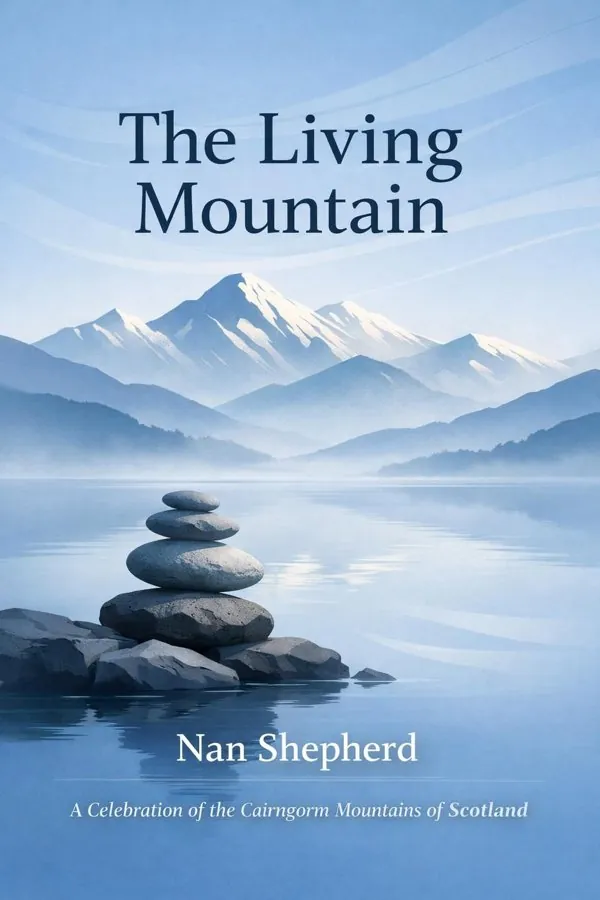
The Living Mountain: A Celebration of the Cairngorm Mountains of Scotland: Summary & Key Insights
by Nan Shepherd
 10 min9 chaptersAudio available
Key Takeaways from The Living Mountain: A Celebration of the Cairngorm Mountains of Scotland
The highest places do not always produce drama; sometimes they teach stillness.
What is concealed is often more alive than what is obvious.
A mountain is never only stone; it is also movement.
Snow does more than cover the mountain; it remakes it.
Where some see barrenness, Shepherd sees abundance.
What Is The Living Mountain: A Celebration of the Cairngorm Mountains of Scotland About?
The Living Mountain: A Celebration of the Cairngorm Mountains of Scotland by Nan Shepherd is a environment book spanning 9 pages. Nan Shepherd’s The Living Mountain is not a guidebook, an adventure memoir, or a tale of heroic ascent. It is a profound meditation on what it means to enter a landscape with humility, attention, and love. Drawing on decades of walking in Scotland’s Cairngorm Mountains, Shepherd invites readers to see the mountain not as an object to be conquered but as a living presence to be encountered through the body, the senses, and the mind. Her prose moves from high plateaus to hidden corries, from snowfields and clear burns to animal life, weather, touch, and silence, revealing a world that is endlessly subtle and alive. What makes this book endure is its radical shift in perspective. Long before environmental writing became a recognized genre, Shepherd argued that nature is not scenery for human use but a reality with its own integrity. Her authority comes not from scientific detachment or mountaineering bravado, but from years of close, patient, embodied attention. The result is a lyrical and philosophical classic that changes how we think about walking, seeing, and belonging within the natural world.
This FizzRead summary covers all 9 key chapters of The Living Mountain: A Celebration of the Cairngorm Mountains of Scotland in approximately 10 minutes, distilling the most important ideas, arguments, and takeaways from Nan Shepherd's work. Also available as an audio summary and Key Quotes Podcast.
The Living Mountain: A Celebration of the Cairngorm Mountains of Scotland
Nan Shepherd’s The Living Mountain is not a guidebook, an adventure memoir, or a tale of heroic ascent. It is a profound meditation on what it means to enter a landscape with humility, attention, and love. Drawing on decades of walking in Scotland’s Cairngorm Mountains, Shepherd invites readers to see the mountain not as an object to be conquered but as a living presence to be encountered through the body, the senses, and the mind. Her prose moves from high plateaus to hidden corries, from snowfields and clear burns to animal life, weather, touch, and silence, revealing a world that is endlessly subtle and alive.
What makes this book endure is its radical shift in perspective. Long before environmental writing became a recognized genre, Shepherd argued that nature is not scenery for human use but a reality with its own integrity. Her authority comes not from scientific detachment or mountaineering bravado, but from years of close, patient, embodied attention. The result is a lyrical and philosophical classic that changes how we think about walking, seeing, and belonging within the natural world.
Who Should Read The Living Mountain: A Celebration of the Cairngorm Mountains of Scotland?
This book is perfect for anyone interested in environment and looking to gain actionable insights in a short read. Whether you're a student, professional, or lifelong learner, the key ideas from The Living Mountain: A Celebration of the Cairngorm Mountains of Scotland by Nan Shepherd will help you think differently.
- ✓Readers who enjoy environment and want practical takeaways
- ✓Professionals looking to apply new ideas to their work and life
- ✓Anyone who wants the core insights of The Living Mountain: A Celebration of the Cairngorm Mountains of Scotland in just 10 minutes
Want the full summary?
Get instant access to this book summary and 100K+ more with Fizz Moment.
Get Free SummaryAvailable on App Store • Free to download
Key Chapters
The highest places do not always produce drama; sometimes they teach stillness. In Shepherd’s account of the Cairngorm plateau, the reader enters a world that feels almost level with the sky: wide, open, quiet, and stripped of distraction. This is not the mountain imagined by thrill-seekers or summit collectors. It is a place where the scale is so vast and the features so spare that a person must learn to be present in a different way. On the plateau, attention becomes more refined. Light, distance, texture, cloud shadow, and silence matter more than spectacle.
Shepherd’s great insight is that altitude does not have to intensify the ego. Many people approach mountains as tests to pass or goals to achieve. Shepherd approaches them as realities to enter. The plateau offers a lesson in receptive awareness: instead of asking, “How do I master this place?” she asks, “What can this place reveal if I stop imposing myself on it?” That shift transforms walking into a form of contemplation.
This idea has practical relevance beyond mountain travel. In daily life, we often assume that meaningful experience must be dramatic, productive, or visibly successful. Shepherd suggests otherwise. A quiet walk without headphones, time spent watching weather move across a field, or simply sitting still in a park can deepen perception in ways busyness cannot. The practice is not withdrawal but attention.
Actionable takeaway: The next time you are in nature, resist the urge to rush toward a destination. Pause for five full minutes and notice space, sound, light, and air before taking another step.
A mountain is never only stone; it is also movement. In Shepherd’s writing, water becomes one of the most important ways of understanding the Cairngorms. Burns, springs, pools, rain, and hidden flows reveal the mountain as dynamic rather than fixed. Water cuts channels, gathers in secret places, reflects light, sustains life, and links surface to depth. It is both visible and elusive, showing how the mountain lives through circulation and change.
Shepherd pays attention to water not simply as scenery but as process. She notices its temperatures, sounds, clarity, force, and stillness. Sometimes it rushes and sparkles; sometimes it lies dark and silent in a pool. This variety matters. By following water, she learns that the mountain cannot be understood from a single angle or in a single mood. It is alive through constant transformation. Even in apparent stillness, there is flow.
For modern readers, this chapter offers a powerful corrective to the way we often relate to nature as a static background. Water reminds us that every landscape is active, interconnected, and vulnerable. To pollute a stream or divert a flow is to alter an entire system. On a personal level, water also offers a metaphor for attention: we can become less rigid, more responsive, more willing to notice the subtle currents shaping our lives.
In practice, this means learning from movement instead of resisting it. Walk beside a stream and observe how it navigates obstacles without losing direction. Notice how your own routines, emotions, or creative work might benefit from similar flexibility.
Actionable takeaway: Spend time near moving water and write down five details you would normally ignore—sound, speed, temperature, color, and the way it shapes what surrounds it.
Snow does more than cover the mountain; it remakes it. In Shepherd’s vision, snow transforms familiar terrain into something strange, austere, and revelatory. Paths disappear, contours soften, distances become harder to judge, and light behaves differently. The mountain under snow is not merely the same place in a different season. It becomes another reality, demanding fresh awareness and humility.
This is one of Shepherd’s most important themes: nature is not fixed for our convenience. We may think we know a place, but weather, season, and light continually alter its character. Snow exposes the limits of habitual perception. What seemed straightforward becomes uncertain. Orientation must be relearned. Movement slows. The body becomes more alert to cold, effort, danger, and beauty.
There is also a philosophical dimension here. Snow strips away clutter and leaves essentials. In a white landscape, detail may vanish, but so do distractions. The world becomes more elemental: brightness, silence, exposure, form. Shepherd finds in this not emptiness but concentration. The mountain asks to be met on its terms, not interpreted through expectation.
This idea can help us in ordinary life whenever circumstances change abruptly. A job shifts, a relationship evolves, a familiar routine falls away. Like snow on the mountain, change can disorient us. But it can also sharpen perception and reveal what matters most. The answer is not to force certainty too quickly but to attend carefully to new conditions.
Actionable takeaway: When a familiar situation changes, pause before reacting. Ask yourself what the new conditions require you to notice that you previously overlooked.
Where some see barrenness, Shepherd sees abundance. The Cairngorms may appear austere, especially at height, yet The Living Mountain is full of plants, birds, insects, and animals adapted to specific niches. Life on the mountain is not decorative; it is resilient, precise, and deeply fitted to place. Shepherd notices the smallest signs of vitality and treats them with the same seriousness as grand views. A flower in a crevice, a ptarmigan in snow, a deer moving across heather—each reveals the mountain as inhabited rather than empty.
Her observation carries an ecological lesson. Life does not need human approval to be meaningful. It unfolds according to relationships among soil, water, climate, shelter, and time. By paying attention to these lives, Shepherd resists the human tendency to value only what is useful, dramatic, or familiar. She invites us to understand wild creatures and plants not as accessories to our experience but as participants in a larger order.
This perspective matters urgently today. Environmental crises often begin in failures of attention. When we dismiss a wetland as wasteland or ignore a species because it seems insignificant, we make destruction easier. Shepherd’s mountain ethic starts with noticing. The more precisely we see life, the less easily we treat ecosystems as expendable.
On a personal level, her approach also broadens our understanding of flourishing. Strength is not always loud or dominant. Often it appears as adaptation, patience, and fitness to one’s environment. We might ask not how to overpower our conditions, but how to live more intelligently within them.
Actionable takeaway: Learn the names of three species—plant, bird, or insect—in your local area and observe how each is uniquely adapted to where it lives.
We do not truly encounter a place by looking at it alone. One of Shepherd’s most original contributions is her insistence that the mountain is known through the whole body. Sight matters, but so do touch, sound, smell, temperature, and movement. The feel of rock under the hand, the sting of cold water, the scent of peat, the pressure of wind, the rhythm of walking—these are not secondary details. They are forms of knowledge.
This challenges the detached way modern people often observe nature. We photograph landscapes, classify them, and describe them from a distance, yet remain insulated from direct contact. Shepherd offers another model: to know the mountain, one must be physically open to it. The body is not an obstacle to understanding but a medium of participation. Through sensory attention, the world becomes richer and more specific.
Her insight extends beyond outdoor experience. Much of contemporary life takes place in abstract spaces—screens, schedules, data, concepts. We can become over-reliant on visual scanning and mental categorizing, losing touch with embodied awareness. Shepherd reminds us that real understanding often begins when we slow down enough to feel where we are.
Practical applications are simple but powerful. Walk without constant documentation. Notice the texture of bark, the difference between damp and dry air, the changing sound of your footsteps on gravel, grass, or stone. Such attention can reduce stress, deepen memory, and restore a sense of aliveness.
Actionable takeaway: On your next walk, choose one sense besides sight—hearing, touch, or smell—and let it lead your attention for ten uninterrupted minutes.
The deepest experience of nature begins when ambition loosens its grip. Shepherd explicitly rejects the language of conquest that so often shapes mountain writing. She has no interest in “bagging” peaks or measuring worth through domination. Instead, she seeks to be in the mountain. This is not passivity. It is a disciplined openness, a way of entering relationship rather than asserting control.
At first, this can seem countercultural. Many people are taught to approach challenge through winning, achieving, and proving themselves. In outdoor culture especially, success is often framed in terms of summits reached, miles covered, or hardships endured. Shepherd does not deny effort, but she questions the mindset behind it. If the landscape becomes merely a stage for ego, we miss its reality. The mountain is not there to validate us.
Her alternative is existential as well as ecological. To “be” in the mountain is to let oneself be changed by encounter. One listens, adapts, and receives. The value of the experience lies not in possession but in participation. This posture can transform not only how we travel but how we work, create, and relate to others. Instead of asking how to get the most out of every situation, we might ask how to meet it more fully.
This shift can reduce exhaustion and deepen satisfaction. In hiking, it may mean walking slower and noticing more. In creative work, it may mean attending to process instead of chasing recognition. In relationships, it may mean presence over performance.
Actionable takeaway: Before your next goal-oriented activity, ask yourself one question: am I trying to conquer this experience, or genuinely enter it?
To enter wild places well, we must abandon the fiction that humans stand outside the natural world. In Shepherd’s reflections on “Man,” she neither romanticizes humanity nor condemns it absolutely. Instead, she examines how people often misperceive their place in nature. We approach mountains with maps, categories, ambitions, and fears, but we remain creatures among other creatures—embodied, vulnerable, dependent on air, water, weather, and terrain.
This is a subtle but important argument. Shepherd does not erase the differences between human consciousness and other forms of life. What she challenges is human exceptionalism in its arrogant form: the assumption that nature exists as material for our use or as scenery for our self-expression. On the mountain, human centrality shrinks. Weather can overwhelm us. Terrain can humble us. Yet this humbling is not demeaning. It restores proportion.
Such proportion is essential for environmental ethics. If we imagine ourselves outside ecosystems, exploitation becomes easier. If we recognize that we are participants within them, care becomes more reasonable and necessary. The mountain teaches interdependence through lived experience. We breathe its air, drink its water, depend on our physical limits, and learn through exposure.
In everyday terms, this insight can reshape habits. It encourages less waste, more respect for local environments, and greater awareness of how human activity affects soil, rivers, species, and climate. It also offers psychological relief: we do not have to stand above life to have meaning. Belonging is enough.
Actionable takeaway: Identify one everyday habit—water use, travel, consumption, or litter—and change it this week in a way that reflects your participation in, not separation from, the natural world.
A self is not fully known in isolation; it is discovered through relationship with the world. In the culminating philosophical movement of The Living Mountain, Shepherd suggests that being itself is relational. The mountain is not a backdrop against which the self performs. Nor is the self a detached observer surveying inert matter. Instead, mountain and walker meet in an exchange of attention, sensation, and presence. To know the mountain is also to know oneself differently.
This is why the book feels both intimate and expansive. Shepherd does not use the landscape as a metaphor for inner life in any simplistic way. Rather, she shows that consciousness changes according to what it encounters. The clear air sharpens thought. The cold stream wakes the body. The scale of the plateau quiets self-importance. The mountain does not mirror the self; it re-forms it.
There is a profound ecological implication here. If being is relational, then damage to the natural world is not only external loss. It diminishes the conditions under which certain kinds of human awareness become possible. A culture cut off from wildness loses ways of perceiving, feeling, and understanding. Shepherd’s book is therefore not only praise for a mountain range; it is a defense of the kind of consciousness that attentive contact with nature can cultivate.
Readers can apply this by treating time outdoors not as escape from real life but as participation in reality at a deeper level. The goal is not self-improvement in a narrow sense, but fuller contact with what is.
Actionable takeaway: After spending time outside, reflect on one way the place altered your state of mind, and treat that change as knowledge rather than mere mood.
All Chapters in The Living Mountain: A Celebration of the Cairngorm Mountains of Scotland
About the Author
Nan Shepherd (1893–1981) was a Scottish writer, poet, and essayist whose work is deeply rooted in the landscapes of northeast Scotland. Educated at the University of Aberdeen, she later taught literature at Aberdeen College of Education and spent much of her life in the city while maintaining a close, lifelong relationship with the Cairngorm Mountains. Shepherd first published novels and poetry, but her lasting fame rests on The Living Mountain, now considered a classic of nature writing and environmental thought. Her work stands out for its precision, lyric beauty, and refusal to treat nature as mere backdrop or resource. Instead, she wrote from intimate, embodied experience, showing how landscape can shape perception, consciousness, and human belonging in the world.
Get This Summary in Your Preferred Format
Read or listen to the The Living Mountain: A Celebration of the Cairngorm Mountains of Scotland summary by Nan Shepherd anytime, anywhere. FizzRead offers multiple formats so you can learn on your terms — all free.
Available formats: App · Audio · PDF · EPUB — All included free with FizzRead
Download The Living Mountain: A Celebration of the Cairngorm Mountains of Scotland PDF and EPUB Summary
Key Quotes from The Living Mountain: A Celebration of the Cairngorm Mountains of Scotland
“The highest places do not always produce drama; sometimes they teach stillness.”
“What is concealed is often more alive than what is obvious.”
“A mountain is never only stone; it is also movement.”
“Snow does more than cover the mountain; it remakes it.”
“Where some see barrenness, Shepherd sees abundance.”
Frequently Asked Questions about The Living Mountain: A Celebration of the Cairngorm Mountains of Scotland
The Living Mountain: A Celebration of the Cairngorm Mountains of Scotland by Nan Shepherd is a environment book that explores key ideas across 9 chapters. Nan Shepherd’s The Living Mountain is not a guidebook, an adventure memoir, or a tale of heroic ascent. It is a profound meditation on what it means to enter a landscape with humility, attention, and love. Drawing on decades of walking in Scotland’s Cairngorm Mountains, Shepherd invites readers to see the mountain not as an object to be conquered but as a living presence to be encountered through the body, the senses, and the mind. Her prose moves from high plateaus to hidden corries, from snowfields and clear burns to animal life, weather, touch, and silence, revealing a world that is endlessly subtle and alive. What makes this book endure is its radical shift in perspective. Long before environmental writing became a recognized genre, Shepherd argued that nature is not scenery for human use but a reality with its own integrity. Her authority comes not from scientific detachment or mountaineering bravado, but from years of close, patient, embodied attention. The result is a lyrical and philosophical classic that changes how we think about walking, seeing, and belonging within the natural world.
You Might Also Like
A Life on Our Planet: My Witness Statement and a Vision for the Future
David Attenborough
10 min
A Sky Full Of Birds
Matt Merritt
10 min
Carbon Zero: Imagining Cities That Can Save the Planet
Alex Steffen
10 min
Eaarth: Making a Life on a Tough New Planet
Bill McKibben
10 min
The Social Contract and Environmental Governance
Various Editors
10 min
The Wild Places
Robert Macfarlane
10 minBrowse by Category
Ready to read The Living Mountain: A Celebration of the Cairngorm Mountains of Scotland?
Get the full summary and 100K+ more books with Fizz Moment.