
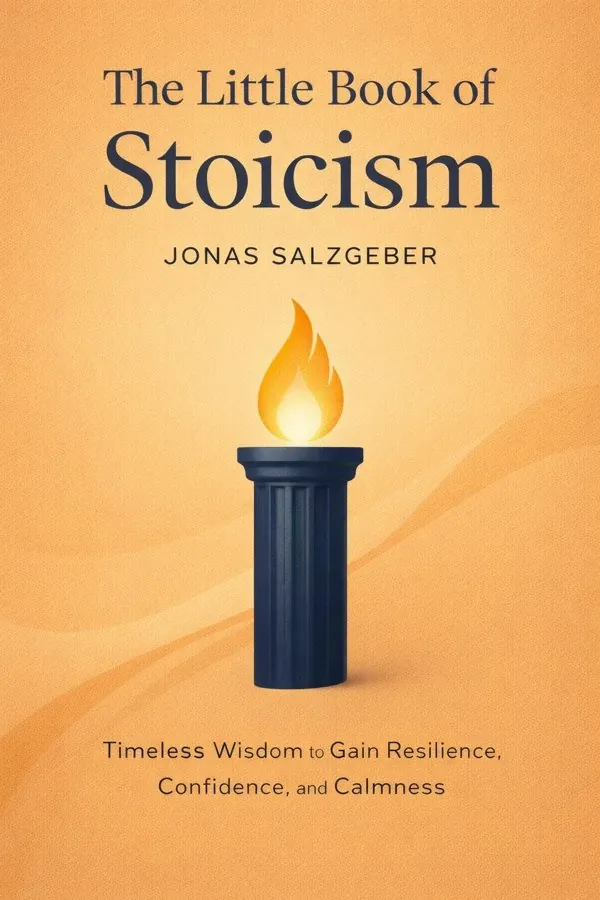
The Little Book of Stoicism: Timeless Wisdom to Gain Resilience, Confidence, and Calmness: Summary & Key Insights
 10 min9 chaptersAudio available
Key Takeaways from The Little Book of Stoicism: Timeless Wisdom to Gain Resilience, Confidence, and Calmness
Freedom begins the moment you stop demanding power over what was never yours to command.
A meaningful life is not built by chasing every desire but by aligning yourself with what you truly are.
Character is not revealed in grand speeches but in repeated choices under pressure.
Events do not break us as quickly as our interpretations of them.
Philosophy changes nothing until it becomes practice.
What Is The Little Book of Stoicism: Timeless Wisdom to Gain Resilience, Confidence, and Calmness About?
The Little Book of Stoicism: Timeless Wisdom to Gain Resilience, Confidence, and Calmness by Jonas Salzgeber is a eastern_wisdom book spanning 9 pages. The Little Book of Stoicism is a modern guide to one of history’s most practical philosophies. In this accessible and highly actionable book, Jonas Salzgeber translates the teachings of Epictetus, Seneca, and Marcus Aurelius into simple principles for everyday life. Rather than treating Stoicism as an abstract system of ideas, he presents it as a training ground for resilience, emotional balance, self-discipline, and inner peace. The central promise is powerful: while we cannot control the world, we can learn to govern our judgments, choices, and character. What makes this book matter is its relevance. Modern life is filled with stress, distraction, comparison, uncertainty, and frustration—the exact conditions in which Stoic wisdom becomes useful. Salzgeber shows how to respond to setbacks without collapse, success without arrogance, and uncertainty without panic. His writing is clear, practical, and rooted in lived application rather than theory alone. As a writer and co-founder of NJlifehacks, a platform focused on personal development and Stoic practice, Salzgeber has built his work around making ancient wisdom usable in the present. The result is a concise but meaningful handbook for anyone seeking calmness, confidence, and a life guided by virtue rather than circumstance.
This FizzRead summary covers all 9 key chapters of The Little Book of Stoicism: Timeless Wisdom to Gain Resilience, Confidence, and Calmness in approximately 10 minutes, distilling the most important ideas, arguments, and takeaways from Jonas Salzgeber's work. Also available as an audio summary and Key Quotes Podcast.
The Little Book of Stoicism: Timeless Wisdom to Gain Resilience, Confidence, and Calmness
The Little Book of Stoicism is a modern guide to one of history’s most practical philosophies. In this accessible and highly actionable book, Jonas Salzgeber translates the teachings of Epictetus, Seneca, and Marcus Aurelius into simple principles for everyday life. Rather than treating Stoicism as an abstract system of ideas, he presents it as a training ground for resilience, emotional balance, self-discipline, and inner peace. The central promise is powerful: while we cannot control the world, we can learn to govern our judgments, choices, and character.
What makes this book matter is its relevance. Modern life is filled with stress, distraction, comparison, uncertainty, and frustration—the exact conditions in which Stoic wisdom becomes useful. Salzgeber shows how to respond to setbacks without collapse, success without arrogance, and uncertainty without panic. His writing is clear, practical, and rooted in lived application rather than theory alone. As a writer and co-founder of NJlifehacks, a platform focused on personal development and Stoic practice, Salzgeber has built his work around making ancient wisdom usable in the present. The result is a concise but meaningful handbook for anyone seeking calmness, confidence, and a life guided by virtue rather than circumstance.
Who Should Read The Little Book of Stoicism: Timeless Wisdom to Gain Resilience, Confidence, and Calmness?
This book is perfect for anyone interested in eastern_wisdom and looking to gain actionable insights in a short read. Whether you're a student, professional, or lifelong learner, the key ideas from The Little Book of Stoicism: Timeless Wisdom to Gain Resilience, Confidence, and Calmness by Jonas Salzgeber will help you think differently.
- ✓Readers who enjoy eastern_wisdom and want practical takeaways
- ✓Professionals looking to apply new ideas to their work and life
- ✓Anyone who wants the core insights of The Little Book of Stoicism: Timeless Wisdom to Gain Resilience, Confidence, and Calmness in just 10 minutes
Want the full summary?
Get instant access to this book summary and 100K+ more with Fizz Moment.
Get Free SummaryAvailable on App Store • Free to download
Key Chapters
Freedom begins the moment you stop demanding power over what was never yours to command. This is the foundational Stoic insight: some things are up to us, and some are not. Our judgments, intentions, choices, and actions belong to us. Other people’s opinions, the weather, the economy, our reputation, and many outcomes do not. According to Epictetus, confusion between these two realms is the source of much human suffering.
Salzgeber emphasizes that Stoicism does not ask us to become passive. It asks us to become precise. You still prepare carefully for a job interview, train hard for a competition, or communicate honestly in a relationship. But you stop tying your peace of mind to the final result. You focus on your effort, your attitude, and your conduct. If the outcome goes your way, good. If not, you still retain your self-command.
This distinction is especially useful in modern life, where stress often comes from trying to control reactions, approval, timing, and certainty. Imagine posting your work online. You can control the quality of what you create and the integrity behind it. You cannot control who praises it, ignores it, or criticizes it. The Stoic move is to commit fully to the first and release attachment to the second.
A practical way to apply this is to ask in difficult situations: What here depends on me? Then act firmly on that and mentally let go of the rest. Actionable takeaway: make a daily habit of separating controllables from uncontrollables before reacting to any stressful event.
A meaningful life is not built by chasing every desire but by aligning yourself with what you truly are. For the Stoics, living according to nature means living in harmony with reason, reality, and human purpose. Human beings are not merely creatures of appetite. We are capable of reflection, restraint, judgment, and moral choice. To live well, then, is to live as a rational and social being rather than as a slave to impulse.
Salzgeber explains this idea in practical terms. Living according to nature does not mean retreating to the forest or rejecting ambition. It means seeing clearly what supports human flourishing and what corrupts it. Vanity, excess, anger, and mindless distraction pull us away from our nature. Wisdom, courage, moderation, and justice bring us back to it.
This perspective is a direct challenge to modern assumptions. Many people are taught that happiness comes from more: more attention, more possessions, more comfort, more status. Stoicism argues that peace comes from fit, not excess. Are your habits aligned with your values? Are your goals consistent with reason? Are you acting in ways that strengthen your character?
For example, if you feel exhausted from constant comparison on social media, living according to nature may mean reducing exposure to what inflames envy and returning to activities that cultivate thoughtfulness and connection. If your work is profitable but morally empty, Stoicism invites you to question whether success without integrity is success at all.
Actionable takeaway: review one major area of your life—work, relationships, or habits—and ask whether it is guided by reason and virtue or by impulse and social pressure.
Character is not revealed in grand speeches but in repeated choices under pressure. Stoicism teaches that the good life rests on four cardinal virtues: wisdom, courage, justice, and temperance. Salzgeber presents these not as abstract moral decorations but as practical standards for daily decision-making.
Wisdom is the ability to judge clearly: to distinguish what matters from what does not, and to respond thoughtfully rather than impulsively. Courage is not fearlessness but the willingness to do what is right despite discomfort, uncertainty, or criticism. Justice means treating others fairly, honestly, and with respect, recognizing that we are part of a shared human community. Temperance is self-restraint, the capacity to govern desires, emotions, and appetites instead of being ruled by them.
These virtues work together. Wisdom without courage becomes hesitation. Courage without wisdom becomes recklessness. Justice without temperance may collapse under emotion. Temperance without justice can become cold self-protection. In Stoicism, virtue is not one life category among many; it is the measure of a life well lived.
Consider a common workplace dilemma. A colleague takes credit for part of your work. Wisdom helps you assess the situation calmly. Courage helps you address it directly. Justice keeps you fair rather than vindictive. Temperance prevents an angry overreaction. The Stoic question is never simply, “How do I win?” but “Who am I becoming through this response?”
Salzgeber’s larger point is that external success is unstable, but virtuous character can be strengthened every day. Actionable takeaway: at the end of each day, reflect on one moment when you could have expressed more wisdom, courage, justice, or temperance—and decide how you will act next time.
Events do not break us as quickly as our interpretations of them. One of Stoicism’s most transformative claims is that emotions are deeply connected to judgment. We are disturbed not only by what happens, but by what we believe it means. Salzgeber uses this insight to show that resilience is less about suppressing feeling and more about examining thought.
Stoicism is often misunderstood as emotional numbness. In reality, it teaches emotional discipline. If someone insults you, the pain often comes from accepting the insult as a threat to your worth. If a plan fails, despair often follows the belief that failure defines you. The Stoic practice is to pause and test the judgment behind the emotion. Is this truly catastrophic? Is my interpretation accurate? Am I adding unnecessary drama to reality?
This approach creates space between stimulus and reaction. For example, being stuck in traffic can trigger anger if you tell yourself, “This ruins everything.” But if you reframe it as an inconvenience rather than a personal injustice, your emotional state changes. Likewise, criticism can become fuel for reflection rather than a wound to the ego.
Salzgeber does not deny that grief, pain, or disappointment are real. Instead, he shows that many forms of psychological suffering are intensified by avoidable stories we tell ourselves. Emotional resilience grows when we replace exaggerated judgments with sober ones.
A useful Stoic habit is to catch emotionally loaded words like “always,” “never,” “disaster,” and “unbearable.” They often signal that judgment has outrun fact. Actionable takeaway: when a strong emotion arises, write down the event, your interpretation of it, and one calmer, more rational alternative explanation.
Philosophy changes nothing until it becomes practice. Salzgeber makes one of Stoicism’s greatest strengths unmistakable: it is a lived discipline, not a set of inspiring quotations. The ancient Stoics used daily exercises to train attention, strengthen character, and prepare for adversity. This book revives those methods in a modern, approachable form.
One important practice is morning reflection. Before the day begins, you remind yourself what may happen—interruptions, difficult people, delays, temptations—and decide in advance how you want to respond. Another is evening review, in which you examine your actions honestly: What did I do well? Where did I fall short? What can I improve tomorrow? This builds self-awareness without self-hatred.
Negative visualization is another powerful tool. By imagining the loss of comforts, health, status, or even loved ones, you do not become gloomy; you become grateful and less entitled. Voluntary discomfort serves a similar purpose. Taking a cold shower, skipping a luxury, or walking instead of driving can remind you that you need less than you think. Simplicity builds confidence.
Journaling, too, becomes a Stoic exercise when used to clarify judgments and reinforce principles. Instead of venting endlessly, you ask: What is in my control? What virtue is required here? What story am I telling that increases distress?
Salzgeber’s message is that resilience is trained in ordinary moments, not only during crises. Small repeated exercises create inner stability over time. Actionable takeaway: choose one Stoic practice—morning reflection, evening review, or journaling—and commit to it daily for the next seven days.
Hardship does not automatically destroy a person; often, it reveals what has and has not been trained. Stoicism treats adversity not as a meaningless interruption of life but as one of life’s central proving grounds. Salzgeber explains that obstacles are unavoidable, but unnecessary suffering comes from resisting reality instead of meeting it with discipline.
The Stoic does not ask, “Why is this happening to me?” in a spirit of self-pity. The better question is, “What does this situation require of me now?” This shift is crucial. It transforms adversity from a personal insult into an opportunity for virtue. Illness may require patience. Financial loss may require courage and simplicity. Conflict may require self-restraint and justice.
This does not romanticize pain. Stoicism does not claim that loss is pleasant. It claims that your response remains morally significant even when circumstances are harsh. Marcus Aurelius wrote that the impediment to action advances action; what stands in the way becomes the way. Salzgeber applies this practically: every setback can become training in resilience if you stop demanding that life unfold on your terms.
Consider losing an important opportunity. A non-Stoic reaction might spiral into bitterness, envy, or self-doubt. A Stoic reaction begins with acceptance: this happened. Then comes agency: what can I learn, improve, or endure with dignity? Adversity can sharpen perspective, expose unhealthy dependence, and remind us that character matters more than comfort.
Actionable takeaway: the next time you face a setback, write down three responses available to you and choose the one that best expresses courage, patience, or wisdom rather than frustration or self-pity.
What if the quality of your life depends less on circumstances than on the lens through which you interpret them? Stoicism repeatedly returns to perspective because perception shapes experience. Salzgeber shows that many people live imprisoned not by events but by mental habits: exaggeration, comparison, entitlement, and constant complaint.
A Stoic mindset trains you to see things as they are, not as fear or ego distorts them. This includes remembering impermanence. Success, health, youth, praise, and comfort are temporary. So are embarrassment, pain, and failure. Keeping this broader view helps you avoid both despair and intoxication. You become steadier because you stop treating every moment as ultimate.
Perspective also protects against trivial agitation. Much of what ruins a day is small: a rude message, a delayed train, a forgotten errand, an awkward conversation. Stoicism asks whether these things truly deserve the power we give them. Often, they do not. Reframing is not denial; it is proportion.
For example, instead of saying, “This is unbearable,” you might say, “This is unpleasant, but manageable.” Instead of thinking, “Everyone is against me,” you might ask, “Do I actually know their intentions?” These subtle shifts reduce emotional excess and preserve clarity.
Salzgeber’s core point is that inner freedom grows when you stop handing your peace over to appearances. A disciplined perspective makes life lighter without making it superficial. Actionable takeaway: whenever something disturbs you today, pause and ask, “How important will this seem in a week, a year, or at the end of my life?”
The deepest form of happiness is not pleasure, luck, or approval but the experience of living in alignment with your best self. This is the Stoic ideal of eudaimonia: flourishing through virtue. Salzgeber stresses that Stoicism does not promise a painless life. It offers something stronger—a stable form of well-being that is not constantly overturned by external change.
Most people chase happiness indirectly through possessions, recognition, comfort, or emotional highs. The problem is that all of these are unstable. If your well-being depends on them, you will be anxious when they are absent and afraid when they are present. Stoicism relocates the center of gravity. Your true good lies in how you think, choose, and act.
This makes the path demanding but liberating. You are no longer waiting for ideal conditions to become peaceful. You practice wisdom in confusion, courage in fear, justice in conflict, and temperance amid temptation. Over time, this builds a life of coherence. You trust yourself more because your values are no longer negotiable.
Eudaimonia in Stoic terms is not constant cheerfulness. It is a grounded life marked by integrity, resilience, gratitude, and purpose. You may still feel sorrow, fatigue, or frustration, but you are not inwardly shattered by them. Your identity rests on character, not circumstance.
Salzgeber’s contribution is to show that this ancient goal remains realistic today. Flourishing is not for philosophers alone; it is available to anyone willing to practice. Actionable takeaway: define in one sentence what a flourishing life means to you, then identify one daily habit that would bring your behavior into closer alignment with that definition.
All Chapters in The Little Book of Stoicism: Timeless Wisdom to Gain Resilience, Confidence, and Calmness
About the Author
Jonas Salzgeber is a Swiss author and the co-founder of NJlifehacks, a platform dedicated to personal development, mental clarity, and practical Stoic philosophy. His writing focuses on translating timeless ideas from ancient thinkers into useful tools for modern life. Rather than approaching Stoicism as a purely academic subject, Salzgeber emphasizes its real-world value for building resilience, self-discipline, confidence, and emotional balance. He is known for clear, structured, and accessible explanations that help readers apply philosophy to stress, habits, relationships, and adversity. Through his books and online work, Salzgeber has introduced a broad audience to Stoicism as a daily practice for living with greater purpose, calmness, and integrity.
Get This Summary in Your Preferred Format
Read or listen to the The Little Book of Stoicism: Timeless Wisdom to Gain Resilience, Confidence, and Calmness summary by Jonas Salzgeber anytime, anywhere. FizzRead offers multiple formats so you can learn on your terms — all free.
Available formats: App · Audio · PDF · EPUB — All included free with FizzRead
Download The Little Book of Stoicism: Timeless Wisdom to Gain Resilience, Confidence, and Calmness PDF and EPUB Summary
Key Quotes from The Little Book of Stoicism: Timeless Wisdom to Gain Resilience, Confidence, and Calmness
“Freedom begins the moment you stop demanding power over what was never yours to command.”
“A meaningful life is not built by chasing every desire but by aligning yourself with what you truly are.”
“Character is not revealed in grand speeches but in repeated choices under pressure.”
“Events do not break us as quickly as our interpretations of them.”
“Philosophy changes nothing until it becomes practice.”
Frequently Asked Questions about The Little Book of Stoicism: Timeless Wisdom to Gain Resilience, Confidence, and Calmness
The Little Book of Stoicism: Timeless Wisdom to Gain Resilience, Confidence, and Calmness by Jonas Salzgeber is a eastern_wisdom book that explores key ideas across 9 chapters. The Little Book of Stoicism is a modern guide to one of history’s most practical philosophies. In this accessible and highly actionable book, Jonas Salzgeber translates the teachings of Epictetus, Seneca, and Marcus Aurelius into simple principles for everyday life. Rather than treating Stoicism as an abstract system of ideas, he presents it as a training ground for resilience, emotional balance, self-discipline, and inner peace. The central promise is powerful: while we cannot control the world, we can learn to govern our judgments, choices, and character. What makes this book matter is its relevance. Modern life is filled with stress, distraction, comparison, uncertainty, and frustration—the exact conditions in which Stoic wisdom becomes useful. Salzgeber shows how to respond to setbacks without collapse, success without arrogance, and uncertainty without panic. His writing is clear, practical, and rooted in lived application rather than theory alone. As a writer and co-founder of NJlifehacks, a platform focused on personal development and Stoic practice, Salzgeber has built his work around making ancient wisdom usable in the present. The result is a concise but meaningful handbook for anyone seeking calmness, confidence, and a life guided by virtue rather than circumstance.
You Might Also Like

A New Earth
Eckhart Tolle
10 min
The Daily Stoic
Ryan Holiday, Stephen Hanselman
10 min
Buddhism: Plain and Simple
Steve Hagen
10 min
Enchiridion
Epictetus
10 min
The Book of Tea
Kakuzō Okakura
10 min
The Light We Give: How Sikh Wisdom Can Transform Your Life
Simran Jeet Singh
10 minBrowse by Category
Ready to read The Little Book of Stoicism: Timeless Wisdom to Gain Resilience, Confidence, and Calmness?
Get the full summary and 100K+ more books with Fizz Moment.