
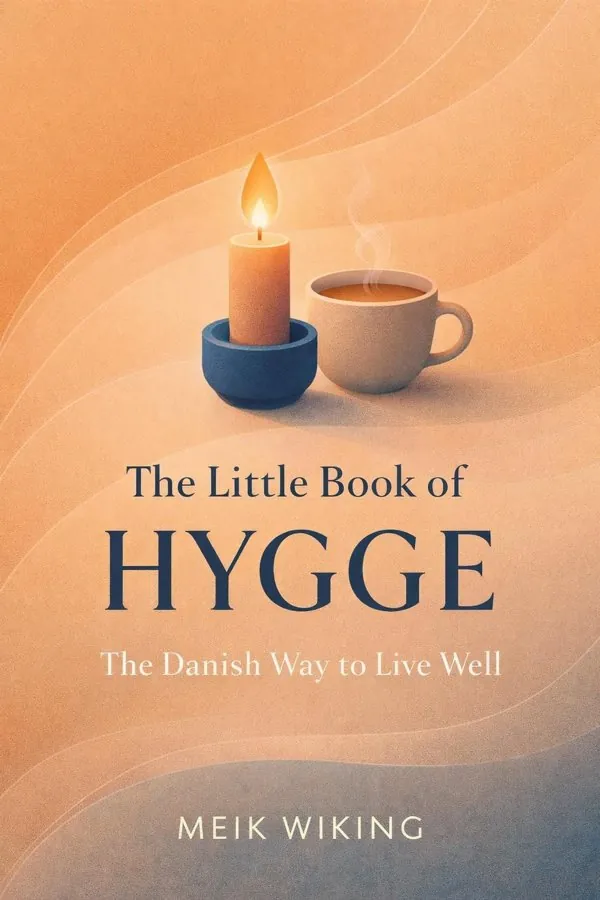
The Little Book of Hygge: The Danish Way to Live Well: Summary & Key Insights
by Meik Wiking
 10 min10 chaptersAudio available
Key Takeaways from The Little Book of Hygge: The Danish Way to Live Well
Some of the most important parts of life are hard to translate because they are felt before they are explained.
National happiness is often explained through economics and policy, but Wiking suggests that culture also shapes how people experience daily life.
Coziness is not mainly about objects; it is about what those objects make possible.
The spaces we inhabit quietly shape our mood, energy, and relationships.
One of the quickest ways to create connection is to share something warm, simple, and satisfying.
What Is The Little Book of Hygge: The Danish Way to Live Well About?
The Little Book of Hygge: The Danish Way to Live Well by Meik Wiking is a wellness book spanning 10 pages. The Little Book of Hygge explores one of Denmark’s most beloved cultural ideas: the art of creating warmth, comfort, and connection in everyday life. In this charming and practical book, Meik Wiking argues that happiness is not built only through major accomplishments or dramatic life changes. More often, it grows out of ordinary moments shared with people we trust, in spaces that help us slow down and feel at ease. Hygge is the Danish word for that feeling of coziness, belonging, and emotional safety. What makes the book especially compelling is Wiking’s authority. As CEO of the Happiness Research Institute in Copenhagen, he combines cultural insight with research on well-being, social trust, and quality of life. He shows why hygge matters not just as a lifestyle trend, but as a meaningful response to stress, isolation, and modern busyness. Through stories, examples, and simple rituals involving light, food, home design, and friendship, Wiking offers readers a gentle blueprint for living better. The result is a warm, inviting guide to finding more joy in simple pleasures and everyday togetherness.
This FizzRead summary covers all 10 key chapters of The Little Book of Hygge: The Danish Way to Live Well in approximately 10 minutes, distilling the most important ideas, arguments, and takeaways from Meik Wiking's work. Also available as an audio summary and Key Quotes Podcast.
The Little Book of Hygge: The Danish Way to Live Well
The Little Book of Hygge explores one of Denmark’s most beloved cultural ideas: the art of creating warmth, comfort, and connection in everyday life. In this charming and practical book, Meik Wiking argues that happiness is not built only through major accomplishments or dramatic life changes. More often, it grows out of ordinary moments shared with people we trust, in spaces that help us slow down and feel at ease. Hygge is the Danish word for that feeling of coziness, belonging, and emotional safety.
What makes the book especially compelling is Wiking’s authority. As CEO of the Happiness Research Institute in Copenhagen, he combines cultural insight with research on well-being, social trust, and quality of life. He shows why hygge matters not just as a lifestyle trend, but as a meaningful response to stress, isolation, and modern busyness. Through stories, examples, and simple rituals involving light, food, home design, and friendship, Wiking offers readers a gentle blueprint for living better. The result is a warm, inviting guide to finding more joy in simple pleasures and everyday togetherness.
Who Should Read The Little Book of Hygge: The Danish Way to Live Well?
This book is perfect for anyone interested in wellness and looking to gain actionable insights in a short read. Whether you're a student, professional, or lifelong learner, the key ideas from The Little Book of Hygge: The Danish Way to Live Well by Meik Wiking will help you think differently.
- ✓Readers who enjoy wellness and want practical takeaways
- ✓Professionals looking to apply new ideas to their work and life
- ✓Anyone who wants the core insights of The Little Book of Hygge: The Danish Way to Live Well in just 10 minutes
Want the full summary?
Get instant access to this book summary and 100K+ more with Fizz Moment.
Get Free SummaryAvailable on App Store • Free to download
Key Chapters
Some of the most important parts of life are hard to translate because they are felt before they are explained. Hygge is one of those ideas. Meik Wiking presents it not as a strict philosophy or a list of design rules, but as a lived experience of coziness, comfort, presence, and emotional safety. Hygge happens when the atmosphere allows people to relax, lower their guard, and enjoy simple pleasures without pressure or performance.
This is why hygge is often misunderstood outside Denmark. It is easy to reduce it to candles, blankets, and warm drinks, but those are only tools. The deeper meaning is relational and emotional. Hygge is the feeling of being at home, whether at home literally or in the company of people who accept you as you are. It values intimacy over impressiveness, and ease over excitement. It can happen during a rainy evening with soup on the stove, a board game with friends, or a quiet moment of reading by soft light.
Wiking emphasizes that hygge is democratic. It does not depend on luxury, wealth, or perfect taste. In fact, too much striving can ruin it. A highly staged evening designed to look cozy on social media may feel less hyggelig than a simple dinner where everyone helps cook and no one is trying to impress anyone.
The practical lesson is to stop treating well-being as something distant or expensive. Instead, begin noticing the conditions that help you feel grounded and connected. Actionable takeaway: create one small daily ritual that makes you feel safe and present, such as lighting a candle at dinner, putting away your phone for an hour, or sharing tea with someone you trust.
National happiness is often explained through economics and policy, but Wiking suggests that culture also shapes how people experience daily life. Denmark frequently ranks near the top of global happiness reports, and while this cannot be credited to hygge alone, hygge plays an important supporting role. It gives people habits and social norms that make ordinary life feel more manageable, intimate, and enjoyable.
Wiking is careful not to oversimplify. Denmark’s high well-being is supported by factors such as social trust, a strong welfare state, and a sense of security. Yet hygge helps translate those larger structures into daily experience. It encourages people to gather in small groups, value equality, and appreciate simple routines. These patterns reduce social tension and create environments where people feel included rather than judged.
One reason hygge matters is that it lowers expectations of constant achievement. In many cultures, happiness is associated with ambition, visibility, or exceptional success. Hygge shifts the focus toward enoughness. A homemade meal, wool socks, a familiar room, and honest conversation are not seen as consolation prizes; they are central ingredients of a good life.
This mindset has practical implications. Instead of constantly chasing upgrades, people can invest in trust, rest, and shared rituals. A neighborhood dinner, regular coffee with a friend, or a calm family evening may contribute more to lasting well-being than expensive entertainment.
Wiking’s broader point is that happiness is often built socially and atmospherically, not just individually. Actionable takeaway: identify one recurring activity in your week that feels rushed or transactional, and redesign it to be slower, warmer, and more communal.
Coziness is not mainly about objects; it is about what those objects make possible. Wiking shows that hygge rests on several emotional foundations: safety, equality, presence, gratitude, and permission to be imperfect. When these conditions exist, people relax into themselves and into one another. Without them, even beautiful surroundings can feel cold.
A key part of hygge is emotional safety. People need to feel that they can speak freely, stay quiet without awkwardness, and appear without performance. This is why hierarchy and status display weaken hygge. If everyone is trying to impress, compete, or dominate, the atmosphere tightens. Hygge works best when the tone is humble and inclusive, where everyone belongs and no one has to earn their place.
Presence is another foundation. Wiking repeatedly points to moments where people are truly there with each other, not distracted by devices, schedules, or self-consciousness. Hygge often involves slowness because slowness creates room for attention. A meal enjoyed without hurry, a conversation that wanders naturally, or a long winter evening with no agenda can all become deeply restorative.
Gratitude also plays a role. Hygge teaches people to notice enoughness in small things: a warm room, a trusted friend, bread fresh from the oven, the relief of being indoors when it is storming outside. Rather than denying life’s difficulties, it creates pockets of steadiness within them.
In practice, this means focusing less on decorating for an aesthetic and more on building emotional conditions for comfort. Actionable takeaway: the next time you host or meet with others, prioritize ease over perfection by simplifying plans, reducing distractions, and creating space for honest conversation.
The spaces we inhabit quietly shape our mood, energy, and relationships. Wiking explains that hygge is easier to experience in environments that communicate warmth, calm, and intimacy. This is why lighting, texture, scale, and arrangement matter so much. A room does not need to be large or expensive to feel welcoming; in fact, smaller and softer spaces often support hygge better than grand ones.
Light is perhaps the most important element. Danes are famous for candles, and Wiking notes that this is not a cliché but a real cultural preference. Soft, warm, low lighting creates a sense of shelter and calm that harsh overhead lighting rarely achieves. Lamps placed at eye level, flickering candlelight, and pools of light instead of total brightness all encourage relaxation.
Texture is equally important. Blankets, wood, ceramics, books, cushions, and natural materials help a room feel lived in rather than sterile. Hygge favors comfort over sleek perfection. The goal is not showroom minimalism but human warmth. A mug with a handmade feel, a worn chair that invites sitting, or a windowsill where one can watch the rain all contribute to atmosphere.
Wiking also highlights the importance of a hyggekrog, or cozy nook: a corner designed for retreat and comfort. It may be a reading chair near a lamp, a kitchen table by a window, or a pile of cushions in a quiet corner.
The lesson is that your home can actively support well-being. Actionable takeaway: choose one corner of your home and transform it into a dedicated cozy space using softer lighting, comfortable textures, and one object that encourages you to slow down.
Many people assume social happiness comes from large, exciting gatherings, but hygge points in a different direction. Wiking argues that the most meaningful forms of togetherness are often quiet, small-scale, and low-pressure. Hygge flourishes in trusted company, where people can drop social armor and simply enjoy being together.
This is one reason hygge often involves small groups of close friends or family rather than large crowds. Intimacy allows for softer conversation, shared jokes, comfortable silence, and a stronger sense of inclusion. The atmosphere is cooperative rather than competitive. There is less need to perform, network, or manage impressions.
Wiking also emphasizes equality. Hygge resists hierarchy. A hyggelig gathering is one where everyone has a place, where no one dominates the room, and where the focus is on shared enjoyment rather than status. This can be seen in informal dinners, game nights, walks, or evenings spent talking around a table. The activity matters less than the emotional tone.
This insight is particularly useful in a world where many social interactions are shaped by speed, distraction, and image management. Hygge reminds us that connection deepens when we create spaces where people feel relaxed and accepted. It is not the number of invitations, but the quality of presence, that matters.
Practical applications are simple: keep groups smaller, make gatherings participatory, reduce noise and distractions, and choose activities that allow conversation. Actionable takeaway: plan one intentionally low-pressure social event, such as tea with two friends or a simple dinner at home, and focus on comfort, equality, and genuine presence rather than entertainment.
It is striking that one of the world’s happiest countries also endures long, dark winters. Wiking suggests that hygge is part of how Danes respond to the season. Rather than fighting winter entirely, they adapt to it by creating islands of warmth, light, and companionship. Hygge becomes a form of seasonal resilience.
This is an important lesson because many people treat difficult seasons, literal or emotional, as periods to endure until life improves. Hygge offers another approach: make the season itself meaningful. In winter, that may mean leaning into candles, hearty food, wool blankets, warm drinks, and evenings spent indoors with people you care about. Darkness outside can sharpen the sense of refuge inside.
Wiking shows that hygge is not denial. It does not pretend cold weather is pleasant all the time. Instead, it recognizes that comfort is especially powerful in contrast. A fire feels better when it is freezing outdoors. Soup tastes richer after a windy walk. Togetherness becomes more precious when the world outside feels harsh.
This seasonal perspective can be applied more broadly. Any demanding period of life can be softened by rituals of care and continuity. During busy months, grief, stress, or uncertainty, small routines help anchor us. A lamp switched on at dusk, baking on Sundays, or a standing invitation for a friend to stop by can create stability.
Wiking’s message is that atmosphere can help us cooperate with reality rather than resist it. Actionable takeaway: choose one seasonal ritual for the current time of year that helps you welcome it rather than merely tolerate it.
Although home is a natural setting for hygge, Wiking makes clear that hygge is not confined to private domestic life. It can appear in workplaces, public spaces, neighborhoods, and outdoor experiences. Wherever people create comfort, trust, and ease, hygge becomes possible.
At work, this may mean shared coffee breaks, humane lighting, communal lunches, and a culture that values people over pure efficiency. A workplace can be productive without feeling mechanical. Small gestures, such as bringing in pastries on a Friday or making meeting spaces more welcoming, can shift the tone from transactional to collaborative.
In public life, hygge may emerge in cafés with warm light and simple seating, libraries that invite lingering, or community events that feel local and unpretentious. Outdoor hygge is also possible: bonfires, picnics, bike rides, garden gatherings, and bundled-up walks all fit the spirit. The key is not whether one is indoors or outdoors, but whether the setting encourages comfort and connection.
This matters because many people compartmentalize well-being, assuming life must be stressful in public and restful only in private. Wiking invites a broader view. The values of hygge can shape how we design routines, relationships, and environments across the whole day.
You do not need to wait for a perfect evening at home to practice it. A thermos of coffee on a park bench, a gentle team ritual, or a relaxed neighborhood meal can all carry the same spirit.
Actionable takeaway: identify one non-home setting in your life and introduce a small element of hygge there, such as softer lighting, a shared snack ritual, or a more welcoming way to gather.
Modern culture often tells us that a better life comes from more: more upgrades, more novelty, more optimization. Wiking’s portrait of hygge quietly challenges that assumption. Hygge is rooted in sufficiency rather than excess. It values simple pleasures, durable comforts, and meaningful use over status consumption.
This does not mean rejecting material things altogether. Objects matter in hygge, but mostly because of how they support experience. A favorite mug, a sturdy wool blanket, a lamp that casts warm light, or a wooden table marked by years of meals all have value because they invite ease and continuity. Hygge prefers the personal over the flashy and the lasting over the disposable.
Wiking also implies a subtle sustainability in the hygge mindset. When people derive satisfaction from small rituals, close relationships, and comforting spaces, they may feel less pressure to seek stimulation through constant buying. Simplicity becomes enriching rather than restrictive. A quiet evening at home can feel abundant if the atmosphere is right.
This is especially relevant in an age of comparison-driven consumption. People often chase aesthetics or possessions that look desirable but do not actually improve daily well-being. Hygge asks a more useful question: does this make life feel warmer, calmer, and more connected?
A hygge approach to consumption is therefore selective and intentional. Buy less, choose well, and use what you have in ways that create shared enjoyment.
Actionable takeaway: before your next discretionary purchase, ask whether it will genuinely support comfort, connection, or daily ritual; if not, consider investing instead in a shared experience or improving a space you already use.
The global appeal of hygge reveals something important about modern life: many people are starved for slowness, belonging, and uncomplicated comfort. Wiking explains that hygge has traveled so widely because it answers needs that are increasingly universal. In fast, digital, achievement-focused societies, people long for rituals that restore presence and human warmth.
Psychologically, hygge works because it engages several pathways to well-being at once. It reduces stress through soothing sensory cues such as warm light and soft textures. It strengthens social bonds through intimate gatherings and shared rituals. It encourages gratitude by drawing attention to ordinary pleasures. And it supports emotional regulation by creating predictable, comforting routines.
The idea also resonates because it is accessible. Unlike many wellness trends, hygge does not require exceptional discipline, expensive equipment, or a total life overhaul. It is built from small choices available to most people: turning down bright lights, sharing soup, walking with a friend, reading under a blanket, or making room for unhurried conversation.
Still, Wiking’s deeper contribution is to show that hygge is not merely a style but a value system. It says that ordinary life deserves care. It says that comfort is not laziness, intimacy is not trivial, and small joys are not insignificant. In that sense, hygge is both practical and quietly radical.
Its enduring message is that well-being can be cultivated in the texture of daily life. Actionable takeaway: choose one recurring moment in your routine and redesign it as a tiny act of resistance against haste by adding comfort, attention, and shared humanity.
All Chapters in The Little Book of Hygge: The Danish Way to Live Well
About the Author
Meik Wiking is a Danish writer, speaker, and well-being researcher best known for exploring what makes people happy. He is the CEO of the Happiness Research Institute in Copenhagen, an independent think tank focused on life satisfaction, quality of life, and public policy related to happiness. Wiking has become an internationally recognized voice on Danish approaches to well-being, combining research findings with accessible storytelling and practical advice. His work often examines how culture, memory, relationships, and everyday habits influence a good life. In addition to The Little Book of Hygge, he is the author of books such as The Little Book of Lykke and The Art of Making Memories. His writing is valued for making happiness research warm, usable, and deeply human.
Get This Summary in Your Preferred Format
Read or listen to the The Little Book of Hygge: The Danish Way to Live Well summary by Meik Wiking anytime, anywhere. FizzRead offers multiple formats so you can learn on your terms — all free.
Available formats: App · Audio · PDF · EPUB — All included free with FizzRead
Download The Little Book of Hygge: The Danish Way to Live Well PDF and EPUB Summary
Key Quotes from The Little Book of Hygge: The Danish Way to Live Well
“Some of the most important parts of life are hard to translate because they are felt before they are explained.”
“National happiness is often explained through economics and policy, but Wiking suggests that culture also shapes how people experience daily life.”
“Coziness is not mainly about objects; it is about what those objects make possible.”
“The spaces we inhabit quietly shape our mood, energy, and relationships.”
“One of the quickest ways to create connection is to share something warm, simple, and satisfying.”
Frequently Asked Questions about The Little Book of Hygge: The Danish Way to Live Well
The Little Book of Hygge: The Danish Way to Live Well by Meik Wiking is a wellness book that explores key ideas across 10 chapters. The Little Book of Hygge explores one of Denmark’s most beloved cultural ideas: the art of creating warmth, comfort, and connection in everyday life. In this charming and practical book, Meik Wiking argues that happiness is not built only through major accomplishments or dramatic life changes. More often, it grows out of ordinary moments shared with people we trust, in spaces that help us slow down and feel at ease. Hygge is the Danish word for that feeling of coziness, belonging, and emotional safety. What makes the book especially compelling is Wiking’s authority. As CEO of the Happiness Research Institute in Copenhagen, he combines cultural insight with research on well-being, social trust, and quality of life. He shows why hygge matters not just as a lifestyle trend, but as a meaningful response to stress, isolation, and modern busyness. Through stories, examples, and simple rituals involving light, food, home design, and friendship, Wiking offers readers a gentle blueprint for living better. The result is a warm, inviting guide to finding more joy in simple pleasures and everyday togetherness.
More by Meik Wiking
You Might Also Like

How We Heal: Uncover Your Power and Set Yourself Free
Alexandra Elle
10 min
A Year of Self-Care: Daily Practices and Inspiration for Caring for Yourself
Zoe Shaw
10 min
Biohacker’s Handbook: Upgrade Your Life
Olli Sovijärvi, Teemu Arina, Jaakko Halmetoja
10 min
Bliss More: How to Succeed in Meditation Without Really Trying
Light Watkins
10 min
Body Kindness: Transform Your Health from the Inside Out—and Never Say Diet Again
Rebecca Scritchfield
10 min
Cook, Eat, Run: Cook Fast, Boost Performance with 75 Ultimate Recipes for Runners
Charlie Watson
10 minBrowse by Category
Ready to read The Little Book of Hygge: The Danish Way to Live Well?
Get the full summary and 100K+ more books with Fizz Moment.