
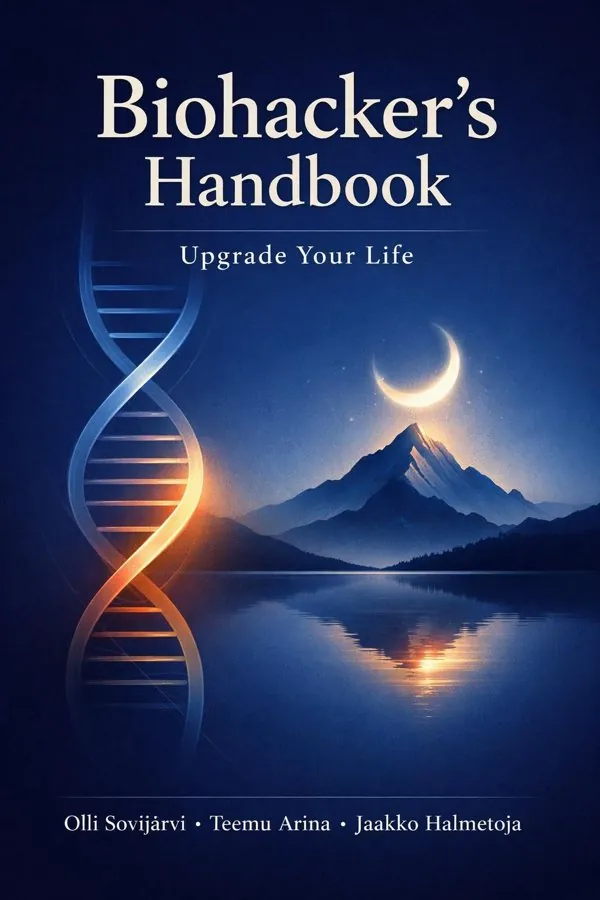
Biohacker’s Handbook: Upgrade Your Life: Summary & Key Insights
by Olli Sovijärvi, Teemu Arina, Jaakko Halmetoja
 10 min9 chaptersAudio available
Key Takeaways from Biohacker’s Handbook: Upgrade Your Life
Most people try to improve health in fragments, yet the body never operates in fragments.
If you want to improve anything in your life, start the night before.
Food does more than fill the stomach; it sends instructions to the body.
Exercise is valuable, but the book makes an even broader point: the body expects movement all day, not just a workout squeezed between long periods of sitting.
Many people treat stress as a mental issue, but the book shows that stress is a full-body biological event.
What Is Biohacker’s Handbook: Upgrade Your Life About?
Biohacker’s Handbook: Upgrade Your Life by Olli Sovijärvi, Teemu Arina, Jaakko Halmetoja is a wellness book spanning 6 pages. What if better health were not a matter of guesswork, but of systems, feedback, and deliberate daily design? Biohacker’s Handbook: Upgrade Your Life argues that human performance can be improved when we understand the body as an interconnected biological network rather than a collection of isolated symptoms. Covering sleep, nutrition, movement, stress, cognition, and measurable self-experimentation, the book presents biohacking not as a trend, but as a practical framework for optimizing energy, resilience, productivity, and long-term wellbeing. What makes the book especially compelling is its interdisciplinary approach. Olli Sovijärvi brings a medical and functional-health perspective, Teemu Arina contributes expertise in technology and digital wellbeing, and Jaakko Halmetoja adds deep knowledge of nutrition and performance-enhancing foods. Together, they combine modern research with concrete protocols, lifestyle tools, and habit-based interventions. The result is both ambitious and grounded: a guide for people who want to sleep better, think more clearly, work more effectively, and age more intelligently. Rather than promising magic fixes, the authors show that meaningful upgrades come from understanding your body, observing your patterns, and making small changes that compound over time.
This FizzRead summary covers all 9 key chapters of Biohacker’s Handbook: Upgrade Your Life in approximately 10 minutes, distilling the most important ideas, arguments, and takeaways from Olli Sovijärvi, Teemu Arina, Jaakko Halmetoja's work. Also available as an audio summary and Key Quotes Podcast.
Biohacker’s Handbook: Upgrade Your Life
What if better health were not a matter of guesswork, but of systems, feedback, and deliberate daily design? Biohacker’s Handbook: Upgrade Your Life argues that human performance can be improved when we understand the body as an interconnected biological network rather than a collection of isolated symptoms. Covering sleep, nutrition, movement, stress, cognition, and measurable self-experimentation, the book presents biohacking not as a trend, but as a practical framework for optimizing energy, resilience, productivity, and long-term wellbeing.
What makes the book especially compelling is its interdisciplinary approach. Olli Sovijärvi brings a medical and functional-health perspective, Teemu Arina contributes expertise in technology and digital wellbeing, and Jaakko Halmetoja adds deep knowledge of nutrition and performance-enhancing foods. Together, they combine modern research with concrete protocols, lifestyle tools, and habit-based interventions. The result is both ambitious and grounded: a guide for people who want to sleep better, think more clearly, work more effectively, and age more intelligently. Rather than promising magic fixes, the authors show that meaningful upgrades come from understanding your body, observing your patterns, and making small changes that compound over time.
Who Should Read Biohacker’s Handbook: Upgrade Your Life?
This book is perfect for anyone interested in wellness and looking to gain actionable insights in a short read. Whether you're a student, professional, or lifelong learner, the key ideas from Biohacker’s Handbook: Upgrade Your Life by Olli Sovijärvi, Teemu Arina, Jaakko Halmetoja will help you think differently.
- ✓Readers who enjoy wellness and want practical takeaways
- ✓Professionals looking to apply new ideas to their work and life
- ✓Anyone who wants the core insights of Biohacker’s Handbook: Upgrade Your Life in just 10 minutes
Want the full summary?
Get instant access to this book summary and 100K+ more with Fizz Moment.
Get Free SummaryAvailable on App Store • Free to download
Key Chapters
Most people try to improve health in fragments, yet the body never operates in fragments. Biohacker’s Handbook begins with a central insight: sleep, nutrition, movement, stress, hormones, digestion, immunity, and cognition form one dynamic system. When one part is impaired, the effects ripple through everything else. Poor sleep alters appetite and glucose control. Chronic stress disrupts recovery and gut health. Inactivity lowers mood and metabolic flexibility. The biohacker’s advantage comes from recognizing these connections and intervening where leverage is highest.
The book encourages readers to think like systems designers rather than symptom chasers. Instead of asking, “How do I fix my energy dip?” you ask, “What combination of sleep quality, meal timing, stress load, light exposure, and movement pattern is producing this result?” This shift creates a more intelligent approach to wellbeing. You stop relying on random hacks and begin identifying causes.
A practical example is the office worker who depends on caffeine and blames low motivation. A systems view would look deeper: late-night screen exposure reduces deep sleep, rushed mornings elevate stress hormones, a refined-carb lunch causes an afternoon crash, and hours of sitting lower circulation and alertness. None of these factors alone explains the problem, but together they do.
The authors show that optimization begins with awareness, measurement, and pattern recognition. Once you understand the body as an adaptive network, better decisions become easier and more precise.
Actionable takeaway: For one week, track sleep, meals, exercise, stress, mood, and energy in one place, then look for patterns instead of isolated problems.
If you want to improve anything in your life, start the night before. The book treats sleep not as passive downtime but as the foundation of every biological repair process. During sleep, the brain consolidates memory, the nervous system recalibrates, hormones regulate appetite and recovery, and damaged tissues begin to repair. In that sense, sleep is not a luxury for after work is done; it is the invisible process that determines how well work, training, decision-making, and emotional regulation will go the next day.
The authors explain that modern life is designed to damage sleep. Artificial light delays melatonin release. Late meals interfere with digestion and body temperature. Stress keeps the nervous system activated. Alcohol may induce drowsiness but worsens sleep quality. As a result, many people normalize fatigue and attempt to override biology with stimulants. Biohacking reverses that pattern by improving the conditions in which sleep can happen naturally.
Practical recommendations include limiting bright blue light in the evening, creating a cool and dark sleep environment, keeping a consistent sleep-wake rhythm, avoiding heavy meals and excessive alcohol before bed, and using morning sunlight to anchor circadian timing. The book also emphasizes recovery as broader than sleep alone: breaks, nervous-system regulation, and strategic rest matter too.
The message is simple but powerful: when sleep improves, cravings fall, focus sharpens, inflammation often decreases, and exercise capacity rises. Better sleep is one of the highest-return interventions available.
Actionable takeaway: Build a 60-minute wind-down routine tonight with dim lights, no stimulating screens, and a consistent bedtime.
Food does more than fill the stomach; it sends instructions to the body. One of the book’s strongest ideas is that nutrition should be understood as information that affects metabolism, inflammation, cognition, hormones, and recovery. Instead of focusing only on calories, the authors encourage readers to develop metabolic intelligence: the ability to choose foods based on how they influence energy stability, nutrient density, and long-term health.
This approach prioritizes whole, minimally processed foods, adequate protein, healthy fats, high-quality carbohydrates when appropriate, fiber, micronutrients, and meal timing that supports circadian biology. The book pays particular attention to blood sugar regulation. Sharp glucose spikes may produce short-term pleasure or stimulation, but they often lead to crashes, cravings, and impaired focus later. A more strategic meal pattern can support stable energy and mental clarity.
The authors also discuss individual variation. Some people perform well with fewer carbohydrates and greater fat adaptation; others thrive with more carbohydrates around training. Biohacking means testing rather than blindly following ideology. You observe how breakfast composition affects concentration, how fasting windows affect mood and sleep, and which foods increase bloating, fatigue, or cravings.
A practical example is replacing a sugary breakfast with eggs, vegetables, berries, and nuts. For many people, that single shift reduces the midmorning crash and improves satiety. Likewise, eating a protein-rich lunch instead of a processed convenience meal can support afternoon productivity.
The deeper lesson is that the best diet is not the most fashionable one, but the one that supports your biology consistently.
Actionable takeaway: Choose one daily meal to upgrade this week by increasing protein, reducing ultra-processed foods, and noticing the effect on energy for three hours afterward.
Exercise is valuable, but the book makes an even broader point: the body expects movement all day, not just a workout squeezed between long periods of sitting. Muscles, fascia, circulation, lymphatic flow, insulin sensitivity, posture, and even mood all depend on frequent physical signaling. When movement disappears from daily life, the consequences are metabolic, cognitive, and emotional as much as physical.
Biohacker’s Handbook treats movement as a layered practice. At the base is non-exercise activity: walking, standing, mobility, squatting, taking stairs, carrying things, changing positions, and avoiding static postures for too long. On top of that come structured forms of training such as strength work, aerobic conditioning, interval training, and skill-based movement. Each layer serves a different purpose. Strength training supports muscle mass, bone density, and metabolic health. Aerobic work improves mitochondrial efficiency and cardiovascular resilience. Mobility and restoration preserve range of motion and reduce wear.
The authors also emphasize matching exercise to recovery capacity. More is not always better. A person sleeping poorly and under high stress may benefit more from walking, light strength work, and mobility than from repeated maximal-intensity sessions. In biohacking, training is judged not just by effort but by adaptation.
A practical application is changing the structure of a workday: standing during calls, taking a five-minute walk every hour, using a mobility break after lunch, and doing three strength sessions per week. These changes often improve energy more than a single punishing workout.
Actionable takeaway: Add movement snacks to your day by setting a timer to stand, stretch, or walk for five minutes every hour.
Many people treat stress as a mental issue, but the book shows that stress is a full-body biological event. The nervous system, endocrine system, digestion, immunity, inflammation, sleep, and cognition all respond to perceived threat. In small doses, stress can sharpen performance and build resilience. In chronic doses, it corrodes the very systems people are trying to optimize.
The biohacking perspective is not to eliminate all stress, which is impossible and undesirable, but to regulate exposure and improve recovery. The authors distinguish between productive stressors and harmful overload. Exercise, fasting, cold exposure, and focused work can be beneficial when used intelligently and followed by adequate restoration. Endless multitasking, poor sleep, emotional strain, and digital overstimulation are different: they keep the body in a semi-activated state without enough repair.
Practical tools include breathwork, time in nature, mindfulness practices, strategic breaks, reduced notification exposure, and better boundaries around work. A simple breathing protocol, such as a longer exhale than inhale, can begin shifting the autonomic nervous system toward parasympathetic recovery. Likewise, short pauses between meetings may seem minor, yet they reduce cumulative tension and improve decision quality.
The book also highlights the role of awareness. Many high performers confuse stress tolerance with health, only realizing the cost when sleep breaks down, digestion worsens, patience disappears, or motivation collapses. Measuring heart rate variability or simply tracking perceived stress can reveal this hidden burden.
Actionable takeaway: Insert one deliberate recovery ritual into each day, such as 10 minutes of slow breathing, a walk outdoors, or a phone-free lunch break.
Focus is not merely a matter of willpower; it is the result of environment, physiology, and mental habits. One of the book’s most useful contributions is its treatment of cognitive performance as something that can be designed. Attention, creativity, memory, and productivity improve when the brain receives the right inputs: sleep, oxygenation, movement, stable blood sugar, strategic breaks, and a work environment that reduces distraction.
The authors challenge the modern norm of constant partial attention. Notifications, open tabs, fragmented tasks, and digital overload train the brain to switch rapidly rather than think deeply. That pattern may feel productive, but it lowers output quality and increases mental fatigue. Biohacking the mind therefore starts with subtracting friction: reducing interruptions, creating blocks for deep work, and aligning demanding tasks with peak energy periods.
The book also emphasizes neurobiology. Hydration, posture, light exposure, and brief movement can significantly affect alertness. So can timing caffeine intelligently rather than using it reflexively. Some readers may experiment with meditation, nootropic compounds, journaling, or binaural sound environments, but the broader principle remains: high-quality cognition rests on high-quality physiology.
A practical example is structuring the morning for mentally demanding work after sunlight exposure, hydration, and a protein-rich meal, while saving email and reactive tasks for later. Another is using 90-minute focus blocks followed by real breaks instead of endless low-grade work.
The aim is not to become a machine, but to create conditions in which clear thinking becomes more natural and less effortful.
Actionable takeaway: Protect one distraction-free deep-work block each day and pair it with a pre-work ritual that includes hydration, movement, and notification silence.
Guessing feels intuitive, but data often tells a different story. A defining theme of Biohacker’s Handbook is that measurement turns vague self-improvement into informed experimentation. When you track relevant signals, you can separate what feels healthy from what actually works. This does not mean obsessing over numbers. It means using feedback to make better decisions.
The book discusses a range of self-quantification tools: sleep trackers, heart rate variability, resting heart rate, glucose monitoring, lab markers, body composition, training logs, and subjective journaling. Each tool offers a different lens. Objective measures can reveal hidden stress or poor recovery, while subjective notes capture mood, motivation, and context. Used together, they create a clearer picture than either one alone.
For example, someone may believe an evening glass of wine helps them unwind, yet sleep data might show elevated heart rate and reduced recovery. Another person may think fasting improves focus, but logs may reveal irritability and weaker training performance. The point is not to outsource self-knowledge to devices. It is to use devices and records as mirrors that sharpen self-awareness.
The authors also caution against becoming trapped by endless measurement. Data should support action, not replace it. A marker matters only if it helps you understand a meaningful pattern and change behavior accordingly.
The most effective use of self-tracking is simple: choose a variable, change one behavior, observe the result, and keep what works. That is biohacking at its best—curious, disciplined, and adaptive.
Actionable takeaway: Pick one metric to track for two weeks, such as sleep duration, resting heart rate, or afternoon energy, and test one habit change against it.
Willpower matters less when your surroundings are constantly shaping your behavior. The book repeatedly shows that health is not created only by internal choices but by external conditions: light, temperature, air quality, noise, food availability, ergonomic design, digital exposure, and social context. In this sense, your environment is either helping your biology function well or nudging it off course.
Light is one of the clearest examples. Morning sunlight supports circadian rhythm, alertness, and hormone timing. Harsh artificial light late at night delays sleep readiness. Similarly, poor indoor air can reduce cognitive performance and increase fatigue, while sedentary workstations encourage physical stagnation. Easy access to sugary snacks drives impulsive eating more effectively than motivation can resist day after day.
Biohacking the environment means designing defaults that make healthy behavior easier. You place nutritious foods in sight and remove junk from immediate reach. You improve your workspace with standing options, better posture support, and fewer distractions. You keep the bedroom cool, dark, and screen-free. You use apps, filters, or device settings that reduce nighttime blue light. You create friction for bad habits and convenience for good ones.
The authors imply a powerful truth: consistency often comes less from discipline than from architecture. When the environment is aligned with your goals, self-control becomes less exhausting. This is especially important for people with demanding jobs or family responsibilities, because reliable systems outperform heroic effort.
Actionable takeaway: Change one room today so that it supports a health goal automatically, whether by improving sleep conditions, reducing digital distraction, or making better food choices more visible.
The most effective upgrades are rarely dramatic. The book’s long-term vision is not about extreme self-optimization for its own sake, but about preserving vitality across decades. Longevity, in this framework, is not merely living longer. It is extending healthspan: the years in which you remain energetic, capable, mentally sharp, and physically independent.
This perspective changes how you evaluate habits. A late night, a missed workout, or a processed meal is not catastrophic. What matters is what repeats. The authors encourage readers to think in compounding effects. Better sleep improves recovery, which supports better training, which improves metabolic health, which supports better cognition and emotional resilience. Conversely, chronic sleep debt, constant stress, and sedentary living slowly accumulate costs that may not be obvious until later.
The book also avoids the trap of perfectionism. Biohacking is presented as a process of continuous calibration, not flawless control. As life changes, routines change. Travel, illness, aging, and workload all require adaptation. The goal is to build a resilient base: quality sleep, nutrient-dense food, regular movement, stress regulation, meaningful recovery, and smart use of technology.
A practical way to apply this is to focus on keystone habits with broad effects rather than chasing every possible intervention. Ten thousand sophisticated hacks cannot compensate for neglected fundamentals. But strong fundamentals often make smaller add-ons more effective.
In the end, the book’s promise is not superhuman transformation. It is something more valuable: a body and mind that function better because they are supported deliberately, day after day.
Actionable takeaway: Choose three non-negotiable baseline habits—one for sleep, one for food, and one for movement—and commit to maintaining them consistently for the next month.
All Chapters in Biohacker’s Handbook: Upgrade Your Life
About the Authors
Olli Sovijärvi, Teemu Arina, and Jaakko Halmetoja are Finnish experts whose combined backgrounds shape the interdisciplinary perspective of Biohacker’s Handbook. Olli Sovijärvi is a medical doctor with a focus on functional medicine, preventive care, and holistic approaches to health optimization. Teemu Arina is a technology entrepreneur, author, and speaker known for his work on digital wellbeing, human performance, and the relationship between technology and human behavior. Jaakko Halmetoja is a nutrition specialist and author recognized for his expertise in functional foods, herbal compounds, and performance nutrition. Together, they blend medicine, technology, and nutritional science to create a practical framework for improving energy, cognition, recovery, and long-term wellbeing through evidence-based lifestyle design.
Get This Summary in Your Preferred Format
Read or listen to the Biohacker’s Handbook: Upgrade Your Life summary by Olli Sovijärvi, Teemu Arina, Jaakko Halmetoja anytime, anywhere. FizzRead offers multiple formats so you can learn on your terms — all free.
Available formats: App · Audio · PDF · EPUB — All included free with FizzRead
Download Biohacker’s Handbook: Upgrade Your Life PDF and EPUB Summary
Key Quotes from Biohacker’s Handbook: Upgrade Your Life
“Most people try to improve health in fragments, yet the body never operates in fragments.”
“If you want to improve anything in your life, start the night before.”
“Food does more than fill the stomach; it sends instructions to the body.”
“Exercise is valuable, but the book makes an even broader point: the body expects movement all day, not just a workout squeezed between long periods of sitting.”
“Many people treat stress as a mental issue, but the book shows that stress is a full-body biological event.”
Frequently Asked Questions about Biohacker’s Handbook: Upgrade Your Life
Biohacker’s Handbook: Upgrade Your Life by Olli Sovijärvi, Teemu Arina, Jaakko Halmetoja is a wellness book that explores key ideas across 9 chapters. What if better health were not a matter of guesswork, but of systems, feedback, and deliberate daily design? Biohacker’s Handbook: Upgrade Your Life argues that human performance can be improved when we understand the body as an interconnected biological network rather than a collection of isolated symptoms. Covering sleep, nutrition, movement, stress, cognition, and measurable self-experimentation, the book presents biohacking not as a trend, but as a practical framework for optimizing energy, resilience, productivity, and long-term wellbeing. What makes the book especially compelling is its interdisciplinary approach. Olli Sovijärvi brings a medical and functional-health perspective, Teemu Arina contributes expertise in technology and digital wellbeing, and Jaakko Halmetoja adds deep knowledge of nutrition and performance-enhancing foods. Together, they combine modern research with concrete protocols, lifestyle tools, and habit-based interventions. The result is both ambitious and grounded: a guide for people who want to sleep better, think more clearly, work more effectively, and age more intelligently. Rather than promising magic fixes, the authors show that meaningful upgrades come from understanding your body, observing your patterns, and making small changes that compound over time.
You Might Also Like

How We Heal: Uncover Your Power and Set Yourself Free
Alexandra Elle
10 min
A Year of Self-Care: Daily Practices and Inspiration for Caring for Yourself
Zoe Shaw
10 min
Bliss More: How to Succeed in Meditation Without Really Trying
Light Watkins
10 min
Body Kindness: Transform Your Health from the Inside Out—and Never Say Diet Again
Rebecca Scritchfield
10 min
Cook, Eat, Run: Cook Fast, Boost Performance with 75 Ultimate Recipes for Runners
Charlie Watson
10 min
Corporate Wellness Programs That Work: Case Studies & Practical Tools
Laura Putnam
10 minFeatured In
Browse by Category
Ready to read Biohacker’s Handbook: Upgrade Your Life?
Get the full summary and 100K+ more books with Fizz Moment.