
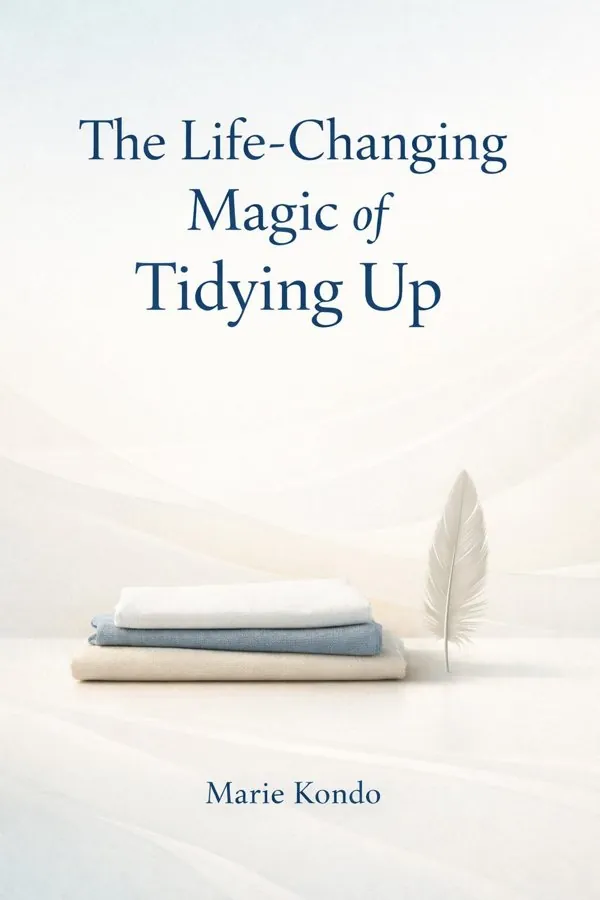
The Life-Changing Magic of Tidying Up: Summary & Key Insights
by Marie Kondo
 10 min9 chaptersAudio available
Key Takeaways from The Life-Changing Magic of Tidying Up
Most people do not fail at tidying because they are lazy; they fail because they have been taught the wrong method.
Clutter survives when you only see part of it.
A home becomes lighter when decisions come from desire rather than duty.
How you treat your belongings reflects how you treat your daily life.
We often keep things not because we love them, but because they represent who we thought we should be.
What Is The Life-Changing Magic of Tidying Up About?
The Life-Changing Magic of Tidying Up by Marie Kondo is a self-help book published in 2014 spanning 4 pages. What if tidying were not a dull household chore, but a turning point that could reshape your home, habits, and state of mind? In The Life-Changing Magic of Tidying Up, Marie Kondo argues that clutter is not simply a problem of limited storage or poor discipline. It is often a sign of unfinished decisions, emotional attachments, and a lack of clarity about how we want to live. Her now-famous KonMari Method offers a radically different approach: instead of organizing room by room and asking what to throw away, you tidy by category and keep only what “sparks joy.” First published in 2014, the book became an international phenomenon because it speaks to something deeper than neat closets. Kondo shows that our possessions shape our daily experience, and that choosing them intentionally can bring calm, gratitude, and freedom. Drawing on years of hands-on experience as a professional organizing consultant, she combines practical technique with a distinctive philosophy that treats tidying as a once-in-a-lifetime reset. The result is a self-help classic that turns order into a path toward a more conscious life.
This FizzRead summary covers all 9 key chapters of The Life-Changing Magic of Tidying Up in approximately 10 minutes, distilling the most important ideas, arguments, and takeaways from Marie Kondo's work. Also available as an audio summary and Key Quotes Podcast.
The Life-Changing Magic of Tidying Up
What if tidying were not a dull household chore, but a turning point that could reshape your home, habits, and state of mind? In The Life-Changing Magic of Tidying Up, Marie Kondo argues that clutter is not simply a problem of limited storage or poor discipline. It is often a sign of unfinished decisions, emotional attachments, and a lack of clarity about how we want to live. Her now-famous KonMari Method offers a radically different approach: instead of organizing room by room and asking what to throw away, you tidy by category and keep only what “sparks joy.”
First published in 2014, the book became an international phenomenon because it speaks to something deeper than neat closets. Kondo shows that our possessions shape our daily experience, and that choosing them intentionally can bring calm, gratitude, and freedom. Drawing on years of hands-on experience as a professional organizing consultant, she combines practical technique with a distinctive philosophy that treats tidying as a once-in-a-lifetime reset. The result is a self-help classic that turns order into a path toward a more conscious life.
Who Should Read The Life-Changing Magic of Tidying Up?
This book is perfect for anyone interested in self-help and looking to gain actionable insights in a short read. Whether you're a student, professional, or lifelong learner, the key ideas from The Life-Changing Magic of Tidying Up by Marie Kondo will help you think differently.
- ✓Readers who enjoy self-help and want practical takeaways
- ✓Professionals looking to apply new ideas to their work and life
- ✓Anyone who wants the core insights of The Life-Changing Magic of Tidying Up in just 10 minutes
Want the full summary?
Get instant access to this book summary and 100K+ more with Fizz Moment.
Get Free SummaryAvailable on App Store • Free to download
Key Chapters
Most people do not fail at tidying because they are lazy; they fail because they have been taught the wrong method. Marie Kondo begins with her own story: as a child, she devoured homemaking magazines and experimented endlessly with storage tricks, only to watch the clutter return. That frustration led her to a crucial realization. Conventional tidying advice focuses on where to put things, how to fold them, or how to store more efficiently. But if you keep too much, no storage system can save you.
Kondo argues that rebound clutter happens when people tidy gradually, in small bursts, and concentrate on what to discard based on vague standards like usefulness, cost, or guilt. They move objects around without confronting the real issue: they own more than they truly want in their lives. Tidying becomes an endless maintenance task rather than a transformative decision.
Her insight is that tidying should be treated as a special event, not a daily chore. A dramatic, focused reset creates a clear contrast between before and after. That emotional shift matters because it changes identity: you stop seeing yourself as someone always trying to catch up and start becoming someone who lives intentionally.
Imagine a person who buys bins for every drawer, labels shelves, and color-codes a closet, yet still feels overwhelmed. The problem is not organization skill; it is volume and indecision. Kondo invites readers to stop managing excess and start choosing what deserves space in their lives.
Actionable takeaway: Before buying containers or rearranging shelves, commit to one complete tidying festival and accept that the first goal is not storage, but deciding what you truly want to keep.
Clutter survives when you only see part of it. One of the most distinctive principles of the KonMari Method is tidying by category rather than by location. Instead of cleaning the bedroom today and the kitchen next week, Kondo instructs readers to gather every item in a single category from the entire home and sort it all at once. This reveals the true quantity of what you own and prevents the common illusion that “there isn’t that much.”
The recommended order is deliberate: clothes, books, papers, komono or miscellaneous items, and finally sentimental possessions. Each category builds decision-making skill for the next. Clothes are usually easier because the emotional stakes are lower. Sentimental objects come last because they often carry memory, identity, and guilt.
This method works psychologically as much as practically. When you collect all your shirts from closets, laundry piles, storage boxes, and coat racks into one heap, the volume itself becomes instructive. You can no longer pretend that your purchases are isolated or that duplicates do not exist. The same is true for books scattered across rooms or toiletries hidden in several cabinets.
Tidying by category also leads to better decisions because it encourages comparison. When all similar items are together, you can distinguish the truly useful and beloved from the mediocre and forgotten. A worn sweater, for example, may seem acceptable on its own. But beside five better sweaters, its place becomes harder to justify.
Actionable takeaway: Choose one category, gather every item from every room into one place, and make decisions only after you can see the full scale of what you own.
A home becomes lighter when decisions come from desire rather than duty. Kondo’s most famous idea is the question she asks of every possession: does it spark joy? At first, the phrase can sound sentimental or vague, but her point is practical. Most people decide what to keep based on utility, fear, or obligation. They keep things “just in case,” because they were expensive, because someone gave them as a gift, or because throwing them away feels wasteful. The joy question shifts attention from scarcity and guilt to lived experience.
To use the method, you physically hold each item and notice your response. The goal is not abstract admiration but an embodied sense of rightness. Some things spark joy because they are beautiful. Others do because they serve a clear purpose well, such as a reliable winter coat or a comfortable frying pan. Joy, in Kondo’s framework, includes usefulness when it supports the life you want.
This question also trains discernment. If you have twenty mugs, you may discover that only four genuinely please you. If you own piles of clothing, you may realize that you repeatedly avoid pieces that technically fit but make you feel unlike yourself. The process clarifies taste, priorities, and identity.
Importantly, the method is not about building a perfect minimalist home according to someone else’s aesthetic. It is about creating a space filled with items that support and delight you. One person’s joyful home may be sparse; another’s may be colorful and full of books.
Actionable takeaway: As you sort, stop asking “Might I need this someday?” and instead ask “Do I want this in my life now?” Keep only the items that give a clear yes.
How you treat your belongings reflects how you treat your daily life. Kondo’s philosophy goes beyond efficiency into a form of mindful respect. She suggests that possessions are not just objects to be managed, but things that support us and deserve care. This is why she recommends handling items attentively, storing them visibly when possible, and even thanking discarded belongings for their role before letting them go.
Some readers interpret this as symbolic or spiritual, but its practical value is easy to see. When you treat clothing carelessly, shove papers into random stacks, or toss keys onto any surface, your environment begins to feel chaotic. In contrast, assigning every item a home and returning it there turns order into a simple routine rather than a constant search effort.
Kondo also encourages greeting the home and noticing what it needs. Whether or not one takes this literally, the deeper message is powerful: your home is not an adversary generating work, but a place that shelters your life. That perspective often softens resentment and makes maintenance feel meaningful rather than burdensome.
A practical example is folding clothes so they can stand upright in drawers. This is not merely a space-saving trick. It allows each item to be seen, reduces wrinkling, and prevents clothes at the bottom from being neglected. Similarly, emptying your bag each day can help you notice what you carry unnecessarily and protect items from damage.
Actionable takeaway: Give every possession a designated home, put items back after use, and adopt one small ritual of respect, such as folding clothes neatly or clearing your bag each evening.
We often keep things not because we love them, but because they represent who we thought we should be. One of the deepest insights in The Life-Changing Magic of Tidying Up is that clutter is tied to the past and future. Some objects anchor us to old identities: clothes from a former job, hobby supplies from abandoned ambitions, books we bought to seem more serious or informed. Others trap us in imagined futures: the jeans we will wear when we change, the craft materials for projects we never start, the kitchen gadgets for a lifestyle we do not live.
Kondo argues that tidying helps us face the gap between fantasy and reality. This can be uncomfortable, but it is liberating. When you let go of unused language textbooks or unworn formal wear, you are not necessarily giving up potential. You are acknowledging the truth of your current life and making room for a more honest future.
She also reframes guilt around gifts and expensive purchases. A gift’s purpose is to be received; once it has conveyed affection, it has fulfilled its role. Likewise, money spent in the past is already gone. Keeping a disappointing item does not recover the cost. Sometimes the item’s lesson was simply to teach you what not to buy again.
This shift can be profoundly emotional. People often discover that discarding possessions helps them release regret, comparison, and self-criticism. The act of choosing what remains becomes a declaration: this is who I am now, and this is the life I am ready to support.
Actionable takeaway: Identify one group of items tied to guilt or an outdated identity, and ask whether they reflect your present life. If not, thank them for their lesson and let them go.
The sequence of decisions matters more than most people realize. Kondo insists that tidying should follow a specific order because each stage strengthens your ability to choose. Starting with easy categories builds confidence; moving too soon into emotionally charged items can cause exhaustion, hesitation, and poor decisions.
Clothes come first because they are numerous but relatively straightforward. You wear them, or you do not. Books follow, and here Kondo is famously strict: unread books kept out of aspiration often weigh on us more than they enrich us. Papers come next, and her advice is refreshingly simple. Keep only what is currently needed, must be saved for a limited period, or must be kept indefinitely. Most papers are neither useful nor joyful; they are postponed decisions.
After that comes komono, the broad category of miscellaneous belongings. This includes toiletries, kitchen tools, electronics, cords, hobby gear, makeup, household supplies, and more. Because these categories are varied, they force you to refine your judgment. Finally come sentimental items such as photographs, letters, and heirlooms. By then, you have practiced on easier possessions and can approach memory-laden objects with more clarity.
The order is essential because sentimental objects can derail the entire process. A single old letter can pull you into hours of nostalgia. Kondo does not deny the value of memory; she simply warns against starting there. First build momentum. Then face the past.
Actionable takeaway: Follow the KonMari sequence exactly once through your home: clothes, books, papers, miscellaneous items, then sentimental possessions. Avoid jumping ahead to emotionally difficult categories.
People often assume organization begins with buying containers, but Kondo sees storage as the final and easiest step. Once you have reduced your belongings to what truly belongs in your life, storage becomes straightforward. The goal is not to maximize capacity, but to make ownership visible, accessible, and sustainable.
Kondo recommends storing items where they naturally belong, keeping similar things together, and favoring simple arrangements that let you see what you have at a glance. Vertical storage in drawers is a classic example. When shirts, socks, and undergarments are folded compactly and arranged upright, every item is visible. This reduces forgotten duplicates and makes daily choices easier.
She is skeptical of elaborate storage systems because they often enable over-accumulation. A box with compartments can make clutter look neat without solving it. Under-bed storage, off-season overflow, and “temporary” holding zones easily become hiding places for excess. In Kondo’s view, if an item has no clear home, that is usually a sign that you own too much in that category.
Simple storage also supports maintenance. If putting something away requires moving five other things, the system will fail. By contrast, one drawer for stationery, one shelf for skincare, or one basket for chargers is easy to preserve because it matches real habits.
A well-tidied home should feel calm, not crowded with organizing products. The beauty comes from clarity, not complexity.
Actionable takeaway: Declutter first, then store by making every category visible and easy to return. Use the simplest possible solution before buying any bins, dividers, or labels.
Outer order does more than improve appearances; it changes the way you think and act. One reason Kondo’s book resonated so widely is that it connects tidying with personal transformation. When people complete the process, they often report changes far beyond a neater living room. They shop more carefully, make decisions faster, feel calmer, and become more aware of what truly matters to them.
This happens because clutter creates low-grade friction in daily life. It steals time through searching, drains attention through visual noise, and fosters avoidance by making tasks feel larger than they are. A tidy environment reduces those hidden costs. It also reflects back a sense of self-respect. When your space supports you, it becomes easier to cook, rest, work, or welcome others.
Kondo shares examples of clients who, after tidying, reconsidered careers, relationships, or lifestyles. The point is not that cleaning a closet magically solves every problem. Rather, the act of deciding what to keep strengthens a general capacity for choice. You practice saying yes with conviction and no without apology. That skill transfers.
There is also a financial effect. Once people become sensitive to joy, they often buy less impulsively. Instead of chasing bargains or trends, they choose more selectively. Homes stay tidier because fewer unnecessary items enter in the first place.
Actionable takeaway: Notice one area of life where clutter has created friction, such as getting dressed, paying bills, or cooking dinner. Tidy that category thoroughly and observe how the change affects your mood, time, and decisions.
The real goal of tidying is not perfection; it is alignment. After the dramatic initial reset, Kondo says maintenance becomes surprisingly easy because you have already made the hard decisions. The challenge is no longer constant decluttering but preserving a relationship with possessions that is intentional and appreciative.
This means being mindful about what enters the home. Every purchase is a future object to store, clean, use, and eventually release. When you have gone through the effort of choosing what sparks joy, you become less willing to bring in things that are merely convenient, discounted, or socially expected. Tidying, then, evolves into a lifestyle of clearer consumption.
Maintenance also depends on routine habits. Return items to their homes after use. Finish the day with a brief reset. Avoid creating “miscellaneous” piles that postpone decisions. If gifts, mail, or purchases come in, process them quickly rather than letting them drift into clutter. The system works because it is simple enough to repeat.
Kondo’s deeper message is that a tidy home is not a static image but a living environment that should support the person you are becoming. As life changes, your definition of joy may change too. A successful home is one that can adapt without collapsing back into chaos.
Actionable takeaway: Create a five-minute daily reset and one rule for incoming items, such as opening mail immediately or requiring every new purchase to have a clear home before you bring it in.
All Chapters in The Life-Changing Magic of Tidying Up
About the Author
Marie Kondo is a Japanese organizing consultant, author, and media personality who transformed decluttering into a global movement. Fascinated by tidying from a young age, she studied organization methods for years before developing her own approach, now known as the KonMari Method. Her system emphasizes tidying by category, keeping only items that spark joy, and treating the home as a space of intention rather than storage. Kondo rose to international prominence with The Life-Changing Magic of Tidying Up, which became a worldwide bestseller and introduced millions of readers to her philosophy. She later expanded her influence through additional books, courses, and the Netflix series Tidying Up with Marie Kondo. Her work sits at the intersection of organization, mindfulness, and lifestyle design.
Get This Summary in Your Preferred Format
Read or listen to the The Life-Changing Magic of Tidying Up summary by Marie Kondo anytime, anywhere. FizzRead offers multiple formats so you can learn on your terms — all free.
Available formats: App · Audio · PDF · EPUB — All included free with FizzRead
Download The Life-Changing Magic of Tidying Up PDF and EPUB Summary
Key Quotes from The Life-Changing Magic of Tidying Up
“Most people do not fail at tidying because they are lazy; they fail because they have been taught the wrong method.”
“Clutter survives when you only see part of it.”
“A home becomes lighter when decisions come from desire rather than duty.”
“How you treat your belongings reflects how you treat your daily life.”
“We often keep things not because we love them, but because they represent who we thought we should be.”
Frequently Asked Questions about The Life-Changing Magic of Tidying Up
The Life-Changing Magic of Tidying Up by Marie Kondo is a self-help book that explores key ideas across 9 chapters. What if tidying were not a dull household chore, but a turning point that could reshape your home, habits, and state of mind? In The Life-Changing Magic of Tidying Up, Marie Kondo argues that clutter is not simply a problem of limited storage or poor discipline. It is often a sign of unfinished decisions, emotional attachments, and a lack of clarity about how we want to live. Her now-famous KonMari Method offers a radically different approach: instead of organizing room by room and asking what to throw away, you tidy by category and keep only what “sparks joy.” First published in 2014, the book became an international phenomenon because it speaks to something deeper than neat closets. Kondo shows that our possessions shape our daily experience, and that choosing them intentionally can bring calm, gratitude, and freedom. Drawing on years of hands-on experience as a professional organizing consultant, she combines practical technique with a distinctive philosophy that treats tidying as a once-in-a-lifetime reset. The result is a self-help classic that turns order into a path toward a more conscious life.
More by Marie Kondo
Kurashi at Home: How to Organize Your Space and Achieve Your Ideal Life
Marie Kondo
10 min
Marie Kondo's Kurashi at Home: How to Organize Your Space and Achieve Your Ideal Life
Marie Kondo
10 min
Joy at Work: Organizing Your Professional Life
Marie Kondo, Scott Sonenshein
10 min
Spark Joy: An Illustrated Master Class on the Art of Organizing and Tidying Up
Marie Kondo
10 minYou Might Also Like



Featured In
Browse by Category
Ready to read The Life-Changing Magic of Tidying Up?
Get the full summary and 100K+ more books with Fizz Moment.