
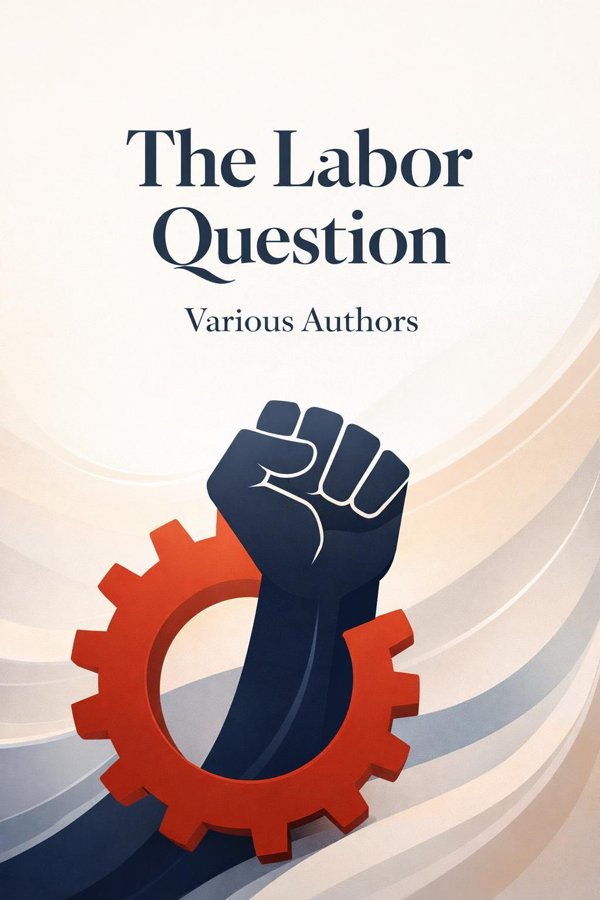
The Labor Question: Summary & Key Insights
 10 min10 chaptersAudio available
Key Takeaways from The Labor Question
A society changes profoundly when work moves from field and workshop into the factory.
The labor market seems simple until we remember that labor is performed by people, not commodities.
Work does not end at the factory gate; it spills into family life, citizenship, health, education, and community stability.
Every labor system reveals what a society believes about human worth.
An individual worker may negotiate, but a workforce organized together can shape history.
What Is The Labor Question About?
The Labor Question by Various Authors is a economics book spanning 10 pages. The Labor Question is a compact but rich collection of classic essays on one of the defining problems of modern society: how work should be organized, rewarded, and governed in an industrial age. Written by economists, reformers, religious thinkers, and public intellectuals of the late nineteenth and early twentieth centuries, the book examines labor not merely as a market transaction but as a human, social, and moral reality. It explores wages, unions, factory conditions, gender, legislation, and the responsibilities of employers and governments as industrial capitalism reshaped everyday life. What makes this collection enduring is its breadth. Rather than offering one ideological answer, it stages a serious conversation between competing viewpoints: laissez-faire economics, social reform, Christian ethics, democratic politics, and labor activism. That variety gives readers a fuller understanding of why labor became such a central political issue and why many of its tensions remain unresolved today. In an era still marked by wage insecurity, automation, inequality, and debates over worker dignity, this book remains strikingly relevant. Its contributors speak with historical authority because they were responding to the labor crisis as it unfolded around them.
This FizzRead summary covers all 10 key chapters of The Labor Question in approximately 10 minutes, distilling the most important ideas, arguments, and takeaways from Various Authors's work. Also available as an audio summary and Key Quotes Podcast.
The Labor Question
The Labor Question is a compact but rich collection of classic essays on one of the defining problems of modern society: how work should be organized, rewarded, and governed in an industrial age. Written by economists, reformers, religious thinkers, and public intellectuals of the late nineteenth and early twentieth centuries, the book examines labor not merely as a market transaction but as a human, social, and moral reality. It explores wages, unions, factory conditions, gender, legislation, and the responsibilities of employers and governments as industrial capitalism reshaped everyday life. What makes this collection enduring is its breadth. Rather than offering one ideological answer, it stages a serious conversation between competing viewpoints: laissez-faire economics, social reform, Christian ethics, democratic politics, and labor activism. That variety gives readers a fuller understanding of why labor became such a central political issue and why many of its tensions remain unresolved today. In an era still marked by wage insecurity, automation, inequality, and debates over worker dignity, this book remains strikingly relevant. Its contributors speak with historical authority because they were responding to the labor crisis as it unfolded around them.
Who Should Read The Labor Question?
This book is perfect for anyone interested in economics and looking to gain actionable insights in a short read. Whether you're a student, professional, or lifelong learner, the key ideas from The Labor Question by Various Authors will help you think differently.
- ✓Readers who enjoy economics and want practical takeaways
- ✓Professionals looking to apply new ideas to their work and life
- ✓Anyone who wants the core insights of The Labor Question in just 10 minutes
Want the full summary?
Get instant access to this book summary and 100K+ more with Fizz Moment.
Get Free SummaryAvailable on App Store • Free to download
Key Chapters
A society changes profoundly when work moves from field and workshop into the factory. The opening historical perspective in The Labor Question shows that the labor problem did not emerge in a vacuum; it was born from the great economic transformation of the nineteenth century. Agrarian rhythms, household production, apprenticeship, and small-scale craft labor gave way to mechanized production, urban migration, and large impersonal firms. Workers who once controlled at least some part of their pace, tools, and social identity increasingly sold labor by the hour under systems designed for efficiency and profit.
This transition created wealth on an unprecedented scale, but it also generated instability. Crowded industrial cities, child labor, dangerous machinery, irregular employment, and widening divisions between owners and workers all made labor a public issue rather than a private contract. The essays suggest that industrial progress alone could not solve the problems it created. The more productive the economy became, the more urgent the question became: who benefits from that productivity, and under what conditions is it achieved?
The historical lens matters because it helps modern readers see labor conflict as structural rather than accidental. When workers protest low pay, surveillance, or loss of autonomy today, they echo older struggles over power and dignity in the workplace. Gig workers dealing with algorithmic control face a different technology but a familiar problem.
Actionable takeaway: when evaluating any labor system, look beyond productivity figures and ask how technological and organizational change affects worker security, bargaining power, and human dignity.
The labor market seems simple until we remember that labor is performed by people, not commodities. One of the core economic foundations explored in the collection is the classical question of value and distribution: how national income is divided among wages, profits, rents, and interest. Traditional political economy often treated wages as one factor among many, shaped by supply, demand, productivity, and competition. But the essays push further by showing that labor cannot be understood through abstract market logic alone.
Unlike raw materials or machinery, labor involves fatigue, family life, skill, aspiration, and moral worth. A wage may be efficient in market terms and still be socially destructive if it cannot sustain a household or if it depends on exhausting conditions. The contributors wrestle with whether labor should be priced like any other good or protected because it is inseparable from human life. That tension lies at the heart of the entire book.
Practical examples make the point clearer. Two factories may pay the same wage, but if one exposes workers to injury, arbitrary dismissal, and chronic overwork, the true cost of labor differs dramatically. Likewise, modern employers may offer flexible contracts that reduce overhead while shifting risk onto workers. The economic transaction remains legal, yet the human consequences can be severe.
The broader lesson is that economics must be joined to ethics and social policy. Wages matter, but so do stability, safety, bargaining power, and the ability to live a decent life.
Actionable takeaway: when judging jobs, policies, or companies, evaluate labor in full human terms, not only by pay rate or efficiency.
Every labor system reveals what a society believes about human worth. The moral and ethical essays in The Labor Question insist that labor cannot be reduced to contract law or economic necessity. Even if an arrangement is legal and profitable, it may still be unjust. This is one of the book’s most powerful claims: the treatment of workers is a moral test of civilization.
The contributors debate what employers owe workers beyond wages. Are they responsible only for payment agreed upon in the market, or also for safety, humane hours, respect, and opportunities for advancement? Many essays reject the narrowest view of employer obligation. They argue that power creates duty. Because owners and managers often control conditions workers cannot easily escape, they bear moral responsibility for how production is organized.
The same applies to consumers and governments. If cheap goods depend on dangerous factories or underpaid labor, then society cannot pretend innocence simply because exploitation is hidden in supply chains or subcontracting arrangements. Practical examples from both the industrial era and today show how moral blindness can become normalized when competition rewards cost-cutting without accountability.
This perspective does not require uniform political conclusions. Some contributors favor paternal reform, others legal intervention, and others stronger worker organization. But they agree on a basic principle: labor is never only about price; it is also about justice.
Actionable takeaway: in professional and civic decisions, ask not only whether a labor arrangement is efficient or lawful, but whether it treats workers with dignity, fairness, and moral seriousness.
An individual worker may negotiate, but a workforce organized together can shape history. The collection’s treatment of labor movements and organization explains why unions, guilds, mutual aid societies, and collective bargaining emerged as responses to unequal power. In theory, employer and worker enter a contract freely. In practice, the employer usually has greater resources, information, legal support, and staying power. Organization is therefore not merely a political tactic; it is a way of balancing structural inequality.
The essays examine both the promise and the controversy of labor movements. Supporters argue that unions improve wages, reduce arbitrary treatment, create channels for grievance, and give workers a voice in industrial decisions. Critics warn of coercion, strikes, inefficiency, or conflict between labor and capital. By presenting these tensions, the book avoids romanticizing organization while still recognizing why it became necessary.
Practical applications are easy to see. Collective bargaining can standardize wages and hours where individual negotiation would fail. Worker associations can provide education, legal aid, unemployment support, and shared solidarity. Even outside formal unions, modern worker networks, employee councils, and professional associations continue this tradition by giving individuals a collective platform.
One of the book’s enduring lessons is that labor peace usually requires institutions for representation. When workers have no voice, discontent often reappears in more explosive forms. Organization channels conflict into negotiation.
Actionable takeaway: if you care about fair labor outcomes, support institutions that give workers genuine collective voice, whether through unions, councils, associations, or transparent workplace representation.
When private bargaining fails to protect the vulnerable, public law enters the scene. The essays on government and legislation argue that the labor question eventually became impossible to leave entirely to market forces. As industrial abuses became visible, reformers pressed for laws on factory safety, child labor, working hours, wages, inspection, compensation, and the legal recognition of labor rights. The underlying insight is simple but profound: freedom of contract is hollow when one side bargains under desperation.
This does not mean every contributor supports expansive state control. Some worry about overreach, bureaucracy, or harm to enterprise. Yet even cautious voices acknowledge that industrial society creates risks too large to be solved through charity or voluntary goodwill alone. Law establishes minimum standards beneath which competition cannot push workers. It also helps prevent ethical employers from being undercut by rivals willing to exploit labor more aggressively.
Modern parallels are everywhere. Minimum wage laws, overtime protections, anti-discrimination statutes, workplace safety rules, parental leave, and social insurance all reflect the same principle debated in the book: markets need rules if labor is to remain compatible with citizenship and human welfare. Without such rules, workers may bear risks that should be socially shared.
The best legislation, the collection suggests, does not abolish enterprise. It civilizes it. It defines the moral floor of economic life while still leaving room for innovation and productivity.
Actionable takeaway: evaluate labor law not by asking whether it constrains business in the abstract, but whether it creates fair baseline conditions for work, competition, and social stability.
The labor question becomes clearer when we ask what work is for. Religious and philosophical perspectives in the collection broaden the discussion beyond economics and policy. They ask whether work is merely a means of survival, a path to self-development, a social duty, or a sphere where justice and solidarity must be practiced. These essays are especially valuable because they reveal how deeply labor issues are tied to worldviews.
Christian social thought, for example, often emphasizes the dignity of the person, the obligations of wealth, and the moral bankruptcy of treating workers as tools. Philosophical liberalism may stress freedom and contract, while more social or democratic traditions emphasize interdependence and the common good. Some writers defend property and enterprise while insisting they remain subordinate to moral law. Others argue that social peace requires a more fraternal model of economic life.
These perspectives matter because policy debates always rest on hidden assumptions. If work is viewed only as a commodity exchange, then low-wage insecurity may seem unfortunate but acceptable. If work is seen as central to human dignity and participation, then degrading labor conditions become intolerable even when efficient.
In practical terms, values shape institutions. A company that truly believes workers are persons rather than inputs will design schedules, management, pay, and safety differently. A society that links labor to citizenship will build stronger protections and educational opportunities.
Actionable takeaway: clarify your own philosophy of work, because your values will shape how you judge wages, management, reform, and the proper balance between profit and human dignity.
Industrial labor may begin in local factories, but its logic quickly becomes international. The essays on international perspectives show that the labor question was never confined to one nation’s policies or customs. As industrial capitalism expanded across borders, so did migration, trade competition, colonial extraction, and comparative debates over wages and labor standards. Reformers recognized an unsettling reality: workers in one country could be harmed by conditions in another if employers shifted production to wherever labor was cheapest and least protected.
This insight feels remarkably modern. Today’s global supply chains reproduce the same tension on a larger scale. Consumers in wealthy countries buy goods produced by workers they never see, under legal regimes they barely understand. National labor reform remains necessary, but the book implies it may not be sufficient if global competition rewards the lowest standards.
The essays also compare how different societies responded to industrialization. Some relied more heavily on voluntary reform, others on unions, state intervention, or religious social teaching. These comparisons reveal that labor arrangements are not inevitable. Institutions matter, and nations make choices about how to balance profit, protection, and social peace.
The practical lesson is that labor ethics must travel with commerce. Investors, firms, consumers, and governments cannot excuse abusive conditions by outsourcing them. International awareness strengthens domestic reform by exposing alternatives and shared responsibilities.
Actionable takeaway: when assessing labor issues today, think globally as well as locally, and favor policies and purchasing decisions that support fair standards throughout the supply chain.
The most striking feature of The Labor Question is that it treats the future not as destiny, but as a matter of institutions and moral will. The concluding outlook in the collection does not pretend that industrial conflict will disappear on its own. Instead, it asks whether modern societies will organize production in ways that deepen division or cultivate fairness, cooperation, and civic stability. The labor question persists because economic development continuously creates new forms of dependency, inequality, and displacement.
In the authors’ era, machines, factories, and urbanization transformed labor. In ours, digital platforms, automation, artificial intelligence, and fragmented employment arrangements raise parallel concerns. Will productivity gains be broadly shared? Will workers have security in periods of technological disruption? Will economic systems value people only for efficiency, or also for their social and moral worth?
The collection offers no single formula, but it points toward several durable principles: workers need representation, markets need ethical limits, law must protect against destructive competition, and prosperity should be judged by human outcomes, not output alone. These are not outdated slogans. They are frameworks for thinking about freelance precarity, job polarization, remote work surveillance, and technological unemployment.
The future of labor is therefore political and moral before it is technical. Societies choose whether innovation serves concentrated power or broad human flourishing.
Actionable takeaway: treat every debate about technology, productivity, and workplace reform as a chance to ask who gains, who bears the risk, and what kind of working society you want to build.
All Chapters in The Labor Question
About the Author
Various Authors refers to the group of writers whose essays make up The Labor Question. The contributors include economists, social reformers, political commentators, and moral thinkers writing during the late nineteenth and early twentieth centuries, when industrialization was transforming work and social life. Their backgrounds differ, but they are united by a common concern: how modern societies should respond to the hardships, inequalities, and conflicts created by wage labor and industrial capitalism. Some approach the problem through economic theory, others through ethics, religion, legislation, or labor activism. This diversity is one of the book’s strengths. Rather than advancing a single doctrine, the collection captures a broad intellectual debate from a critical historical moment, giving readers a layered and authoritative picture of the labor issues that shaped the modern world.
Get This Summary in Your Preferred Format
Read or listen to the The Labor Question summary by Various Authors anytime, anywhere. FizzRead offers multiple formats so you can learn on your terms — all free.
Available formats: App · Audio · PDF · EPUB — All included free with FizzRead
Download The Labor Question PDF and EPUB Summary
Key Quotes from The Labor Question
“A society changes profoundly when work moves from field and workshop into the factory.”
“The labor market seems simple until we remember that labor is performed by people, not commodities.”
“Work does not end at the factory gate; it spills into family life, citizenship, health, education, and community stability.”
“Every labor system reveals what a society believes about human worth.”
“An individual worker may negotiate, but a workforce organized together can shape history.”
Frequently Asked Questions about The Labor Question
The Labor Question by Various Authors is a economics book that explores key ideas across 10 chapters. The Labor Question is a compact but rich collection of classic essays on one of the defining problems of modern society: how work should be organized, rewarded, and governed in an industrial age. Written by economists, reformers, religious thinkers, and public intellectuals of the late nineteenth and early twentieth centuries, the book examines labor not merely as a market transaction but as a human, social, and moral reality. It explores wages, unions, factory conditions, gender, legislation, and the responsibilities of employers and governments as industrial capitalism reshaped everyday life. What makes this collection enduring is its breadth. Rather than offering one ideological answer, it stages a serious conversation between competing viewpoints: laissez-faire economics, social reform, Christian ethics, democratic politics, and labor activism. That variety gives readers a fuller understanding of why labor became such a central political issue and why many of its tensions remain unresolved today. In an era still marked by wage insecurity, automation, inequality, and debates over worker dignity, this book remains strikingly relevant. Its contributors speak with historical authority because they were responding to the labor crisis as it unfolded around them.
More by Various Authors




You Might Also Like
Business Adventures
John Brooks
10 min
Nudge
Richard H. Thaler, Cass R. Sunstein
10 min
The Hitchhiker"s Guide to the Galaxy
Douglas Adams
10 minThe Muqaddimah
Ibn Khaldun
10 minThe Outsiders
William N. Thorndike
10 min
A Little History of Economics
Niall Kishtainy
10 minBrowse by Category
Ready to read The Labor Question?
Get the full summary and 100K+ more books with Fizz Moment.