
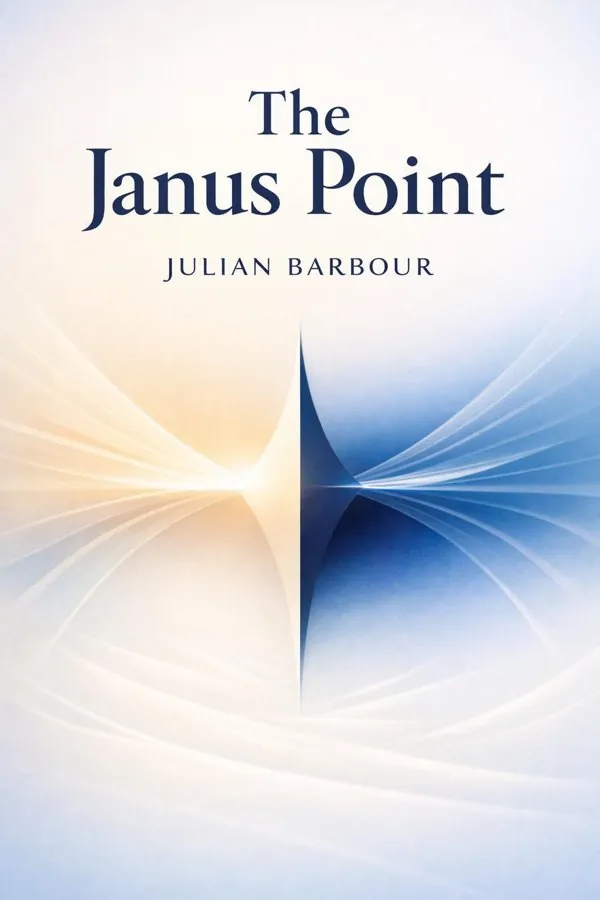
The Janus Point: A New Theory of Time: Summary & Key Insights
 10 min10 chaptersAudio available
What Is The Janus Point: A New Theory of Time About?
The Janus Point: A New Theory of Time by Julian Barbour is a space_physics book spanning 10 pages. In The Janus Point, physicist Julian Barbour presents a revolutionary theory about the nature of time. He argues that the universe’s evolution is not governed by increasing disorder, as the second law of thermodynamics suggests, but by the growth of order. Barbour proposes that the universe has a 'Janus point'—a moment of minimum complexity—from which time flows in two opposite directions, giving rise to the arrow of time we experience. This work challenges conventional cosmology and offers a new perspective on entropy, time, and the structure of the cosmos.
This FizzRead summary covers all 10 key chapters of The Janus Point: A New Theory of Time in approximately 10 minutes, distilling the most important ideas, arguments, and takeaways from Julian Barbour's work. Also available as an audio summary and Key Quotes Podcast.
The Janus Point: A New Theory of Time
In The Janus Point, physicist Julian Barbour presents a revolutionary theory about the nature of time. He argues that the universe’s evolution is not governed by increasing disorder, as the second law of thermodynamics suggests, but by the growth of order. Barbour proposes that the universe has a 'Janus point'—a moment of minimum complexity—from which time flows in two opposite directions, giving rise to the arrow of time we experience. This work challenges conventional cosmology and offers a new perspective on entropy, time, and the structure of the cosmos.
Who Should Read The Janus Point: A New Theory of Time?
This book is perfect for anyone interested in space_physics and looking to gain actionable insights in a short read. Whether you're a student, professional, or lifelong learner, the key ideas from The Janus Point: A New Theory of Time by Julian Barbour will help you think differently.
- ✓Readers who enjoy space_physics and want practical takeaways
- ✓Professionals looking to apply new ideas to their work and life
- ✓Anyone who wants the core insights of The Janus Point: A New Theory of Time in just 10 minutes
Want the full summary?
Get instant access to this book summary and 100K+ more with Fizz Moment.
Get Free SummaryAvailable on App Store • Free to download
Key Chapters
Ever since Newton, time has been taken as an unquestioned background variable—a dimension against which events unfold. Yet as I examined the foundations of physics, I found that this assumption is far from stable. In classical mechanics, time is an external clock that coordinates motion; in relativity, it becomes entwined with space, forming the four-dimensional spacetime fabric. But in quantum mechanics, time reappears only as a parameter defining change. These conceptions never reconcile harmoniously, and the result is that time seems to be both everything and nothing.
The problem, as I see it, lies in regarding time as a thing rather than an emergent feature. Physics describes motion, but to measure motion we compare configurations. In other words, what truly exists are relations between particles and fields—the network of shapes that defines the universe’s instantaneous state. Time is not an additional ingredient; it is the order in which these shapes succeed one another. The universe doesn’t evolve in time. Time *is* the universe’s evolution.
General relativity takes us closer to this insight. Einstein’s equations describe the geometry of spacetime, yet when applied to the universe as a whole, they yield what cosmologists call the ‘frozen formalism.’ In the complete description, there is no global time; the equations merely relate configurations to each other. This is the so-called ‘problem of time’ in quantum gravity—the fact that at the deepest level, physics ceases to speak of moments occurring in sequence. Instead, the universe appears as a timeless entity containing all possible correlations.
This paradox has driven me for decades. It suggests that time, as experienced by conscious beings, might not be fundamental at all. It might arise from our local vantage point within a relational universe where complexity and structure continually develop. The challenge, then, is to build a picture of the cosmos that honors this insight—where time is not an external measure but a manifestation of unfolding order.
To situate my proposal, we must revisit how cosmology has been shaped. Newton’s universe was infinite, absolute, and static—a framework of positions and velocities evolving under universal laws. When Einstein introduced relativity, this picture changed dramatically. Space and time became dynamic; gravity itself was geometry. Later, quantum mechanics shattered determinism by introducing uncertainty and probability at fundamental scales.
Despite these revolutions, a critical notion endured: the arrow of time linked to entropy. In the nineteenth century, Boltzmann’s statistical mechanics equated entropy with the number of microstates corresponding to a macroscopic configuration. It seemed to explain why equilibrium and disorder must increase. Cosmologists, following this principle, interpreted the universe’s beginning as an extraordinarily ordered, low-entropy condition from which entropy grows indefinitely.
But this interpretation masks a deep assumption—that the arrow of time must start with special initial conditions. Why should the early universe be so peculiar? The Big Bang, though majestic, remains conceptually loaded with this mystery: entropy begins low, structure forms, galaxies emerge, and yet the direction of time depends on that mysterious asymmetry in the beginning.
In modern cosmology, we’ve extended these discussions through inflationary models and observations of cosmic expansion, but the conceptual tension persists. The physics we use says evolution should be symmetric under time reversal, yet our experience—our memories, decay, causation—are profoundly asymmetric. This contradiction is what led me to explore models beyond conventional spacetime frameworks, pointing instead toward the notion of ‘shape space’ as the true stage of the universe.
+ 8 more chapters — available in the FizzRead app
All Chapters in The Janus Point: A New Theory of Time
About the Author
Julian Barbour is a British theoretical physicist known for his work on the foundations of physics, particularly in the areas of time and motion. He studied at the University of Cambridge and has written extensively on the nature of time, including his earlier book 'The End of Time'. Barbour’s research explores timeless formulations of quantum mechanics and general relativity, positioning him as one of the most original thinkers in modern physics.
Get This Summary in Your Preferred Format
Read or listen to the The Janus Point: A New Theory of Time summary by Julian Barbour anytime, anywhere. FizzRead offers multiple formats so you can learn on your terms — all free.
Available formats: App · Audio · PDF · EPUB — All included free with FizzRead
Download The Janus Point: A New Theory of Time PDF and EPUB Summary
Key Quotes from The Janus Point: A New Theory of Time
“Ever since Newton, time has been taken as an unquestioned background variable—a dimension against which events unfold.”
“To situate my proposal, we must revisit how cosmology has been shaped.”
Frequently Asked Questions about The Janus Point: A New Theory of Time
The Janus Point: A New Theory of Time by Julian Barbour is a space_physics book that explores key ideas across 10 chapters. In The Janus Point, physicist Julian Barbour presents a revolutionary theory about the nature of time. He argues that the universe’s evolution is not governed by increasing disorder, as the second law of thermodynamics suggests, but by the growth of order. Barbour proposes that the universe has a 'Janus point'—a moment of minimum complexity—from which time flows in two opposite directions, giving rise to the arrow of time we experience. This work challenges conventional cosmology and offers a new perspective on entropy, time, and the structure of the cosmos.
You Might Also Like
The Means Of Prediction
Mark P. Silverman
10 min
AstroTech
Various Authors
10 min
Black Holes and Time Warps: Einstein’s Outrageous Legacy
Kip S. Thorne
10 min
Dark Matter and the Dinosaurs: The Astounding Interconnectedness of the Universe
Lisa Randall
10 min
Helgoland
Carlo Rovelli
10 min
Hyperspace: A Scientific Odyssey Through Parallel Universes, Time Warps, and the 10th Dimension
Michio Kaku
10 minBrowse by Category
Ready to read The Janus Point: A New Theory of Time?
Get the full summary and 100K+ more books with Fizz Moment.