
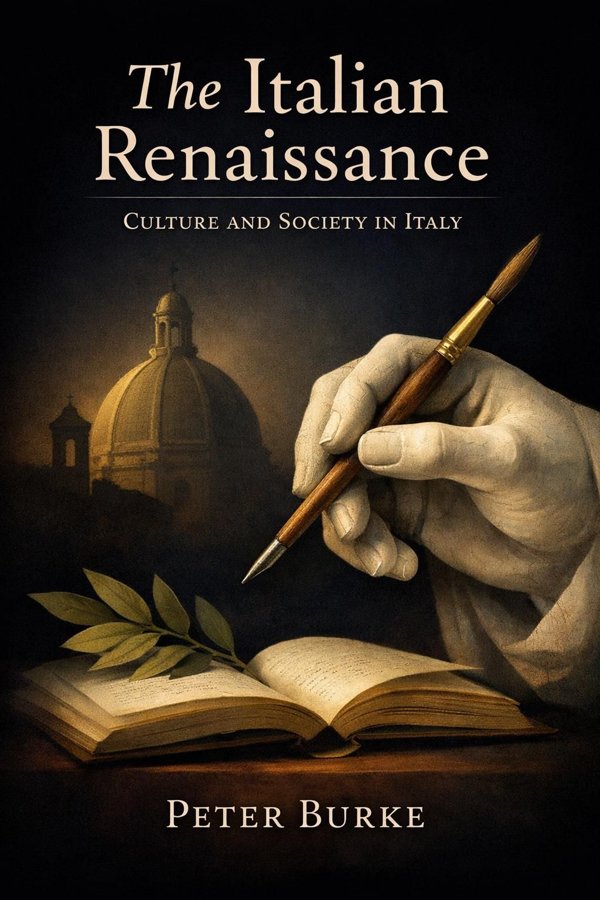
The Italian Renaissance: Culture and Society in Italy: Summary & Key Insights
by Peter Burke
 10 min5 chaptersAudio available
What Is The Italian Renaissance: Culture and Society in Italy About?
The Italian Renaissance: Culture and Society in Italy by Peter Burke is a civilization book spanning 5 pages. This influential study by historian Peter Burke explores the social and cultural context of the Italian Renaissance, examining how art, politics, religion, and everyday life intertwined in fifteenth- and sixteenth-century Italy. Burke analyzes the roles of patrons, artists, and intellectuals, and how their interactions shaped the broader European cultural transformation.
This FizzRead summary covers all 5 key chapters of The Italian Renaissance: Culture and Society in Italy in approximately 10 minutes, distilling the most important ideas, arguments, and takeaways from Peter Burke's work. Also available as an audio summary and Key Quotes Podcast.
The Italian Renaissance: Culture and Society in Italy
This influential study by historian Peter Burke explores the social and cultural context of the Italian Renaissance, examining how art, politics, religion, and everyday life intertwined in fifteenth- and sixteenth-century Italy. Burke analyzes the roles of patrons, artists, and intellectuals, and how their interactions shaped the broader European cultural transformation.
Who Should Read The Italian Renaissance: Culture and Society in Italy?
This book is perfect for anyone interested in civilization and looking to gain actionable insights in a short read. Whether you're a student, professional, or lifelong learner, the key ideas from The Italian Renaissance: Culture and Society in Italy by Peter Burke will help you think differently.
- ✓Readers who enjoy civilization and want practical takeaways
- ✓Professionals looking to apply new ideas to their work and life
- ✓Anyone who wants the core insights of The Italian Renaissance: Culture and Society in Italy in just 10 minutes
Want the full summary?
Get instant access to this book summary and 100K+ more with Fizz Moment.
Get Free SummaryAvailable on App Store • Free to download
Key Chapters
To grasp the origins of Renaissance culture, one must first picture Italy in the fifteenth century: a patchwork of fiercely independent city-states—Florence, Venice, Milan, Rome, and a host of smaller urban republics and principalities. The peninsula was not politically unified, but this very fragmentation fostered extraordinary competition and innovation. Each city strove for prestige, displaying its wealth and civic pride through art, architecture, and scholarship. The Renaissance thus unfolded within a dynamic interplay of rivalry and ambition.
Florence, with its strong mercantile tradition, became a model of this energy. The city’s rich but fractious social life translated into a constant pursuit of distinction, as merchants sought to demonstrate not only prosperity but cultural refinement. The same was true in Venice, whose stable oligarchic regime cultivated grandeur through patronage and public ceremony. Rome, restored as a papal center, offered yet another version—a church intertwined with classical revival, where spiritual and secular ambitions fused.
Urbanization was the key. The city became the crucible of Renaissance culture, not the court or the countryside. This urban pattern shaped social mobility, commercial networks, and civic consciousness. Guilds, confraternities, academies—all these institutions nurtured the social conditions for intellectual flourishing. At the same time, Italy’s prosperity was fragile, tied to changing trade routes and political upheavals, reminding us that cultural flowering often coexists with instability. As cities grew and vied for dominance, they drew artisans, scholars, and patrons into close contact, creating a fertile environment where artistic and intellectual creativity could thrive in response to both opportunity and anxiety.
+ 3 more chapters — available in the FizzRead app
All Chapters in The Italian Renaissance: Culture and Society in Italy
About the Author
Peter Burke is a British cultural historian and professor emeritus at the University of Cambridge. He is known for his pioneering work in cultural history, early modern European history, and the sociology of knowledge.
Get This Summary in Your Preferred Format
Read or listen to the The Italian Renaissance: Culture and Society in Italy summary by Peter Burke anytime, anywhere. FizzRead offers multiple formats so you can learn on your terms — all free.
Available formats: App · Audio · PDF · EPUB — All included free with FizzRead
Download The Italian Renaissance: Culture and Society in Italy PDF and EPUB Summary
Key Quotes from The Italian Renaissance: Culture and Society in Italy
“The peninsula was not politically unified, but this very fragmentation fostered extraordinary competition and innovation.”
“The Renaissance was not a golden age for all Italians.”
Frequently Asked Questions about The Italian Renaissance: Culture and Society in Italy
The Italian Renaissance: Culture and Society in Italy by Peter Burke is a civilization book that explores key ideas across 5 chapters. This influential study by historian Peter Burke explores the social and cultural context of the Italian Renaissance, examining how art, politics, religion, and everyday life intertwined in fifteenth- and sixteenth-century Italy. Burke analyzes the roles of patrons, artists, and intellectuals, and how their interactions shaped the broader European cultural transformation.
You Might Also Like

The Structure of Scientific Revolutions
Thomas S. Kuhn
10 min
Genius
Harold Bloom
10 min
A Cultural History of the Medieval Age
Various Editors
10 min
A History of God: The 4,000-Year Quest of Judaism, Christianity and Islam
Karen Armstrong
10 min
A History of the World in 10½ Chapters
Julian Barnes
10 min
A Short History of Progress
Ronald Wright
10 minBrowse by Category
Ready to read The Italian Renaissance: Culture and Society in Italy?
Get the full summary and 100K+ more books with Fizz Moment.