
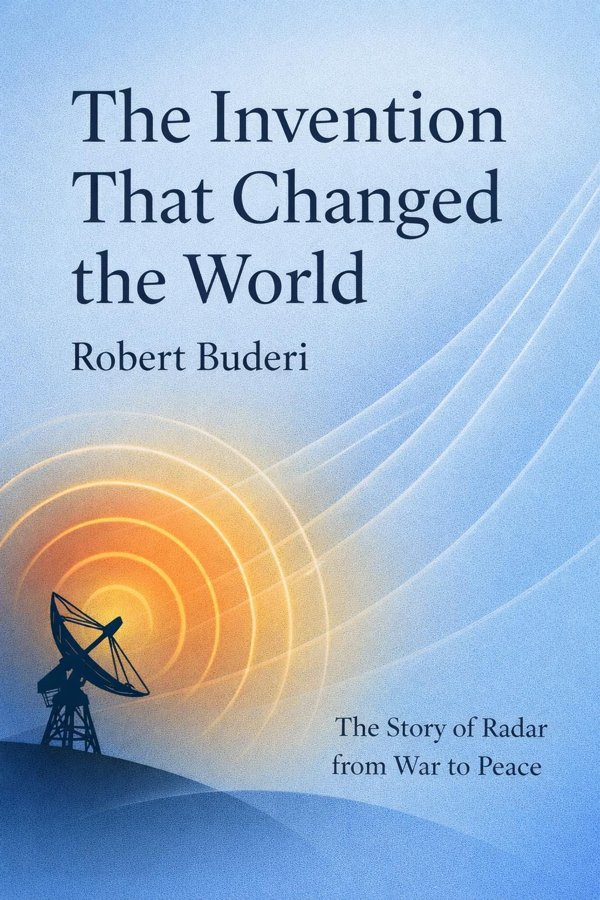
The Invention That Changed the World: The Story of Radar from War to Peace: Summary & Key Insights
 10 min9 chaptersAudio available
Key Takeaways from The Invention That Changed the World: The Story of Radar from War to Peace
The most world-changing inventions often begin long before anyone knows what they will be used for.
Nothing concentrates invention like existential danger.
A transformative invention is rarely a single object; it is usually a network of linked advances.
Seeing first can matter more than striking first.
One of the book’s deepest themes is that radar’s success came from a new model of collaboration.
What Is The Invention That Changed the World: The Story of Radar from War to Peace About?
The Invention That Changed the World: The Story of Radar from War to Peace by Robert Buderi is a world_history book spanning 12 pages. Robert Buderi’s The Invention That Changed the World tells the remarkable story of radar: a technology born from scientific curiosity, accelerated by wartime urgency, and transformed into one of the great engines of modern innovation. At first glance, radar seems like a military tool designed simply to spot enemy aircraft and ships. Buderi shows that it was far more than that. The race to develop and improve radar during World War II created new ways of organizing research, linking universities, industry, and government in a scale of collaboration the world had never seen before. Out of that effort came not only military victory, but also breakthroughs in electronics, microwave engineering, computing, communications, and postwar scientific institutions. What makes this book so important is its central argument: radar did not just help win the war; it reshaped the modern technological world. Buderi, an accomplished technology journalist and former editor-in-chief of MIT’s Technology Review, brings both narrative energy and analytical depth to the subject. He connects laboratory experiments, battlefield decisions, and postwar industry into one sweeping history, revealing how a single invention can change not only warfare, but the structure of society itself.
This FizzRead summary covers all 9 key chapters of The Invention That Changed the World: The Story of Radar from War to Peace in approximately 10 minutes, distilling the most important ideas, arguments, and takeaways from Robert Buderi's work. Also available as an audio summary and Key Quotes Podcast.
The Invention That Changed the World: The Story of Radar from War to Peace
Robert Buderi’s The Invention That Changed the World tells the remarkable story of radar: a technology born from scientific curiosity, accelerated by wartime urgency, and transformed into one of the great engines of modern innovation. At first glance, radar seems like a military tool designed simply to spot enemy aircraft and ships. Buderi shows that it was far more than that. The race to develop and improve radar during World War II created new ways of organizing research, linking universities, industry, and government in a scale of collaboration the world had never seen before. Out of that effort came not only military victory, but also breakthroughs in electronics, microwave engineering, computing, communications, and postwar scientific institutions.
What makes this book so important is its central argument: radar did not just help win the war; it reshaped the modern technological world. Buderi, an accomplished technology journalist and former editor-in-chief of MIT’s Technology Review, brings both narrative energy and analytical depth to the subject. He connects laboratory experiments, battlefield decisions, and postwar industry into one sweeping history, revealing how a single invention can change not only warfare, but the structure of society itself.
Who Should Read The Invention That Changed the World: The Story of Radar from War to Peace?
This book is perfect for anyone interested in world_history and looking to gain actionable insights in a short read. Whether you're a student, professional, or lifelong learner, the key ideas from The Invention That Changed the World: The Story of Radar from War to Peace by Robert Buderi will help you think differently.
- ✓Readers who enjoy world_history and want practical takeaways
- ✓Professionals looking to apply new ideas to their work and life
- ✓Anyone who wants the core insights of The Invention That Changed the World: The Story of Radar from War to Peace in just 10 minutes
Want the full summary?
Get instant access to this book summary and 100K+ more with Fizz Moment.
Get Free SummaryAvailable on App Store • Free to download
Key Chapters
The most world-changing inventions often begin long before anyone knows what they will be used for. Radar emerged from decades of theoretical and experimental work on electromagnetic waves, especially the foundations laid by James Clerk Maxwell and later physicists and engineers who explored how radio energy traveled, reflected, and could be measured. Before radar became a practical wartime system, it existed as a possibility hidden inside basic science.
Buderi emphasizes that radar was not conjured overnight by military necessity. Researchers in Britain, Germany, the United States, and elsewhere had already been experimenting with radio detection in the interwar years. The challenge was not merely proving that reflected radio waves could reveal an object’s position, but turning fragile laboratory concepts into reliable systems that could operate under real conditions: bad weather, long distances, moving targets, and noisy environments. That transformation required patient, cumulative work in electronics, antennas, signal interpretation, and system design.
This is one of the book’s most important historical lessons. Societies often celebrate the final breakthrough while overlooking the years of abstract inquiry that made it possible. Radar reminds us that “useless” science can become indispensable when conditions change. Modern parallels are easy to see in quantum research, AI, biotechnology, and space systems. Investments in foundational knowledge create options that may become decisive later.
A practical application of this insight is how governments, companies, and universities should think about innovation portfolios. Not every research project needs an immediate commercial payoff. Some of the most transformative advances come from maintaining broad scientific capacity before crises arrive.
Actionable takeaway: support long-term basic research, because the discoveries that seem remote today may become society’s most important tools tomorrow.
Nothing concentrates invention like existential danger. When Nazi aggression threatened Britain and the balance of power in Europe, radar shifted from an intriguing technical project into a strategic necessity. The Allied nations needed warning systems that could detect incoming aircraft before they struck, and they needed them fast. In this emergency, science was pulled directly into the machinery of national survival.
Buderi shows how wartime mobilization changed not just the speed of research, but its entire structure. Britain’s radar defenses, including the early warning chain that proved crucial during the Battle of Britain, demonstrated that technology mattered most when integrated into a larger operational system. Detection stations, command centers, communications networks, and decision-making protocols all had to work together. Radar’s value was not simply in the device, but in the coordinated architecture built around it.
A pivotal moment came when Britain shared crucial radar knowledge with the United States, especially through the famous Tizard Mission. This exchange revealed a powerful truth: in moments of profound threat, national security can depend on scientific openness among allies. The transfer of advanced microwave radar knowledge, especially the cavity magnetron, helped ignite massive American development efforts. It also helped create an unprecedented alliance among scientists, military planners, and industrial manufacturers.
The broader lesson extends beyond war. Crises force institutions to move past bureaucracy, rivalry, and caution. Whether the challenge is a military threat, a pandemic, or climate risk, the ability to mobilize talent and share breakthroughs quickly can determine outcomes.
Actionable takeaway: when facing urgent problems, build systems that combine speed, cooperation, and clear mission alignment rather than relying on isolated excellence.
A transformative invention is rarely a single object; it is usually a network of linked advances. One of Buderi’s most valuable insights is that radar became powerful only because many difficult technical problems were solved together. The cavity magnetron made high-power microwave generation practical. New receiver designs increased sensitivity. Better antennas improved directionality. Display systems translated invisible signals into actionable information. Manufacturing techniques made mass deployment possible.
This systems view matters because it challenges the common myth of lone genius invention. Radar was not one discovery but a layered achievement involving physicists, mathematicians, engineers, operators, military officers, and factory workers. A magnetron without trained users, reliable maintenance, and production capacity would have been little more than a brilliant curiosity. Likewise, a detection signal without interpretation and command response would have had limited battlefield value.
Buderi’s account also shows how engineering maturity often matters as much as scientific novelty. A practical wartime technology must be rugged, manufacturable, repairable, and usable by non-specialists under pressure. This is why wartime laboratories such as the MIT Radiation Laboratory became so important: they linked frontier science to urgent application. Their success came from compressing the distance between theory, prototyping, testing, production, and deployment.
The same principle applies in business and technology today. A new algorithm, battery chemistry, or medical device is not enough on its own. Impact depends on interfaces, training, supply chains, standards, and institutions. The winners are often those who build complete systems, not just superior components.
Actionable takeaway: when evaluating innovation, ask not only “Is the core technology impressive?” but “Can the surrounding system make it useful at scale?”
Seeing first can matter more than striking first. Radar changed warfare because it altered the relationship between information and action. By detecting aircraft, ships, submarines, and weather patterns beyond normal human sight, radar gave commanders time, and in war, time is often the decisive advantage. Early warning made defense more efficient, interception more precise, and surprise more difficult.
Buderi details how radar influenced both air and naval combat. In the air war, Britain’s integrated radar system helped it survive the Luftwaffe’s attacks by directing limited fighter resources where they were needed most. At sea, radar improved convoy protection, night fighting, navigation, and submarine detection. Airborne radar allowed bombers and patrol aircraft to find targets through darkness and cloud cover. Microwave radar increased precision and helped close the gap between theoretical detection and practical battlefield superiority.
But radar’s impact was not just tactical. It changed doctrine. Once militaries could detect threats at longer range and in poor visibility, they had to rethink formations, command structures, mission planning, and the balance between offense and defense. Radar also sparked countermeasures and counter-countermeasures, creating an early form of electronic warfare in which each side tried to blind, deceive, or overwhelm the other’s sensors.
For modern readers, radar’s wartime role offers a larger strategic lesson: information technologies reshape institutions, not just operations. New sensing tools change what leaders believe is possible, which in turn changes how they organize resources and define success.
Actionable takeaway: treat information advantage as a structural capability, and redesign strategy around it rather than simply adding new tools to old methods.
One of the book’s deepest themes is that radar’s success came from a new model of collaboration. Before World War II, scientific research, industrial production, and military planning often operated in separate spheres. The radar effort helped fuse them into a coordinated innovation machine. Universities generated ideas, government funded and organized programs, the military defined urgent needs, and private industry manufactured technologies at scale.
Buderi pays special attention to the MIT Radiation Laboratory, which became a symbol of this new arrangement. It gathered exceptional talent, gave researchers a clear mission, and connected them directly to real operational problems. Scientists were not left in isolation; they worked in constant dialogue with users and manufacturers. This produced a feedback loop in which design flaws were identified quickly, improvements were implemented rapidly, and ideas moved faster from blackboard to battlefield.
The effects lasted far beyond the war. The radar enterprise helped normalize large-scale, mission-driven research institutions and demonstrated that coordinated public-private-academic partnerships could solve technically complex problems in astonishingly short periods. This model later shaped fields such as aerospace, computing, semiconductor development, and defense R&D more broadly.
There is a practical management lesson here. Innovation often stalls when experts work in silos, when incentives are misaligned, or when the people building systems rarely meet the people using them. Radar succeeded because the barriers between disciplines and institutions were deliberately reduced.
Today, the same lesson applies to climate technologies, AI safety, public health systems, and advanced manufacturing. Complex problems require integrators, not just specialists.
Actionable takeaway: create cross-functional teams with shared goals, rapid feedback, and decision-making authority if you want difficult innovations to move from idea to impact.
Some inventions end with the conflict that created them. Radar did the opposite: it became a bridge from wartime mobilization to peacetime modernity. Buderi argues that the radar effort left behind more than devices. It created technical expertise, industrial capacity, research methods, and institutions that continued generating breakthroughs long after the shooting stopped.
The transition to peace was not automatic. Wartime laboratories had to be repurposed, scientists had to find new missions, and governments had to decide whether large-scale research should continue outside emergency conditions. Yet the radar experience had already proven the value of sustained investment in electronics and organized innovation. As a result, the postwar world inherited both trained personnel and a tested model for solving advanced technical problems.
Radar also spilled into civilian domains in direct and indirect ways. Air traffic control, weather forecasting, navigation, and maritime safety all benefited from radar technologies and techniques. At the same time, the microwave and electronics expertise developed during the war fed into other sectors, including telecommunications, instrumentation, and eventually computing. In this sense, radar was not just a military success with civilian aftereffects; it was a platform technology whose methods and components reshaped multiple industries.
This historical shift highlights an important question for modern societies: how can crisis-era investments be converted into durable public value? The answer often lies in preserving talent networks, adapting infrastructure, and broadening the mission from survival to prosperity.
Actionable takeaway: after major collective efforts, focus deliberately on translating emergency capabilities into long-term civilian benefits rather than letting them dissolve once the crisis passes.
Many people associate the origins of the modern technological world with computers alone, but Buderi shows that radar deserves a central place in that story. Radar development pushed advances in electronics, signal processing, control systems, miniaturization, instrumentation, and high-frequency engineering. It also encouraged new habits of thinking about information: detecting signals, filtering noise, interpreting displays, and coordinating action based on real-time data.
These habits fed directly into postwar science and technology. Researchers trained in radar moved into fields such as computer engineering, communications, aerospace, solid-state electronics, and systems analysis. The infrastructure built to support radar research helped strengthen institutions that would later drive American technological leadership. In this way, radar was both a weapon and a school. It taught a generation how to build complex, data-driven systems under demanding constraints.
Buderi’s larger point is that technological revolutions are interconnected. Radar did not simply coexist with computing; it helped cultivate the laboratories, expertise, and engineering culture from which computing flourished. The same can be said for space tracking, guided missiles, and telecommunications networks during the Cold War. Radar’s legacy persisted not because people kept doing exactly the same work, but because the methods, instruments, and institutions migrated into adjacent fields.
For readers today, this offers a useful way to think about innovation ecosystems. The most influential technologies often create second- and third-order effects by training people, funding institutions, and opening technical pathways that later produce entirely new industries.
Actionable takeaway: when assessing a technology, look beyond its immediate use and ask what capabilities, talent, and institutions it is likely to generate for the future.
Victory in World War II did not end radar’s strategic importance; it expanded it. In the Cold War, radar became part of a much larger architecture of surveillance, deterrence, air defense, missile warning, and command-and-control. As threats grew faster and more destructive, especially with jet aircraft and nuclear weapons, the ability to detect danger early became even more essential.
Buderi traces how radar evolved from a tactical wartime tool into a pillar of national security systems. Ground-based networks monitored airspace. Advanced radar supported anti-aircraft defenses and guided interception. Longer-range systems became crucial to early warning against bombers and later ballistic missiles. Radar also intertwined with the rise of computing, since larger defense systems required faster data processing and more automated decision support.
Yet the Cold War story also reveals a sobering truth: every technological advantage generates new vulnerabilities and fresh competition. Radar prompted stealth efforts, jamming techniques, decoys, and an expanding electronic battlefield. This dynamic illustrates a recurring pattern in military technology: no breakthrough remains uncontested for long. Superiority requires continuous adaptation.
There is also a broader civic lesson. Technologies developed for security can reshape budgets, institutions, and political priorities for generations. Radar became part of a permanent national infrastructure of vigilance, influencing how states imagined threats and organized resources.
In modern contexts, we see similar dynamics in cybersecurity, space surveillance, and autonomous systems. A sensing advantage can be powerful, but it also locks societies into ongoing technological competition.
Actionable takeaway: treat strategic technologies as evolving ecosystems that require constant learning, not one-time investments that guarantee lasting advantage.
The most consequential technologies rarely stay confined to the purpose for which they were invented. Radar began as a means of detecting threats, but its social and economic effects extended far beyond defense. Buderi shows how radar influenced transportation safety, weather prediction, civilian aviation, maritime operations, industrial measurement, and the broader organization of postwar research and development.
Consider aviation. Radar made modern air traffic control possible by helping track aircraft, manage crowded skies, and improve safety under poor visibility. In meteorology, radar allowed storms to be observed as dynamic systems, changing forecasting from a largely inferential science into one increasingly driven by real-time observation. In shipping and navigation, radar reduced risks in darkness and fog. These practical benefits affected commerce, travel, agriculture, and everyday life, not just military planning.
The economic consequences were equally significant. Radar stimulated entire sectors of electronics manufacturing and reinforced the postwar partnership between government funding and high-technology industry. It contributed to regional innovation ecosystems, especially around universities and defense labs, helping shape the geography of modern technological development.
Buderi’s deepest message is that inventions alter society in indirect ways that are easy to miss while they are unfolding. A nation that builds a wartime sensor may, without fully intending to, also build new industries, institutions, professions, and expectations about what science can do.
That perspective remains highly relevant. Today’s AI, biotech, and climate technologies will likewise have effects far beyond their initial use cases.
Actionable takeaway: judge new technologies not only by their immediate function, but by the broader institutional, economic, and social worlds they are likely to create.
All Chapters in The Invention That Changed the World: The Story of Radar from War to Peace
About the Author
Robert Buderi is an American author and technology journalist known for writing about innovation, science, and the institutions that shape modern technological life. He has served as editor-in-chief of MIT’s Technology Review, where he developed a strong reputation for explaining complex scientific and engineering subjects with clarity and historical depth. His work often explores the intersection of research, industry, public policy, and social change. In The Invention That Changed the World, Buderi brings those strengths to the story of radar, showing how one wartime invention influenced everything from military strategy to postwar electronics and computing. His writing is especially valued for linking technical developments to broader human and historical consequences, making him a trusted guide for readers interested in how innovation transforms the world.
Get This Summary in Your Preferred Format
Read or listen to the The Invention That Changed the World: The Story of Radar from War to Peace summary by Robert Buderi anytime, anywhere. FizzRead offers multiple formats so you can learn on your terms — all free.
Available formats: App · Audio · PDF · EPUB — All included free with FizzRead
Download The Invention That Changed the World: The Story of Radar from War to Peace PDF and EPUB Summary
Key Quotes from The Invention That Changed the World: The Story of Radar from War to Peace
“The most world-changing inventions often begin long before anyone knows what they will be used for.”
“Nothing concentrates invention like existential danger.”
“A transformative invention is rarely a single object; it is usually a network of linked advances.”
“Seeing first can matter more than striking first.”
“One of the book’s deepest themes is that radar’s success came from a new model of collaboration.”
Frequently Asked Questions about The Invention That Changed the World: The Story of Radar from War to Peace
The Invention That Changed the World: The Story of Radar from War to Peace by Robert Buderi is a world_history book that explores key ideas across 9 chapters. Robert Buderi’s The Invention That Changed the World tells the remarkable story of radar: a technology born from scientific curiosity, accelerated by wartime urgency, and transformed into one of the great engines of modern innovation. At first glance, radar seems like a military tool designed simply to spot enemy aircraft and ships. Buderi shows that it was far more than that. The race to develop and improve radar during World War II created new ways of organizing research, linking universities, industry, and government in a scale of collaboration the world had never seen before. Out of that effort came not only military victory, but also breakthroughs in electronics, microwave engineering, computing, communications, and postwar scientific institutions. What makes this book so important is its central argument: radar did not just help win the war; it reshaped the modern technological world. Buderi, an accomplished technology journalist and former editor-in-chief of MIT’s Technology Review, brings both narrative energy and analytical depth to the subject. He connects laboratory experiments, battlefield decisions, and postwar industry into one sweeping history, revealing how a single invention can change not only warfare, but the structure of society itself.
You Might Also Like
The Age of Capital
Eric Hobsbawm
10 min
The Gulag Archipelago
Aleksandr Solzhenitsyn
10 min
Jerusalem: The Biography
Simon Sebag Montefiore
10 min
The Anglo-Saxons
James Campbell
10 min
The Boer War
Thomas Pakenham
10 min
The Industrial Revolutionaries: The Making of the Modern World 1776–1914
Gavin Weightman
10 minBrowse by Category
Ready to read The Invention That Changed the World: The Story of Radar from War to Peace?
Get the full summary and 100K+ more books with Fizz Moment.