
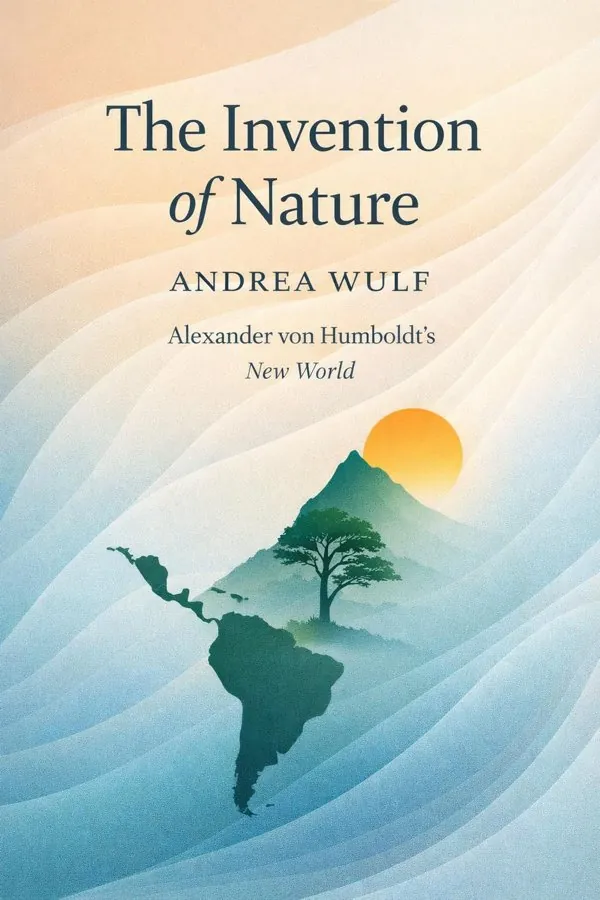
The Invention of Nature: Alexander von Humboldt's New World: Summary & Key Insights
by Andrea Wulf
 10 min11 chaptersAudio available
What Is The Invention of Nature: Alexander von Humboldt's New World About?
The Invention of Nature: Alexander von Humboldt's New World by Andrea Wulf is a biographies book spanning 11 pages. The Invention of Nature: Alexander von Humboldt's New World explores the life and legacy of the visionary Prussian naturalist Alexander von Humboldt, whose ideas transformed our understanding of nature. Andrea Wulf traces Humboldt’s expeditions through South America, his influence on figures such as Darwin, Thoreau, and Goethe, and his revolutionary concept of nature as an interconnected global force. The book reintroduces Humboldt as a forgotten hero of science and environmentalism, showing how his holistic view of the natural world shaped modern ecological thought.
This FizzRead summary covers all 11 key chapters of The Invention of Nature: Alexander von Humboldt's New World in approximately 10 minutes, distilling the most important ideas, arguments, and takeaways from Andrea Wulf's work. Also available as an audio summary and Key Quotes Podcast.
The Invention of Nature: Alexander von Humboldt's New World
The Invention of Nature: Alexander von Humboldt's New World explores the life and legacy of the visionary Prussian naturalist Alexander von Humboldt, whose ideas transformed our understanding of nature. Andrea Wulf traces Humboldt’s expeditions through South America, his influence on figures such as Darwin, Thoreau, and Goethe, and his revolutionary concept of nature as an interconnected global force. The book reintroduces Humboldt as a forgotten hero of science and environmentalism, showing how his holistic view of the natural world shaped modern ecological thought.
Who Should Read The Invention of Nature: Alexander von Humboldt's New World?
This book is perfect for anyone interested in biographies and looking to gain actionable insights in a short read. Whether you're a student, professional, or lifelong learner, the key ideas from The Invention of Nature: Alexander von Humboldt's New World by Andrea Wulf will help you think differently.
- ✓Readers who enjoy biographies and want practical takeaways
- ✓Professionals looking to apply new ideas to their work and life
- ✓Anyone who wants the core insights of The Invention of Nature: Alexander von Humboldt's New World in just 10 minutes
Want the full summary?
Get instant access to this book summary and 100K+ more with Fizz Moment.
Get Free SummaryAvailable on App Store • Free to download
Key Chapters
Humboldt’s story begins in Prussia, in a society disciplined and hierarchical, where curiosity was tolerated only within the bounds of convention. Born in 1769 into a family of noble standing, he was expected to serve the state. Yet even as a boy, he felt an inner rebellion against confinement. His mother, strict and emotionally distant, oversaw his classical education, while his older brother Wilhelm nurtured a scholarly bent that later produced Germany’s humanistic ideals. Alexander’s world, however, was outside—the fields, the stones, the strange specimens he collected around Schloss Tegel. The forest was his first laboratory.
His professional training started in mining engineering and geology, under the influence of the Enlightenment’s hunger for measurement and classification. At the Mining Academy in Freiberg, he learned from pioneers like Abraham Gottlob Werner, whose mineralogical theories stressed detailed observation. Humboldt absorbed these lessons but later revolted against their rigidity. He began to feel that analytic partitioning killed the life within nature, dissecting rather than understanding it. His work in mines gave him a sense of the earth’s inner pulse—the veins of metal as the body’s circulatory system. He later said that the mine taught him how alive the planet truly was.
Through the scientific circles of Berlin and Weimar, Humboldt formed a network that would define his cosmopolitan spirit. He met Goethe, whose holistic views transformed him. Goethe argued that nature must be understood as a living force—a unity of form and spirit. Humboldt felt as if his soul had been electrified. Science, he realized, could be poetic, emotional, and moral. This encounter altered the course of his thought and set the stage for his greatest adventure—the journey that would make his imagination global.
In 1799, after years of frustrated ambitions under political tension and his mother’s death—which finally freed him from financial restraint—Humboldt sailed from Spain with the French botanist Aimé Bonpland. They intended, at first, only a brief exploration of Spanish America; instead, they spent five years traversing nearly 6,000 miles across Venezuela, Cuba, the Andes, and Mexico, producing a revolution in the way we saw the planet.
Their journey was a theatre of risk and revelation. They ascended tropical rivers, catalogued thousands of species, and mapped regions never before measured by Europeans. When Humboldt entered the dense forests of the Orinoco, he felt the living system pulsate around him. His instruments recorded temperature, humidity, magnetic deviation, and air composition—but his mind connected these numbers into a symphony. The forest was no isolated garden; it was an ecological network, where every plant and creature reflected the conditions of the whole.
As they traveled through territory scarred by colonial exploitation, Humboldt also documented social realities. He condemned the brutal labor systems of mines and plantations, appalled by slavery and the reduction of people to economic instruments. He sensed that the ecological desecration and human oppression were part of the same pattern of domination. The naturalist became, in those years, a moral philosopher. His journals shimmer with both empirical detail and poetic exaltation—they are the first drafts of what we now call environmental ethics.
By the time they reached Mexico, Humboldt had collected enough data to change geography itself. He drafted contour maps, recorded volcanic chains, and traced climate zones across continents. When he returned to Europe in 1804, he carried not only specimens and measurements but an idea—a vision that the planet was a unified organism, bound by invisible threads of relation. The voyage had transformed him into the architect of a new worldview.
+ 9 more chapters — available in the FizzRead app
All Chapters in The Invention of Nature: Alexander von Humboldt's New World
About the Author
Andrea Wulf is a British historian and author known for her works on science, nature, and the Enlightenment. Born in India and educated in Germany and the UK, she has written several acclaimed books, including Founding Gardeners and The Brother Gardeners. Wulf’s writing combines meticulous research with vivid storytelling, earning her numerous literary awards and recognition for bringing historical figures to life.
Get This Summary in Your Preferred Format
Read or listen to the The Invention of Nature: Alexander von Humboldt's New World summary by Andrea Wulf anytime, anywhere. FizzRead offers multiple formats so you can learn on your terms — all free.
Available formats: App · Audio · PDF · EPUB — All included free with FizzRead
Download The Invention of Nature: Alexander von Humboldt's New World PDF and EPUB Summary
Key Quotes from The Invention of Nature: Alexander von Humboldt's New World
“Humboldt’s story begins in Prussia, in a society disciplined and hierarchical, where curiosity was tolerated only within the bounds of convention.”
Frequently Asked Questions about The Invention of Nature: Alexander von Humboldt's New World
The Invention of Nature: Alexander von Humboldt's New World by Andrea Wulf is a biographies book that explores key ideas across 11 chapters. The Invention of Nature: Alexander von Humboldt's New World explores the life and legacy of the visionary Prussian naturalist Alexander von Humboldt, whose ideas transformed our understanding of nature. Andrea Wulf traces Humboldt’s expeditions through South America, his influence on figures such as Darwin, Thoreau, and Goethe, and his revolutionary concept of nature as an interconnected global force. The book reintroduces Humboldt as a forgotten hero of science and environmentalism, showing how his holistic view of the natural world shaped modern ecological thought.
More by Andrea Wulf
You Might Also Like

An American Marriage
Tayari Jones
10 min
Benjamin Franklin: An American Life
Walter Isaacson
10 min
I Know Why The Caged Bird Sings
Maya Angelou
10 min
Long Walk to Freedom
Nelson Mandela
10 min
Persepolis
Marjane Satrapi
10 min
Surely You're Joking, Mr. Feynman!
Richard P. Feynman
10 minBrowse by Category
Ready to read The Invention of Nature: Alexander von Humboldt's New World?
Get the full summary and 100K+ more books with Fizz Moment.