
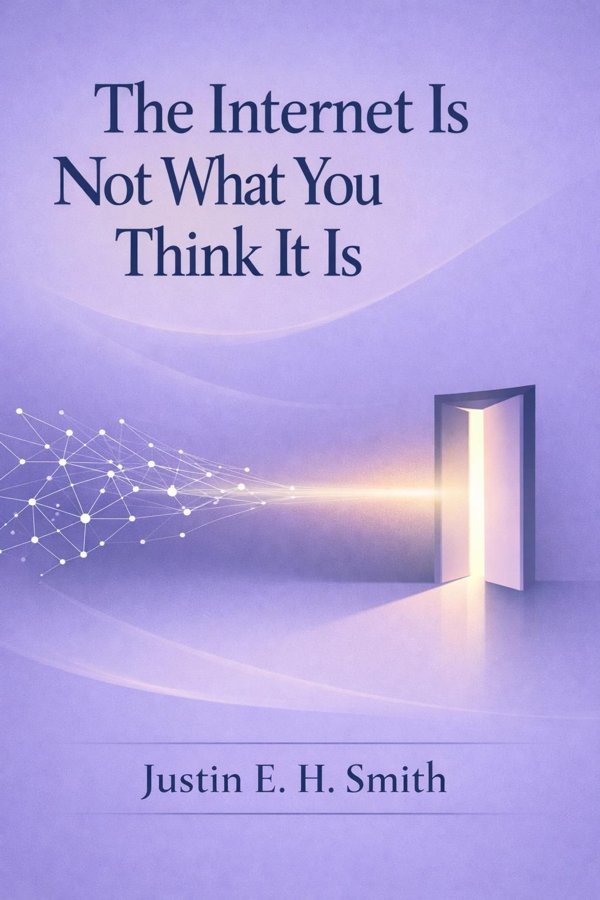
The Internet Is Not What You Think It Is: A History, a Philosophy, a Warning: Summary & Key Insights
 10 min9 chaptersAudio available
What Is The Internet Is Not What You Think It Is: A History, a Philosophy, a Warning About?
The Internet Is Not What You Think It Is: A History, a Philosophy, a Warning by Justin E. H. Smith is a digital_culture book spanning 9 pages. In this thought-provoking work, philosopher Justin E. H. Smith explores the origins, nature, and consequences of the internet. He argues that the internet is not a neutral tool but a reflection of human desires, limitations, and philosophical assumptions. Drawing on history, philosophy, and cultural analysis, Smith examines how the internet shapes our understanding of knowledge, communication, and identity, warning that its current trajectory may undermine the very ideals it was meant to serve.
This FizzRead summary covers all 9 key chapters of The Internet Is Not What You Think It Is: A History, a Philosophy, a Warning in approximately 10 minutes, distilling the most important ideas, arguments, and takeaways from Justin E. H. Smith's work. Also available as an audio summary and Key Quotes Podcast.
The Internet Is Not What You Think It Is: A History, a Philosophy, a Warning
In this thought-provoking work, philosopher Justin E. H. Smith explores the origins, nature, and consequences of the internet. He argues that the internet is not a neutral tool but a reflection of human desires, limitations, and philosophical assumptions. Drawing on history, philosophy, and cultural analysis, Smith examines how the internet shapes our understanding of knowledge, communication, and identity, warning that its current trajectory may undermine the very ideals it was meant to serve.
Who Should Read The Internet Is Not What You Think It Is: A History, a Philosophy, a Warning?
This book is perfect for anyone interested in digital_culture and looking to gain actionable insights in a short read. Whether you're a student, professional, or lifelong learner, the key ideas from The Internet Is Not What You Think It Is: A History, a Philosophy, a Warning by Justin E. H. Smith will help you think differently.
- ✓Readers who enjoy digital_culture and want practical takeaways
- ✓Professionals looking to apply new ideas to their work and life
- ✓Anyone who wants the core insights of The Internet Is Not What You Think It Is: A History, a Philosophy, a Warning in just 10 minutes
Want the full summary?
Get instant access to this book summary and 100K+ more with Fizz Moment.
Get Free SummaryAvailable on App Store • Free to download
Key Chapters
If we want to understand the Internet, we must begin long before the first computer or circuit board was ever imagined. Every significant innovation in communication—from the invention of writing to the printing press to the telegraph—transformed what it meant to be human. Writing allowed our thoughts to transcend the limits of our memory; printing democratized knowledge, liberating it from the cloisters of the elite; telegraphy shrank the world, enabling messages to fly faster than any messenger could run. Each of these revolutions carried within it not just technical achievements but philosophical claims. Writing taught us that thoughts could have independent existence. Printing suggested that truth might be found through replication and distribution. The telegraph pushed the notion that connectivity itself was a form of enlightenment.
When I draw these parallels, I am making a point about continuity. The Internet is not an alien artifact that fell from the sky—it is an iteration of the same human drive that has always shaped communication. Its architecture, a web of nodes and connections, is the logical descendant of the postal routes and telegraph lines that once symbolized the conquering of distance. Yet, paradoxically, each technological compression of space and time seems to widen our existential gap. We connect more swiftly, but understand one another less deeply. We store more data, but lose the thread of meaning.
This historical understanding gives us a map of the Internet’s moral terrain. Technology is never neutral; it carries intentions inherited from the past. The dreams of perfect knowledge and universal communication linger in fiber cables as they once did in Gutenberg’s press. And just as print culture brought both enlightenment and propaganda, today’s Internet brings both shared understanding and collective confusion. To see its ancestors is to see its destiny—and perhaps to reclaim the discernment those earlier ages demanded.
Behind every wire and pixel lies a philosophical genealogy. The Internet’s intellectual foundations reached maturity during the Enlightenment, when thinkers like Leibniz, Diderot, and Kant pursued universal systems of knowledge and reason. Leibniz dreamed of a ‘characteristica universalis,’ a language in which human thought could be encoded, analyzed, and perfected—a precursor of the digital logic that undergirds our online world. Diderot and the encyclopedists envisioned knowledge as a democratic web, accessible to all. Kant imagined reason as the unifying faculty of humanity, transcending personal bias and geography.
I argue that the Internet inherited these ambitions but twisted them in practice. Its algorithms claim objectivity, echoing the Enlightenment’s faith in reason, yet they often function as opaque systems of commercial persuasion. Its search engines promise universality of access, but instead deliver hierarchies of relevance engineered for profit. The Enlightenment wanted a republic of letters grounded in shared rationality; the Internet has given us endless letters without a republic.
When philosophy dreamed of universal connection, it did so under the assumption that understanding would ennoble humanity. Now, in the digital age, we must ask a grim question: can we still trust that connectivity implies enlightenment? The Internet might fulfill the Enlightenment’s form—the boundless circulation of ideas—but not its spirit. To recover that spirit, we must recognize that rationality is not an algorithmic output but a moral responsibility. Our networks catalyze knowledge only when guided by ethical intention.
+ 7 more chapters — available in the FizzRead app
All Chapters in The Internet Is Not What You Think It Is: A History, a Philosophy, a Warning
About the Author
Justin E. H. Smith is a professor of history and philosophy of science at the Université Paris Cité. His research focuses on early modern philosophy, the history of science, and the intersection of technology and human thought. He is also the author of several books exploring the relationship between philosophy, culture, and the natural world.
Get This Summary in Your Preferred Format
Read or listen to the The Internet Is Not What You Think It Is: A History, a Philosophy, a Warning summary by Justin E. H. Smith anytime, anywhere. FizzRead offers multiple formats so you can learn on your terms — all free.
Available formats: App · Audio · PDF · EPUB — All included free with FizzRead
Download The Internet Is Not What You Think It Is: A History, a Philosophy, a Warning PDF and EPUB Summary
Key Quotes from The Internet Is Not What You Think It Is: A History, a Philosophy, a Warning
“If we want to understand the Internet, we must begin long before the first computer or circuit board was ever imagined.”
“Behind every wire and pixel lies a philosophical genealogy.”
Frequently Asked Questions about The Internet Is Not What You Think It Is: A History, a Philosophy, a Warning
The Internet Is Not What You Think It Is: A History, a Philosophy, a Warning by Justin E. H. Smith is a digital_culture book that explores key ideas across 9 chapters. In this thought-provoking work, philosopher Justin E. H. Smith explores the origins, nature, and consequences of the internet. He argues that the internet is not a neutral tool but a reflection of human desires, limitations, and philosophical assumptions. Drawing on history, philosophy, and cultural analysis, Smith examines how the internet shapes our understanding of knowledge, communication, and identity, warning that its current trajectory may undermine the very ideals it was meant to serve.
More by Justin E. H. Smith
You Might Also Like
An Ugly Truth: Inside Facebook’s Battle for Domination
Sheera Frenkel, Cecilia Kang
10 min
Cyber Citizens
Ian Goodfellow
10 min
Digital Minimalism: Choosing a Focused Life in a Noisy World
Cal Newport
10 min
E‑Books & Beyond
Various Authors
10 min
The Future of Media
Various Authors
10 min
This Is Why We Can't Have Nice Things
Whitney Phillips
10 minBrowse by Category
Ready to read The Internet Is Not What You Think It Is: A History, a Philosophy, a Warning?
Get the full summary and 100K+ more books with Fizz Moment.