
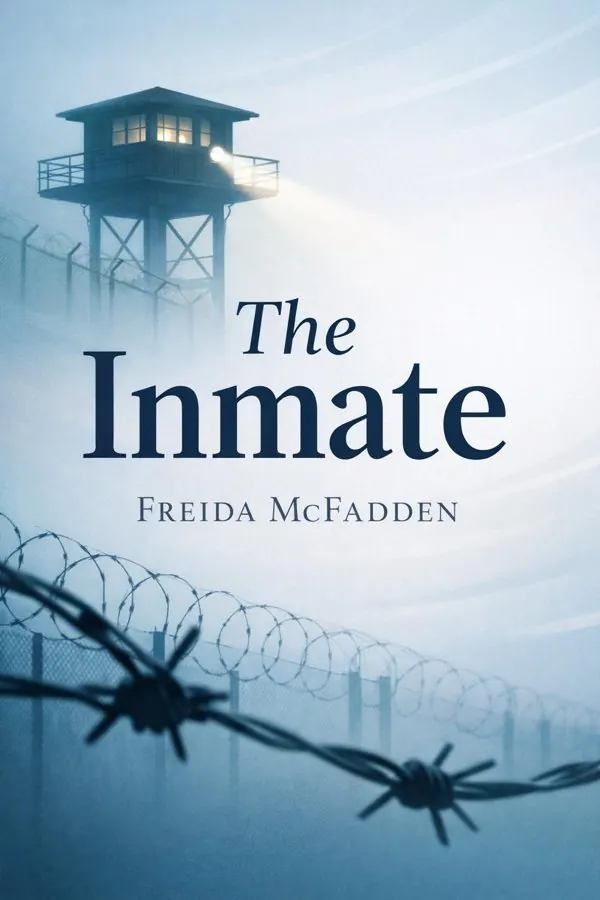
The Inmate: Summary & Key Insights
 10 min8 chaptersAudio available
Key Takeaways from The Inmate
One of the most unsettling truths in The Inmate is that the past does not disappear just because we try to outgrow it.
A powerful idea running through The Inmate is that trust is never a neutral act in a thriller; it is a risk calculation.
Few settings intensify suspense as effectively as institutions with rigid rules and limited freedom, and The Inmate uses the prison environment brilliantly.
One of the novel’s deepest psychological engines is its treatment of memory as something uncertain rather than fixed.
In The Inmate, openness is not always the safest choice.
What Is The Inmate About?
The Inmate by Freida McFadden is a mystery book. Freida McFadden’s The Inmate is a fast-paced psychological thriller built on a deceptively simple premise: a nurse practitioner accepts a job at a maximum-security prison, only to discover that one of the inmates is a man from her past who may have ruined her life. From that moment, the novel becomes a tense study of memory, guilt, fear, and the way buried secrets never stay buried for long. The story combines the claustrophobic atmosphere of prison life with the emotional intensity of a woman forced to confront old trauma while trying to protect the life she has rebuilt. What makes The Inmate compelling is not just its suspense, but its constant manipulation of certainty. McFadden keeps readers questioning what really happened, who is telling the truth, and whether the most dangerous threat is behind bars or walking free. The novel matters because it explores how trauma distorts trust and how survival often depends on seeing through appearances. McFadden, widely known for her bestselling domestic and psychological thrillers, brings her medical background and talent for sharp, twist-driven storytelling to create a gripping read that is both entertaining and unsettling. This is a thriller designed to keep readers suspicious of everyone, right up to the final reveal.
This FizzRead summary covers all 8 key chapters of The Inmate in approximately 10 minutes, distilling the most important ideas, arguments, and takeaways from Freida McFadden's work. Also available as an audio summary and Key Quotes Podcast.
The Inmate
Freida McFadden’s The Inmate is a fast-paced psychological thriller built on a deceptively simple premise: a nurse practitioner accepts a job at a maximum-security prison, only to discover that one of the inmates is a man from her past who may have ruined her life. From that moment, the novel becomes a tense study of memory, guilt, fear, and the way buried secrets never stay buried for long. The story combines the claustrophobic atmosphere of prison life with the emotional intensity of a woman forced to confront old trauma while trying to protect the life she has rebuilt.
What makes The Inmate compelling is not just its suspense, but its constant manipulation of certainty. McFadden keeps readers questioning what really happened, who is telling the truth, and whether the most dangerous threat is behind bars or walking free. The novel matters because it explores how trauma distorts trust and how survival often depends on seeing through appearances. McFadden, widely known for her bestselling domestic and psychological thrillers, brings her medical background and talent for sharp, twist-driven storytelling to create a gripping read that is both entertaining and unsettling. This is a thriller designed to keep readers suspicious of everyone, right up to the final reveal.
Who Should Read The Inmate?
This book is perfect for anyone interested in mystery and looking to gain actionable insights in a short read. Whether you're a student, professional, or lifelong learner, the key ideas from The Inmate by Freida McFadden will help you think differently.
- ✓Readers who enjoy mystery and want practical takeaways
- ✓Professionals looking to apply new ideas to their work and life
- ✓Anyone who wants the core insights of The Inmate in just 10 minutes
Want the full summary?
Get instant access to this book summary and 100K+ more with Fizz Moment.
Get Free SummaryAvailable on App Store • Free to download
Key Chapters
One of the most unsettling truths in The Inmate is that the past does not disappear just because we try to outgrow it. The novel centers on Brooke Sullivan, who believes she has built some distance from a traumatic chapter in her youth. She now has a career, responsibilities, and a son to protect. But when she takes a job in a prison and comes face-to-face with Shane Nelson, a man tied to her darkest memories, the wall between past and present collapses instantly.
Freida McFadden uses this setup to show how unresolved experiences continue shaping decisions long after the visible crisis has ended. Brooke is not simply reacting to a prisoner she once knew. She is reacting to everything that relationship represented: trust misplaced, danger overlooked, and the lingering fear that she misunderstood crucial truths. This is what gives the thriller emotional force. The prison is only one setting of confinement. The other is psychological. Brooke is trapped inside memories she thought were settled.
This idea applies far beyond the plot. Many people tell themselves they have “moved on” because daily life appears functional. Yet old betrayals, bad judgments, or traumatic relationships often resurface when a new situation mirrors the old one. A workplace conflict, a new romance, or a parenting decision can reopen unresolved fear and confusion. The lesson is not that healing is impossible. It is that healing requires more than avoidance.
McFadden turns this into suspense by showing how dangerous it can be to rely on a simplified version of the past. If the story you tell yourself is incomplete, your present choices may be compromised as well. Brooke’s struggle reminds readers that clarity about the past is often necessary for safety in the present.
Actionable takeaway: Pay attention to situations that trigger outsized fear or doubt. They may signal an unresolved experience that deserves honest reexamination rather than suppression.
A powerful idea running through The Inmate is that trust is never a neutral act in a thriller; it is a risk calculation. Nearly every major turn in the book depends on whether Brooke can correctly judge the people around her. Is Shane truly the monster the world believes he is? Are the people outside prison walls as harmless as they appear? Can old assumptions be relied upon, or are they exactly what put her in danger in the first place?
McFadden builds tension by forcing readers into Brooke’s uncertainty. Trust usually feels like a moral virtue, but here it becomes a high-stakes decision with real consequences. Trust the wrong person, and you invite harm. Refuse to trust anyone, and you isolate yourself so completely that you become vulnerable in a different way. This balance gives the novel much of its psychological complexity. Brooke must function in a system where rules exist, but those rules do not guarantee safety. Titles, appearances, and official narratives are not enough.
The practical relevance is clear. In real life, people often lean too heavily on social shorthand when deciding whom to trust. We trust professionals because of credentials, acquaintances because of familiarity, and charming people because confidence feels persuasive. At the same time, we may dismiss those who seem damaged, awkward, or socially condemned. The Inmate challenges that instinct by repeatedly asking whether social reputation is actually evidence.
The novel does not argue that suspicion is always wise. Instead, it suggests that trust should be earned through consistency, behavior, and verifiable truth. Emotional history can cloud judgment just as much as fear can. Brooke’s dilemma illustrates how difficult it is to assess character when trauma, love, and guilt are all in play.
Actionable takeaway: When trust matters, separate emotion from evidence. Look for patterns, facts, and actions over labels, charisma, or assumptions rooted in the past.
Few settings intensify suspense as effectively as institutions with rigid rules and limited freedom, and The Inmate uses the prison environment brilliantly. The maximum-security facility is not just a backdrop. It is a mechanism that amplifies dread. Every locked door, surveillance protocol, and power imbalance reinforces the sense that danger can be controlled but never eliminated. Brooke works inside a place built to contain violent men, yet the novel constantly suggests that structure itself does not create true security.
McFadden exploits the contradiction at the heart of prisons: they are designed for order, but they are full of people with hidden motives, fractured loyalties, and histories of harm. For Brooke, the setting is especially destabilizing because she is both an insider and an outsider. She belongs there professionally, yet emotionally she is deeply exposed. The prison turns routine interactions into loaded encounters. A medical visit is never just a medical visit when it involves someone tied to personal trauma.
This idea extends to any closed system, not just a prison. Offices, schools, hospitals, and families can all become environments where hierarchy suppresses truth and appearances mask danger. In systems that prioritize control, people often assume risk is being managed. But systems are only as reliable as the people operating inside them. Fear grows when individuals realize the rules may not protect them as much as they imagined.
The novel’s atmosphere reminds readers that confinement changes behavior. People hide more, scheme more carefully, and cling more tightly to partial truths. That pressure cooker effect is what makes revelations so explosive. In restricted environments, one secret can destabilize everything.
Actionable takeaway: Do not confuse formal structure with actual safety. In any high-stakes environment, stay aware of interpersonal dynamics, hidden vulnerabilities, and where real power actually lies.
One of the novel’s deepest psychological engines is its treatment of memory as something uncertain rather than fixed. The Inmate thrives on the gap between what Brooke believes happened and what may have actually occurred. That gap is not a simple trick; it is the book’s central emotional battleground. Memory in McFadden’s world is vulnerable to fear, suggestion, shame, and time. A remembered event may feel solid while still being incomplete or misleading.
This matters because Brooke’s sense of safety rests on her interpretation of the past. If her memory is accurate, then her fear is justified. If her memory is partial or manipulated, then she may be protecting herself from the wrong threat. McFadden turns this instability into suspense by showing how people construct narratives around traumatic events. Once a version becomes emotionally necessary, it can be difficult to question, even when new information appears.
The theme has broad human relevance. In real life, memory is often treated as proof, especially in emotionally charged situations. But memory is influenced by perspective and emotion. Two people can experience the same event and carry away profoundly different truths. This does not mean all memories are false. It means they should be handled with humility.
The novel also highlights how memory becomes social. Communities, institutions, and relationships reinforce certain stories while silencing others. Once a consensus forms, revisiting the past becomes dangerous because it threatens identities and moral certainty. Brooke is caught inside that dynamic. To revise her understanding would require not only personal courage but also a willingness to dismantle long-held beliefs.
Actionable takeaway: Treat emotionally charged memories seriously, but not as beyond question. When the stakes are high, revisit assumptions, seek corroboration, and allow room for complexity.
In The Inmate, openness is not always the safest choice. McFadden repeatedly shows that in threatening environments, people survive by managing what they reveal, to whom, and when. Brooke enters the prison carrying private knowledge and private fears. She cannot simply expose every thought she has, because information itself is a form of power. In a thriller, secrets are often portrayed as moral failings, but this novel makes a more complicated point: sometimes secrecy is defensive, even necessary.
Brooke’s challenge is that secrecy cuts both ways. The same instinct that protects her can also isolate her, distort relationships, and delay crucial action. This tension gives the book much of its propulsion. Every withheld detail creates two simultaneous possibilities: it may preserve safety, or it may strengthen the danger. McFadden keeps readers hooked by making that line hard to see until late in the story.
This idea is useful in everyday life, especially in situations involving personal boundaries, workplace politics, family conflict, or legal and emotional risk. Radical honesty is often praised, but context matters. You do not owe full transparency to people who may misuse what they learn. At the same time, withholding key information from trusted allies can leave you unsupported when you most need help. The real skill lies in discernment.
The novel suggests that survival is not about saying everything or hiding everything. It is about understanding timing, trustworthiness, and consequences. Brooke’s predicament reveals that the question is not merely whether a secret exists, but what the secret is doing. Is it shielding someone from harm, or preserving a lie that enables more harm?
Actionable takeaway: Be intentional with disclosure. Share sensitive information selectively, based on safety and purpose, and distinguish between healthy privacy and secrecy that keeps you trapped.
A defining pleasure of The Inmate is how effectively it undermines surface-level judgment. The prison setting encourages readers to think in binaries: inmates are dangerous, professionals are safer; convicted men are suspect, ordinary citizens are trustworthy. McFadden relies on those assumptions only to destabilize them. The result is a thriller that warns readers against equating visibility of threat with actual threat.
The title itself directs attention toward the prisoner, inviting the expectation that danger sits plainly behind bars. But psychological thrillers work by turning attention into misdirection. If readers fixate on the obvious suspect, they become less attentive to subtler forms of menace: manipulation, grooming, coercion, and the abuse of trust. Brooke’s experience unfolds in that uneasy space where the known danger may not be the immediate one.
This is one of the book’s strongest real-world parallels. People often fear threats that are easy to label while missing those embedded in familiar relationships or respectable roles. A person with a criminal history may seem more alarming than a polished, socially approved individual, even though actual harm often comes through proximity and credibility. The novel exposes how cultural assumptions can make people blind.
McFadden does not flatten this into a simple moral reversal. She does not suggest that every obvious threat is harmless or that every respectable person is corrupt. Instead, she insists that appearance is insufficient. Danger must be judged through behavior, motive, and pattern. That principle drives both the mystery and Brooke’s gradual reassessment of what she thought she knew.
Actionable takeaway: When evaluating risk, resist the urge to rely on image alone. Watch for behavior over presentation, and pay particular attention to threats hidden inside familiarity and trust.
At the emotional center of The Inmate is not only Brooke’s fear for herself, but her determination to protect her son. This parental layer elevates the novel beyond a standard cat-and-mouse thriller. Brooke’s decisions are sharpened by motherhood, which means every uncertainty carries multiplied stakes. She is not merely trying to understand the past. She is trying to prevent that past from contaminating the future of someone she loves.
McFadden portrays trauma as something that reshapes protective instincts. When people have been hurt, they often become hypervigilant, scanning constantly for signs of repeated danger. This can be lifesaving, but it can also distort judgment. Brooke’s protective drive is understandable and sympathetic, yet it also raises difficult questions: when does caution become paranoia? When does shielding a child from harm require telling hard truths, and when does silence become another form of risk?
The novel captures a common dilemma for survivors and parents alike. Adults often want to create a clean boundary between their children and their own painful history. But unresolved trauma has a way of leaking into tone, routine, secrecy, and decision-making. Children may not know the facts, yet they feel the atmosphere. Brooke’s struggle reflects the broader challenge of parenting while still healing.
Outside the novel, this theme applies to anyone responsible for others. Leaders, caregivers, and parents often make protective choices based not only on present evidence but also on old wounds. That is human, but it can create overcorrection or blind spots. True protection requires understanding both the external threat and the internal fear shaping your response.
Actionable takeaway: If you are protecting someone you love, examine whether your decisions are guided by current reality, old trauma, or both. Awareness makes protection wiser and more effective.
The Inmate demonstrates that truth rarely arrives as a clean confession or a neat clue. More often, it emerges when competing stories begin to strain under pressure. McFadden structures the novel so that contradictions accumulate. Small inconsistencies, emotional reactions, withheld details, and shifting perceptions gradually force a reevaluation of what seemed settled. This is one reason the book feels so propulsive: each new revelation does not simply answer a question; it destabilizes the answer that came before.
Brooke’s journey reflects how difficult it is to find the truth when falsehood is mixed with partial honesty. People in the novel do not necessarily lie in straightforward ways. They omit, redirect, rationalize, and speak from self-interest. That makes the mystery more psychologically convincing. In real life, deception often operates exactly this way. The challenge is not merely spotting a lie but noticing when a story works too hard to preserve itself.
This concept has practical significance beyond fiction. Whether dealing with personal conflict, workplace politics, or public narratives, people often seek certainty too quickly. A single persuasive explanation can feel comforting, especially after chaos. But truth usually becomes clearer through comparison: what is said, what is avoided, what changes over time, and who benefits from a given version of events.
McFadden uses suspense to reward patience. Readers who stay alert to contradiction are better prepared for the novel’s twists. Brooke, too, must learn to tolerate uncertainty long enough to see the larger pattern. That is a valuable skill in any context where appearances and motives are in conflict.
Actionable takeaway: When the truth matters, do not settle for the first coherent story. Compare versions, track inconsistencies, and let contradictions reveal what polished narratives are trying to hide.
All Chapters in The Inmate
About the Author
Freida McFadden is a bestselling author of psychological thrillers known for writing fast, twist-heavy novels that explore secrecy, deception, and the darker side of everyday relationships. Her books have gained a large international audience thanks to their addictive pacing, accessible style, and dramatic reveals. Before rising to major popularity as a novelist, McFadden trained and worked in medicine, and that professional background often adds credibility to the clinical and institutional settings in her fiction. She is especially associated with contemporary commercial suspense that blends domestic tension with psychological manipulation. With novels such as The Housemaid and The Inmate, she has become one of the most widely read thriller authors for readers looking for compulsive, page-turning stories.
Get This Summary in Your Preferred Format
Read or listen to the The Inmate summary by Freida McFadden anytime, anywhere. FizzRead offers multiple formats so you can learn on your terms — all free.
Available formats: App · Audio · PDF · EPUB — All included free with FizzRead
Download The Inmate PDF and EPUB Summary
Key Quotes from The Inmate
“One of the most unsettling truths in The Inmate is that the past does not disappear just because we try to outgrow it.”
“A powerful idea running through The Inmate is that trust is never a neutral act in a thriller; it is a risk calculation.”
“Few settings intensify suspense as effectively as institutions with rigid rules and limited freedom, and The Inmate uses the prison environment brilliantly.”
“One of the novel’s deepest psychological engines is its treatment of memory as something uncertain rather than fixed.”
“In The Inmate, openness is not always the safest choice.”
Frequently Asked Questions about The Inmate
The Inmate by Freida McFadden is a mystery book that explores key ideas across 8 chapters. Freida McFadden’s The Inmate is a fast-paced psychological thriller built on a deceptively simple premise: a nurse practitioner accepts a job at a maximum-security prison, only to discover that one of the inmates is a man from her past who may have ruined her life. From that moment, the novel becomes a tense study of memory, guilt, fear, and the way buried secrets never stay buried for long. The story combines the claustrophobic atmosphere of prison life with the emotional intensity of a woman forced to confront old trauma while trying to protect the life she has rebuilt. What makes The Inmate compelling is not just its suspense, but its constant manipulation of certainty. McFadden keeps readers questioning what really happened, who is telling the truth, and whether the most dangerous threat is behind bars or walking free. The novel matters because it explores how trauma distorts trust and how survival often depends on seeing through appearances. McFadden, widely known for her bestselling domestic and psychological thrillers, brings her medical background and talent for sharp, twist-driven storytelling to create a gripping read that is both entertaining and unsettling. This is a thriller designed to keep readers suspicious of everyone, right up to the final reveal.
More by Freida McFadden


You Might Also Like


Browse by Category
Ready to read The Inmate?
Get the full summary and 100K+ more books with Fizz Moment.