
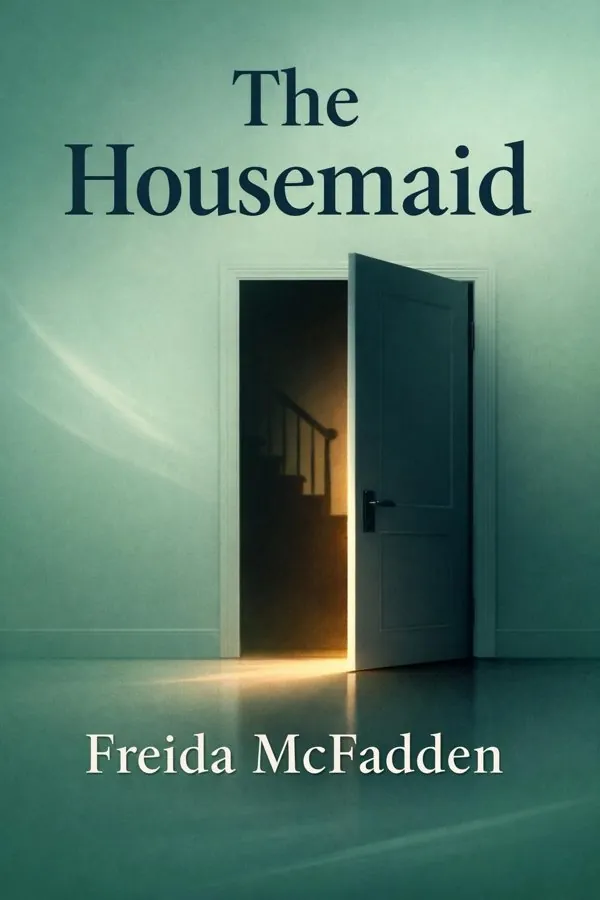
The Housemaid: Summary & Key Insights
 10 min9 chaptersAudio available
Key Takeaways from The Housemaid
The most dangerous decisions are often the ones that feel necessary.
A beautiful home can function as camouflage.
Psychological control rarely begins with open cruelty; it starts with confusion.
Every secret gains power when access is denied.
People often mistake gentleness in presentation for goodness in character.
What Is The Housemaid About?
The Housemaid by Freida McFadden is a thriller book published in 2022 spanning 4 pages. Some of the most frightening stories begin with an opportunity that seems too good to refuse. In The Housemaid, Freida McFadden turns a simple job offer into a tightly wound psychological trap, following Millie, a young woman desperate for a fresh start after prison. Hired by the wealthy Winchester family to clean their elegant Long Island home and help care for their daughter, Millie tells herself she has finally found stability. But inside the polished halls of the house, nothing feels quite right. The mistress of the home is erratic, the husband seems almost too kind, and the rules surrounding the family’s private life grow stranger by the day. What begins as domestic unease becomes a tense battle over truth, identity, and survival. McFadden is especially effective in this kind of story because she understands how fear often hides inside ordinary routines. Best known for fast-paced psychological thrillers and informed by her career as a physician, she writes with precision, momentum, and a sharp sense of human vulnerability. The Housemaid matters because it exposes how easily appearances can mislead us, and how power often operates most dangerously behind closed doors.
This FizzRead summary covers all 9 key chapters of The Housemaid in approximately 10 minutes, distilling the most important ideas, arguments, and takeaways from Freida McFadden's work. Also available as an audio summary and Key Quotes Podcast.
The Housemaid
Some of the most frightening stories begin with an opportunity that seems too good to refuse. In The Housemaid, Freida McFadden turns a simple job offer into a tightly wound psychological trap, following Millie, a young woman desperate for a fresh start after prison. Hired by the wealthy Winchester family to clean their elegant Long Island home and help care for their daughter, Millie tells herself she has finally found stability. But inside the polished halls of the house, nothing feels quite right. The mistress of the home is erratic, the husband seems almost too kind, and the rules surrounding the family’s private life grow stranger by the day. What begins as domestic unease becomes a tense battle over truth, identity, and survival.
McFadden is especially effective in this kind of story because she understands how fear often hides inside ordinary routines. Best known for fast-paced psychological thrillers and informed by her career as a physician, she writes with precision, momentum, and a sharp sense of human vulnerability. The Housemaid matters because it exposes how easily appearances can mislead us, and how power often operates most dangerously behind closed doors.
Who Should Read The Housemaid?
This book is perfect for anyone interested in thriller and looking to gain actionable insights in a short read. Whether you're a student, professional, or lifelong learner, the key ideas from The Housemaid by Freida McFadden will help you think differently.
- ✓Readers who enjoy thriller and want practical takeaways
- ✓Professionals looking to apply new ideas to their work and life
- ✓Anyone who wants the core insights of The Housemaid in just 10 minutes
Want the full summary?
Get instant access to this book summary and 100K+ more with Fizz Moment.
Get Free SummaryAvailable on App Store • Free to download
Key Chapters
The most dangerous decisions are often the ones that feel necessary. Millie’s arrival at the Winchester home is not driven by ambition or curiosity, but by survival. Recently released from prison, unemployed, and sleeping in her car, she has been pushed to the edge of what a person can endure alone. So when she sees a housekeeping job that includes room and board, she does not have the luxury of being selective. That is what makes the opening of The Housemaid so effective: McFadden shows how desperation can blur judgment without making the person seem foolish.
Millie recognizes the job is unusually generous. The house is beautiful, the salary is fair, and the family appears wealthy enough to solve many of her immediate problems. Yet from the start, small details suggest that comfort may come at a cost. Her attic room is cramped and unsettling. Nina Winchester, the lady of the house, behaves unpredictably. The family dynamic feels off in ways Millie cannot yet explain. Still, because she needs safety more than certainty, she stays.
This opening idea extends beyond the novel. In real life, people under pressure often accept environments, relationships, or jobs that others would immediately question. Financial insecurity, loneliness, and social stigma can make red flags feel secondary to immediate relief. McFadden captures that emotional calculus with unsettling honesty.
The practical lesson is not to blame people for compromised choices, but to understand how vulnerability changes risk assessment. When someone feels trapped, even a suspicious opportunity can look like rescue. The actionable takeaway: whenever urgency forces a major decision, pause long enough to identify what you may be ignoring simply because you need the answer to be yes.
A beautiful home can function as camouflage. One of the novel’s most compelling tensions comes from the contrast between the Winchesters’ outward perfection and the emotional decay hidden inside their household. The manicured image of wealth suggests order, sophistication, and security, yet Millie quickly learns that expensive surroundings do not create healthy relationships. In fact, they can make dysfunction harder to detect because outsiders assume that privilege equals stability.
The Winchester house is not merely a setting; it is a psychological instrument. Every polished surface, carefully furnished room, and social performance encourages Millie to doubt her instincts. If something feels wrong, she wonders whether she is projecting her own troubled past onto a family that simply lives differently from her. This is a powerful dynamic, because people often trust appearances over discomfort. A person who speaks well, dresses elegantly, and lives in a large home is frequently granted credibility that others must fight to earn.
McFadden uses that imbalance brilliantly. Millie is aware of her own social vulnerability. As a woman with a criminal record and no safety net, she knows she is less likely to be believed if conflict arises. That awareness increases the psychological pressure. The house becomes a symbol of how power protects itself: not just through money, but through the assumption that respectable-looking people must be trustworthy.
This idea has broad application. In workplaces, families, and communities, polished exteriors can hide manipulation, abuse, or corruption. We are often trained to evaluate people by status markers instead of emotional evidence. The actionable takeaway: when assessing a person or environment, do not confuse appearance with character. Pay closer attention to patterns of behavior than to signals of success.
Psychological control rarely begins with open cruelty; it starts with confusion. After Millie settles into the Winchester household, Nina’s behavior moves from eccentric to destabilizing. She gives contradictory instructions, creates scenes that make Millie look incompetent, and shifts between warmth and hostility so quickly that Millie cannot predict what version of her employer she will face each day. This is the essence of gaslighting and coercive manipulation: the target is not simply mistreated, but mentally disoriented.
McFadden carefully shows how this process works. Millie is not physically trapped at first. She can, in theory, leave. But Nina’s erratic conduct erodes her confidence, making her question whether events are as sinister as they seem. When a manipulator controls the emotional atmosphere, every interaction becomes exhausting. The victim spends more time decoding tone, trying to avoid conflict, and reconstructing conversations than making clear decisions. That exhaustion is a form of power.
The novel also demonstrates how isolation strengthens manipulation. Millie has little support system, no secure reputation, and no one who fully knows her circumstances. That makes Nina’s version of reality more dangerous. Without witnesses or trusted allies, even obvious misconduct can begin to feel ambiguous. Readers see how abuse can hide not because it is subtle, but because the victim has been forced to live inside the abuser’s logic.
Outside fiction, this idea matters in relationships, workplaces, and caregiving environments. Controlling people often weaponize uncertainty rather than force, especially when they want to preserve a respectable image. Warning signs include frequent contradiction, blame-shifting, selective kindness, and behavior that leaves you constantly second-guessing yourself. The actionable takeaway: if a person consistently makes you feel confused, unstable, or responsible for their chaos, document patterns and trust the evidence over their performance.
People often mistake gentleness in presentation for goodness in character. Andrew Winchester initially appears to be the stabilizing force in the home: calm where Nina is volatile, handsome where the house feels cold, and attentive in ways that make Millie feel seen. In a story full of tension, he seems to offer emotional refuge. That perception is exactly why his role is so important. McFadden uses him to explore how easily charisma can bypass critical thinking, especially when it is contrasted with more obvious dysfunction.
Millie’s attraction to Andrew is not irrational. He speaks to her kindly, notices her struggles, and presents himself as the victim of Nina’s instability. In psychological terms, this is a familiar trap. When one person appears dramatically more reasonable than another, observers may grant them trust without demanding deeper proof. The comparison effect becomes a form of manipulation. Against chaos, even calculated behavior can look sincere.
The novel warns readers that danger does not always announce itself through aggression. Some of the most harmful people are skilled at appearing protective, patient, or wounded. They build credibility by understanding what others most want to hear. In Millie’s case, that includes reassurance, validation, and the fantasy of being rescued from hardship. McFadden turns that emotional longing into vulnerability.
This idea applies widely. In dating, hiring, friendship, and leadership, charm can create a false shortcut to trust. A polished demeanor may mask entitlement, deceit, or violence. The better question is not whether someone feels persuasive, but whether their actions remain consistent under scrutiny. The actionable takeaway: do not let contrast create trust. Evaluate people on evidence, not on how appealing they seem next to someone more visibly difficult.
The most satisfying thrillers do not merely reveal secrets; they rearrange the moral landscape. In The Housemaid, one of the novel’s major achievements is the reversal of power that follows the exposure of buried truths. What initially seems like a straightforward story of a vulnerable worker trapped by a wealthy, unstable employer transforms into something far more complex. McFadden does not rely on twists for shock alone. She uses them to show how incomplete information can produce false moral certainty.
As hidden histories come to light, readers are forced to revisit their assumptions about victimhood, guilt, and control. Characters who appeared weak reveal strategic intelligence. Characters who looked trustworthy become terrifying in new ways. Millie herself evolves from passive observer to someone capable of action, calculation, and moral risk. This shift is central to the book’s appeal. The tension is not just about discovering what happened, but about watching who gains agency once the truth can no longer be buried.
The novel also raises an uncomfortable question: when institutions fail to protect the vulnerable, what kinds of justice become imaginable? McFadden does not offer a neat ethical framework. Instead, she explores revenge, self-preservation, and the gray zone between legal innocence and moral accountability. That ambiguity gives the story emotional force. Readers are invited not merely to cheer the twist, but to wrestle with the conditions that made it necessary.
In practical terms, this theme reminds us that first impressions are often built on curated evidence. Workplace conflicts, family disputes, and public scandals frequently look different once hidden context emerges. The actionable takeaway: hold your judgments lightly until you understand the full pattern, and remember that real power often lies not with the loudest person, but with whoever controls the story.
Reinvention is fragile when the past still controls the terms of your future. Millie’s criminal record is more than backstory; it is the pressure point around which much of the novel’s tension turns. She wants to be judged by who she is becoming, not by the worst chapter of her life. Yet the world repeatedly reminds her that social forgiveness is selective. Her record limits where she can live, where she can work, and how much risk she can take. It also makes her easier to trap, because she knows others will be quicker to suspect her than to defend her.
McFadden uses Millie’s past to complicate the usual thriller dynamic. Millie is sympathetic, but she is not presented as spotless. That makes her feel more human and also more vulnerable. She carries shame, secrecy, and the exhausting need to prove she deserves another chance. This emotional burden shapes her decisions in subtle ways. She tolerates more than she should because she believes she cannot afford to lose what little she has. In that sense, the thriller becomes a story about stigma as much as danger.
The broader insight is that society often claims to support second chances while still punishing people indefinitely for previous mistakes. Whether the issue is incarceration, addiction, scandal, or failure, labels can become cages. People with damaged reputations may accept mistreatment simply because they fear no one else will take them in.
This theme offers a practical lesson in both self-awareness and empathy. If you carry a painful history, know that secrecy can make you easier to control. If you are evaluating someone else, avoid reducing them to a record or label. The actionable takeaway: protect your future by finding at least one trusted person or institution that knows your full story, so your past cannot be used against you in silence.
Home is supposed to be the place where vigilance can finally rest. McFadden turns that expectation inside out by making the house itself a site of surveillance, hierarchy, and dread. In The Housemaid, domestic labor is not background detail; it is central to the story’s power structure. Millie cooks, cleans, observes, and moves through spaces others take for granted. Her job gives her intimate access to the family’s life, but not equal standing within it. She sees nearly everything, yet formally belongs nowhere.
This tension makes the house feel psychologically charged. Everyday routines become suspenseful because domestic work exposes invisible boundaries: which rooms belong to whom, who gives orders, who is watched, and who must remain grateful. Even Millie’s tiny attic room reinforces the hierarchy. She is sheltered, but also contained. She lives inside the Winchester world while being constantly reminded that she is not truly part of it.
McFadden is especially sharp in showing how class shapes perception. A maid notices details employers overlook, but her observations may carry less authority because of her position. That imbalance matters. The person who sees the truth most clearly is often the one least likely to be believed. In this way, the novel becomes not only a thriller about secrets, but also a critique of how domestic workers can be both intimate insiders and disposable outsiders.
Readers can apply this insight by paying closer attention to the hidden power structures inside ordinary environments. Homes, offices, and institutions all create roles that determine whose reality counts. The actionable takeaway: whenever you enter a system, ask who performs the invisible labor, who controls the rules, and whose voice would be discounted if something went wrong.
A great twist works because it exposes a blind spot we secretly shared with the narrator. The Housemaid is a masterclass in this effect. McFadden structures the novel so that readers are not simply watching Millie be misled; they are being misled alongside her. This shared uncertainty creates a particularly intense reading experience. Each reveal forces a reassessment of earlier scenes, proving that suspense is not just about what happens next, but about what was happening all along.
The book’s momentum comes from careful control of perspective. Information is released in emotionally loaded fragments, allowing readers to form strong judgments before the full context is available. That is why the twists feel satisfying rather than random. They do not violate the story’s logic; they expose the assumptions built into it. McFadden understands that readers enjoy being surprised, but they love realizing they were fooled in a way that now seems obvious.
There is also a deeper appeal. Twist-driven psychological thrillers let readers rehearse distrust in a safe setting. They sharpen attention to motive, contradiction, and performance. In a world where people curate public images constantly, stories like The Housemaid feel relevant because they dramatize a common fear: that what looks ordinary or attractive may conceal a dangerous truth.
For readers and thinkers, the practical value of such fiction is that it trains interpretive patience. It reminds us to revisit conclusions, question narratives, and remain alert to omitted information. The actionable takeaway: when a situation feels neatly explained too early, stay curious. The first coherent story is not always the true one; often it is simply the most convenient.
All Chapters in The Housemaid
About the Author
Freida McFadden is an American bestselling author celebrated for her psychological thrillers, many of which have gained a wide international audience for their fast pacing, shocking twists, and addictive readability. Alongside her writing career, she is also a practicing physician who specializes in brain injury, a professional background that informs her interest in human behavior, memory, trauma, and perception. McFadden has written across both suspense and humor, but she is best known for domestic thrillers that uncover danger beneath ordinary lives. Her novels frequently explore deception, hidden motives, and the gap between public appearances and private truths. With books such as The Housemaid, she has become a standout voice in contemporary commercial suspense, appealing to readers who want gripping plots, emotional tension, and unforgettable reversals.
Get This Summary in Your Preferred Format
Read or listen to the The Housemaid summary by Freida McFadden anytime, anywhere. FizzRead offers multiple formats so you can learn on your terms — all free.
Available formats: App · Audio · PDF · EPUB — All included free with FizzRead
Download The Housemaid PDF and EPUB Summary
Key Quotes from The Housemaid
“The most dangerous decisions are often the ones that feel necessary.”
“A beautiful home can function as camouflage.”
“Psychological control rarely begins with open cruelty; it starts with confusion.”
“Every secret gains power when access is denied.”
“People often mistake gentleness in presentation for goodness in character.”
Frequently Asked Questions about The Housemaid
The Housemaid by Freida McFadden is a thriller book that explores key ideas across 9 chapters. Some of the most frightening stories begin with an opportunity that seems too good to refuse. In The Housemaid, Freida McFadden turns a simple job offer into a tightly wound psychological trap, following Millie, a young woman desperate for a fresh start after prison. Hired by the wealthy Winchester family to clean their elegant Long Island home and help care for their daughter, Millie tells herself she has finally found stability. But inside the polished halls of the house, nothing feels quite right. The mistress of the home is erratic, the husband seems almost too kind, and the rules surrounding the family’s private life grow stranger by the day. What begins as domestic unease becomes a tense battle over truth, identity, and survival. McFadden is especially effective in this kind of story because she understands how fear often hides inside ordinary routines. Best known for fast-paced psychological thrillers and informed by her career as a physician, she writes with precision, momentum, and a sharp sense of human vulnerability. The Housemaid matters because it exposes how easily appearances can mislead us, and how power often operates most dangerously behind closed doors.
More by Freida McFadden

You Might Also Like



Browse by Category
Ready to read The Housemaid?
Get the full summary and 100K+ more books with Fizz Moment.