
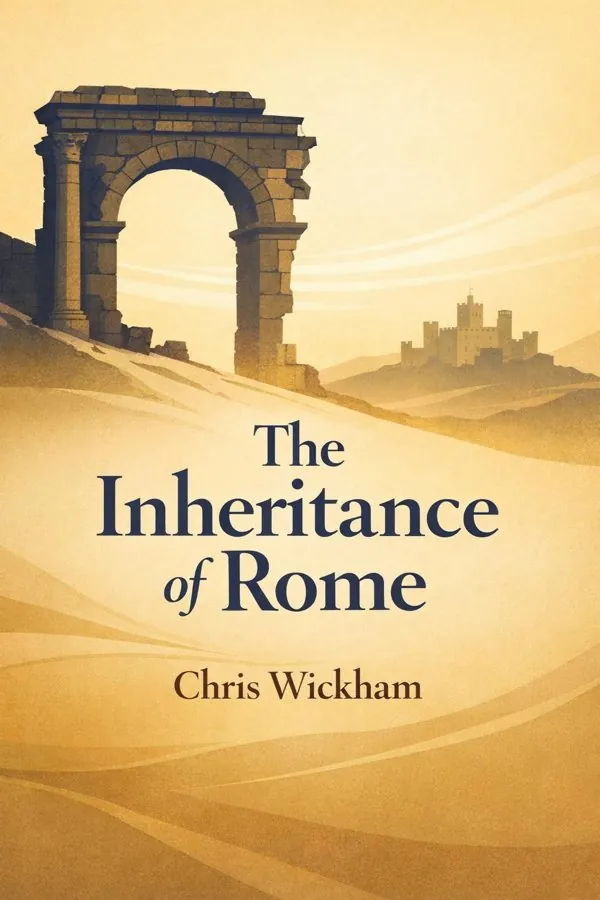
The Inheritance of Rome: A History of Europe from 400 to 1000: Summary & Key Insights
 10 min10 chaptersAudio available
Key Takeaways from The Inheritance of Rome: A History of Europe from 400 to 1000
The most misleading idea about late antiquity is that Rome vanished overnight.
New kingdoms do not simply replace old empires; they redefine what power means.
If the western empire fragmented, the eastern empire proved that Rome could survive by changing form.
One of Wickham’s most important arguments is that Europe between 400 and 1000 cannot be understood as an isolated Christian story.
Ambition often peaks when resources are most fragile.
What Is The Inheritance of Rome: A History of Europe from 400 to 1000 About?
The Inheritance of Rome: A History of Europe from 400 to 1000 by Chris Wickham is a world_history book spanning 11 pages. What if the “fall of Rome” was not a single civilizational collapse, but the beginning of a long, uneven reinvention of Europe? In The Inheritance of Rome, historian Chris Wickham traces the centuries from 400 to 1000 CE with remarkable breadth and precision, showing how Roman institutions, habits, and ideas survived even as new kingdoms, religions, and economic systems emerged. Rather than retelling a familiar story of decline into darkness, Wickham reconstructs a continent in transition: the western empire fragmented, Byzantium endured, Islam transformed the Mediterranean, and the Carolingians attempted to rebuild political order on new foundations. Across these changes, ordinary people, local elites, rulers, clerics, and merchants all helped shape the medieval world. The book matters because it replaces simplistic narratives with a richer understanding of continuity, adaptation, and regional diversity. Wickham’s authority comes from decades of scholarship on early medieval Europe, especially its social and economic structures. The result is a deeply informed yet intellectually exciting history of how Europe inherited Rome without ever simply preserving it.
This FizzRead summary covers all 10 key chapters of The Inheritance of Rome: A History of Europe from 400 to 1000 in approximately 10 minutes, distilling the most important ideas, arguments, and takeaways from Chris Wickham's work. Also available as an audio summary and Key Quotes Podcast.
The Inheritance of Rome: A History of Europe from 400 to 1000
What if the “fall of Rome” was not a single civilizational collapse, but the beginning of a long, uneven reinvention of Europe? In The Inheritance of Rome, historian Chris Wickham traces the centuries from 400 to 1000 CE with remarkable breadth and precision, showing how Roman institutions, habits, and ideas survived even as new kingdoms, religions, and economic systems emerged. Rather than retelling a familiar story of decline into darkness, Wickham reconstructs a continent in transition: the western empire fragmented, Byzantium endured, Islam transformed the Mediterranean, and the Carolingians attempted to rebuild political order on new foundations. Across these changes, ordinary people, local elites, rulers, clerics, and merchants all helped shape the medieval world. The book matters because it replaces simplistic narratives with a richer understanding of continuity, adaptation, and regional diversity. Wickham’s authority comes from decades of scholarship on early medieval Europe, especially its social and economic structures. The result is a deeply informed yet intellectually exciting history of how Europe inherited Rome without ever simply preserving it.
Who Should Read The Inheritance of Rome: A History of Europe from 400 to 1000?
This book is perfect for anyone interested in world_history and looking to gain actionable insights in a short read. Whether you're a student, professional, or lifelong learner, the key ideas from The Inheritance of Rome: A History of Europe from 400 to 1000 by Chris Wickham will help you think differently.
- ✓Readers who enjoy world_history and want practical takeaways
- ✓Professionals looking to apply new ideas to their work and life
- ✓Anyone who wants the core insights of The Inheritance of Rome: A History of Europe from 400 to 1000 in just 10 minutes
Want the full summary?
Get instant access to this book summary and 100K+ more with Fizz Moment.
Get Free SummaryAvailable on App Store • Free to download
Key Chapters
The most misleading idea about late antiquity is that Rome vanished overnight. Wickham’s central insight is that the fifth-century collapse of imperial rule in the West was dramatic at the political level, but far less absolute in everyday social life. Armies disappeared, tax systems weakened, and emperors lost control of provinces, yet landowners still managed estates, bishops still organized communities, and Roman law, language, and administrative habits continued to shape local society.
This matters because it changes how we think about historical change. Instead of imagining a clean break between “Roman” and “medieval,” Wickham shows a long transition in which old structures were reused, hollowed out, or transformed. In some regions, cities shrank and long-distance trade declined; in others, local elites adapted with surprising resilience. The real story is not sudden annihilation but uneven restructuring. Roman state power collapsed more quickly than Roman social memory.
A practical way to understand this is to compare modern state failure with cultural continuity. If a government falls, people do not instantly forget laws, property customs, religious practices, or social hierarchies. Institutions can die faster than habits. That is exactly what happened in many western regions after Rome’s political retreat.
For readers, the lesson is to resist simplistic turning-point narratives. When studying any era of upheaval—whether ancient, medieval, or modern—ask what disappeared, what survived, and who benefited from the transition. Actionable takeaway: whenever you encounter the phrase “fall of Rome,” mentally replace it with “transformation of the Roman world,” and many later developments become clearer.
New kingdoms do not simply replace old empires; they redefine what power means. After imperial authority receded in the West, rulers such as the Visigoths in Spain, the Ostrogoths and later Lombards in Italy, and the Franks in Gaul built political systems that drew on Roman practices while adapting to military realities and local loyalties. Wickham stresses that these were not barbarian wastelands but functioning states with courts, legal norms, taxation experiments, religious politics, and strategic use of inherited Roman legitimacy.
What changed was scale and capacity. These kingdoms generally lacked the bureaucratic depth and fiscal reach of the Roman Empire. They often depended more heavily on personal bonds, negotiated loyalty, landed wealth, and aristocratic cooperation. Yet they were not primitive. Frankish rulers, for example, could mobilize military resources effectively; Visigothic kings used councils and law codes to stabilize rule; Ostrogothic Italy consciously preserved Roman administrative forms.
This helps explain a recurring historical pattern: strong states are often assembled from the remains of older systems. Modern governments do this too, keeping legal frameworks, infrastructure, and symbolic traditions even when political ideology changes. Wickham’s analysis invites readers to look at how legitimacy is borrowed. New rulers often govern best when they present themselves not as destroyers, but as heirs.
The practical takeaway is to focus less on labels like “Roman” or “barbarian” and more on governance mechanisms. Ask: how did rulers collect resources, reward supporters, and justify authority? Actionable takeaway: when comparing political systems, evaluate not whether they look familiar, but whether they solved core problems of rule with the tools available.
If the western empire fragmented, the eastern empire proved that Rome could survive by changing form. Wickham presents Byzantium not as a fading remnant but as a durable and adaptive state that preserved imperial institutions, taxation, literacy, law, and military organization long after the West had lost them. Constantinople remained one of the greatest cities in the world, and the empire’s rulers still thought of themselves as Romans. In that sense, Rome did not end in 476; part of it carried on vigorously in the East.
Yet Byzantium was not simply old Rome frozen in place. It became increasingly Greek in language and culture, faced repeated military and fiscal pressures, and had to remake itself after territorial losses in the seventh century. The state’s resilience came from its capacity to reorganize administration, defend core territories, and align imperial authority with Christian orthodoxy. This was continuity through reinvention, not continuity through stasis.
A useful application of this idea is institutional resilience. Organizations survive major shocks not by preserving every old structure, but by identifying which functions are essential and rebuilding around them. Byzantium retained the capacity to tax, command armies, and articulate a compelling ideological order. That combination mattered more than preserving every provincial boundary.
For modern readers, Byzantium is a reminder that survival depends on adaptability more than on purity of tradition. To understand durable systems, study how they recover from contraction. Actionable takeaway: when evaluating whether an institution is declining, ask not only what it has lost, but what core capacities it still retains and how effectively it can reorganize around them.
One of Wickham’s most important arguments is that Europe between 400 and 1000 cannot be understood as an isolated Christian story. The rise of Islam in the seventh century transformed the political and economic map of the Mediterranean and fundamentally altered the post-Roman world. Arab conquests removed key provinces from Byzantine control, created a powerful new religious and imperial civilization, and shifted trade, taxation, and cultural exchange across North Africa, the Near East, Spain, and beyond.
This expansion did not simply destroy old systems. In many areas, Muslim rulers inherited and adapted existing administrative structures, tax practices, and urban traditions. The Islamic world became a center of wealth, scholarship, and state capacity. Meanwhile, western Europe, increasingly peripheral to Mediterranean high culture, developed along more regional and localized lines. Wickham uses this contrast to challenge any narrow narrative in which medieval Europe alone carries the story of civilization forward.
The practical implication is that regional history always makes more sense in a larger network. When trade routes, religious affiliations, and military frontiers shift, societies that once seemed central can become marginal, and vice versa. This applies beyond history: markets, ideas, and institutions are shaped by wider systems they do not control.
Readers can use this insight to avoid Eurocentric timelines. Europe’s development was heavily conditioned by stronger and wealthier neighbors, especially Byzantium and the Islamic caliphates. Actionable takeaway: whenever you study a society’s rise or decline, map its external connections first; internal change is often driven by transformations in the surrounding world.
Ambition often peaks when resources are most fragile. Wickham shows that the Carolingian project—especially under Charlemagne—was a bold attempt to restore large-scale political order in western Europe. Through conquest, alliance with the papacy, Christian reform, and royal patronage, the Carolingians assembled a realm larger and more coherent than anything the post-Roman West had seen for centuries. Their court promoted learning, standardized aspects of religious practice, and projected a revived imperial identity.
But the Carolingian achievement contained its own limits. The empire depended heavily on aristocratic cooperation, landed wealth, military campaigns, and personal rulership. Its administrative reach was real but thin compared with Roman precedents. After Charlemagne, succession disputes and regionalization exposed how difficult it was to sustain centralized authority without a robust fiscal apparatus. The Carolingians mattered not because they permanently restored empire, but because they clarified what post-Roman kingship could and could not accomplish.
This is highly applicable to leadership and organizational design. Charismatic success can create the impression of durable structure, but unless systems of revenue, succession, and enforcement are deeply institutionalized, apparent unity may unravel quickly. Expansion is easier than consolidation.
Wickham’s treatment also shows that cultural reform can amplify political ambition. The Carolingian Renaissance was not ornamental; it helped define correct worship, better education for clergy, and a shared language of governance. Actionable takeaway: when assessing any large project—political, corporate, or personal—distinguish between what depends on exceptional leadership and what can survive after the leader is gone.
History is often told through kings and conquests, but Wickham insists that the real transformation of Europe happened just as much in fields, villages, rents, and markets. Between 400 and 1000, economic life became more regionalized in much of western Europe. Long-distance exchange contracted in many areas, urban centers often shrank, and peasant agriculture became even more central to social organization. Yet this was not mere stagnation. Different regions developed distinct balances between peasant independence, aristocratic landlord power, and commercial activity.
Wickham pays close attention to material structures: who owned land, how surplus was extracted, where markets survived, and how local production supported political authority. In some regions, free peasants retained meaningful autonomy; in others, aristocrats consolidated stronger control over labor and resources. Economic history here is not background detail—it explains why some rulers could mobilize armies, why some churches grew rich, and why some societies became more hierarchical over time.
This perspective has a practical use beyond medieval studies. Large political systems rest on ordinary economic arrangements. Taxation, labor relations, supply chains, and local inequality determine what states can actually do. Grand rhetoric means little without material support.
For readers, this chapter of the book is a reminder to look below the level of official narratives. To understand any society, ask how most people worked, what they produced, and who captured the surplus. Actionable takeaway: when analyzing power, start with the economy of everyday life; political authority is strongest when rooted in stable control over land, labor, and exchange.
When states fractured, the Church often outlasted them. Wickham shows that Christianity was not simply a spiritual background to early medieval Europe; it became one of the most stable and far-reaching institutions across the continent. Bishops managed cities, monasteries accumulated wealth and learning, saints’ cults organized local devotion, and the papacy gradually expanded its influence. In a fragmented political landscape, the Church provided continuity, literacy, legitimacy, and networks that crossed regional borders.
Yet ecclesiastical power was never purely religious. Churches owned land, competed with secular elites, and helped define law, morality, and social hierarchy. Conversion also reshaped rulership: kings gained prestige by aligning with Christian norms, while missionaries and clerics helped integrate frontier societies into broader political and cultural systems. Religion, in Wickham’s account, is inseparable from governance.
This has broad relevance because it highlights how institutions endure by serving multiple roles at once. The medieval Church was not resilient merely because people believed in it, but because it offered administration, education, identity, mediation, and sacred authority. Durable organizations often succeed by embedding themselves in daily life as well as in ideology.
The book also encourages readers to understand belief as a social force rather than a private matter. Religious structures helped preserve texts, standardize rituals, and create common cultural horizons across otherwise disconnected territories. Actionable takeaway: when examining any powerful institution, ask what practical needs it fulfills in addition to its official mission; institutions last when they become indispensable in several domains at once.
Civilizations do not preserve everything; they choose, copy, and forget. Wickham’s discussion of cultural and intellectual life shows that early medieval Europe inherited the classical past unevenly. Literacy contracted in many places, advanced schooling became rarer, and much ancient knowledge was lost or became inaccessible. Yet monasteries, cathedral schools, royal courts, and Byzantine and Islamic centers preserved and transmitted essential parts of older learning. The result was not cultural extinction, but selective continuity.
This matters because it corrects both extremes: the myth of a total Dark Age and the myth of seamless classical survival. Early medieval intellectual life was narrower than that of the Roman Empire, but also creative in new ways. Script reform, biblical scholarship, legal compilation, liturgical standardization, and vernacular traditions all emerged in this environment. The Carolingian world in particular invested in copying texts, improving handwriting, and shaping educational norms that would influence later Europe profoundly.
A modern parallel is digital preservation. Vast quantities of information exist, but only some are curated, archived, and made usable for future generations. Survival depends not on volume alone, but on systems of transmission. The same was true in the early Middle Ages.
For readers, the lesson is to treat culture as infrastructure. Texts survive because institutions copy them, teach them, and attach value to them. Actionable takeaway: if you want knowledge to endure—personally or socially—build habits and institutions of preservation, not just production.
One of the deepest changes in early medieval Europe was not who ruled, but how rule operated on the ground. Wickham shows that over time, especially in parts of the West, effective power often moved away from centralized state structures toward local aristocrats, landlords, and military elites. Public authority and private control became increasingly entangled. Lords extracted rents, dispensed justice, commanded armed followings, and mediated access to resources in ways that made local dominance more important than distant government.
This shift helps explain the emergence of the social and political patterns later associated with medieval Europe. Weak taxation, limited bureaucracy, and dependence on landed elites meant that kings often ruled through negotiation rather than direct command. In some regions this created flexibility; in others it entrenched inequality and fragmented authority. Wickham’s point is not that feudalism suddenly appeared in finished form, but that the foundations of lordship-based politics were laid gradually through changing economic and military relationships.
The concept applies far beyond the Middle Ages. Whenever formal institutions lose capacity, informal or semi-private power centers expand. That can mean oligarchs, regional bosses, corporations, militias, or patronage networks. The forms differ, but the dynamic is familiar: governance becomes personalized when public systems weaken.
This makes Wickham’s analysis especially useful for readers interested in state formation. Political labels tell only part of the story; the location of actual coercive and economic control matters more. Actionable takeaway: when evaluating a society’s power structure, ask not only who is officially sovereign, but who can really collect resources, enforce decisions, and command loyalty locally.
Historical maps can trick us into focusing only on former Roman lands. Wickham expands the picture by bringing northern and eastern Europe into the narrative, showing that regions beyond the old imperial frontier were not peripheral blanks waiting to join civilization. They had their own social structures, trading systems, warrior elites, and paths to political development. Over time, contact with Christian kingdoms, missionary efforts, commerce, and military pressure drew these areas more tightly into the evolving European world.
This wider view is crucial because it shows Europe as a mosaic, not a single civilizational core radiating outward. Scandinavia, the Slavic lands, and other frontier regions developed through interaction, adaptation, and selective borrowing. Christianity, literacy, kingship, and coinage might arrive from outside, but they were always reshaped locally. Wickham thus resists the idea that medieval Europe was simply the afterlife of Rome. It was also built by peoples who had never been Roman.
The tenth century becomes especially important here. New polities hardened, aristocratic power deepened, external raids and internal consolidation reshaped kingdoms, and the groundwork for the better-documented high medieval world came into view. Europe by 1000 was not recovering Rome; it was becoming something distinct.
The broader lesson is to study margins as engines of change. What appears peripheral in one era may define the future in the next. Actionable takeaway: whenever you examine a historical system, look beyond its center; frontier regions often reveal the clearest signs of long-term transformation.
All Chapters in The Inheritance of Rome: A History of Europe from 400 to 1000
About the Author
Chris Wickham is a distinguished British historian specializing in the social, economic, and political history of early medieval Europe. He has held leading academic positions, including serving as Chichele Professor of Medieval History at the University of Oxford and as a Fellow of All Souls College. Wickham is especially known for his work on post-Roman Europe, medieval Italy, peasant societies, state formation, and aristocratic power. His scholarship combines detailed source analysis with sweeping comparative interpretation, allowing him to explain large historical transformations without oversimplifying them. In books such as The Inheritance of Rome, he has helped reshape how scholars and general readers understand the centuries between the Roman Empire and the high Middle Ages, challenging outdated ideas of decline and emphasizing continuity, adaptation, and regional diversity.
Get This Summary in Your Preferred Format
Read or listen to the The Inheritance of Rome: A History of Europe from 400 to 1000 summary by Chris Wickham anytime, anywhere. FizzRead offers multiple formats so you can learn on your terms — all free.
Available formats: App · Audio · PDF · EPUB — All included free with FizzRead
Download The Inheritance of Rome: A History of Europe from 400 to 1000 PDF and EPUB Summary
Key Quotes from The Inheritance of Rome: A History of Europe from 400 to 1000
“The most misleading idea about late antiquity is that Rome vanished overnight.”
“New kingdoms do not simply replace old empires; they redefine what power means.”
“If the western empire fragmented, the eastern empire proved that Rome could survive by changing form.”
“One of Wickham’s most important arguments is that Europe between 400 and 1000 cannot be understood as an isolated Christian story.”
“Ambition often peaks when resources are most fragile.”
Frequently Asked Questions about The Inheritance of Rome: A History of Europe from 400 to 1000
The Inheritance of Rome: A History of Europe from 400 to 1000 by Chris Wickham is a world_history book that explores key ideas across 10 chapters. What if the “fall of Rome” was not a single civilizational collapse, but the beginning of a long, uneven reinvention of Europe? In The Inheritance of Rome, historian Chris Wickham traces the centuries from 400 to 1000 CE with remarkable breadth and precision, showing how Roman institutions, habits, and ideas survived even as new kingdoms, religions, and economic systems emerged. Rather than retelling a familiar story of decline into darkness, Wickham reconstructs a continent in transition: the western empire fragmented, Byzantium endured, Islam transformed the Mediterranean, and the Carolingians attempted to rebuild political order on new foundations. Across these changes, ordinary people, local elites, rulers, clerics, and merchants all helped shape the medieval world. The book matters because it replaces simplistic narratives with a richer understanding of continuity, adaptation, and regional diversity. Wickham’s authority comes from decades of scholarship on early medieval Europe, especially its social and economic structures. The result is a deeply informed yet intellectually exciting history of how Europe inherited Rome without ever simply preserving it.
You Might Also Like
The Age of Capital
Eric Hobsbawm
10 min
The Gulag Archipelago
Aleksandr Solzhenitsyn
10 min
Jerusalem: The Biography
Simon Sebag Montefiore
10 min
The Anglo-Saxons
James Campbell
10 min
The Boer War
Thomas Pakenham
10 min
The Industrial Revolutionaries: The Making of the Modern World 1776–1914
Gavin Weightman
10 minBrowse by Category
Ready to read The Inheritance of Rome: A History of Europe from 400 to 1000?
Get the full summary and 100K+ more books with Fizz Moment.