
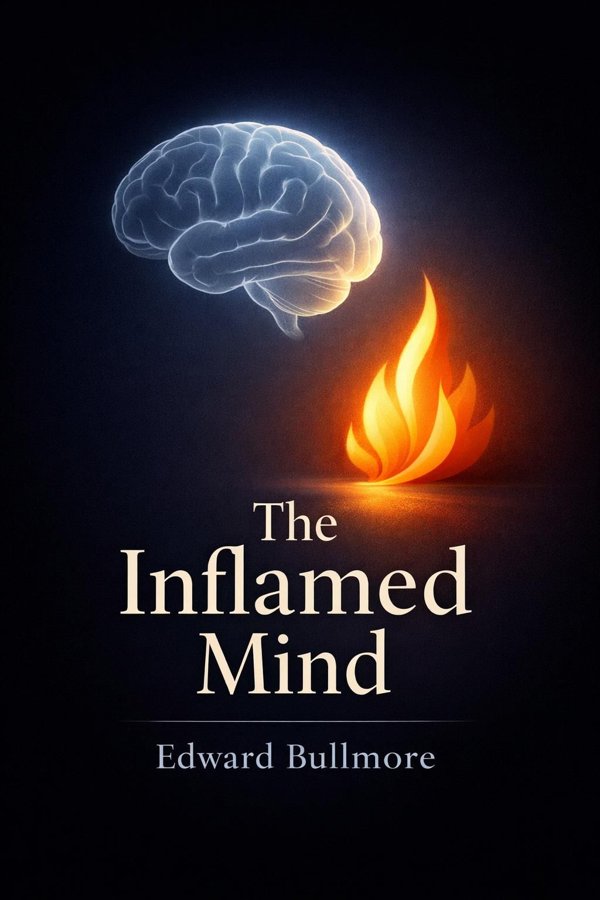
The Inflamed Mind: A Radical New Approach to Depression: Summary & Key Insights
 10 min6 chaptersAudio available
What Is The Inflamed Mind: A Radical New Approach to Depression About?
The Inflamed Mind: A Radical New Approach to Depression by Edward Bullmore is a mental_health book spanning 6 pages. In this groundbreaking work, psychiatrist and neuroscientist Edward Bullmore explores the link between inflammation and depression. Drawing on cutting-edge research, he argues that mental health and physical health are deeply interconnected, and that inflammation in the body can directly influence mood and mental well-being. The book challenges traditional views of depression as purely psychological, proposing a new biological framework that could transform treatment approaches.
This FizzRead summary covers all 6 key chapters of The Inflamed Mind: A Radical New Approach to Depression in approximately 10 minutes, distilling the most important ideas, arguments, and takeaways from Edward Bullmore's work. Also available as an audio summary and Key Quotes Podcast.
The Inflamed Mind: A Radical New Approach to Depression
In this groundbreaking work, psychiatrist and neuroscientist Edward Bullmore explores the link between inflammation and depression. Drawing on cutting-edge research, he argues that mental health and physical health are deeply interconnected, and that inflammation in the body can directly influence mood and mental well-being. The book challenges traditional views of depression as purely psychological, proposing a new biological framework that could transform treatment approaches.
Who Should Read The Inflamed Mind: A Radical New Approach to Depression?
This book is perfect for anyone interested in mental_health and looking to gain actionable insights in a short read. Whether you're a student, professional, or lifelong learner, the key ideas from The Inflamed Mind: A Radical New Approach to Depression by Edward Bullmore will help you think differently.
- ✓Readers who enjoy mental_health and want practical takeaways
- ✓Professionals looking to apply new ideas to their work and life
- ✓Anyone who wants the core insights of The Inflamed Mind: A Radical New Approach to Depression in just 10 minutes
Want the full summary?
Get instant access to this book summary and 100K+ more with Fizz Moment.
Get Free SummaryAvailable on App Store • Free to download
Key Chapters
For centuries, medicine has lived in the shadow of René Descartes, the philosopher who in the seventeenth century declared that mind and body were different substances. This Cartesian dualism was intellectually elegant, but it carved a line through the heart of medical practice. Since then, doctors have learned to fix the body, psychiatrists have tended the mind, and seldom have the two spoken the same language.
In my early training, this division seemed natural. If a patient had a heart problem, they went to a cardiologist. If they were depressed, they came to me, the psychiatrist. Yet, the reality in clinics never fit that tidy model. I saw patients whose emotional pain intensified with physical illness, and those who recovered mentally when their bodies healed. Medicine had a blind spot—an arbitrary boundary drawn not by biology, but by history.
To understand why this divide persists, we need to return to the intellectual roots of our medical model. Descartes helped birth modern science, but his distinction between res cogitans (thinking substance) and res extensa (extended substance) made it almost impossible to imagine that thoughts and molecules could influence each other. Thus, psychiatry drifted toward psychodynamics and talking cures, while physiology pursued biochemistry and tissue.
The result is what I call 'mind-body apartheid'—a health system fractured along philosophical lines. The Inflamed Mind calls for reconciliation. Modern neuroscience and immunology reveal what Descartes could not have known: that the brain is not sealed off from the body but constantly bathed in signals from it. Inflammation is one of those signals, a conversation carried by cytokines traveling through blood and nerve pathways. Recognizing this is not a metaphor—it’s an anatomical fact. The mind and body are not merely connected; they are continuous expressions of the same biological system.
Inflammation is the body’s natural defense—a complex, coordinated response to injury or infection. The immune system releases molecular messengers called cytokines, which orchestrate the healing process. Yet this same mechanism can, under chronic pressure, turn against us, spreading low-grade inflammation throughout the bloodstream and even into the brain.
I want you to picture this system as a conversation. When a cut becomes infected, the immune cells surge to respond, releasing cytokines that act as digital messages to the rest of the body: 'Prepare defenses.' These cytokines—interleukin-6, TNF-alpha, interferons—trigger a vast cascade of cellular changes. They alter metabolism, blood flow, even behavior, because to heal, we often must rest.
The fascinating, and sobering, truth is that the same molecules which defend us can also depress us. Cytokines can cross—or signal across—the blood-brain barrier, influencing neural circuits tied to motivation and mood. When inflammation whips up persistent changes in those circuits, the result can be a profound sense of fatigue, loss of pleasure, and social withdrawal—the very symptoms of depression.
For years, we assumed such symptoms were 'psychological'; now we can see their biological footprints. In animal experiments, injections of inflammatory cytokines reliably induce depressive-like behaviors. In humans, patients receiving interferon therapy for hepatitis often experience severe depression. The chemistry of sadness, it seems, can begin with the chemistry of inflammation.
This doesn’t mean every case of depression stems from the immune system. But it does mean we must reconsider a model that’s purely psychological. The immune system and the brain are partners in a dynamic exchange—when one is inflamed, the other responds.
+ 4 more chapters — available in the FizzRead app
All Chapters in The Inflamed Mind: A Radical New Approach to Depression
About the Author
Edward Bullmore is a British psychiatrist, neuroscientist, and academic. He is Professor of Psychiatry at the University of Cambridge and has conducted extensive research on brain imaging, inflammation, and mental health. His work bridges neuroscience and clinical psychiatry, focusing on the biological mechanisms underlying mental disorders.
Get This Summary in Your Preferred Format
Read or listen to the The Inflamed Mind: A Radical New Approach to Depression summary by Edward Bullmore anytime, anywhere. FizzRead offers multiple formats so you can learn on your terms — all free.
Available formats: App · Audio · PDF · EPUB — All included free with FizzRead
Download The Inflamed Mind: A Radical New Approach to Depression PDF and EPUB Summary
Key Quotes from The Inflamed Mind: A Radical New Approach to Depression
“For centuries, medicine has lived in the shadow of René Descartes, the philosopher who in the seventeenth century declared that mind and body were different substances.”
“Inflammation is the body’s natural defense—a complex, coordinated response to injury or infection.”
Frequently Asked Questions about The Inflamed Mind: A Radical New Approach to Depression
The Inflamed Mind: A Radical New Approach to Depression by Edward Bullmore is a mental_health book that explores key ideas across 6 chapters. In this groundbreaking work, psychiatrist and neuroscientist Edward Bullmore explores the link between inflammation and depression. Drawing on cutting-edge research, he argues that mental health and physical health are deeply interconnected, and that inflammation in the body can directly influence mood and mental well-being. The book challenges traditional views of depression as purely psychological, proposing a new biological framework that could transform treatment approaches.
You Might Also Like

Big Feelings: How to Be Okay When Things Are Not Okay
Liz Fosslien, Mollie West Duffy
10 min
Creative Arts Therapies Handbook: Art, Music and Dance Therapy Practices for Wellbeing
Susan I. Buchalter
10 min
Emotional First Aid: Healing Rejection, Guilt, Failure, and Other Everyday Hurts
Guy Winch
10 min
Lost Connections: Why You're Depressed and How to Find Hope
Johann Hari
10 min
No Time to Panic: How to Stop Worrying and Embrace Life
Matt Gutman
10 min
Overcoming Mobbing: A Recovery Guide for Workplace Aggression and Bullying
Maureen Duffy, Len Sperry
10 minBrowse by Category
Ready to read The Inflamed Mind: A Radical New Approach to Depression?
Get the full summary and 100K+ more books with Fizz Moment.