
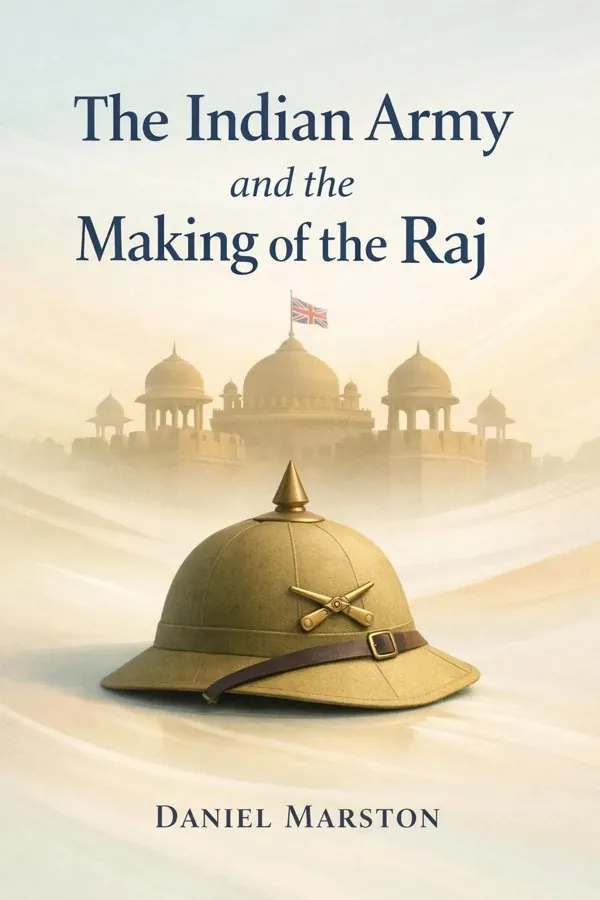
The Indian Army and the Making of the Raj: Summary & Key Insights
 10 min10 chaptersAudio available
What Is The Indian Army and the Making of the Raj About?
The Indian Army and the Making of the Raj by Daniel Marston is a world_history book spanning 10 pages. This scholarly work by Daniel Marston examines the crucial role of the Indian Army in the establishment, maintenance, and eventual transformation of British rule in India. Drawing on extensive archival research, Marston explores how the Indian Army functioned as both a military and political instrument of the British Empire, shaping the Raj’s governance and its legacy in postcolonial South Asia.
This FizzRead summary covers all 10 key chapters of The Indian Army and the Making of the Raj in approximately 10 minutes, distilling the most important ideas, arguments, and takeaways from Daniel Marston's work. Also available as an audio summary and Key Quotes Podcast.
The Indian Army and the Making of the Raj
This scholarly work by Daniel Marston examines the crucial role of the Indian Army in the establishment, maintenance, and eventual transformation of British rule in India. Drawing on extensive archival research, Marston explores how the Indian Army functioned as both a military and political instrument of the British Empire, shaping the Raj’s governance and its legacy in postcolonial South Asia.
Who Should Read The Indian Army and the Making of the Raj?
This book is perfect for anyone interested in world_history and looking to gain actionable insights in a short read. Whether you're a student, professional, or lifelong learner, the key ideas from The Indian Army and the Making of the Raj by Daniel Marston will help you think differently.
- ✓Readers who enjoy world_history and want practical takeaways
- ✓Professionals looking to apply new ideas to their work and life
- ✓Anyone who wants the core insights of The Indian Army and the Making of the Raj in just 10 minutes
Want the full summary?
Get instant access to this book summary and 100K+ more with Fizz Moment.
Get Free SummaryAvailable on App Store • Free to download
Key Chapters
When the East India Company first began its territorial expansion in the eighteenth century, it quickly realized that military force was essential, yet reliance solely on British troops was unsustainable. Thus emerged the early Indian Army—a hybrid force composed of Indian soldiers (sepoys) under British command. Recruitment patterns reflected pragmatic choices as well as social bias: martial communities were favored, caste and regional divisions exploited, and the British constructed what they saw as an efficient, loyal fighting machine.
In this early period, the Company’s regiments reflected the patchwork nature of empire. Administrative control over the army evolved alongside the expansion of territory. The army became the Company’s most effective instrument not just of war, but of rule. Training and discipline were tailored to maintain British authority, with careful separation between officer and soldier, European and Indian. The command structure itself embodied imperial ideology—the British at the top, Indians as disciplined subordinates, symbolizing a hierarchy that extended far beyond the battlefield.
What emerges is that the army was never merely a collection of regiments; it was the scaffolding of governance. Its formation defined the political character of early British India: coercion balanced by co-option, the use of local manpower to enforce foreign rule. In this period lay the foundations of the later imperial military system, and also the tensions that would explode in 1857.
The rebellion of 1857 changed everything. It revealed the fragility of British control and the potential instability of an army built on divided loyalties. In my examination of this period, I show how the British, shaken by near catastrophe, reengineered the Indian Army’s organization to ensure that such an uprising could never occur again.
After the Crown replaced the Company, policy turned sharply toward securing political reliability. Recruitment shifted: the British favored groups they deemed inherently loyal—the so-called ‘martial races’ such as Punjabis, Gurkhas, and Pathans—while distrusting others whose allegiance seemed suspect. The new structure integrated European troops with Indian regiments in a way that maintained a constant check on potential disloyalty. The command system was solidified, and the principle of British oversight tightened.
This consolidation was not just military but social and political. The army became an instrument for knitting together the empire’s authority. It garrisoned newly pacified regions, supported civil administrators, and embodied the fusion of military efficiency with imperial ideology. In the aftermath of rebellion, the army’s function expanded beyond fighting wars—it became a crucial agent of colonial governance, a visible presence reinforcing British power.
The post-1857 reforms also deepened the professionalization and bureaucratic nature of military administration. The Indian Army was increasingly tied to the imperial structure in London, even as it retained a distinctive local character. Through its reorganization, the Raj stabilized. Yet the foundations of future change were set: while British control appeared firm, the very process of integrating Indian soldiers into imperial service planted the seeds of a shared military culture that would later prove transformative.
+ 8 more chapters — available in the FizzRead app
All Chapters in The Indian Army and the Making of the Raj
About the Author
Daniel Marston is a historian specializing in military history and the British Empire. He has written extensively on the Indian Army and its role in both world wars and the colonial administration of India.
Get This Summary in Your Preferred Format
Read or listen to the The Indian Army and the Making of the Raj summary by Daniel Marston anytime, anywhere. FizzRead offers multiple formats so you can learn on your terms — all free.
Available formats: App · Audio · PDF · EPUB — All included free with FizzRead
Download The Indian Army and the Making of the Raj PDF and EPUB Summary
Key Quotes from The Indian Army and the Making of the Raj
“Thus emerged the early Indian Army—a hybrid force composed of Indian soldiers (sepoys) under British command.”
“The rebellion of 1857 changed everything.”
Frequently Asked Questions about The Indian Army and the Making of the Raj
The Indian Army and the Making of the Raj by Daniel Marston is a world_history book that explores key ideas across 10 chapters. This scholarly work by Daniel Marston examines the crucial role of the Indian Army in the establishment, maintenance, and eventual transformation of British rule in India. Drawing on extensive archival research, Marston explores how the Indian Army functioned as both a military and political instrument of the British Empire, shaping the Raj’s governance and its legacy in postcolonial South Asia.
You Might Also Like
The Age of Capital
Eric Hobsbawm
10 min
The Gulag Archipelago
Aleksandr Solzhenitsyn
10 min
Jerusalem: The Biography
Simon Sebag Montefiore
10 min
The Anglo-Saxons
James Campbell
10 min
The Boer War
Thomas Pakenham
10 min
The Industrial Revolutionaries: The Making of the Modern World 1776–1914
Gavin Weightman
10 minBrowse by Category
Ready to read The Indian Army and the Making of the Raj?
Get the full summary and 100K+ more books with Fizz Moment.