
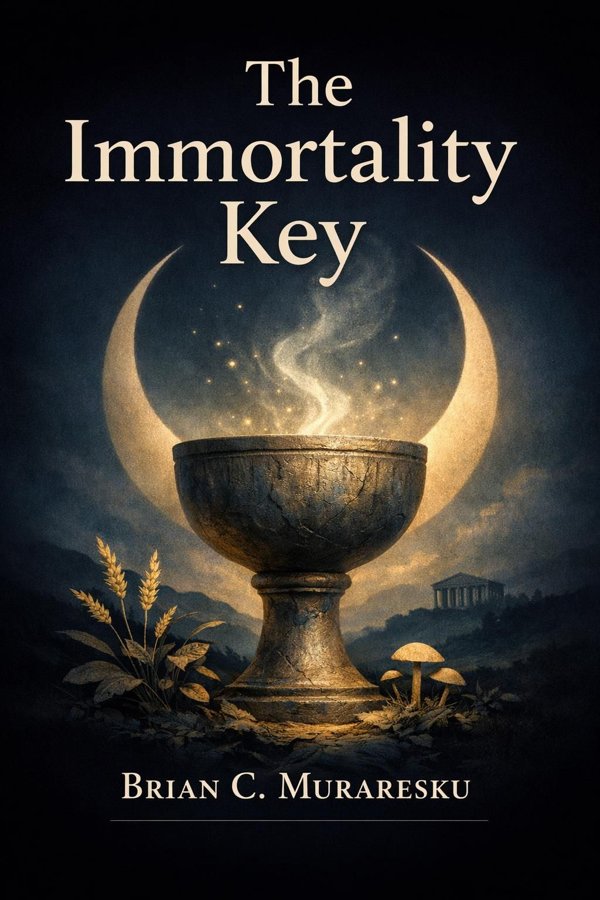
The Immortality Key: The Secret History of the Religion with No Name: Summary & Key Insights
 10 min10 chaptersAudio available
What Is The Immortality Key: The Secret History of the Religion with No Name About?
The Immortality Key: The Secret History of the Religion with No Name by Brian C. Muraresku is a civilization book spanning 10 pages. An investigation into the ancient origins of Western religion, exploring how early Christian rituals may have been influenced by psychedelic practices from the Greek world. Drawing on archaeological, textual, and scientific evidence, the author argues that the roots of spiritual experience lie in the use of mind-altering substances that connected humanity to the divine.
This FizzRead summary covers all 10 key chapters of The Immortality Key: The Secret History of the Religion with No Name in approximately 10 minutes, distilling the most important ideas, arguments, and takeaways from Brian C. Muraresku's work. Also available as an audio summary and Key Quotes Podcast.
The Immortality Key: The Secret History of the Religion with No Name
An investigation into the ancient origins of Western religion, exploring how early Christian rituals may have been influenced by psychedelic practices from the Greek world. Drawing on archaeological, textual, and scientific evidence, the author argues that the roots of spiritual experience lie in the use of mind-altering substances that connected humanity to the divine.
Who Should Read The Immortality Key: The Secret History of the Religion with No Name?
This book is perfect for anyone interested in civilization and looking to gain actionable insights in a short read. Whether you're a student, professional, or lifelong learner, the key ideas from The Immortality Key: The Secret History of the Religion with No Name by Brian C. Muraresku will help you think differently.
- ✓Readers who enjoy civilization and want practical takeaways
- ✓Professionals looking to apply new ideas to their work and life
- ✓Anyone who wants the core insights of The Immortality Key: The Secret History of the Religion with No Name in just 10 minutes
Want the full summary?
Get instant access to this book summary and 100K+ more with Fizz Moment.
Get Free SummaryAvailable on App Store • Free to download
Key Chapters
To understand how the ancient world pursued the divine, we must enter the greatest secret of classical antiquity: the Eleusinian Mysteries. Nestled near Athens, Eleusis was home to a ritual experience so sacred that betrayal of its secrets was punishable by death. And yet, for nearly two thousand years, it stood as the beating heart of Greek spirituality—a place where peasants and philosophers alike sought communion with the goddess Demeter and her daughter Persephone, death and rebirth manifest.
Thousands would journey to Eleusis each year, fasting, purifying, and preparing for an experience so transformative that even the most stoic thinkers—Cicero, Plato—spoke of it in reverence. Initiates emerged changed, claiming to have seen what lay beyond life’s veil. They were not told stories; they experienced revelation. This is the earliest Western example of a religion that promised immortality not through belief, but through direct experience.
The question that haunted me was how. What produced such profound visions in an era long before the language of neuroscience or psychedelics existed? Could the power of Eleusis have involved more than symbolism—could it have involved a tangible, chemical doorway to the divine?
As I retraced the ritual journey—from purification in the sea to the drinking of the kykeon, the ceremonial brew—I found faint but persistent echoes of something psychotropic concealed beneath the poetry. Ancient initiates described visions of light, of death transformed into joyous rebirth, of unity with the cosmos—imagery remarkably consistent with entheogenic experience as described today. If Eleusis promised immortality, its secret may have rested in a communion that dissolved the boundaries between the human and the divine, not metaphorically, but biochemically.
The heart of this investigation lies in evidence—chemical, textual, and archaeological. To separate fantasy from fact, I turned to the scientists who could quite literally scrape the story from the walls of antiquity. What they discovered was astonishing: residue analyses from ancient vessels and chalices revealed traces of ergot, a fungus that grows on barley. Ergot, as modern pharmacology knows, is the natural source of lysergic compounds—the same molecular family as LSD.
When combined with ritual fasting and sensory deprivation, even a mild dose of an ergot-derived compound could provoke visionary states of consciousness. The evidence suggested that ancient Greek brewers may have known more about biochemistry than we care to admit. Rather than crude intoxication, what they pursued was communion through a substance crafted with precision and reverence.
Alongside this material evidence came the textual hints: in Homeric hymns, in Euripides, and later in Platonic dialogues. The texts described a drink called kykeon—at once ordinary and mysterious—that, when consumed, led to revelation. What if this drink was the key to the Mystery? That possibility reframes much of Western spiritual history. It implies that the earliest experiences of the divine were participatory and embodied—that knowing God meant drinking something sacred, crossing the membrane between the real and the eternal.
This is the biochemical hypothesis of religion: that altered states of consciousness mediated through plant sacraments may have shaped our spiritual imagination. It’s not reductionism; it’s revelation through matter. The ancients saw no boundary between nature and the divine. They brewed their theology.
+ 8 more chapters — available in the FizzRead app
All Chapters in The Immortality Key: The Secret History of the Religion with No Name
About the Author
Brian C. Muraresku is an American author and attorney. He graduated from Brown University and Georgetown Law, and his research focuses on the intersection of classical studies, religion, and psychoactive substances. 'The Immortality Key' is his first book, which became a bestseller and sparked wide discussion on the origins of Western spirituality.
Get This Summary in Your Preferred Format
Read or listen to the The Immortality Key: The Secret History of the Religion with No Name summary by Brian C. Muraresku anytime, anywhere. FizzRead offers multiple formats so you can learn on your terms — all free.
Available formats: App · Audio · PDF · EPUB — All included free with FizzRead
Download The Immortality Key: The Secret History of the Religion with No Name PDF and EPUB Summary
Key Quotes from The Immortality Key: The Secret History of the Religion with No Name
“To understand how the ancient world pursued the divine, we must enter the greatest secret of classical antiquity: the Eleusinian Mysteries.”
“The heart of this investigation lies in evidence—chemical, textual, and archaeological.”
Frequently Asked Questions about The Immortality Key: The Secret History of the Religion with No Name
The Immortality Key: The Secret History of the Religion with No Name by Brian C. Muraresku is a civilization book that explores key ideas across 10 chapters. An investigation into the ancient origins of Western religion, exploring how early Christian rituals may have been influenced by psychedelic practices from the Greek world. Drawing on archaeological, textual, and scientific evidence, the author argues that the roots of spiritual experience lie in the use of mind-altering substances that connected humanity to the divine.
You Might Also Like
The Structure of Scientific Revolutions
Thomas S. Kuhn
10 min
Genius
Harold Bloom
10 min
A Cultural History of the Medieval Age
Various Editors
10 min
A History of God: The 4,000-Year Quest of Judaism, Christianity and Islam
Karen Armstrong
10 min
A History of the World in 10½ Chapters
Julian Barnes
10 min
A Short History of Progress
Ronald Wright
10 minBrowse by Category
Ready to read The Immortality Key: The Secret History of the Religion with No Name?
Get the full summary and 100K+ more books with Fizz Moment.