
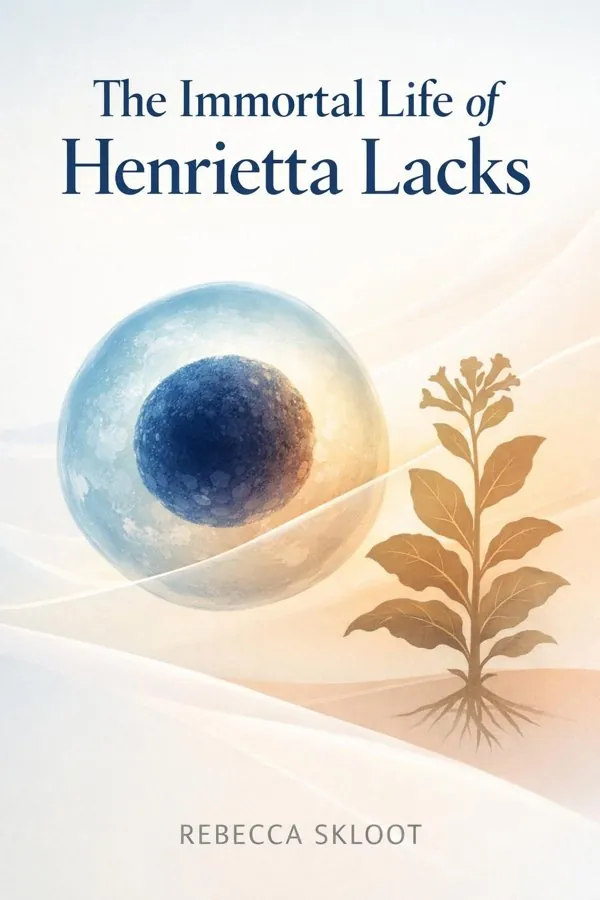
The Immortal Life of Henrietta Lacks: Summary & Key Insights
 10 min10 chaptersAudio available
Key Takeaways from The Immortal Life of Henrietta Lacks
Scientific revolutions often begin far from universities and laboratories.
A hospital can be a place of healing, but it can also reveal who holds power and who does not.
Immortality in science can emerge from tragedy.
Many breakthroughs we take for granted depend on invisible foundations.
Knowledge can be unevenly distributed in ways that deepen harm.
What Is The Immortal Life of Henrietta Lacks About?
The Immortal Life of Henrietta Lacks by Rebecca Skloot is a biographies book spanning 10 pages. What if one of the greatest breakthroughs in modern medicine began with a woman whose name was nearly lost to history? In The Immortal Life of Henrietta Lacks, Rebecca Skloot tells the extraordinary true story of Henrietta Lacks, a Black woman whose cancer cells were taken without her knowledge in 1951 and became the first immortal human cell line: HeLa. Those cells transformed science, helping researchers develop the polio vaccine, study cancer, test drugs, and advance genetics, yet Henrietta’s family remained in the dark for decades. Skloot’s book is far more than a medical mystery. It is a deeply human investigation into race, poverty, scientific ambition, informed consent, and the hidden costs of progress. With the rigor of a science journalist and the empathy of a gifted storyteller, Skloot bridges laboratory history and family memory, showing how one woman’s cells reshaped the world while her descendants struggled to understand what had been taken from them. The result is a powerful biography, a work of investigative reporting, and an essential book about ethics in modern medicine.
This FizzRead summary covers all 10 key chapters of The Immortal Life of Henrietta Lacks in approximately 10 minutes, distilling the most important ideas, arguments, and takeaways from Rebecca Skloot's work. Also available as an audio summary and Key Quotes Podcast.
The Immortal Life of Henrietta Lacks
What if one of the greatest breakthroughs in modern medicine began with a woman whose name was nearly lost to history? In The Immortal Life of Henrietta Lacks, Rebecca Skloot tells the extraordinary true story of Henrietta Lacks, a Black woman whose cancer cells were taken without her knowledge in 1951 and became the first immortal human cell line: HeLa. Those cells transformed science, helping researchers develop the polio vaccine, study cancer, test drugs, and advance genetics, yet Henrietta’s family remained in the dark for decades. Skloot’s book is far more than a medical mystery. It is a deeply human investigation into race, poverty, scientific ambition, informed consent, and the hidden costs of progress. With the rigor of a science journalist and the empathy of a gifted storyteller, Skloot bridges laboratory history and family memory, showing how one woman’s cells reshaped the world while her descendants struggled to understand what had been taken from them. The result is a powerful biography, a work of investigative reporting, and an essential book about ethics in modern medicine.
Who Should Read The Immortal Life of Henrietta Lacks?
This book is perfect for anyone interested in biographies and looking to gain actionable insights in a short read. Whether you're a student, professional, or lifelong learner, the key ideas from The Immortal Life of Henrietta Lacks by Rebecca Skloot will help you think differently.
- ✓Readers who enjoy biographies and want practical takeaways
- ✓Professionals looking to apply new ideas to their work and life
- ✓Anyone who wants the core insights of The Immortal Life of Henrietta Lacks in just 10 minutes
Want the full summary?
Get instant access to this book summary and 100K+ more with Fizz Moment.
Get Free SummaryAvailable on App Store • Free to download
Key Chapters
Scientific revolutions often begin far from universities and laboratories. Henrietta Lacks was born Loretta Pleasant in 1920 in Roanoke, Virginia, and grew up in Clover, a rural tobacco-farming community shaped by poverty, segregation, and the lingering structures of slavery. After her mother died, she was raised among relatives in an old slave quarters cabin. Her childhood was marked by hard labor, limited formal education, tight family bonds, and a social world in which survival depended on resilience. She later married her cousin David “Day” Lacks and moved to Turner Station, a Black working-class community near Baltimore, where they raised children while navigating the pressures of mid-century America.
Skloot shows that Henrietta’s life cannot be understood apart from the history around her. She was not simply a “patient” whose cells became famous. She was a daughter, wife, mother, and laboring woman whose opportunities were shaped by racism and class inequality. These conditions matter because they help explain why she received care at Johns Hopkins, one of the few hospitals that treated poor Black patients, and why she had little power over what happened once she entered the medical system.
Today, this idea remains practical and urgent. Whether discussing healthcare access, medical mistrust, or health outcomes, background matters. Patients do not arrive as isolated individuals; they bring histories of community, inequality, and lived experience. Better care begins when institutions recognize those realities instead of pretending medicine exists above them.
Actionable takeaway: When evaluating any medical or social issue, start by asking what historical and economic forces shaped the person’s choices, risks, and access to care.
A hospital can be a place of healing, but it can also reveal who holds power and who does not. In 1951, Henrietta went to Johns Hopkins Hospital after noticing a painful “knot” in her womb. Doctors diagnosed her with aggressive cervical cancer. She underwent radium treatment, then a common therapy, in the segregated ward for Black patients. During the course of her care, a sample of her cancer cells was taken without her knowledge, alongside a sample of healthy tissue.
Skloot uses this moment to illustrate how medicine once operated with minimal concern for patient consent, especially when the patient was poor, Black, or considered socially powerless. Henrietta signed forms for treatment, but not for tissue use in research in the modern sense we understand today. This distinction matters. The issue is not simply whether doctors broke a rule that had not yet been fully formalized; it is whether they respected her autonomy as a person. The answer is deeply uncomfortable.
The story also reminds readers that ordinary patients often do not fully understand medical language, procedures, or downstream consequences. Even now, consent can become a formality rather than a genuine conversation. In clinical settings, patients may nod along while feeling confused, intimidated, or rushed. For institutions, that creates ethical and practical risks.
Actionable takeaway: In any healthcare setting, ask for plain-language explanations, request time to think, and confirm what samples, data, or records may be used beyond immediate treatment.
Immortality in science can emerge from tragedy. Henrietta’s cells were sent to researcher George Gey, who had long been trying to grow human cells outside the body. Most cells died quickly, but Henrietta’s cancer cells behaved differently: they reproduced with astonishing speed and survived in conditions that defeated other samples. Gey labeled the line “HeLa,” using the first letters of Henrietta Lacks’s first and last names. Without fully grasping the implications, science had gained a living tool it had never had before.
The significance of HeLa is difficult to overstate. Before this breakthrough, researchers struggled to perform repeatable experiments on human cells. HeLa changed that by providing a durable, shareable cell line that could be sent from lab to lab. Suddenly, scientists could observe cellular behavior, test treatments, and compare findings across experiments. HeLa cells made biomedical research more scalable, faster, and more standardized.
Skloot also highlights a painful irony: while Henrietta herself died from cancer later that year, a part of her body continued multiplying indefinitely in laboratories around the world. That contrast gives the book its title and its emotional force. The cells became scientifically immortal, but the woman behind them was nearly forgotten.
The broader application is clear. Scientific tools often appear neutral once they are established, but every tool has a human origin story. Remembering that origin does not diminish scientific value; it deepens our ethical understanding of it.
Actionable takeaway: When you encounter a major scientific innovation, ask not only how it works, but also whose bodies, labor, or lives made it possible.
Many breakthroughs we take for granted depend on invisible foundations. HeLa cells became one of those foundations. Because they grew so robustly, they were used in the development of the polio vaccine, cancer research, virology, gene mapping, fertility studies, toxicology, and space biology. Scientists exposed HeLa cells to radiation, infected them with viruses, and used them to test the effects of countless compounds. Entire industries emerged around producing, shipping, and selling cell cultures, and HeLa became one of the most famous cell lines in the world.
Skloot explains these advances in accessible language, showing readers that Henrietta’s cells were not a narrow technical curiosity but a central engine of postwar biomedical science. Their use helped establish large-scale tissue culture methods and accelerated the pace of experimentation in fields that influence everyday healthcare. If you have benefited from vaccines, cancer therapies, or modern cell biology, you have likely benefited indirectly from HeLa.
At the same time, the book asks a hard question: does scientific benefit erase ethical concern? Clearly not. Progress and injustice can coexist. A medical triumph can still be built on a failure of recognition, transparency, and fairness. That tension is one of the book’s greatest strengths. It resists simplistic conclusions and asks readers to hold gratitude and discomfort at the same time.
For modern readers, this applies to discussions about AI, genetics, and big health data. Innovation should not be judged only by outcomes, but also by how those outcomes are achieved.
Actionable takeaway: Support scientific progress, but evaluate it with two questions in mind: What good did it produce, and what ethical obligations came with that good?
Knowledge can be unevenly distributed in ways that deepen harm. For decades, Henrietta Lacks’s family knew little to nothing about the significance of HeLa cells. They were not told clearly that her cells were alive in laboratories, being bought and sold, or driving major discoveries. When researchers later contacted family members for blood samples, relatives often misunderstood why. Some feared they might have cancer. Others believed Henrietta herself might still somehow be alive. The confusion reflected a painful gap between scientific language and ordinary understanding.
Skloot portrays this not as a simple information failure, but as a moral one. The Lacks family was expected to cooperate with systems they did not understand and had no reason to trust. Meanwhile, companies and institutions profited from HeLa, while many members of the family struggled to afford healthcare. That contrast created a lasting sense of betrayal. Even if legal standards around tissue ownership were different, the human impact was profound.
This part of the story offers a practical lesson in communication. Experts often underestimate how alien their vocabulary sounds to non-experts. Terms like “cell line,” “culture,” or “genetic testing” can be misheard or misinterpreted, especially in emotionally loaded contexts. Clear communication is not a soft skill on the margins of science; it is central to ethical practice.
In workplaces, hospitals, and public institutions, trust grows when people are told what is happening, why it matters, and what it means for them in direct language.
Actionable takeaway: If you work with specialized knowledge, explain it as if misunderstanding could cause real harm—because often, it can.
Behind public controversies are often private griefs that never healed. One of the book’s emotional centers is Deborah Lacks, Henrietta’s daughter, who spent years trying to understand who her mother was and what happened to her cells. Deborah was not searching only for facts; she was searching for connection, dignity, and peace. Growing up amid secrecy, misinformation, and family trauma, she carried a deep fear about what science had done with her mother’s body and what it might mean for her own health.
Skloot’s relationship with Deborah becomes a crucial part of the narrative. Through interviews, trips, records, and painful conversations, Deborah slowly pieces together both Henrietta’s life and the scientific afterlife of HeLa. This journey reveals how information can be emotionally overwhelming when it arrives too late and without support. Deborah wanted recognition for her mother, but she also wanted reassurance that Henrietta had not been reduced to a commodity.
The practical insight here is that facts alone rarely resolve human distress. People need context, empathy, and the chance to process difficult truths. In medicine, law, education, and journalism, delivering information without emotional care can intensify suffering rather than relieve it.
Deborah’s quest also reminds us that identity matters. People are not satisfied being told a relative contributed to history if that contribution erased the person they loved. Recognition requires more than a citation; it requires honoring the whole life.
Actionable takeaway: When sharing difficult information, pair accuracy with compassion, and make room for people to ask what the facts mean for their identity, memory, and future.
Medical ethics becomes clearest when viewed through the lives of those least protected by it. The story of Henrietta Lacks unfolds against a broader history of racial exploitation in American medicine, from segregated hospitals to notorious abuses such as the Tuskegee syphilis study. Skloot does not claim Henrietta’s case is identical to every other abuse, but she shows how race and class shaped who was informed, who was respected, and whose bodies were made available for research without meaningful power to object.
The book therefore becomes a major case study in informed consent. Modern readers may assume consent means signing a form, but Skloot pushes the question further: was the person truly informed, able to understand, and free to decide? Ethical practice requires more than paperwork. It requires transparency, comprehension, and respect. Henrietta’s story also raises questions about tissue ownership, profit, and benefit sharing. If biological materials taken from a patient become commercially valuable, what obligations exist to the donor or family? The law has often answered narrowly. The book invites a broader moral answer.
These questions remain deeply relevant in the era of genomics, biobanks, and digital health records. Today, patients contribute blood, tissue, and data to systems far larger than they can fully see. Trust depends on how responsibly institutions handle that contribution.
Actionable takeaway: Treat consent as an ongoing conversation, not a one-time signature, and advocate for policies that prioritize clarity, fairness, and respect for vulnerable communities.
Some stories resist easy telling because they involve not just facts, but wounded relationships. Rebecca Skloot spent years investigating Henrietta Lacks’s life, the scientific history of HeLa, and the emotional landscape of the Lacks family. Her task was unusually difficult: records were fragmented, myths had accumulated, family members were wary of exploitation, and science itself had often hidden Henrietta behind the abbreviation “HeLa.” Skloot had to become historian, journalist, translator, and trusted listener all at once.
What makes the book stand out is not only the information she gathers, but the method she uses. She does not write from a falsely detached perspective. Instead, she acknowledges the barriers, the mistrust, and her own role in trying to bridge two worlds that often misunderstood each other. That self-awareness gives the narrative credibility. It also models responsible nonfiction: rigorous research combined with humility about what can and cannot be fully resolved.
For readers, there is a practical lesson in how to approach complex human issues. Important truths are rarely contained in one archive, one interview, or one discipline. To understand a subject fully, you often need science, history, sociology, and personal testimony together. Skloot’s work demonstrates the power of patient inquiry and relational trust.
In professional life, this means that the best analysis often comes from integrating hard data with lived experience. Numbers reveal patterns, but stories reveal consequences.
Actionable takeaway: When investigating a complex issue, gather both evidence and human perspective, and recognize that trust is often as important as information.
The greatest gap in modern systems is often not technical but human. As the book progresses, science and family slowly move toward each other, though never perfectly. Members of the Lacks family begin learning more about HeLa’s role in medicine, and scientists increasingly recognize the importance of naming Henrietta rather than hiding her behind a cell label. This reconnection does not undo the past, nor does it settle every legal or ethical question. But it represents a crucial moral shift: acknowledging that the person behind the tissue matters.
Skloot suggests that recognition itself has power. To speak Henrietta’s name, tell her story, and include her family in conversations about her legacy is a way of restoring dignity that science alone cannot provide. This does not replace material justice, but it is part of justice. It challenges institutions to remember that discoveries are not abstract events detached from human lives.
This idea has broad applications. In hospitals, research institutions, and technology companies, systems become more ethical when they intentionally reconnect outcomes to the people affected by them. Human-centered practice means more than compliance. It means asking whether those who contributed to progress are visible, respected, and heard.
For teams and leaders, this principle also improves culture. People engage more responsibly when they can see the human stakes of their work rather than treating tasks as purely procedural.
Actionable takeaway: In any field that deals with data, bodies, or decisions, make the affected people visible by naming them, listening to them, and including them in the story.
A legacy is not only what someone leaves behind, but what later generations choose to do with it. Henrietta Lacks’s story continues to shape debates about bioethics, racial justice, patient rights, and scientific accountability. Her cells remain central to research, but her name now also symbolizes the need to balance innovation with consent and fairness. Schools teach her story, medical programs use it to discuss ethics, and policymakers invoke it when considering how biological samples and genetic information should be handled.
Skloot’s book helped change public awareness by restoring Henrietta as a person to a narrative that had long celebrated only the cells. That shift matters because memory influences policy. Once people understand the human cost of scientific progress, they are more likely to demand better standards around transparency, compensation, privacy, and community trust. Henrietta’s legacy has thus expanded from the laboratory into public culture.
For modern readers, the relevance is immediate. We live in an era of precision medicine, DNA testing, and global data-sharing, where personal biological information can travel far beyond the original context in which it was collected. Henrietta’s story warns against assuming that beneficial outcomes automatically justify opaque practices. It also offers hope: science can advance while becoming more humane, if institutions choose accountability.
Actionable takeaway: Let Henrietta’s legacy guide your view of innovation—celebrate discovery, but insist that future progress be built on informed participation, transparency, and respect.
All Chapters in The Immortal Life of Henrietta Lacks
About the Author
Rebecca Skloot is an American science writer acclaimed for bringing complex medical and ethical issues to a broad audience through vivid storytelling. She is best known for her bestselling debut, The Immortal Life of Henrietta Lacks, which spent years on major bestseller lists and became a landmark work of narrative nonfiction. Skloot studied biological sciences and creative writing, a combination that helped shape her distinctive style: scientifically rigorous, emotionally rich, and highly accessible. Her articles have appeared in publications such as The New York Times Magazine, O, The Oprah Magazine, and Discover. She is especially recognized for exploring the intersection of science, medicine, race, and human experience. Through her work, Skloot has helped countless readers engage more deeply with bioethics, medical history, and the people often left out of scientific narratives.
Get This Summary in Your Preferred Format
Read or listen to the The Immortal Life of Henrietta Lacks summary by Rebecca Skloot anytime, anywhere. FizzRead offers multiple formats so you can learn on your terms — all free.
Available formats: App · Audio · PDF · EPUB — All included free with FizzRead
Download The Immortal Life of Henrietta Lacks PDF and EPUB Summary
Key Quotes from The Immortal Life of Henrietta Lacks
“Scientific revolutions often begin far from universities and laboratories.”
“A hospital can be a place of healing, but it can also reveal who holds power and who does not.”
“Immortality in science can emerge from tragedy.”
“Many breakthroughs we take for granted depend on invisible foundations.”
“Knowledge can be unevenly distributed in ways that deepen harm.”
Frequently Asked Questions about The Immortal Life of Henrietta Lacks
The Immortal Life of Henrietta Lacks by Rebecca Skloot is a biographies book that explores key ideas across 10 chapters. What if one of the greatest breakthroughs in modern medicine began with a woman whose name was nearly lost to history? In The Immortal Life of Henrietta Lacks, Rebecca Skloot tells the extraordinary true story of Henrietta Lacks, a Black woman whose cancer cells were taken without her knowledge in 1951 and became the first immortal human cell line: HeLa. Those cells transformed science, helping researchers develop the polio vaccine, study cancer, test drugs, and advance genetics, yet Henrietta’s family remained in the dark for decades. Skloot’s book is far more than a medical mystery. It is a deeply human investigation into race, poverty, scientific ambition, informed consent, and the hidden costs of progress. With the rigor of a science journalist and the empathy of a gifted storyteller, Skloot bridges laboratory history and family memory, showing how one woman’s cells reshaped the world while her descendants struggled to understand what had been taken from them. The result is a powerful biography, a work of investigative reporting, and an essential book about ethics in modern medicine.
Compare The Immortal Life of Henrietta Lacks
You Might Also Like

An American Marriage
Tayari Jones
10 min
Benjamin Franklin: An American Life
Walter Isaacson
10 min
I Know Why The Caged Bird Sings
Maya Angelou
10 min
Long Walk to Freedom
Nelson Mandela
10 min
Persepolis
Marjane Satrapi
10 min
Surely You're Joking, Mr. Feynman!
Richard P. Feynman
10 minBrowse by Category
Ready to read The Immortal Life of Henrietta Lacks?
Get the full summary and 100K+ more books with Fizz Moment.