
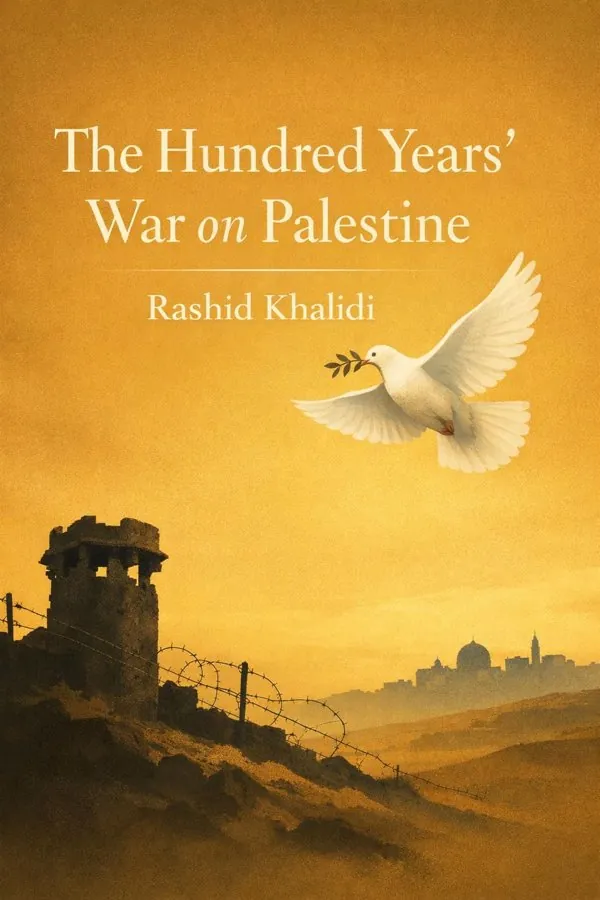
The Hundred Years' War on Palestine: A History of Settler Colonialism and Resistance, 1917–2017: Summary & Key Insights
 10 min7 chaptersAudio available
What Is The Hundred Years' War on Palestine: A History of Settler Colonialism and Resistance, 1917–2017 About?
The Hundred Years' War on Palestine: A History of Settler Colonialism and Resistance, 1917–2017 by Rashid Khalidi is a world_history book spanning 7 pages. A landmark historical account that reframes the Israeli–Palestinian conflict as a century-long war against the Palestinian people. Drawing on personal family archives and diplomatic records, Rashid Khalidi traces the evolution of settler colonialism and Palestinian resistance from the Balfour Declaration of 1917 through the twenty-first century. The book offers a deeply informed narrative of dispossession, occupation, and resilience, challenging dominant Western perspectives on the conflict.
This FizzRead summary covers all 7 key chapters of The Hundred Years' War on Palestine: A History of Settler Colonialism and Resistance, 1917–2017 in approximately 10 minutes, distilling the most important ideas, arguments, and takeaways from Rashid Khalidi's work. Also available as an audio summary and Key Quotes Podcast.
The Hundred Years' War on Palestine: A History of Settler Colonialism and Resistance, 1917–2017
A landmark historical account that reframes the Israeli–Palestinian conflict as a century-long war against the Palestinian people. Drawing on personal family archives and diplomatic records, Rashid Khalidi traces the evolution of settler colonialism and Palestinian resistance from the Balfour Declaration of 1917 through the twenty-first century. The book offers a deeply informed narrative of dispossession, occupation, and resilience, challenging dominant Western perspectives on the conflict.
Who Should Read The Hundred Years' War on Palestine: A History of Settler Colonialism and Resistance, 1917–2017?
This book is perfect for anyone interested in world_history and looking to gain actionable insights in a short read. Whether you're a student, professional, or lifelong learner, the key ideas from The Hundred Years' War on Palestine: A History of Settler Colonialism and Resistance, 1917–2017 by Rashid Khalidi will help you think differently.
- ✓Readers who enjoy world_history and want practical takeaways
- ✓Professionals looking to apply new ideas to their work and life
- ✓Anyone who wants the core insights of The Hundred Years' War on Palestine: A History of Settler Colonialism and Resistance, 1917–2017 in just 10 minutes
Want the full summary?
Get instant access to this book summary and 100K+ more with Fizz Moment.
Get Free SummaryAvailable on App Store • Free to download
Key Chapters
The story begins with Britain’s imperial ambition at the height of World War I. When I examine the Balfour Declaration, I see not a simple diplomatic statement but a document drenched in colonial arrogance. Britain promised a 'national home for the Jewish people' in Palestine—a land that was already inhabited by an indigenous population. This was the first act in a sustained campaign that viewed Palestinians as incidental, as a population to be managed or displaced. The declaration ignored the people living there, reducing them to 'non-Jewish communities.' That omission was deliberate. It encapsulated a worldview that would drive policy for decades—one where colonial power arrogates the right to allocate land and determine destiny.
Throughout the 1920s and 1930s, Britain carried out the practical mechanisms of that promise: facilitating Zionist immigration, transferring land ownership, policing resistance, and suppressing dissent. Palestinians protested, organized strikes, and petitioned the British government, insisting that their rights be recognized. Their appeals were systematically disregarded. In these episodes, we see the formation of the Palestine war’s first battlefield—a struggle fought not only on the ground but in the very language of legality and legitimacy.
Looking back, I view 1917 not merely as a date in history, but as the ideological foundation of a century-long process. It institutionalized a hierarchy of belonging, where Palestinians were deemed illegitimate in their own homeland. The Balfour Declaration thus inaugurated the historical arc of settler colonialism under the guise of humanitarianism and progress. By exposing its underlying logic, we unmask the continuity that runs through every subsequent stage of the 'war on Palestine.'
Under British rule, Palestine was transformed both administratively and demographically. From Jerusalem to Jaffa, the British Mandate operated as a colonial apparatus designed to implement the Balfour Declaration while maintaining an illusion of civil governance. I describe in the book how the Mandate’s dual commitments—to 'protect all inhabitants' while supporting Zionist settlement—were impossible to reconcile. The contradiction was not accidental; it was structural. Britain functioned as a patron of Zionism, training the bureaucracy, police, and military systems that would later be taken over by Israel.
This period also witnessed the emergence of modern Palestinian nationalism. Writers, teachers, and activists organized to resist both foreign rule and land displacement. Revolts in the 1930s demonstrated that Palestinians understood their struggle in terms of self-determination and anti-colonial resistance, mirroring movements in India, Egypt, and beyond. Yet each uprising was crushed by superior force. British aircraft bombed villages; administrative orders silenced dissent; new legal codes criminalized assembly.
In writing about this era, I underscore its lasting significance: the Mandate was not simply an interlude between Ottoman rule and Israeli statehood, but the laboratory in which the dispossession of Palestine was systematized. The policies, maps, and censuses created then would serve as instruments of domination long after 1948. And yet, amid oppression, Palestinians built schools, newspapers, and institutions that preserved their identity. That persistence became the cornerstone of future resistance.
+ 5 more chapters — available in the FizzRead app
All Chapters in The Hundred Years' War on Palestine: A History of Settler Colonialism and Resistance, 1917–2017
About the Author
Rashid Khalidi is the Edward Said Professor of Modern Arab Studies at Columbia University and a leading historian of the Middle East. He has written extensively on Palestinian identity, nationalism, and U.S. policy in the region, and is recognized for his scholarly and public contributions to understanding the Arab–Israeli conflict.
Get This Summary in Your Preferred Format
Read or listen to the The Hundred Years' War on Palestine: A History of Settler Colonialism and Resistance, 1917–2017 summary by Rashid Khalidi anytime, anywhere. FizzRead offers multiple formats so you can learn on your terms — all free.
Available formats: App · Audio · PDF · EPUB — All included free with FizzRead
Download The Hundred Years' War on Palestine: A History of Settler Colonialism and Resistance, 1917–2017 PDF and EPUB Summary
Key Quotes from The Hundred Years' War on Palestine: A History of Settler Colonialism and Resistance, 1917–2017
“The story begins with Britain’s imperial ambition at the height of World War I.”
“Under British rule, Palestine was transformed both administratively and demographically.”
Frequently Asked Questions about The Hundred Years' War on Palestine: A History of Settler Colonialism and Resistance, 1917–2017
The Hundred Years' War on Palestine: A History of Settler Colonialism and Resistance, 1917–2017 by Rashid Khalidi is a world_history book that explores key ideas across 7 chapters. A landmark historical account that reframes the Israeli–Palestinian conflict as a century-long war against the Palestinian people. Drawing on personal family archives and diplomatic records, Rashid Khalidi traces the evolution of settler colonialism and Palestinian resistance from the Balfour Declaration of 1917 through the twenty-first century. The book offers a deeply informed narrative of dispossession, occupation, and resilience, challenging dominant Western perspectives on the conflict.
You Might Also Like
The Age of Capital
Eric Hobsbawm
10 min
The Gulag Archipelago
Aleksandr Solzhenitsyn
10 min
Jerusalem: The Biography
Simon Sebag Montefiore
10 min
The Anglo-Saxons
James Campbell
10 min
The Boer War
Thomas Pakenham
10 min
The Industrial Revolutionaries: The Making of the Modern World 1776–1914
Gavin Weightman
10 minBrowse by Category
Ready to read The Hundred Years' War on Palestine: A History of Settler Colonialism and Resistance, 1917–2017?
Get the full summary and 100K+ more books with Fizz Moment.