
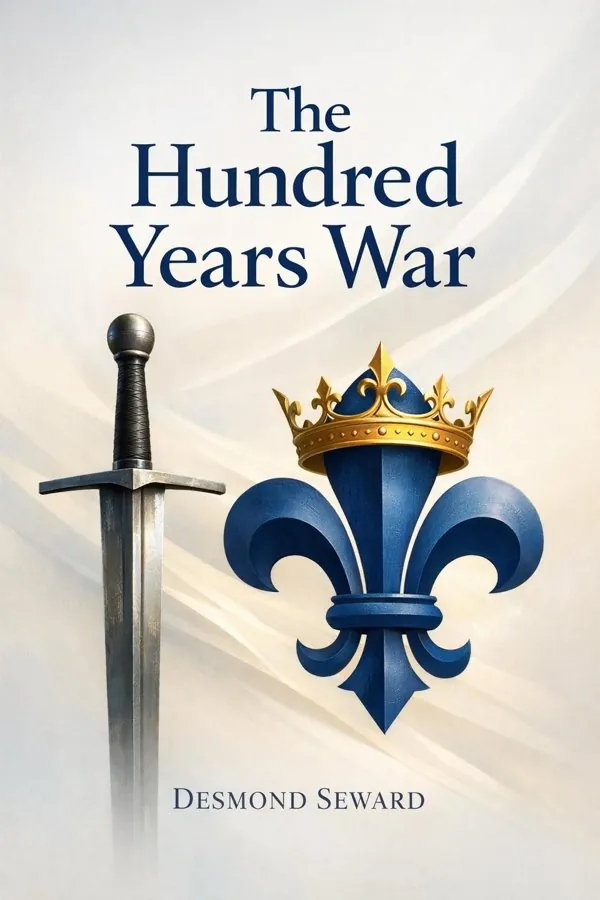
The Hundred Years War: Summary & Key Insights
 10 min9 chaptersAudio available
Key Takeaways from The Hundred Years War
Great wars often begin with a legal argument that hides deeper struggles for power.
Military revolutions are often recognized only after traditional elites have been shattered by them.
Some peace settlements end wars; others merely pause them while storing up future resentment.
A losing side does not always need a miracle; sometimes it needs patience, reform, and a better understanding of its opponent.
Empires often collapse less from enemy brilliance than from the unbearable cost of holding what they have seized.
What Is The Hundred Years War About?
The Hundred Years War by Desmond Seward is a world_history book spanning 9 pages. The Hundred Years War is far more than a long medieval conflict between England and France. In Desmond Seward’s vivid account, it becomes a gripping story of dynastic ambition, battlefield innovation, political betrayal, and social transformation stretching from 1337 to 1453. Seward shows how a quarrel over succession evolved into a struggle that devastated regions, toppled rulers, elevated unlikely heroes, and helped forge stronger ideas of kingship and national identity on both sides of the Channel. The book moves from the triumphs of Edward III and the Black Prince to the disasters of occupation, the brilliance of Henry V, and the astonishing intervention of Joan of Arc. What makes Seward’s work especially compelling is his ability to combine military history with human drama: kings age, nobles scheme, peasants suffer, and commanders gamble entire realms on a single day’s fighting. As a historian of medieval Europe and a skilled narrative writer, Seward offers both authority and momentum. His book matters because it explains how one prolonged war reshaped France, weakened England, and transformed the political landscape of late medieval Europe.
This FizzRead summary covers all 9 key chapters of The Hundred Years War in approximately 10 minutes, distilling the most important ideas, arguments, and takeaways from Desmond Seward's work. Also available as an audio summary and Key Quotes Podcast.
The Hundred Years War
The Hundred Years War is far more than a long medieval conflict between England and France. In Desmond Seward’s vivid account, it becomes a gripping story of dynastic ambition, battlefield innovation, political betrayal, and social transformation stretching from 1337 to 1453. Seward shows how a quarrel over succession evolved into a struggle that devastated regions, toppled rulers, elevated unlikely heroes, and helped forge stronger ideas of kingship and national identity on both sides of the Channel. The book moves from the triumphs of Edward III and the Black Prince to the disasters of occupation, the brilliance of Henry V, and the astonishing intervention of Joan of Arc. What makes Seward’s work especially compelling is his ability to combine military history with human drama: kings age, nobles scheme, peasants suffer, and commanders gamble entire realms on a single day’s fighting. As a historian of medieval Europe and a skilled narrative writer, Seward offers both authority and momentum. His book matters because it explains how one prolonged war reshaped France, weakened England, and transformed the political landscape of late medieval Europe.
Who Should Read The Hundred Years War?
This book is perfect for anyone interested in world_history and looking to gain actionable insights in a short read. Whether you're a student, professional, or lifelong learner, the key ideas from The Hundred Years War by Desmond Seward will help you think differently.
- ✓Readers who enjoy world_history and want practical takeaways
- ✓Professionals looking to apply new ideas to their work and life
- ✓Anyone who wants the core insights of The Hundred Years War in just 10 minutes
Want the full summary?
Get instant access to this book summary and 100K+ more with Fizz Moment.
Get Free SummaryAvailable on App Store • Free to download
Key Chapters
Great wars often begin with a legal argument that hides deeper struggles for power. Seward presents the origins of the Hundred Years War as precisely that: a dispute over the French crown that quickly grew into a vast contest between two ambitious monarchies. When Charles IV of France died in 1328 without a male heir, Edward III of England claimed the throne through his mother, Isabella, who was Charles’s sister. The French, however, rejected inheritance through the female line and chose Philip VI of Valois. On paper, this looked like a technical dynastic disagreement. In practice, it exposed unresolved tensions over feudal obligations, control of lands in France, trade interests, and the pride of rival ruling houses.
Seward makes clear that Edward III’s position was complicated. As king of England, he was sovereign. Yet as duke of Aquitaine, he remained a vassal to the French crown, a humiliating arrangement that invited friction. Add disputes over Flanders, maritime rivalry, and intermittent confiscation of English-held territories, and the conflict became almost inevitable. The war did not emerge from nationalism in the modern sense, but over time it helped create it. What began as a feud among elites drew in towns, peasants, clergy, and merchants, gradually producing wider loyalties to “England” and “France.”
A useful modern application is to remember that major conflicts are rarely caused by one issue alone. Constitutional questions, economic pressure, prestige, and personal ego often combine. The opening phase of the Hundred Years War is a case study in how unresolved political ambiguity can escalate into generations of violence.
Actionable takeaway: When analyzing any conflict, look beyond the official trigger and identify the layered interests beneath it.
Military revolutions are often recognized only after traditional elites have been shattered by them. Seward shows that the early English victories of the Hundred Years War stunned Europe because they overturned accepted assumptions about knightly warfare. At Crécy in 1346 and Poitiers in 1356, English armies under Edward III and the Black Prince defeated larger French forces through discipline, defensive positioning, and the devastating use of the longbow. These were not merely battlefield upsets; they revealed that heavily armored cavalry, long seen as the aristocratic core of war, could be broken by coordinated infantry and missile fire.
Seward emphasizes the importance of leadership and preparation. At Crécy, the English chose strong ground, organized their men effectively, and forced the French into repeated, chaotic assaults. At Poitiers, the capture of King John II of France turned military defeat into political humiliation. These victories encouraged English confidence and damaged French prestige, but they also showed the growing importance of logistics, tactical planning, and mixed forces over pure feudal valor.
The lesson extends beyond medieval warfare. Institutions often cling to old models long after circumstances have changed. The French nobility believed courage and status would compensate for poor coordination. Instead, they ran into an enemy that had adapted. In modern organizations, the equivalent mistake is relying on hierarchy or reputation instead of process, training, and realistic assessment.
Seward’s narrative also reminds readers that spectacular success can create dangerous illusions. Early triumphs convinced many in England that France could be mastered permanently, a belief later events would expose as naive.
Actionable takeaway: Do not confuse inherited prestige with effectiveness; adapt strategy to reality, not tradition.
Some peace settlements end wars; others merely pause them while storing up future resentment. Seward treats the Treaty of Brétigny in 1360 as a striking example of a settlement that seemed decisive but proved unstable. After years of English military success, France was exhausted, its king had been captured, and vast concessions appeared possible. Under the treaty, Edward III renounced his claim to the French throne in exchange for expanded sovereignty over major French territories, including Aquitaine. On the surface, this looked like a pragmatic compromise: England gained land and status, while France gained the release of its king and a chance to recover.
Yet Seward shows why the agreement did not resolve the deeper conflict. The territorial arrangements were difficult to implement, local loyalties remained uncertain, and neither side truly abandoned its larger ambitions. Edward’s renunciation of the French crown did not erase generations of rivalry, and the French monarchy had every incentive to reverse humiliating losses once it regained strength. The treaty also depended on a feudal and administrative clarity that simply did not exist in many contested areas.
This is one of Seward’s most valuable historical insights: military victory can produce terms that look impressive on parchment but are impossible to sustain politically. Modern readers can compare this to negotiations that focus on headline concessions while neglecting enforcement, legitimacy, and local acceptance. Durable peace requires more than territorial exchange; it needs structures that both sides can live with.
Brétigny briefly elevated England to the height of its continental power, but it also encouraged overreach. Because the English misunderstood the fragility of their gains, they failed to prepare for French recovery.
Actionable takeaway: Judge any settlement not by how dramatic it appears, but by whether its terms can realistically endure under pressure.
A losing side does not always need a miracle; sometimes it needs patience, reform, and a better understanding of its opponent. Seward’s account of the renewed hostilities from 1369 to 1389 highlights the French recovery under Charles V and his commander Bertrand du Guesclin. Instead of seeking grand chivalric showdowns like Crécy or Poitiers, the French shifted toward a war of attrition. They avoided battles that favored English tactics, targeted garrisons, pressured supply lines, and slowly reclaimed territory.
This strategic change was decisive. Seward presents Charles V as one of the conflict’s most capable rulers, not because he won famous battles, but because he understood the larger mechanics of power. France had greater resources and population than England. If it stopped handing the English dramatic victories and instead prolonged the contest on more favorable terms, time itself would become a weapon. Du Guesclin, less glamorous than some knightly heroes, embodied this practical approach. He excelled in maneuver, siege warfare, and political realism.
The phase also reveals the importance of governance behind the front lines. Taxation, administration, and local cooperation mattered as much as battlefield courage. The French crown gradually reasserted authority while English holdings became harder to defend. In practical terms, this is a lesson in strategic adjustment: when your current model repeatedly fails, changing the conditions of competition can matter more than trying harder.
Seward invites readers to appreciate that resilience often looks unheroic in the moment. The French revival was built not on one dramatic reversal, but on cumulative, disciplined recovery. That pattern applies to business, politics, and personal setbacks alike.
Actionable takeaway: If you cannot win on your opponent’s terms, redesign the contest around your own strengths.
Empires often collapse less from enemy brilliance than from the unbearable cost of holding what they have seized. Seward’s discussion of the crisis of English rule shows how difficult it was for England to maintain authority across French territories over decades. Conquest created obligations: garrisons had to be paid, local elites had to be managed, fortifications supplied, roads protected, and rebellious populations kept under control. Even when English armies won spectacular victories, they faced the exhausting problem of turning triumph into stable government.
Seward pays close attention to the social and political consequences of prolonged war. In France, roaming companies of soldiers ravaged the countryside, weakening legitimacy and intensifying suffering. In England, repeated campaigns and taxation strained resources and widened political tensions. The war was not a series of isolated battles but a system of pressure that distorted both kingdoms. English power in France depended heavily on local cooperation, yet occupation naturally bred resistance, especially when foreign rulers appeared temporary, extractive, or militarized.
This is one reason the war lasted so long. The English were often strong enough to conquer, but not strong enough to settle the question permanently. Seward’s narrative undercuts any simplistic idea that battlefield dominance guarantees political success. In modern terms, organizations frequently underestimate the maintenance cost of expansion. Acquiring a new market, territory, or institutional domain can be easier than governing it well.
The English crisis also had domestic consequences, contributing to instability that would later feed into the Wars of the Roses. Sustained external ambition weakened the kingdom internally.
Actionable takeaway: Before pursuing expansion, calculate the long-term cost of governing what you gain, not just the short-term cost of winning it.
Charismatic leadership can revive a failing cause, but it can also tempt a state into believing old ambitions are newly achievable. Seward portrays the Lancastrian phase, especially under Henry V, as the last great surge of English power in the Hundred Years War. Henry inherited a kingdom with internal problems yet brought discipline, legitimacy, and strategic focus. His 1415 campaign culminated in the famous victory at Agincourt, where an exhausted, outnumbered English army inflicted a crushing defeat on French forces. As at Crécy and Poitiers, tactical skill, terrain, and the longbow once again exposed French weaknesses.
But Seward does not reduce Henry V to Agincourt alone. He highlights Henry’s persistence, diplomatic shrewdness, and ability to exploit divisions within France, particularly the rivalry between Armagnacs and Burgundians. The result was the Treaty of Troyes in 1420, under which Henry married Catherine of Valois and was recognized as heir to the French throne, disinheriting the Dauphin. It seemed that the dream of a dual monarchy was finally within reach.
Yet this triumph contained its own fragility. The arrangement depended heavily on Henry’s personal authority and on a fractured France remaining fractured. When Henry died in 1422, the project immediately became less viable. Seward uses this moment to show how much large political systems can depend on individual rulers. Strong leaders can achieve what institutions alone cannot sustain.
For modern readers, the lesson is to distinguish between personal momentum and structural stability. A leader may create extraordinary results, but unless those gains are institutionalized, they may vanish with him.
Actionable takeaway: Build systems that can survive the departure of exceptional leaders, or your greatest successes may prove temporary.
History sometimes turns when people regain belief before they regain power. Seward’s treatment of Joan of Arc captures why her appearance in 1429 mattered so profoundly. France was politically divided, militarily pressured, and psychologically battered. The English and their allies seemed close to making the Treaty of Troyes permanent reality. Into this bleak landscape came Joan, a young peasant woman claiming divine guidance to support the Dauphin, later Charles VII. To a skeptical modern reader, her visions may seem secondary. Seward’s deeper point is that her effect on morale, legitimacy, and momentum was transformative.
Joan’s role in lifting the siege of Orléans and helping bring about Charles VII’s coronation at Reims gave the French cause renewed spiritual and political confidence. She did not single-handedly win the war, and Seward avoids reducing the conflict to legend. But he makes clear that symbols matter in politics and war. Joan re-centered the conflict around rightful kingship and divine favor, energizing supporters who had grown accustomed to defeat and hesitation.
Her capture and execution in 1431 as a heretic and relapsed offender reveal the brutal fusion of religion, propaganda, and state power in late medieval Europe. Yet even in death, her impact endured. She had already changed the emotional direction of the war. Practical application is easy to see: in moments of institutional drift, morale can be as important as resources. Teams, nations, and movements often recover first in confidence, then in performance.
Actionable takeaway: Never underestimate the power of a compelling symbol or messenger to restore purpose in a discouraged community.
The final victories in long conflicts usually belong not to the side with the best legend, but to the side that learns how to organize power more effectively. Seward’s account of the decline of English power from 1431 to 1453 shows that France ultimately prevailed because it developed more durable political and military institutions. After Joan’s initial intervention, Charles VII gradually strengthened royal authority, improved taxation, expanded artillery, and created more reliable military structures. These changes made French recovery cumulative rather than episodic.
The English position, by contrast, became increasingly untenable. Their regime in France depended on a minority king, contested finances, vulnerable alliances, and local obedience that was steadily evaporating. The Burgundian alliance weakened, French reconquest accelerated, and English strongholds became isolated. Key moments such as the French victory at Castillon in 1453 signaled not just another battlefield defeat, but the collapse of England’s centuries-old continental project. Castillon, with its effective use of artillery, also suggested a changing military age in which old methods were losing relevance.
Seward’s larger argument is that wars of endurance reward administrative capacity. Charisma, courage, and tactical brilliance matter, but over decades they cannot compensate for structural weakness. This insight has broad application. Organizations that invest in systems, finance, and talent pipelines usually outlast rivals that depend on heroic improvisation.
By the end of the war, England retained only Calais. France, though scarred, emerged more centralized and politically coherent. That result was not inevitable from the start, but it became possible because the French monarchy learned and adapted more thoroughly.
Actionable takeaway: Long-term success belongs to those who turn temporary momentum into lasting institutions.
One of the paradoxes of the Hundred Years War is that a dynastic struggle helped create something larger than dynasty. Seward argues that the war’s deepest legacy was not merely territorial change, but the strengthening of political identity in both England and France. At the outset, kings and nobles thought primarily in terms of lineage, feudal rights, and personal allegiance. By the end, the language of collective belonging had become far stronger. Subjects increasingly imagined themselves as part of a wider kingdom whose fate mattered beyond the person of a single ruler.
In France, repeated invasion and eventual recovery encouraged loyalty to a more centralized monarchy. In England, victories abroad temporarily nourished pride, but final defeat contributed to inward turmoil and a reorientation of political life. The war also accelerated changes in taxation, military recruitment, administration, and public messaging. These developments did not create modern nation-states overnight, yet they pushed both kingdoms in that direction.
Seward is especially effective at showing the war’s human cost behind these grand transformations. The conflict devastated towns and countryside, burdened populations with taxes and raids, and left a trail of social trauma. Historical progress, in this case, was paid for in suffering. That makes the legacy morally complicated: the war helped shape Europe, but through ruin as much as through achievement.
For modern readers, this idea is useful because it highlights how collective identities are often forged under pressure. Shared danger, sacrifice, and memory can bind societies together, though at terrible cost. Understanding that process helps explain not only medieval Europe but many later conflicts.
Actionable takeaway: When evaluating historical change, ask not only what new institutions emerged, but what human price was paid to create them.
All Chapters in The Hundred Years War
About the Author
Desmond Seward is a British historian, biographer, and popular writer on medieval and early modern European history. Born in 1935 and educated at Ampleforth and Cambridge, he became known for combining solid historical research with a vivid, narrative style that appeals to both general readers and history enthusiasts. Much of his work focuses on monarchy, aristocratic power, warfare, and political conflict, with books on subjects such as the Plantagenets, Richard III, the Wars of the Roses, and revolutionary France. Seward has a particular talent for turning complex historical periods into dramatic, character-driven stories without losing sight of broader social and political forces. In The Hundred Years War, that strength is especially clear: he blends military history, dynastic politics, and human drama into a compelling account of one of Europe’s most consequential medieval conflicts.
Get This Summary in Your Preferred Format
Read or listen to the The Hundred Years War summary by Desmond Seward anytime, anywhere. FizzRead offers multiple formats so you can learn on your terms — all free.
Available formats: App · Audio · PDF · EPUB — All included free with FizzRead
Download The Hundred Years War PDF and EPUB Summary
Key Quotes from The Hundred Years War
“Great wars often begin with a legal argument that hides deeper struggles for power.”
“Military revolutions are often recognized only after traditional elites have been shattered by them.”
“Some peace settlements end wars; others merely pause them while storing up future resentment.”
“A losing side does not always need a miracle; sometimes it needs patience, reform, and a better understanding of its opponent.”
“Empires often collapse less from enemy brilliance than from the unbearable cost of holding what they have seized.”
Frequently Asked Questions about The Hundred Years War
The Hundred Years War by Desmond Seward is a world_history book that explores key ideas across 9 chapters. The Hundred Years War is far more than a long medieval conflict between England and France. In Desmond Seward’s vivid account, it becomes a gripping story of dynastic ambition, battlefield innovation, political betrayal, and social transformation stretching from 1337 to 1453. Seward shows how a quarrel over succession evolved into a struggle that devastated regions, toppled rulers, elevated unlikely heroes, and helped forge stronger ideas of kingship and national identity on both sides of the Channel. The book moves from the triumphs of Edward III and the Black Prince to the disasters of occupation, the brilliance of Henry V, and the astonishing intervention of Joan of Arc. What makes Seward’s work especially compelling is his ability to combine military history with human drama: kings age, nobles scheme, peasants suffer, and commanders gamble entire realms on a single day’s fighting. As a historian of medieval Europe and a skilled narrative writer, Seward offers both authority and momentum. His book matters because it explains how one prolonged war reshaped France, weakened England, and transformed the political landscape of late medieval Europe.
You Might Also Like
The Age of Capital
Eric Hobsbawm
10 min
The Gulag Archipelago
Aleksandr Solzhenitsyn
10 min
Jerusalem: The Biography
Simon Sebag Montefiore
10 min
The Anglo-Saxons
James Campbell
10 min
The Boer War
Thomas Pakenham
10 min
The Industrial Revolutionaries: The Making of the Modern World 1776–1914
Gavin Weightman
10 minBrowse by Category
Ready to read The Hundred Years War?
Get the full summary and 100K+ more books with Fizz Moment.