
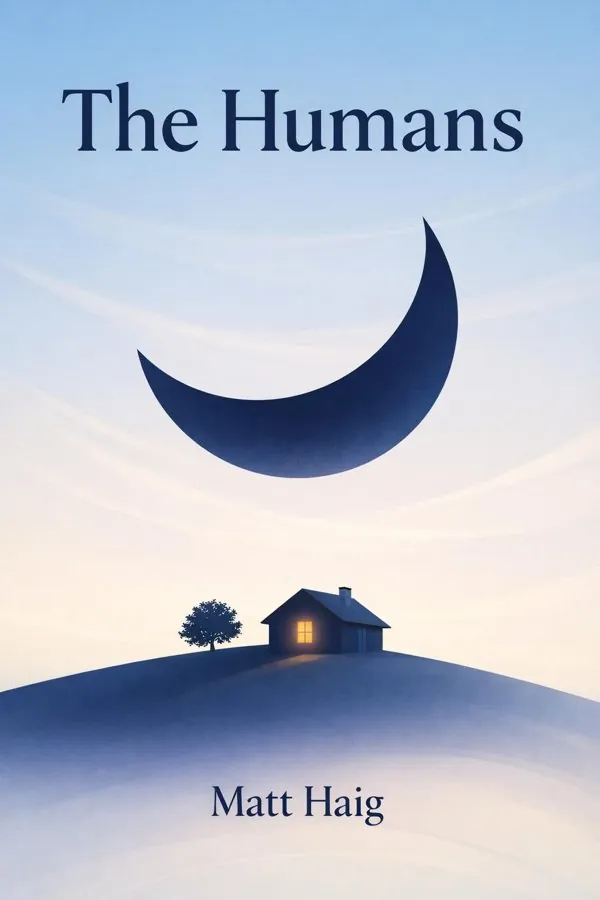
The Humans: Summary & Key Insights
by Matt Haig
 10 min9 chaptersAudio available
Key Takeaways from The Humans
Sometimes the fastest way to expose the absurdity of everyday life is to see it through a complete outsider’s eyes.
Moral certainty often collapses the moment we truly see another person.
Perfection may sound desirable, but The Humans suggests it can also be lifeless.
Intelligence without love can become a sophisticated form of emptiness.
One of the most quietly devastating truths in The Humans is that people can be surrounded by others and still feel profoundly alone.
What Is The Humans About?
The Humans by Matt Haig is a bestsellers book spanning 4 pages. What if the best way to understand human life were to see it through the eyes of someone who is not human at all? In The Humans, Matt Haig takes a brilliant sci-fi premise and turns it into a deeply moving exploration of love, loneliness, family, and the strange beauty of existence. The novel begins when an alien from the highly advanced planet Vonnadoria arrives on Earth and inhabits the body of mathematician Andrew Martin, whose recent breakthrough could accelerate humanity’s development too quickly. His mission is simple: erase all traces of the discovery and eliminate anyone who knows about it. But Earth is not as simple as it first appears. As the narrator observes human habits, flaws, pleasures, and pain, contempt slowly gives way to curiosity, compassion, and wonder. Haig uses humor, satire, and tenderness to ask profound questions: Why do humans suffer so much? Why do they love so fiercely? And what makes life worth living despite its fragility? Known for writing with emotional intelligence and philosophical depth, Haig delivers a novel that is entertaining, wise, and unexpectedly uplifting.
This FizzRead summary covers all 9 key chapters of The Humans in approximately 10 minutes, distilling the most important ideas, arguments, and takeaways from Matt Haig's work. Also available as an audio summary and Key Quotes Podcast.
The Humans
What if the best way to understand human life were to see it through the eyes of someone who is not human at all? In The Humans, Matt Haig takes a brilliant sci-fi premise and turns it into a deeply moving exploration of love, loneliness, family, and the strange beauty of existence. The novel begins when an alien from the highly advanced planet Vonnadoria arrives on Earth and inhabits the body of mathematician Andrew Martin, whose recent breakthrough could accelerate humanity’s development too quickly. His mission is simple: erase all traces of the discovery and eliminate anyone who knows about it. But Earth is not as simple as it first appears. As the narrator observes human habits, flaws, pleasures, and pain, contempt slowly gives way to curiosity, compassion, and wonder. Haig uses humor, satire, and tenderness to ask profound questions: Why do humans suffer so much? Why do they love so fiercely? And what makes life worth living despite its fragility? Known for writing with emotional intelligence and philosophical depth, Haig delivers a novel that is entertaining, wise, and unexpectedly uplifting.
Who Should Read The Humans?
This book is perfect for anyone interested in bestsellers and looking to gain actionable insights in a short read. Whether you're a student, professional, or lifelong learner, the key ideas from The Humans by Matt Haig will help you think differently.
- ✓Readers who enjoy bestsellers and want practical takeaways
- ✓Professionals looking to apply new ideas to their work and life
- ✓Anyone who wants the core insights of The Humans in just 10 minutes
Want the full summary?
Get instant access to this book summary and 100K+ more with Fizz Moment.
Get Free SummaryAvailable on App Store • Free to download
Key Chapters
Sometimes the fastest way to expose the absurdity of everyday life is to see it through a complete outsider’s eyes. That is exactly how The Humans begins. The narrator, an alien from Vonnadoria, wakes up in the body of Professor Andrew Martin and immediately finds Earth grotesque, chaotic, and irrational. Human bodies seem frail and embarrassing. Clothing appears pointless. Social customs feel confusing. Food, weather, small talk, and emotion all strike him as signs of a species governed by weakness rather than logic.
This beginning matters because it strips away familiarity. Most people accept daily life without questioning it. We rush, consume, complain, and perform routines as if they are natural and inevitable. But Haig’s narrator forces us to look again. Why do we hide behind politeness while feeling disconnected? Why are we so uncomfortable with our own bodies? Why do we spend so much energy trying to appear normal? By making the ordinary look bizarre, the novel reveals how much of human life is built on habit rather than wisdom.
The alien’s first reactions are funny, but they also contain a serious insight: being human is strange. We are emotional creatures trying to live as rational ones. We crave love yet fear vulnerability. We build civilizations while remaining deeply confused about ourselves. In workplaces, families, and social circles, people often feel like they are acting from scripts they barely understand.
A practical way to use this idea is to practice deliberate defamiliarization. Look at one part of your life—a commute, a meeting, a social media habit—as if you were seeing it for the first time. Ask what is useful, what is absurd, and what is simply inherited behavior.
Actionable takeaway: Once this week, step back from one “normal” routine and question whether it actually deserves a place in your life.
Moral certainty often collapses the moment we truly see another person. At first, the narrator approaches Earth with cold clarity. His mission is to protect advanced knowledge from humanity by eliminating everyone connected to Andrew Martin’s mathematical breakthrough. From his perspective, this is not cruelty but necessity. Humans are too violent, too immature, and too unstable to be trusted with power. The logic is clean, efficient, and absolute.
Yet that logic begins to erode as he encounters Andrew’s wife, son, and colleagues not as abstractions but as individuals. Once he starts observing grief, confusion, affection, and need, the task becomes harder. It is one thing to judge “humanity” in the abstract and another to look into the eyes of a frightened child or a wounded spouse. Empathy disrupts ideology. It introduces complication where certainty once ruled.
This is one of the novel’s strongest ideas: distance makes harsh judgment easy, while closeness makes compassion possible. In real life, people often reduce others to labels—coworker, voter, stranger, rival, problem. But once stories emerge, simplifications begin to fail. The person you dismissed may be carrying private pain. The person you envied may be lonely. The person you condemned may be more complex than your first impression allowed.
This shift from mission to moral conflict also reflects how personal transformation happens. We rarely change because of arguments alone. We change because connection forces us to feel what we once avoided. Leaders become wiser when they listen. Parents soften when they understand. Friends repair relationships when they stop defending and start seeing.
Actionable takeaway: Before making a hard judgment about someone, spend five extra minutes trying to understand what fear, hope, or pressure might be shaping their behavior.
Perfection may sound desirable, but The Humans suggests it can also be lifeless. Coming from a superior civilization that values order, intelligence, and control, the narrator initially sees human imperfection as proof of inferiority. Humans get sick, age badly, make irrational decisions, and sabotage their own happiness. They feel too much, think too little, and repeatedly fail to live according to reason. From an advanced alien perspective, this is almost unbearable.
But as the story progresses, those flaws begin to look less like defects and more like the essence of human meaning. Imperfection creates humor, vulnerability, creativity, and connection. Humans write songs because they hurt. They create art because they cannot fully explain themselves. They forgive because everyone falls short. Their lives matter precisely because they are temporary and incomplete.
This idea has practical force. Many people live under the pressure of optimization—perfect career, perfect body, perfect relationship, perfect emotional control. Yet the pursuit of flawlessness often produces anxiety, self-rejection, and emotional distance. Haig’s novel argues for a different standard: not perfection, but aliveness. To be human is to be unfinished. That is not a failure of design; it is the condition that makes growth possible.
Consider everyday examples. A parent loses patience, apologizes, and becomes more loving. A student fails an exam, learns resilience, and returns stronger. A couple argues, then discovers a deeper honesty. In each case, imperfection becomes the doorway to maturity.
The narrator learns that messy feelings are not obstacles to life but part of life itself. Joy is meaningful because it coexists with fear. Love is precious because it includes risk. Even embarrassment and grief reveal our capacity to care.
Actionable takeaway: Replace one perfection-based goal this week with a sincerity-based one—aim not to be flawless, but to be present, honest, and willing to learn.
Intelligence without love can become a sophisticated form of emptiness. The narrator arrives on Earth convinced that superiority justifies intervention. His species is more advanced, more disciplined, more rational. By comparison, humans appear primitive. But this belief in superiority begins to crack when he experiences relationship, especially within Andrew Martin’s family. What starts as observation becomes attachment, and attachment becomes care.
Love changes the scale of value. From a detached cosmic perspective, one family may seem insignificant. From within love, that same family becomes immeasurably important. The narrator comes to see that the human capacity to bond—to worry about another person, to protect them, to miss them, to forgive them—gives life depth that abstract intelligence cannot provide. Knowing more is not the same as living more fully.
This is a sharp challenge to modern habits of emotional distance. Many people protect themselves through irony, overanalysis, or busyness. They prefer competence to vulnerability and control to closeness. But Haig’s novel suggests that detachment is not strength if it prevents genuine feeling. The most meaningful choice is often not to remain above life, but to enter it fully.
In practical terms, this can mean valuing people over performance. A promotion matters, but so does being emotionally available at home. Being right in an argument matters less than preserving trust. A brilliant mind can still lead a lonely life if it never learns tenderness.
The narrator’s transformation is not merely romantic or sentimental. It is ethical. Once he loves, he can no longer treat lives as expendable. Love becomes the force that limits violence, deepens responsibility, and gives freedom a purpose.
Actionable takeaway: Show one concrete act of care today—a call, apology, hug, encouraging message, or unhurried conversation—to remind yourself that connection is more important than superiority.
One of the most quietly devastating truths in The Humans is that people can be surrounded by others and still feel profoundly alone. As the narrator studies human behavior, he notices a painful contradiction: humans are social creatures desperate for connection, yet they often live in emotional isolation. Marriages become routine. Parents and children fail to communicate. Colleagues talk constantly without saying anything meaningful. People hide private despair behind social performance.
Because the narrator begins as an outsider, he notices what insiders overlook. He sees how much human conversation is defensive, polite, coded, or distracted. He also sees how loneliness influences behavior. People become rude because they are afraid. They become ambitious because they want recognition. They become withdrawn because they fear rejection. Much of what appears as personality is actually unspoken need.
This insight is especially relevant now. In a hyperconnected world, many people have endless digital contact but very little felt intimacy. They can message dozens of people and still feel unknown. The novel reminds us that loneliness is not simply the absence of company. It is the absence of being understood.
Practical application starts with attention. Relationships do not deepen through proximity alone; they deepen through curiosity, presence, and honesty. Instead of asking performative questions like “How are you?” and moving on, ask something more specific. What has been heavy lately? What are you excited about? What are you avoiding? Meaningful relationships often begin when one person risks sincerity first.
The narrator gradually learns that human loneliness is tragic, but it also reveals a beautiful fact: people keep reaching anyway. They write, sing, flirt, confess, and hope. Beneath all the awkwardness is a longing to be met.
Actionable takeaway: Reach out to one person you care about and ask a real question that invites an honest answer.
Grand theories rarely sustain a person in the way small pleasures do. At first, the narrator judges humanity by its violence, pettiness, and chaos. But as he spends more time on Earth, he starts noticing the tiny experiences that make human life unexpectedly beautiful: music, peanut butter, wine, dogs, poetry, jokes, sunlight, companionship, and the pleasure of simply being alive in a body despite its limitations.
This is one of the novel’s most life-affirming contributions. Meaning is not found only in major achievements or abstract purpose. It is also found in ordinary sensory and emotional moments. A meal shared with someone you love. A piece of music that reaches you at the right time. A quiet evening. A laugh that breaks tension. These moments may seem insignificant against the scale of the universe, yet they are exactly what make existence feel livable.
Many people postpone joy. They assume life will become meaningful after the next milestone: career success, financial security, recognition, retirement, self-improvement. But Haig suggests that such thinking misses the point. Human life is fragile and temporary. If beauty is always delayed, it may never be fully inhabited.
In practical terms, this idea invites a reorientation of attention. Instead of treating pleasure as a distraction from life, see it as part of life’s texture. Notice what restores you. Protect rituals that bring calm or delight. Cook slowly. Walk without your phone. Read poetry. Listen deeply to a song instead of letting it become background noise.
The alien narrator learns that these small earthly experiences are not trivial. They are evidence that life, though painful and absurd, is still worth choosing.
Actionable takeaway: Make a short list of five small experiences that reliably make you feel glad to be alive, and intentionally include one of them in your day.
Humans often believe that if they could just understand enough, they would finally feel secure. The narrator of The Humans comes from a civilization built on advanced knowledge, and he initially views mathematics as the highest form of truth. In fact, the novel’s central conflict begins with a mathematical breakthrough so significant that it threatens to transform humanity’s future. Knowledge is power, and power in the wrong hands can be catastrophic.
Yet the deeper irony of the novel is that reason, while powerful, cannot answer the most important human questions. Mathematics can describe patterns, but it cannot tell you how to love your child, survive grief, or forgive yourself. Logic can solve technical problems, but it cannot fully account for beauty, longing, or the ache of being mortal. The narrator gradually realizes that understanding life is different from mastering it.
This does not mean anti-intellectualism. Haig does not reject reason; he puts it in proportion. Science, analysis, and intelligence matter enormously. But when they are treated as complete explanations of reality, they become impoverished. A person can be brilliant and still not know how to live. A society can advance technologically while remaining emotionally stunted.
This lesson applies widely. In workplaces, data can improve decisions, but morale still depends on trust. In relationships, being factually right does not automatically heal conflict. In personal growth, reading about emotions is not the same as feeling them honestly.
The novel encourages intellectual humility. Some truths are measured. Others are experienced. A meaningful life needs both precision and wonder, both thought and feeling. The narrator becomes more human not by becoming less intelligent, but by allowing intelligence to coexist with tenderness and uncertainty.
Actionable takeaway: The next time you face a personal problem, ask not only “What is the correct answer?” but also “What response would be wise, compassionate, and life-giving?”
What makes human life precious is not its permanence but its fragility. To the alien narrator, mortality initially seems like one of humanity’s clearest disadvantages. Humans age, decay, and die. They form attachments only to lose them. They build lives under the shadow of endings. From a more advanced and detached perspective, such vulnerability looks cruel and inefficient.
But the novel gradually reveals a paradox: death is part of what gives human life urgency and beauty. Because time is limited, moments matter. Because people can be lost, love becomes precious. Because nothing lasts forever, attention becomes sacred. Mortality turns ordinary experiences into irreplaceable ones.
This idea can reshape how we approach daily life. Many people live as if time were endlessly renewable. They postpone difficult conversations, delay expressions of gratitude, and assume there will always be another chance. But awareness of finitude can sharpen tenderness rather than produce despair. It can remind us to stop performing invulnerability and start inhabiting life more fully.
In practical examples, mortality asks different questions. Instead of “How do I win this argument?” ask “Would this matter if time were short?” Instead of “What will impress others?” ask “What will I be grateful I gave my days to?” Instead of waiting for ideal circumstances, call the person, take the walk, write the note, say the loving thing.
The narrator learns that the pain of loss is inseparable from the value of attachment. Humans suffer because they care, and that caring is not a weakness to transcend. It is one of the noblest things about them.
Actionable takeaway: Act today as if time is meaningful—express appreciation, repair one neglected connection, or give full attention to a moment you would usually rush through.
Feeling like an outsider is one of the most universal human experiences, which is why The Humans resonates so deeply. Although the narrator is literally not human, his alienation mirrors what many readers already feel: the sense of being misplaced, misunderstood, or unable to decode the world around them. The genius of the novel is that it uses literal extraterrestrial estrangement to illuminate ordinary emotional estrangement.
At first, the narrator responds to not belonging with judgment and withdrawal. He sees himself as separate and superior. But over time, he discovers that belonging is not something granted only to those who fit perfectly. It is something built through participation—through caring, risking, listening, staying, and allowing oneself to be changed by others.
This is an encouraging message for anyone who feels different. Belonging does not require flawless social ease or total certainty. It does not demand that you erase your strangeness. In fact, the novel suggests that everyone is strange in some way. What creates community is not sameness but mutual recognition. People begin to belong when they stop waiting to feel naturally included and start offering their presence sincerely.
In real life, this might mean joining a conversation instead of standing at the edge, telling the truth in a friendship, contributing in a family even when it feels awkward, or engaging with a community before you feel fully confident. Belonging often follows investment rather than preceding it.
By the end of the novel, humanity is no longer merely a species to the narrator. It is a shared condition he chooses to embrace. That choice carries hope: even if you feel foreign to the world, you can still make a home in it through love and participation.
Actionable takeaway: If you feel disconnected, take one step toward participation this week—initiate, contribute, volunteer, or speak honestly instead of waiting passively to feel included.
All Chapters in The Humans
About the Author
Matt Haig is a British novelist and nonfiction writer celebrated for his emotionally intelligent, accessible works on mental health, time, identity, and the meaning of life. Born in Sheffield, England, he has written across multiple genres, including literary fiction, speculative fiction, memoir, and children’s literature. His best-known books include The Midnight Library, Reasons to Stay Alive, How to Stop Time, and The Comfort Book. Haig’s writing often draws from his own experiences with depression and anxiety, which gives his work unusual honesty and compassion. He has built a wide international readership by combining philosophical reflection with clear storytelling and emotional warmth. In The Humans, Haig uses humor and science fiction to examine loneliness, love, and what makes human life both difficult and beautiful.
Get This Summary in Your Preferred Format
Read or listen to the The Humans summary by Matt Haig anytime, anywhere. FizzRead offers multiple formats so you can learn on your terms — all free.
Available formats: App · Audio · PDF · EPUB — All included free with FizzRead
Download The Humans PDF and EPUB Summary
Key Quotes from The Humans
“Sometimes the fastest way to expose the absurdity of everyday life is to see it through a complete outsider’s eyes.”
“Moral certainty often collapses the moment we truly see another person.”
“Perfection may sound desirable, but The Humans suggests it can also be lifeless.”
“Intelligence without love can become a sophisticated form of emptiness.”
“One of the most quietly devastating truths in The Humans is that people can be surrounded by others and still feel profoundly alone.”
Frequently Asked Questions about The Humans
The Humans by Matt Haig is a bestsellers book that explores key ideas across 9 chapters. What if the best way to understand human life were to see it through the eyes of someone who is not human at all? In The Humans, Matt Haig takes a brilliant sci-fi premise and turns it into a deeply moving exploration of love, loneliness, family, and the strange beauty of existence. The novel begins when an alien from the highly advanced planet Vonnadoria arrives on Earth and inhabits the body of mathematician Andrew Martin, whose recent breakthrough could accelerate humanity’s development too quickly. His mission is simple: erase all traces of the discovery and eliminate anyone who knows about it. But Earth is not as simple as it first appears. As the narrator observes human habits, flaws, pleasures, and pain, contempt slowly gives way to curiosity, compassion, and wonder. Haig uses humor, satire, and tenderness to ask profound questions: Why do humans suffer so much? Why do they love so fiercely? And what makes life worth living despite its fragility? Known for writing with emotional intelligence and philosophical depth, Haig delivers a novel that is entertaining, wise, and unexpectedly uplifting.
More by Matt Haig

You Might Also Like
The Godfather
Mario Puzo
10 min
The Handmaid's Tale
Margaret Atwood
10 min
The Hunger Games
Suzanne Collins
10 min
The Nightingale
Kristin Hannah
10 min
The Seven Husbands of Evelyn Hugo
Taylor Jenkins Reid
10 min
Backwater Justice
Fern Michaels
10 minBrowse by Category
Ready to read The Humans?
Get the full summary and 100K+ more books with Fizz Moment.