
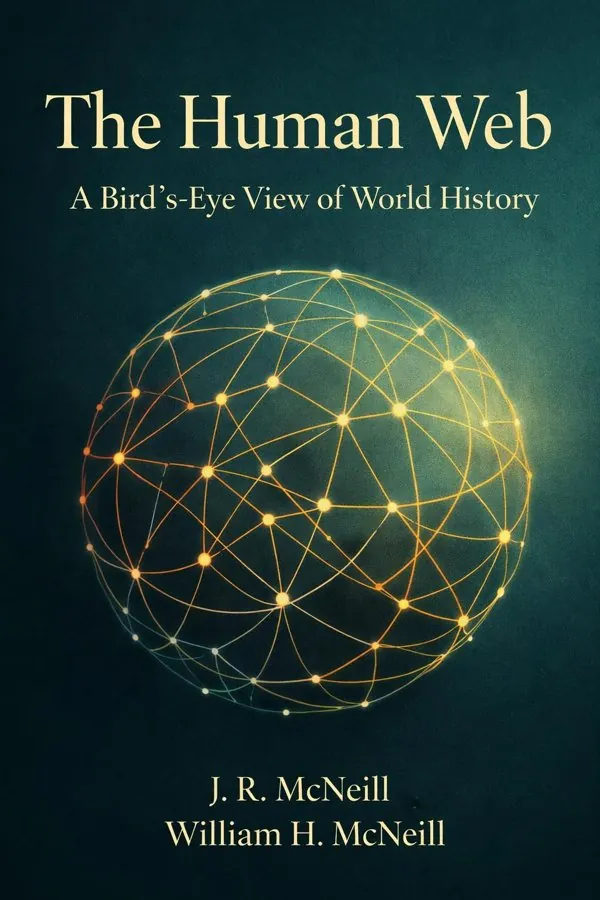
The Human Web: A Bird’s-Eye View of World History: Summary & Key Insights
by J. R. McNeill, William H. McNeill
 10 min10 chaptersAudio available
What Is The Human Web: A Bird’s-Eye View of World History About?
The Human Web: A Bird’s-Eye View of World History by J. R. McNeill, William H. McNeill is a world_history book spanning 10 pages. The Human Web offers a sweeping narrative of world history through the lens of human interconnection. The McNeills trace how webs of communication, trade, and cultural exchange have shaped civilizations from prehistoric times to the modern globalized world. The book emphasizes the growing complexity and density of these networks, showing how they have driven technological, social, and political change across millennia.
This FizzRead summary covers all 10 key chapters of The Human Web: A Bird’s-Eye View of World History in approximately 10 minutes, distilling the most important ideas, arguments, and takeaways from J. R. McNeill, William H. McNeill's work. Also available as an audio summary and Key Quotes Podcast.
The Human Web: A Bird’s-Eye View of World History
The Human Web offers a sweeping narrative of world history through the lens of human interconnection. The McNeills trace how webs of communication, trade, and cultural exchange have shaped civilizations from prehistoric times to the modern globalized world. The book emphasizes the growing complexity and density of these networks, showing how they have driven technological, social, and political change across millennia.
Who Should Read The Human Web: A Bird’s-Eye View of World History?
This book is perfect for anyone interested in world_history and looking to gain actionable insights in a short read. Whether you're a student, professional, or lifelong learner, the key ideas from The Human Web: A Bird’s-Eye View of World History by J. R. McNeill, William H. McNeill will help you think differently.
- ✓Readers who enjoy world_history and want practical takeaways
- ✓Professionals looking to apply new ideas to their work and life
- ✓Anyone who wants the core insights of The Human Web: A Bird’s-Eye View of World History in just 10 minutes
Want the full summary?
Get instant access to this book summary and 100K+ more with Fizz Moment.
Get Free SummaryAvailable on App Store • Free to download
Key Chapters
Humanity’s earliest webs were personal and immediate. Long before cities or kingdoms, humans lived in small, kin-based bands, their connections limited to what could be maintained through memory and face-to-face contact. These miniature webs were fragile yet essential. They allowed for the transmission of survival knowledge — how to make tools, hunt, gather, recognize plants, tell stories, and build alliances. Trust was the core currency of these early networks.
The key to our species’ success lay not in individual strength but in the capacity to connect minds. Shared experience created shared meaning, establishing the cognitive scaffolding for cooperation. Over time, these tiny webs began to meet and overlap. Seasonal gatherings, marriages between groups, or exchanges of tools and ornaments forged the first intergroup links. Slowly, the human web began to spread.
Geographic isolation limited these networks, but even in prehistory, diffusion occurred across astonishing distances. Ideas — how to knap flint, how to domesticate fire — traveled faster than people. Thus began a principle that would define all later eras: innovation and interconnection reinforced one another. The broader the web, the faster and farther ideas moved, accelerating humanity’s development.
Around 10,000 years ago, the invention of agriculture transformed both human life and the structure of the human web. When people began to cultivate plants and domesticate animals, they settled into villages. What had once been a loose net of nomadic bands now became denser and more stable threads of community. Surplus food enabled population growth, specialization of labor, and the accumulation of knowledge. Village networks blossomed into regional webs linked by trade in grain, pottery, and livestock.
The agricultural revolution did more than fill granaries; it established the ecological and social foundations for civilization. It also confined human beings within new constraints — epidemics spread more easily in dense populations, hierarchies hardened, and power disparities emerged. But for the first time, sustained webs of exchange tied distant places together through shared crops, technologies, and customs.
Even as regions like the Fertile Crescent, the Yellow River valley, and Mesoamerica developed independently, the logic of the web remained constant: density fostered complexity. Innovation became cumulative, and culture now had memory beyond the individual’s lifespan, sustained through record-keeping and ritual tradition. Agriculture strengthened the threads of interdependence until societies could no longer exist in isolation.
+ 8 more chapters — available in the FizzRead app
All Chapters in The Human Web: A Bird’s-Eye View of World History
About the Authors
J. R. McNeill is an American environmental historian and professor at Georgetown University, known for his work on global environmental history. William H. McNeill (1917–2016) was a Canadian-American historian and professor at the University of Chicago, celebrated for his influential works on world history, including 'The Rise of the West'.
Get This Summary in Your Preferred Format
Read or listen to the The Human Web: A Bird’s-Eye View of World History summary by J. R. McNeill, William H. McNeill anytime, anywhere. FizzRead offers multiple formats so you can learn on your terms — all free.
Available formats: App · Audio · PDF · EPUB — All included free with FizzRead
Download The Human Web: A Bird’s-Eye View of World History PDF and EPUB Summary
Key Quotes from The Human Web: A Bird’s-Eye View of World History
“Humanity’s earliest webs were personal and immediate.”
“Around 10,000 years ago, the invention of agriculture transformed both human life and the structure of the human web.”
Frequently Asked Questions about The Human Web: A Bird’s-Eye View of World History
The Human Web: A Bird’s-Eye View of World History by J. R. McNeill, William H. McNeill is a world_history book that explores key ideas across 10 chapters. The Human Web offers a sweeping narrative of world history through the lens of human interconnection. The McNeills trace how webs of communication, trade, and cultural exchange have shaped civilizations from prehistoric times to the modern globalized world. The book emphasizes the growing complexity and density of these networks, showing how they have driven technological, social, and political change across millennia.
You Might Also Like
The Age of Capital
Eric Hobsbawm
10 min
The Gulag Archipelago
Aleksandr Solzhenitsyn
10 min
Jerusalem: The Biography
Simon Sebag Montefiore
10 min
The Anglo-Saxons
James Campbell
10 min
The Boer War
Thomas Pakenham
10 min
The Industrial Revolutionaries: The Making of the Modern World 1776–1914
Gavin Weightman
10 minBrowse by Category
Ready to read The Human Web: A Bird’s-Eye View of World History?
Get the full summary and 100K+ more books with Fizz Moment.