
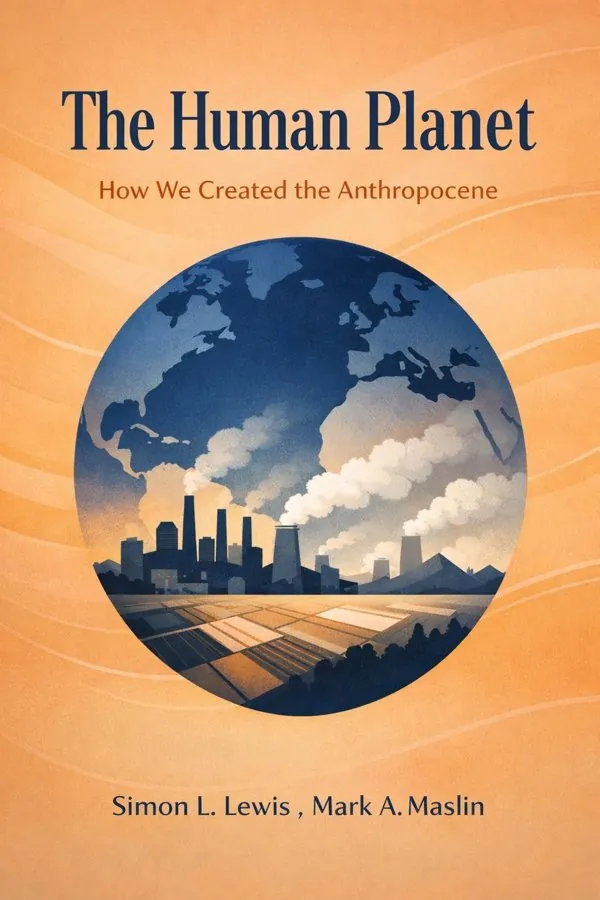
The Human Planet: How We Created the Anthropocene: Summary & Key Insights
by Simon L. Lewis, Mark A. Maslin
 10 min6 chaptersAudio available
What Is The Human Planet: How We Created the Anthropocene About?
The Human Planet: How We Created the Anthropocene by Simon L. Lewis, Mark A. Maslin is a environment book spanning 6 pages. The Human Planet explores how humans have transformed Earth into the Anthropocene, a new geological epoch defined by human impact. Simon L. Lewis and Mark A. Maslin trace the history of human influence on the planet, from early agriculture to industrialization and globalization, examining how our species has reshaped ecosystems, climate, and geology. The book argues for a new understanding of humanity’s role as a planetary force and calls for responsible stewardship of Earth’s future.
This FizzRead summary covers all 6 key chapters of The Human Planet: How We Created the Anthropocene in approximately 10 minutes, distilling the most important ideas, arguments, and takeaways from Simon L. Lewis, Mark A. Maslin's work. Also available as an audio summary and Key Quotes Podcast.
The Human Planet: How We Created the Anthropocene
The Human Planet explores how humans have transformed Earth into the Anthropocene, a new geological epoch defined by human impact. Simon L. Lewis and Mark A. Maslin trace the history of human influence on the planet, from early agriculture to industrialization and globalization, examining how our species has reshaped ecosystems, climate, and geology. The book argues for a new understanding of humanity’s role as a planetary force and calls for responsible stewardship of Earth’s future.
Who Should Read The Human Planet: How We Created the Anthropocene?
This book is perfect for anyone interested in environment and looking to gain actionable insights in a short read. Whether you're a student, professional, or lifelong learner, the key ideas from The Human Planet: How We Created the Anthropocene by Simon L. Lewis, Mark A. Maslin will help you think differently.
- ✓Readers who enjoy environment and want practical takeaways
- ✓Professionals looking to apply new ideas to their work and life
- ✓Anyone who wants the core insights of The Human Planet: How We Created the Anthropocene in just 10 minutes
Want the full summary?
Get instant access to this book summary and 100K+ more with Fizz Moment.
Get Free SummaryAvailable on App Store • Free to download
Key Chapters
To understand how human activity could define an entire geological epoch, we must first appreciate how Earth’s history is written in layers. Geologists divide time by physical evidence: sediments, fossils, isotopes. When changes are global, persistent, and recorded in this way, a new epoch is declared. The Anthropocene stakes exactly this claim: that the totality of human influence—biological, atmospheric, and geochemical—has exceeded the bounds of natural variability.
Our starting point is the Holocene, the twelve-thousand-year span following the last Ice Age. During this time, Earth stabilized into the mild climate that enabled agriculture and civilization. Yet, what was once a calm equilibrium began to shift under human hands. Agricultural clearing changed regional climate patterns; growing populations demanded more from ecosystems. By domesticating plants and animals, humans began the millennia-long process of transforming Earth’s biosphere.
The concept of the Anthropocene arose from scientific observation, not ideology. In the late twentieth century, researchers noticed anomalies in geological and biological records. Species were disappearing at unprecedented rates, carbon dioxide was climbing sharply, and artificial materials were appearing everywhere. Paul Crutzen’s use of the term “Anthropocene” in 2000 gave this evidence a name. Since then, research has focused on defining when and how humans crossed the boundary from influencing nature to becoming a geologic force.
Simon Lewis and Mark Maslin offered a systematic framework for identifying the epoch through stratigraphic markers—evidence left in sediments, ice cores, and soils. Plastics, industrial fly ash, carbon isotopes, nitrogen from fertilizers, even radioactive particles from nuclear tests all form a unique planetary layer. A distinct signature is now embedded in the Earth system, signaling that humanity’s activities are not ephemeral—they will be recorded for geological eternity.
Our deep history begins not with machines, but with fire and farming. When our ancestors learned to manipulate fire, they gained dominion over landscapes, clearing forests, altering habitat patterns, and even aiding certain plant species to thrive. These were local acts with global implications.
As hunter-gatherers evolved into settled farmers, they changed soil chemistry, domesticated species, and created cultural landscapes. Agriculture was the first systematic method by which humans reshaped entire ecosystems. Carbon emissions from early deforestation subtly altered atmospheric composition. The spread of rice paddies and livestock increased methane. What began as survival evolved into planetary engineering.
Mark Maslin and I emphasize that even sustainable-seeming societies left marks. Ancient irrigation systems diverted rivers; terraced hillsides reshaped erosional patterns. These cumulative changes are what make the Anthropocene not a sudden rupture but an accelerating process. Humans have long modified the biosphere; the difference now is scale.
+ 4 more chapters — available in the FizzRead app
All Chapters in The Human Planet: How We Created the Anthropocene
About the Authors
Simon L. Lewis is a Professor of Global Change Science at University College London and the University of Leeds, specializing in the study of the Anthropocene and tropical forests. Mark A. Maslin is a Professor of Earth System Science at University College London, known for his research on climate change and the Anthropocene. Together, they are leading voices in understanding human impact on the planet.
Get This Summary in Your Preferred Format
Read or listen to the The Human Planet: How We Created the Anthropocene summary by Simon L. Lewis, Mark A. Maslin anytime, anywhere. FizzRead offers multiple formats so you can learn on your terms — all free.
Available formats: App · Audio · PDF · EPUB — All included free with FizzRead
Download The Human Planet: How We Created the Anthropocene PDF and EPUB Summary
Key Quotes from The Human Planet: How We Created the Anthropocene
“To understand how human activity could define an entire geological epoch, we must first appreciate how Earth’s history is written in layers.”
“Our deep history begins not with machines, but with fire and farming.”
Frequently Asked Questions about The Human Planet: How We Created the Anthropocene
The Human Planet: How We Created the Anthropocene by Simon L. Lewis, Mark A. Maslin is a environment book that explores key ideas across 6 chapters. The Human Planet explores how humans have transformed Earth into the Anthropocene, a new geological epoch defined by human impact. Simon L. Lewis and Mark A. Maslin trace the history of human influence on the planet, from early agriculture to industrialization and globalization, examining how our species has reshaped ecosystems, climate, and geology. The book argues for a new understanding of humanity’s role as a planetary force and calls for responsible stewardship of Earth’s future.
You Might Also Like
A Life on Our Planet: My Witness Statement and a Vision for the Future
David Attenborough
10 min
A Sky Full Of Birds
Matt Merritt
10 min
Carbon Zero: Imagining Cities That Can Save the Planet
Alex Steffen
10 min
Eaarth: Making a Life on a Tough New Planet
Bill McKibben
10 min
The Social Contract and Environmental Governance
Various Editors
10 min
The Wild Places
Robert Macfarlane
10 minBrowse by Category
Ready to read The Human Planet: How We Created the Anthropocene?
Get the full summary and 100K+ more books with Fizz Moment.