
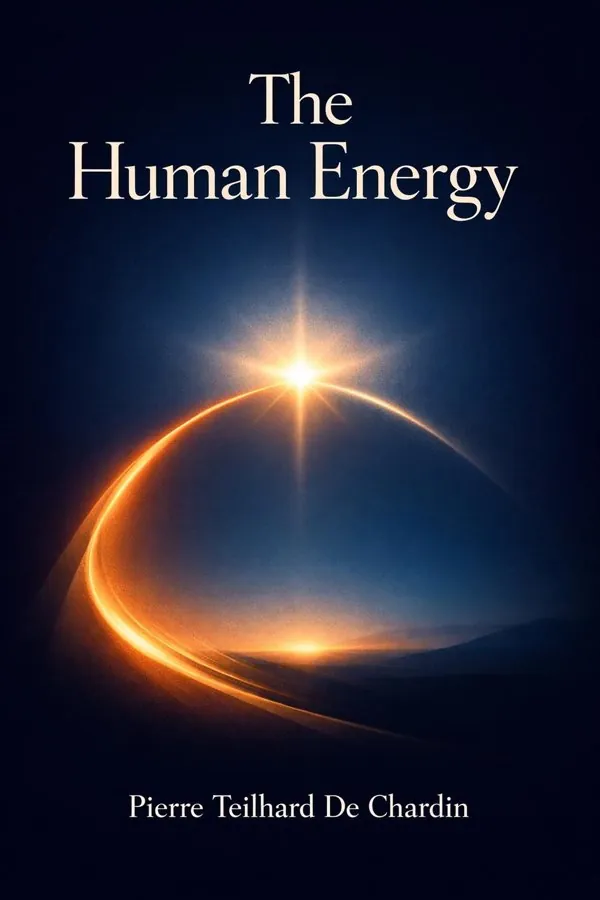
The Human Energy: Summary & Key Insights
 10 min9 chaptersAudio available
Key Takeaways from The Human Energy
The most revolutionary force in the universe may not be mechanical power but the inward fire of consciousness.
What if consciousness is not an accidental byproduct of evolution, but its clearest direction?
The modern individual often imagines freedom as separation, yet Teilhard insists that our fullest power emerges through connection.
Self-development matters most when it is larger than the self.
One of Teilhard’s boldest convictions is that the deepest truths of science and religion should converge rather than cancel each other.
What Is The Human Energy About?
The Human Energy by Pierre Teilhard De Chardin is a western_phil book spanning 9 pages. Originally published in French in 1962 as L'Énergie Humaine, The Human Energy gathers Pierre Teilhard de Chardin’s reflections on one of his most daring ideas: that humanity is driven by an interior force deeper than biology, economics, or politics. For Teilhard, evolution is not only a physical process but also a spiritual drama. Matter gives rise to life, life to consciousness, and consciousness to reflection, cooperation, and love. Human beings therefore carry a distinctive energy—the power to know, create, unite, and consciously participate in the future of the world. What makes this book enduring is its unusual synthesis. Teilhard writes as both scientist and mystic, drawing on his work as a paleontologist while advancing a profoundly religious vision of cosmic development. He argues that history is not random drift but movement toward greater complexity, unity, and awareness, culminating in what he calls the Omega Point. Whether one reads him as theologian, philosopher, or visionary, his essays challenge modern readers to see personal growth, social progress, and spiritual life as inseparable parts of a single evolutionary adventure.
This FizzRead summary covers all 9 key chapters of The Human Energy in approximately 10 minutes, distilling the most important ideas, arguments, and takeaways from Pierre Teilhard De Chardin's work. Also available as an audio summary and Key Quotes Podcast.
The Human Energy
Originally published in French in 1962 as L'Énergie Humaine, The Human Energy gathers Pierre Teilhard de Chardin’s reflections on one of his most daring ideas: that humanity is driven by an interior force deeper than biology, economics, or politics. For Teilhard, evolution is not only a physical process but also a spiritual drama. Matter gives rise to life, life to consciousness, and consciousness to reflection, cooperation, and love. Human beings therefore carry a distinctive energy—the power to know, create, unite, and consciously participate in the future of the world.
What makes this book enduring is its unusual synthesis. Teilhard writes as both scientist and mystic, drawing on his work as a paleontologist while advancing a profoundly religious vision of cosmic development. He argues that history is not random drift but movement toward greater complexity, unity, and awareness, culminating in what he calls the Omega Point. Whether one reads him as theologian, philosopher, or visionary, his essays challenge modern readers to see personal growth, social progress, and spiritual life as inseparable parts of a single evolutionary adventure.
Who Should Read The Human Energy?
This book is perfect for anyone interested in western_phil and looking to gain actionable insights in a short read. Whether you're a student, professional, or lifelong learner, the key ideas from The Human Energy by Pierre Teilhard De Chardin will help you think differently.
- ✓Readers who enjoy western_phil and want practical takeaways
- ✓Professionals looking to apply new ideas to their work and life
- ✓Anyone who wants the core insights of The Human Energy in just 10 minutes
Want the full summary?
Get instant access to this book summary and 100K+ more with Fizz Moment.
Get Free SummaryAvailable on App Store • Free to download
Key Chapters
The most revolutionary force in the universe may not be mechanical power but the inward fire of consciousness. Teilhard begins from a simple observation: energy appears in different forms throughout reality. Physical energy drives motion, heat, and matter. Biological energy adds organization, adaptation, and life. But with the emergence of the human being, a new level appears—reflective energy, the power not only to live, but to know that one lives, to choose, to imagine, and to direct action toward meanings beyond survival.
This is what Teilhard calls human energy. It is not a mystical substitute for science, but an attempt to name the special intensity released when evolution turns inward and becomes conscious of itself. Human beings are capable of invention, sacrifice, worship, scientific inquiry, and moral striving because something new has appeared in the cosmos: interiority with direction. We do not simply occupy the world; we interpret it, transform it, and seek our place within it.
In practical terms, this idea changes how we view daily life. Work is no longer merely economic production; it can be participation in a larger process of building the future. Education is not just information transfer; it is the cultivation of consciousness. Relationships are not incidental; they are sites where human energy is exchanged, intensified, and directed.
Teilhard’s insight invites a more demanding self-understanding. If human energy is real, then every act of attention, creativity, and moral courage matters. Actionable takeaway: treat your inner life��your focus, values, and intention—as a real force shaping both your own development and the world around you.
What if consciousness is not an accidental byproduct of evolution, but its clearest direction? Teilhard argues that reflection did not appear suddenly or arbitrarily. Instead, the universe has moved through a long process of increasing complexity: matter formed structures, structures generated life, life developed sensation, and sensation eventually opened into thought. Humanity represents a threshold because we do not merely perceive; we reflect, compare, remember, anticipate, and ask what our existence means.
This reflective capacity transforms destiny. Once evolution becomes conscious in us, the future is no longer shaped only by blind natural selection. It is also shaped by decisions, institutions, ideals, and visions of the good. Human destiny therefore has a psychological and moral dimension. We are not passive products of cosmic history; we become co-workers in it.
This has immediate relevance today. A society with advanced technology but shallow consciousness may become more efficient without becoming wiser. On the other hand, individuals and cultures that deepen awareness—through study, self-examination, dialogue, and responsibility—help direct collective evolution toward richer forms of life. In this sense, the development of consciousness is not a private luxury but a civilizational necessity.
Teilhard’s point also helps explain why modern crises feel so intense. Environmental degradation, war, and fragmentation are not just external problems; they reveal a gap between our technical power and our inner maturity. We have gained control over matter faster than we have expanded wisdom.
Actionable takeaway: invest deliberately in practices that deepen reflection—reading, journaling, contemplation, or serious conversation—because the quality of consciousness influences the quality of both personal and collective destiny.
The modern individual often imagines freedom as separation, yet Teilhard insists that our fullest power emerges through connection. One of the central claims of The Human Energy is that humanity should be understood not as a mere crowd of isolated persons but as a growing whole. As evolution advances, units do not simply multiply; they become more interrelated. Cells form organisms, organisms form systems, and human beings increasingly form a planetary network of exchange, thought, labor, and culture.
Teilhard sees this collective dimension as an evolutionary necessity. The rise of communication, science, trade, and global awareness reveals that humanity is becoming more unified, not less. He later describes this broad sphere of thought and interaction as the noosphere—the layer of reflective consciousness surrounding the earth. Human energy gains strength when minds connect, discoveries circulate, and persons collaborate around shared purposes.
This does not mean dissolving the individual into the mass. Teilhard is careful to say that true union enriches personality rather than erasing it. The highest forms of unity preserve difference while generating higher levels of cooperation. A healthy team, a thriving research community, or a loving family all demonstrate this principle: persons become more fully themselves through meaningful participation in a larger whole.
In practical life, this idea challenges hyper-individualism. Professional success detached from contribution becomes spiritually thin. Social media connection without real communion becomes noise. Communities flourish when people bring their gifts into relationships of mutual growth and service.
Actionable takeaway: choose one sphere—family, work, neighborhood, or civic life—where you can move from private achievement to active contribution, using your talents to strengthen a community rather than merely advancing yourself.
Self-development matters most when it is larger than the self. Teilhard rejects the notion that inner growth is a private escape from history. For him, every genuine act of maturation—intellectual, moral, creative, or spiritual—adds to the total development of humanity. Because persons are interconnected, no one grows alone and no growth remains isolated.
This is a demanding but hopeful view of individuality. Your effort to become more lucid, disciplined, compassionate, or skillful is not merely self-improvement in the modern therapeutic sense. It is participation in the evolutionary rise of consciousness. A scientist refining her understanding, a teacher awakening curiosity, a parent shaping character, an artist enlarging perception—all are converting human energy into forms that can circulate and elevate the whole.
Teilhard’s perspective also clarifies the danger of narcissistic growth. If development becomes obsessed with optimization, status, or self-expression detached from service, it loses its evolutionary value. The question is not simply, “How can I become more fulfilled?” but, “How can my growth make me more capable of truth, love, and contribution?”
Consider how this applies at work. Learning a new skill can increase your income, but it can also improve the quality of what you bring to others. Emotional maturity can reduce conflict in a team. Spiritual depth can make one more patient, courageous, and stable in times of crisis. Personal growth becomes social energy when directed outward.
Teilhard invites us to see vocation in broad terms: each person is called to intensify life where they stand. Actionable takeaway: identify one area of self-development this month and connect it explicitly to service—ask how becoming better in that area will benefit other people, not only yourself.
One of Teilhard’s boldest convictions is that the deepest truths of science and religion should converge rather than cancel each other. Writing as both a trained paleontologist and a Jesuit priest, he refuses the familiar choice between a purely material universe and a purely spiritual one. Instead, he argues that matter and spirit belong to one unfolding reality viewed from different depths.
Science reveals the mechanisms and chronology of evolution. It shows how the universe develops through time, how life emerges, and how complexity increases. Faith, for Teilhard, speaks to the meaning and direction of this process. It asks why consciousness matters, why love has such power, and whether evolution tends toward a final fulfillment rather than endless fragmentation.
The practical significance of this synthesis is immense. If science alone is treated as sufficient, human beings may gain explanation without purpose. If religion ignores science, it risks becoming detached from reality. Teilhard seeks a worldview in which empirical knowledge and spiritual insight enrich one another. Evolution then becomes not a threat to belief but a grander setting for it.
This remains highly relevant for modern readers who feel torn between intellectual honesty and spiritual longing. You do not have to reject scientific inquiry to affirm depth, meaning, and transcendence. Nor must faith fear complexity, history, or change.
Teilhard does not eliminate tension between these domains, but he insists that truth is one. Actionable takeaway: when confronting a difficult question about life, seek both factual understanding and existential meaning—ask not only “How does this work?” but also “What does this call me to become?”
Progress is not mere expansion; it is the difficult art of becoming more complex without falling apart. Teilhard sees a recurring pattern in evolution: as reality advances, it does not simplify into sameness. Instead, it generates richer forms of organization, and these forms require stronger bonds of integration. Molecules, cells, organisms, societies, and cultures all express this principle. Greater complexity demands deeper unity.
He calls this movement convergence. Humanity is pushed not only outward across the globe but inward toward higher forms of coordination, awareness, and shared destiny. Technological networks, global interdependence, and cross-cultural exchange are visible signs of this process. Yet convergence is not guaranteed to be healthy. It can take the form of coercion, standardization, or domination if unity is pursued without respect for persons.
That is why Teilhard distinguishes true union from flattening uniformity. Real convergence preserves diversity while creating meaningful coherence. An orchestra does not reduce every instrument to the same note; it produces harmony through difference. Likewise, a mature global civilization would not erase cultures or consciences but connect them within a wider human purpose.
This idea offers a useful lens for organizations, communities, and even families. Growth often creates complexity: more people, more perspectives, more moving parts. The challenge is not to suppress difference but to build a stronger center—clear values, trust, communication, and shared direction.
Actionable takeaway: the next time you face complexity in a group, resist the urge to oversimplify. Instead, ask what kind of deeper unity—shared goals, better dialogue, clearer principles—could hold diversity together without destroying it.
A civilization can advance in power while declining in purpose. Teilhard is deeply aware that human progress is morally ambiguous. Scientific discovery, industrial growth, political organization, and technical innovation all increase humanity’s capabilities. But capability alone does not guarantee genuine advancement. The central question is whether our growing power is ordered toward higher consciousness, fuller personhood, and deeper communion.
For Teilhard, moral development is not an optional supplement to evolution; it is one of its decisive tests. Once reflection appears, freedom appears with it. Human beings can cooperate with the movement toward unity, or they can distort it through egoism, violence, and greed. That is why the future depends not just on intelligence but on the ethical use of intelligence.
This insight is strikingly contemporary. Artificial intelligence, biotechnology, media systems, and economic globalization can either widen human possibility or intensify alienation and control. Modern societies often celebrate innovation while neglecting wisdom. Teilhard warns that progress detached from moral orientation may produce more coordination externally and more emptiness internally.
At the personal level, the same principle applies. Ambition can build a career while damaging relationships. Efficiency can increase output while hollowing out meaning. Success is not synonymous with evolution in the human sense. Real progress enlarges both competence and conscience.
Teilhard’s vision pushes readers to evaluate growth by deeper standards: Does it create more life, more truth, more solidarity, more interior freedom? If not, it may be motion without ascent. Actionable takeaway: whenever you pursue advancement—personal, professional, or technological—pair it with a moral question: what kind of human being or society is this helping to form?
Every journey implies some horizon, and Teilhard’s most famous claim is that evolution has one. He names this final attractor the Omega Point: the ultimate center toward which consciousness, complexity, and unity are moving. Omega is not simply the end of chronological time, nor just a metaphor for optimism. It is the idea that the universe tends toward a supreme form of integration in which persons are united without being erased and matter is fulfilled in spirit.
For Teilhard, Omega must be personal as well as cosmic. An impersonal endpoint could not satisfy the human hunger for truth, love, and durable meaning. The culmination of evolution must preserve the value of persons even as it gathers them into a greater whole. In his Christian interpretation, Omega is inseparable from the divine presence drawing creation toward completion.
Readers need not share all of Teilhard’s theology to appreciate the force of the idea. Omega gives direction to history. It says that movement toward greater awareness and communion is not pointless. It also reframes suffering and effort. Our unfinishedness is not merely failure; it may be part of a larger process of becoming.
Practically, Omega functions as a guiding image. People live differently when they believe life is heading somewhere meaningful. A teacher teaches differently, a reformer works differently, and a believer hopes differently when present fragments are viewed in relation to a possible fulfillment.
Actionable takeaway: define your own highest horizon—a vision of human flourishing, truth, and unity—and use it to evaluate daily choices, so that immediate actions are aligned with an ultimate direction.
For Teilhard, the energy most capable of uniting the world is not domination, fear, or even intelligence alone, but love. This is not sentimental language. He treats love as a real force of convergence—the power by which persons move beyond isolation while becoming more, not less, themselves. In the human sphere, love is the form energy takes when consciousness recognizes the value of another and chooses union without absorption.
Why does this matter? Because every durable form of human flourishing depends on it. Institutions can organize people, laws can restrain them, and knowledge can inform them, but only love generates the kind of inner adhesion that makes creative cooperation possible. Friendships, families, teams, spiritual communities, and great causes all endure through some form of love: loyalty, admiration, compassion, solidarity, or shared devotion to truth.
Teilhard extends this beyond private relationships. Love animates the labor of civilization when people work not merely for profit or prestige but for the growth of life around them. A doctor’s care, a volunteer’s service, a mentor’s patience, or a citizen’s commitment to the common good are all expressions of human energy reaching its highest form.
Love also counters one of modernity’s deepest illnesses: fragmentation. We know more than ever, yet often feel less connected. Teilhard’s answer is not retreat from complexity but deeper interior union.
Actionable takeaway: in one important relationship or area of work, replace mere efficiency with intentional goodwill—listen more closely, serve more generously, or create with others in mind—because love is what turns activity into lasting human growth.
All Chapters in The Human Energy
About the Author
Pierre Teilhard de Chardin (1881–1955) was a French Jesuit priest, paleontologist, and philosopher whose work sought to unite evolutionary science with Christian spirituality. Trained in both theology and natural science, he participated in major paleontological research and became widely known for his reflections on human origins, consciousness, and the destiny of the universe. Teilhard argued that evolution is not merely biological but also spiritual, moving toward greater complexity, awareness, and unity. His concepts of the noosphere and the Omega Point became especially influential in twentieth-century religious and philosophical thought. Because some of his ideas were controversial within the Catholic Church during his lifetime, many of his writings were published posthumously. Today he remains a singular voice for readers interested in science, faith, and humanity’s larger purpose.
Get This Summary in Your Preferred Format
Read or listen to the The Human Energy summary by Pierre Teilhard De Chardin anytime, anywhere. FizzRead offers multiple formats so you can learn on your terms — all free.
Available formats: App · Audio · PDF · EPUB — All included free with FizzRead
Download The Human Energy PDF and EPUB Summary
Key Quotes from The Human Energy
“The most revolutionary force in the universe may not be mechanical power but the inward fire of consciousness.”
“What if consciousness is not an accidental byproduct of evolution, but its clearest direction?”
“The modern individual often imagines freedom as separation, yet Teilhard insists that our fullest power emerges through connection.”
“Self-development matters most when it is larger than the self.”
“One of Teilhard’s boldest convictions is that the deepest truths of science and religion should converge rather than cancel each other.”
Frequently Asked Questions about The Human Energy
The Human Energy by Pierre Teilhard De Chardin is a western_phil book that explores key ideas across 9 chapters. Originally published in French in 1962 as L'Énergie Humaine, The Human Energy gathers Pierre Teilhard de Chardin’s reflections on one of his most daring ideas: that humanity is driven by an interior force deeper than biology, economics, or politics. For Teilhard, evolution is not only a physical process but also a spiritual drama. Matter gives rise to life, life to consciousness, and consciousness to reflection, cooperation, and love. Human beings therefore carry a distinctive energy—the power to know, create, unite, and consciously participate in the future of the world. What makes this book enduring is its unusual synthesis. Teilhard writes as both scientist and mystic, drawing on his work as a paleontologist while advancing a profoundly religious vision of cosmic development. He argues that history is not random drift but movement toward greater complexity, unity, and awareness, culminating in what he calls the Omega Point. Whether one reads him as theologian, philosopher, or visionary, his essays challenge modern readers to see personal growth, social progress, and spiritual life as inseparable parts of a single evolutionary adventure.
More by Pierre Teilhard De Chardin
You Might Also Like
A Little History of Philosophy
Nigel Warburton
10 min
Areopagitica
John Milton
10 min
How To Think Like A Philosopher: Essential Principles For Clear Thinking
Peter Cave
10 min
Language, Truth and Logic
A. J. Ayer
10 min
The Age of Reason
Thomas Paine
10 min
The Essays
Michel De Montaigne
10 minBrowse by Category
Ready to read The Human Energy?
Get the full summary and 100K+ more books with Fizz Moment.