
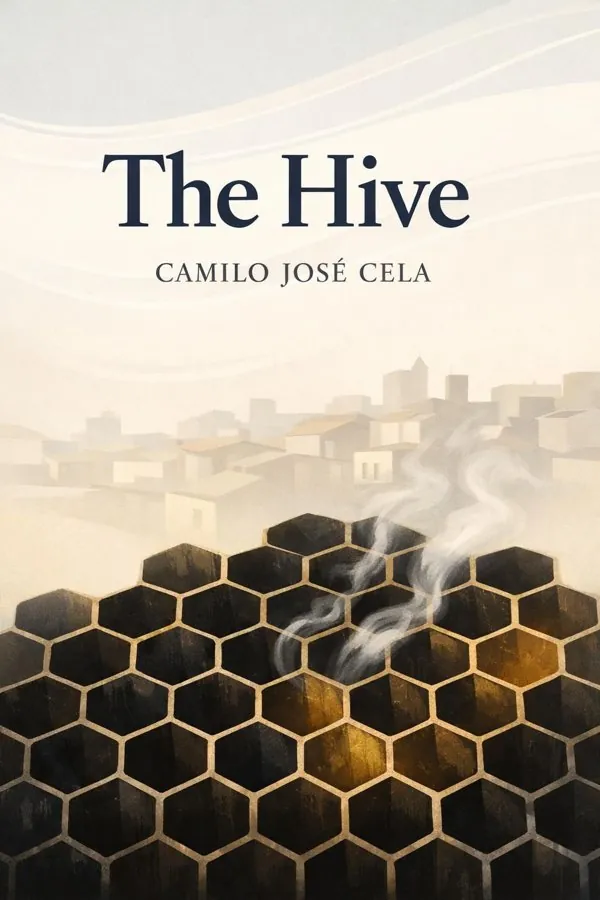
The Hive: Summary & Key Insights
 10 min9 chaptersAudio available
Key Takeaways from The Hive
A city often reveals itself most honestly in the places where strangers briefly share the same air.
Sometimes the most important character in a novel is not a hero but a pair of restless eyes.
A society is judged not by its ideals, but by what it forces people to do in order to live.
Respectability often depends less on virtue than on successful performance.
Fear does not always announce itself loudly; sometimes it settles into daily speech, making people edit themselves before they even know they are doing it.
What Is The Hive About?
The Hive by Camilo José Cela is a classics book spanning 8 pages. Originally published in 1951, The Hive is one of the defining novels of twentieth-century Spanish literature and one of the sharpest portraits ever written of urban life under pressure. Set in post–Civil War Madrid, Camilo José Cela abandons the comfort of a single hero and instead builds a restless mosaic of more than three hundred interconnected lives. Waitresses, petty officials, prostitutes, landladies, students, clerks, lovers, and drifters move through cafés, rented rooms, streets, and boarding houses, each carrying private fears and small ambitions. The result is a city rendered not as scenery but as a living organism. What makes the novel endure is not only its realism, but its moral intelligence. Cela captures hunger, loneliness, sexual frustration, class hypocrisy, and political repression without turning his characters into symbols alone; they remain recognizably human, compromised, vulnerable, and often darkly funny. His fragmented structure was innovative for its time and remains strikingly modern, anticipating cinematic montage and ensemble storytelling. Cela, later awarded the Nobel Prize in Literature, wrote with unsentimental precision, making The Hive both a historical document of Franco-era Spain and a timeless study of how ordinary people survive diminished circumstances.
This FizzRead summary covers all 9 key chapters of The Hive in approximately 10 minutes, distilling the most important ideas, arguments, and takeaways from Camilo José Cela's work. Also available as an audio summary and Key Quotes Podcast.
The Hive
Originally published in 1951, The Hive is one of the defining novels of twentieth-century Spanish literature and one of the sharpest portraits ever written of urban life under pressure. Set in post–Civil War Madrid, Camilo José Cela abandons the comfort of a single hero and instead builds a restless mosaic of more than three hundred interconnected lives. Waitresses, petty officials, prostitutes, landladies, students, clerks, lovers, and drifters move through cafés, rented rooms, streets, and boarding houses, each carrying private fears and small ambitions. The result is a city rendered not as scenery but as a living organism.
What makes the novel endure is not only its realism, but its moral intelligence. Cela captures hunger, loneliness, sexual frustration, class hypocrisy, and political repression without turning his characters into symbols alone; they remain recognizably human, compromised, vulnerable, and often darkly funny. His fragmented structure was innovative for its time and remains strikingly modern, anticipating cinematic montage and ensemble storytelling. Cela, later awarded the Nobel Prize in Literature, wrote with unsentimental precision, making The Hive both a historical document of Franco-era Spain and a timeless study of how ordinary people survive diminished circumstances.
Who Should Read The Hive?
This book is perfect for anyone interested in classics and looking to gain actionable insights in a short read. Whether you're a student, professional, or lifelong learner, the key ideas from The Hive by Camilo José Cela will help you think differently.
- ✓Readers who enjoy classics and want practical takeaways
- ✓Professionals looking to apply new ideas to their work and life
- ✓Anyone who wants the core insights of The Hive in just 10 minutes
Want the full summary?
Get instant access to this book summary and 100K+ more with Fizz Moment.
Get Free SummaryAvailable on App Store • Free to download
Key Chapters
A city often reveals itself most honestly in the places where strangers briefly share the same air. In The Hive, Café La Delicia is not merely a setting; it is the novel’s central social instrument, a place where Madrid’s divisions become visible through overheard talk, small transactions, and fleeting glances. Students posture as intellectuals, waitresses calculate tips and survival, customers nurse coffee they can barely afford, and proprietors guard status with petty authority. In this compressed environment, Cela shows how a fractured society can still appear deceptively ordinary.
The café matters because it gathers people who would otherwise remain in separate worlds. The poor and the respectable, the ambitious and the defeated, the discreetly predatory and the quietly desperate all pass through the same room. Yet proximity does not create solidarity. Instead, the café exposes distance: people watch each other, judge each other, use each other, and occasionally comfort each other, but rarely understand one another fully. That social fragmentation mirrors the structure of the novel itself, which moves rapidly from one life to another like a camera scanning tables in a crowded room.
This technique offers a practical insight into social life: communities are not made simply by sharing space. Offices, classrooms, apartment buildings, and online platforms can function like La Delicia—dense with contact but thin in real connection. Cela urges us to notice the subtle hierarchies embedded in everyday spaces: who speaks freely, who serves, who performs confidence, and who disappears into the background.
Actionable takeaway: pay closer attention to the “public rooms” in your own life, because they often reveal the true structure of your community better than official narratives do.
Sometimes the most important character in a novel is not a hero but a pair of restless eyes. Martín Marco, a struggling writer and drifting intellectual, serves as the loosest thread connecting many of The Hive’s episodes. He is not powerful enough to shape events, nor stable enough to anchor the narrative in a conventional way. Instead, he wanders through Madrid carrying hunger, anxiety, pride, and self-deception, becoming a witness to a society that has little use for men like him.
Martín matters because he embodies the collapse of intellectual prestige in a damaged social order. He thinks, observes, and judges, yet he cannot convert those abilities into meaningful security. He is often evasive, unreliable, and somewhat vain, but he is also painfully sensitive to humiliation. Through him, Cela shows the vulnerability of people who possess awareness without influence. Martín sees hypocrisy clearly, yet he lacks the means to resist it. His drifting presence gives the novel emotional continuity: while the city is a swarm of lives, Martín feels the sting of that swarm more consciously than most.
In practical terms, Martín’s role reminds us that observation alone is not power. Many people today occupy a similar position: culturally alert, critically minded, but economically precarious and socially peripheral. They can diagnose systems with precision while still being trapped inside them. Cela does not romanticize this condition. Insight does not redeem Martín; it merely sharpens his discomfort.
Actionable takeaway: treat self-awareness as a starting point, not an achievement. If you recognize the forces shaping your life, ask what concrete supports, habits, or alliances can keep insight from turning into paralysis.
A society is judged not by its ideals, but by what it forces people to do in order to live. One of The Hive’s most unsettling achievements is its steady attention to those living at the edge of respectability: women who barter affection for security, men who manipulate weakness, tenants who lie to preserve appearances, and workers whose dignity is constantly negotiated under economic pressure. Cela refuses easy moral categories. Poverty does not automatically ennoble, and comfort does not always corrupt in obvious ways. Instead, scarcity bends behavior in countless small directions.
The novel’s world is full of compromises that are both ethically troubling and socially understandable. Characters pursue money, food, warmth, sex, and shelter with a desperation that exposes how moral language changes when basic needs are unstable. A person may exploit and be exploited in the same day. A seemingly improper act may be less a sign of vice than a response to limited options. Cela’s realism lies in his refusal to simplify these lives into case studies or cautionary tales.
This idea remains highly relevant. In any era of financial strain, public judgment tends to focus on individual choices while ignoring the structures that narrow those choices. The Hive invites us to look beneath surface behavior and ask what forms of precarity produce it. In workplaces, neighborhoods, or policy debates, that shift in perspective matters. It does not excuse harm, but it does deepen understanding.
Actionable takeaway: before judging someone’s decisions, examine the pressures surrounding them. Better moral thinking begins by asking not only “What did this person do?” but also “What conditions made this seem necessary?”
Respectability often depends less on virtue than on successful performance. In The Hive, the bourgeois world of shopkeepers, minor officials, proprietors, and socially cautious families presents itself as orderly and moral, yet Cela repeatedly reveals the selfishness, cowardice, and duplicity beneath that façade. These characters defend decorum, reputation, and propriety, but many are driven by the same appetites as everyone else. Their advantage lies not in greater integrity, but in better concealment and stronger protection from consequences.
Cela is especially sharp in showing how power hides in ordinary manners. A landlady can control a tenant through gossip. A proprietor can humiliate an employee while speaking the language of discipline. A minor bureaucrat can use institutional status to reinforce social hierarchy without ever appearing openly cruel. The bourgeois world sustains itself through exclusion, not simply through money. To belong, one must know what not to say, what not to admit, and whom not to associate with publicly.
This insight has broad application. Modern professional culture often works in similar ways: organizations praise values while rewarding conformity, discretion, and status management. Public image can matter more than private conduct. Cela’s point is not that all middle-class order is fraudulent, but that social legitimacy is frequently unevenly distributed. Some people are condemned for visible flaws; others are protected by polish.
Readers can use this chapter of the novel to sharpen their understanding of institutional behavior. Whenever an environment appears unusually “respectable,” it is worth asking who benefits from that appearance and whose discomfort is being hidden.
Actionable takeaway: learn to distinguish genuine ethical behavior from mere social polish. When evaluating people or institutions, look at how they treat the vulnerable, not just how well they maintain appearances.
Fear does not always announce itself loudly; sometimes it settles into daily speech, making people edit themselves before they even know they are doing it. In The Hive, postwar Madrid is shaped by repression not only as a political backdrop but as a psychological atmosphere. People speak cautiously, conceal desires, lower expectations, and avoid forms of honesty that might threaten survival. Silence is not emptiness here; it is evidence of pressure.
Cela captures a society in which speech has become risky and intimacy unstable. Characters often reveal themselves only partially, and even private conversations carry the residue of caution. This climate affects love, friendship, ambition, and self-image. People cannot easily become whole when they are forced to divide what they feel from what they can safely express. The fragmentation of the novel mirrors this condition. Its broken scenes and interrupted trajectories suggest lives that cannot unfold freely in public view.
This idea resonates beyond Franco-era Spain. In workplaces ruled by fear, families dominated by rigid expectations, or digital environments where every statement feels surveilled, people also learn forms of self-censorship. Over time, that constraint alters not just communication but identity. The cost of repression is not only political obedience; it is emotional diminishment.
Cela does not offer a sentimental answer, but he does show the importance of fleeting honest contact. Even brief moments of candor, tenderness, or mutual recognition stand out because they resist the deadening effects of fear. They do not transform the system, but they preserve something human within it.
Actionable takeaway: notice where fear is shaping your language. Identify one relationship or context in which you can practice more honest, careful, and humane expression without unnecessary self-erasure.
Grand historical events are often remembered through dates and slogans, but ordinary life registers them through the body. In The Hive, hunger is not a metaphor first; it is a recurring physical reality. People are tired, underfed, cold, and preoccupied with money, food, rent, and small opportunities. Alongside hunger sits loneliness, another form of deprivation that shapes behavior just as forcefully. Characters seek company, sex, conversation, validation, or distraction not because they are shallow, but because isolation is hard to bear.
Cela’s genius lies in linking material need with emotional atmosphere. A city of scarcity becomes a city of shortened patience, compromised affection, and nervous calculation. People cannot plan far ahead because the near future already feels uncertain. As a result, many interactions are transactional, hurried, or tinged with humiliation. Yet the novel does not become uniformly bleak. It remains alive to gestures of warmth, absurdity, and mutual dependence. Survival includes humor, fantasy, flirtation, and routine.
This is one of the book’s most transferable lessons. When people appear irritable, distracted, or morally inconsistent, unmet needs may be part of the explanation. Scarcity affects concentration, emotional bandwidth, and judgment. Modern readers can recognize this in economic insecurity, burnout, housing stress, or social isolation. The Hive encourages a more compassionate interpretation of strained human behavior without pretending that strain eliminates responsibility.
At the same time, the novel reminds us that survival is collective as much as individual. Even the most solitary figures rely on networks of service, gossip, credit, and presence.
Actionable takeaway: when facing stress, assess your most basic deficits first—rest, food, money, companionship, stability. Many higher-level problems become easier to understand once foundational needs are named clearly.
A novel can expose suffering without becoming solemn at every moment. One of the reasons The Hive remains so vivid is Cela’s use of irony, tonal shifts, and mosaic construction. The book moves in short scenes, quick sketches, and abrupt transitions, creating the sense of a city glimpsed in fragments rather than narrated from above. This structure can initially feel disorienting, but that is precisely its power: Madrid is not a tidy story, and neither are the lives inhabiting it.
Humor plays a crucial role in this form. Cela often notices the ridiculous in the middle of hardship: vanity among the poor, pomp among the insignificant, erotic farce amid loneliness, and social rituals that border on absurd theater. The irony is rarely gentle, but it keeps the novel from flattening into misery. People remain contradictory and alive. They gossip, boast, misread one another, and invent fragile performances to survive embarrassment.
From a literary perspective, the mosaic form allows Cela to democratize attention. No single plot claims absolute importance. A minor figure in one scene may become central in another, and many lives remain unresolved. This resembles real social experience more than traditional narrative closure does. In practical terms, the novel teaches readers to think in systems rather than single stories. Cities, institutions, and families are often best understood as overlapping patterns rather than linear tales.
For modern readers used to ensemble television, social feeds, and documentary montage, Cela’s method feels surprisingly contemporary. He asks us to assemble meaning actively instead of receiving it ready-made.
Actionable takeaway: when a situation seems chaotic, stop looking for one master storyline. Try mapping the smaller interactions and repeated patterns; often the larger truth emerges from the fragments.
The title The Hive suggests movement, crowding, labor, and interdependence, but also impersonality. Cela’s Madrid is full of bodies in motion, each pursuing private needs, yet the larger social organism continues with mechanical indifference. Individuals suffer, desire, scheme, or dream, and still the city absorbs them without pause. This is the novel’s bleakest and perhaps most profound insight: hardship in such a world is not exceptional but cyclical.
The hive metaphor cuts in two directions. On one hand, it emphasizes social connection. No one exists alone; every life touches others through money, appetite, rumor, work, and chance encounter. On the other hand, it suggests replaceability. The city does not reward individuality simply because it exists. Many characters feel trapped in routines they did not choose, performing roles that sustain a system offering little care in return. Their suffering is not organized into heroic tragedy. It repeats, diffuses, and persists.
This idea helps explain why the novel resists neat resolution. Cela is not building toward redemption or catastrophe in the conventional sense. He is portraying a pattern of life in which structural forces outlast personal episodes. That vision remains relevant wherever people experience economic precarity, rigid hierarchy, or social exhaustion. The hive is not just Madrid in the 1940s; it is any environment where people are densely connected but thinly protected.
Yet recognizing the hive has value. It shifts attention from isolated blame to collective conditions. If problems are patterned, responses must be as well.
Actionable takeaway: when difficulties repeat across many lives, stop treating them as purely personal failures. Ask what larger system is being maintained, and what forms of solidarity or reform might interrupt the cycle.
Some classics survive because they are historically important; The Hive survives because it still feels uncomfortably current. Its world of economic insecurity, social performance, sexual tension, institutional hypocrisy, and fragmented attention resembles many modern urban environments. Although the novel is rooted in post–Civil War Madrid, its emotional architecture is recognizable today: people juggling unstable work, guarding self-image, improvising intimacy, and moving through crowded spaces while feeling profoundly alone.
Part of this modernity comes from Cela’s narrative method. He trusts accumulation over explanation. Rather than stopping to interpret every event, he lets repeated details create a social atmosphere. Readers must connect scenes, infer relationships, and sense patterns across many minor moments. This resembles how we understand contemporary life through snippets, updates, overheard fragments, and partial encounters. In that sense, The Hive reads almost like a literary city map built from human signals.
The novel also feels modern because it resists moral simplification. Public discourse often pressures us to divide people into victims and villains, authentic and fake, oppressed and complicit. Cela shows that these categories can overlap. A person can be vulnerable in one context and cruel in another. That complexity is not moral relativism; it is realism.
For readers, the practical lesson is clear. The book trains attention. It makes you better at noticing structures beneath surfaces, mixed motives behind behavior, and loneliness inside noisy environments. Classics matter when they enlarge perception, and this one does exactly that.
Actionable takeaway: read the world around you with the same patience you would give a complex novel—look for patterns, contradictions, and hidden pressures before rushing to simple conclusions.
All Chapters in The Hive
About the Author
Camilo José Cela (1916–2002) was a Spanish novelist, essayist, editor, and academic widely regarded as one of the central literary figures of modern Spain. Born in Galicia, he came of age during a period of deep political and social upheaval that would shape much of his fiction. Cela became known for his stark realism, formal experimentation, and unflinching portrayals of violence, poverty, desire, and social hypocrisy. His novels often examined the moral texture of everyday life under pressure, combining irony with sharp observational detail. The Hive remains one of his most influential works, celebrated for its fragmented structure and panoramic vision of postwar Madrid. In 1989, he received the Nobel Prize in Literature, confirming his international stature as a writer of major originality and force.
Get This Summary in Your Preferred Format
Read or listen to the The Hive summary by Camilo José Cela anytime, anywhere. FizzRead offers multiple formats so you can learn on your terms — all free.
Available formats: App · Audio · PDF · EPUB — All included free with FizzRead
Download The Hive PDF and EPUB Summary
Key Quotes from The Hive
“A city often reveals itself most honestly in the places where strangers briefly share the same air.”
“Sometimes the most important character in a novel is not a hero but a pair of restless eyes.”
“A society is judged not by its ideals, but by what it forces people to do in order to live.”
“Respectability often depends less on virtue than on successful performance.”
“Fear does not always announce itself loudly; sometimes it settles into daily speech, making people edit themselves before they even know they are doing it.”
Frequently Asked Questions about The Hive
The Hive by Camilo José Cela is a classics book that explores key ideas across 9 chapters. Originally published in 1951, The Hive is one of the defining novels of twentieth-century Spanish literature and one of the sharpest portraits ever written of urban life under pressure. Set in post–Civil War Madrid, Camilo José Cela abandons the comfort of a single hero and instead builds a restless mosaic of more than three hundred interconnected lives. Waitresses, petty officials, prostitutes, landladies, students, clerks, lovers, and drifters move through cafés, rented rooms, streets, and boarding houses, each carrying private fears and small ambitions. The result is a city rendered not as scenery but as a living organism. What makes the novel endure is not only its realism, but its moral intelligence. Cela captures hunger, loneliness, sexual frustration, class hypocrisy, and political repression without turning his characters into symbols alone; they remain recognizably human, compromised, vulnerable, and often darkly funny. His fragmented structure was innovative for its time and remains strikingly modern, anticipating cinematic montage and ensemble storytelling. Cela, later awarded the Nobel Prize in Literature, wrote with unsentimental precision, making The Hive both a historical document of Franco-era Spain and a timeless study of how ordinary people survive diminished circumstances.
More by Camilo José Cela
You Might Also Like


Browse by Category
Ready to read The Hive?
Get the full summary and 100K+ more books with Fizz Moment.