
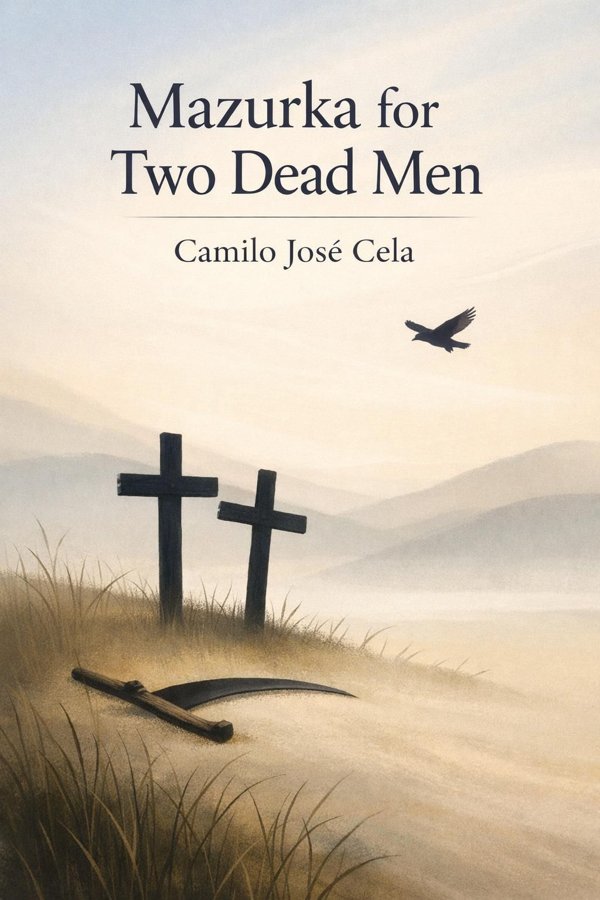
Mazurka for Two Dead Men: Summary & Key Insights
 10 min9 chaptersAudio available
Key Takeaways from Mazurka for Two Dead Men
A place can remember what its people try to forget.
Death can flatten the distinctions that ideology once made seem absolute.
The war ends on paper long before it ends in the mind.
Violence rarely stops with the act that seems to justify it.
One of the most unsettling truths in the novel is that moral categories blur under pressure.
What Is Mazurka for Two Dead Men About?
Mazurka for Two Dead Men by Camilo José Cela is a classics book spanning 7 pages. What if a civil war never really ended, but simply sank into the soil, the weather, and the speech of the people who survived it? In Mazurka for Two Dead Men, Camilo José Cela turns the Spanish Civil War into something larger than a historical event: a haunting force that continues to shape rural Galicia long after the shooting stops. The novel follows no single hero. Instead, it gathers peasants, landowners, widows, fugitives, soldiers, and gossips into a broken chorus of voices, memories, and rumors. At its center are two dead men from opposing sides, but the book’s true subject is the community left behind, trapped between mourning, revenge, and silence. Cela’s fragmented, musical style mirrors the way trauma is actually remembered: in flashes, repetitions, names, landscapes, and stories half told. This matters because the novel refuses easy moral comfort. It shows how violence corrupts everyone it touches and how memory can preserve truth while also prolonging pain. Written by one of Spain’s most important twentieth-century novelists and Nobel laureate, this is a major work on war, grief, and collective memory.
This FizzRead summary covers all 9 key chapters of Mazurka for Two Dead Men in approximately 10 minutes, distilling the most important ideas, arguments, and takeaways from Camilo José Cela's work. Also available as an audio summary and Key Quotes Podcast.
Mazurka for Two Dead Men
What if a civil war never really ended, but simply sank into the soil, the weather, and the speech of the people who survived it? In Mazurka for Two Dead Men, Camilo José Cela turns the Spanish Civil War into something larger than a historical event: a haunting force that continues to shape rural Galicia long after the shooting stops. The novel follows no single hero. Instead, it gathers peasants, landowners, widows, fugitives, soldiers, and gossips into a broken chorus of voices, memories, and rumors. At its center are two dead men from opposing sides, but the book’s true subject is the community left behind, trapped between mourning, revenge, and silence. Cela’s fragmented, musical style mirrors the way trauma is actually remembered: in flashes, repetitions, names, landscapes, and stories half told. This matters because the novel refuses easy moral comfort. It shows how violence corrupts everyone it touches and how memory can preserve truth while also prolonging pain. Written by one of Spain’s most important twentieth-century novelists and Nobel laureate, this is a major work on war, grief, and collective memory.
Who Should Read Mazurka for Two Dead Men?
This book is perfect for anyone interested in classics and looking to gain actionable insights in a short read. Whether you're a student, professional, or lifelong learner, the key ideas from Mazurka for Two Dead Men by Camilo José Cela will help you think differently.
- ✓Readers who enjoy classics and want practical takeaways
- ✓Professionals looking to apply new ideas to their work and life
- ✓Anyone who wants the core insights of Mazurka for Two Dead Men in just 10 minutes
Want the full summary?
Get instant access to this book summary and 100K+ more with Fizz Moment.
Get Free SummaryAvailable on App Store • Free to download
Key Chapters
A place can remember what its people try to forget. In Mazurka for Two Dead Men, Galicia is not a decorative setting but the living structure that holds the novel together. Its rain, fog, forests, stone houses, roads, and fields do more than surround the characters; they shape their habits, speech, fears, and loyalties. Cela presents the region as a moral climate as much as a physical one. The land absorbs secrets, carries old grudges, and seems to preserve the dead in its damp silence. This is why the novel feels less like a sequence of events than like an atmosphere of inherited trauma.
The fragmented community mirrors the broken landscape of memory. Villages are close enough for gossip to travel quickly, yet emotionally divided by class, ideology, and family history. In such a world, everyone knows something, but no one knows everything. That partial knowledge fuels suspicion and mythmaking. A disappearance becomes a legend; a murder becomes a moral argument; a political allegiance becomes a hereditary stain. Galicia’s isolation intensifies this effect. The war is not only fought with guns but also continued through rumor, silence, and social exclusion.
This idea extends beyond the novel. Many communities carry the imprint of old conflicts in their institutions, speech, and local rituals. A neighborhood marked by racial violence, a village divided by religion, or a family split by inheritance can all function similarly: the geography becomes a storage place for unresolved pain. Cela helps us see that history is often lived through landscape.
Actionable takeaway: when you try to understand any conflict, begin by studying the place itself. Ask how environment, local memory, and inherited social patterns keep the past alive long after official history says it is over.
The war ends on paper long before it ends in the mind. One of the novel’s deepest concerns is the inner life of survivors: those who remain in the village, continue working the land, raise children, exchange greetings, and yet never fully escape what they witnessed or tolerated. Cela portrays memory not as a stable archive but as a burden carried in fragments. People remember through gestures, repeated anecdotes, superstition, sudden fear, and strange silences. Trauma is social here, not merely personal. What one person represses, another person repeats; what one witness hides, the village reshapes into rumor.
This fragmented remembering is central to the novel’s structure. The book moves associatively rather than linearly, reflecting how painful history returns. Memory does not arrive in neat chronology. It loops back, skips, fixates, and withholds. A name may carry terror. A field may trigger a buried scene. A passing remark can reopen a wound decades old. In this way, Cela anticipates modern understandings of traumatic memory, where survival often means living with unresolved recollection rather than mastering it.
The relevance is immediate. Families today still live with unspoken histories of war, migration, dictatorship, abuse, or political persecution. Children often inherit the emotional weather of events they never experienced directly. They learn what cannot be said and what must be defended. Cela shows that silence does not erase memory; it merely alters its form.
Actionable takeaway: if you want to understand the legacy of violence, listen for what is repeated, avoided, or ritualized in everyday life. Memory often survives less in official accounts than in family habits, local stories, and emotional reflexes.
Violence rarely stops with the act that seems to justify it. In Mazurka for Two Dead Men, revenge appears not as a dramatic exception but as a social toxin that seeps into ordinary life. The original injuries of the war are terrible enough, yet Cela’s deeper focus is on what follows: retaliation, score-settling, inherited grudges, and the moral logic that insists one death must answer another. This turns history into a chain rather than an event. Each act claims to avenge a prior act, and in doing so prepares the next injury.
The persistence of division depends on memory, but not memory alone. It depends on communities organizing themselves around grievance. Families remember who denounced whom. Villagers remember who hid, who informed, who profited, who remained passive. The war becomes an invisible accounting system. Even when public order returns, private reckoning continues. Cela is unsparing about how corrosive this is. Revenge gives people a sense of moral clarity, yet it narrows life until all relationships are judged by old allegiances.
This pattern is recognizable far beyond the novel. Political polarization, family feuds, and institutional conflicts often endure because people become more attached to vindication than to repair. Social media outrage can operate the same way on a smaller scale: one offense triggers a pile-on, which creates new resentment, which justifies another round of attack. The form changes; the cycle remains.
Actionable takeaway: when you encounter a long-running conflict, identify the story each side tells about what must be repaid. Breaking the cycle starts by questioning the assumption that justice and revenge are the same thing.
One of the most unsettling truths in the novel is that moral categories blur under pressure. Cela does not claim that all guilt is equal or that ideology does not matter. Rather, he shows how war places ordinary people in situations where innocence, complicity, fear, and brutality overlap. A person may suffer violence in one moment and enable it in another. Someone may denounce a neighbor to save a relative. Another may remain silent out of terror, then later live with the knowledge that silence helped murder happen. This ambiguity gives the novel its ethical power.
Such complexity is hard to accept because we prefer cleaner stories. We want villains who are wholly cruel and victims who are wholly pure. But civil conflict especially tends to implicate wider circles of people: informants, bystanders, opportunists, protectors, cowards, and those who simply adapt to survive. Cela’s village is full of these morally mixed figures. By portraying them, he does not excuse wrongdoing. He instead demands a more serious form of judgment, one that accounts for fear, circumstance, and human weakness without abandoning responsibility.
This matters in real life whenever we assess historical wrongdoing. Transitional justice, truth commissions, and post-conflict reconciliation all face the same challenge: how do you acknowledge the gray zones without collapsing into moral relativism? The answer is not to erase distinctions, but to recognize that systems of violence depend on many levels of participation.
Actionable takeaway: resist simple moral labeling when examining collective violence. Ask who acted, who benefited, who kept silent, who resisted, and why. That fuller map leads to a more truthful understanding of responsibility.
Sometimes sorrow is too large for direct statement and must be shaped through rhythm. The title itself points us toward one of the novel’s key meanings: the mazurka, a dance form, becomes a metaphor for patterned remembrance. Cela structures the book with a musical sensibility, using repetition, variation, recurrence of names, and tonal shifts to create a literary lament. The result is not simply a story about death but a ceremony for the dead, a ritualized movement around loss that allows grief to be expressed without being resolved.
Music matters here because war destroys ordinary language. Political slogans flatten experience; official histories sanitize it; silence buries it. A musical structure offers another way to hold contradiction. A dance can be graceful and tragic at once. A refrain can return with altered meaning. A cadence can suggest inevitability, memory, and mourning simultaneously. Cela uses these effects to make readers feel that the dead are never entirely absent. They recur like motifs.
This idea also speaks to how communities process pain in reality. Songs, funerary rites, marches, anniversaries, and repeated stories all function as cultural choreography. They transform raw grief into shared form. Even today, playlists after a loss, memorial services, and repetitive rituals after tragedy help people endure what they cannot explain. Art does not remove suffering, but it can give it shape.
Actionable takeaway: when language fails in the face of grief, turn to form. Whether through music, ritual, journaling, or repeated acts of remembrance, create a structure that allows pain to be carried rather than denied.
History is often imagined as a line, but trauma is lived as a loop. In this novel, time does not proceed neatly from war to aftermath to closure. Instead, it circles. The past erupts into the present through recollection, repetition, and unresolved emotion. Cela’s nonlinear structure is not a stylistic trick; it is the novel’s argument about how violent history persists. Events do not stay behind us just because calendars advance. They recur in stories, suspicions, family identities, and communal rituals.
This cyclical sense of time creates the book’s elegiac quality. The dead are not gone in any simple sense. They are revisited, invoked, and reinterpreted. The village lives among repetitions: repeated names, repeated grievances, repeated patterns of domination. Such recurrence suggests fate, but it also suggests failure. A community unable to metabolize its past remains condemned to relive it symbolically. That is why the novel feels simultaneously historical and immediate.
We can apply this insight to personal life as well. Unprocessed experiences often return in recurring arguments, habits, anxieties, or relationship dynamics. On a collective scale, societies repeat patterns when they celebrate progress without confronting foundational violence. A nation may claim unity while its institutions still encode old exclusions. A family may insist everything is fine while reenacting the same resentments at every gathering.
Actionable takeaway: pay attention to repetition. If the same emotional or social pattern keeps returning, do not treat it as random. Ask what unresolved past event, belief, or wound is still organizing the present.
How a story is told can reveal as much as what it tells. One reason Mazurka for Two Dead Men is so powerful is its fragmented narrative form. Cela avoids a straightforward plot in favor of shifting voices, scattered episodes, remembered scenes, oral storytelling, and accumulative detail. This can feel demanding, but the method is purposeful. A shattered community cannot be represented honestly through a smooth, orderly narrative. The broken form becomes an ethical choice, respecting the discontinuity of traumatic experience.
The novel’s choral texture also decentralizes authority. No single voice explains everything. Instead, understanding emerges from overlap, contradiction, and repetition. This resembles real communal memory, where truth is dispersed across testimonies, rumors, omissions, and competing accounts. Readers must assemble meaning rather than receive it prepackaged. In doing so, they experience the labor of memory itself.
There is a practical lesson here about complex realities. Whether studying history, organizational failure, or family conflict, a single clean narrative is often misleading. The more painful the subject, the more likely the truth is distributed across partial perspectives. Journalists piece together events from witnesses. historians compare archives and oral histories. Therapists listen for contradictions that reveal hidden patterns. Cela’s form trains the reader in this kind of attention.
Actionable takeaway: when a situation seems confusing, do not rush to simplify it. Gather multiple perspectives, notice what repeats across them, and accept that a truthful picture may be mosaic-like rather than linear.
Some books tell a story; this one conducts a mourning. Beyond its characters and events, Mazurka for Two Dead Men works as a collective elegy for those destroyed by the Spanish Civil War and by the vindictive social world that followed it. Cela does not build toward triumph, redemption, or historical closure. He builds toward remembrance. The novel’s cumulative effect is less argument than lament: a sustained acknowledgment that the dead were many, the living were damaged, and no side emerged morally intact.
This elegiac mode matters because it resists the usual temptations of war literature. It does not glamorize combat, flatten politics into abstraction, or pretend suffering automatically creates wisdom. Instead, it asks what it means to remember responsibly. To mourn collectively is not merely to feel sadness. It is to resist erasure, refuse easy myths, and admit the scale of what was lost. In that sense, the novel is both literary art and moral practice.
Readers today can take from this a model for engaging with public tragedy. Collective mourning is necessary after war, pandemic, mass violence, or social catastrophe, yet modern culture often rushes toward opinion before grief. Cela reminds us that lament has civic value. Communities need forms that honor the dead without turning them into propaganda.
Actionable takeaway: make room for remembrance that is neither sentimental nor partisan. When confronting historical or personal loss, ask not how quickly you can move on, but how honestly you can bear witness.
All Chapters in Mazurka for Two Dead Men
About the Author
Camilo José Cela (1916–2002) was a major Spanish novelist, essayist, and man of letters whose work helped define twentieth-century Spanish literature. Born in Galicia, he drew deeply on Spanish landscapes, speech, and social tensions, often portraying lives marked by violence, poverty, repression, and moral ambiguity. He first gained wide recognition with The Family of Pascual Duarte and later confirmed his stature with The Hive, a landmark of postwar fiction. Cela was known for formal experimentation, sharp observational power, and a prose style that could be both brutal and lyrical. In 1989 he received the Nobel Prize in Literature for a body of work that offered, in the words of the Swedish Academy, a rich and challenging vision of human vulnerability. Mazurka for Two Dead Men reflects his mature mastery of memory, history, and polyphonic storytelling.
Get This Summary in Your Preferred Format
Read or listen to the Mazurka for Two Dead Men summary by Camilo José Cela anytime, anywhere. FizzRead offers multiple formats so you can learn on your terms — all free.
Available formats: App · Audio · PDF · EPUB — All included free with FizzRead
Download Mazurka for Two Dead Men PDF and EPUB Summary
Key Quotes from Mazurka for Two Dead Men
“A place can remember what its people try to forget.”
“Death can flatten the distinctions that ideology once made seem absolute.”
“The war ends on paper long before it ends in the mind.”
“Violence rarely stops with the act that seems to justify it.”
“One of the most unsettling truths in the novel is that moral categories blur under pressure.”
Frequently Asked Questions about Mazurka for Two Dead Men
Mazurka for Two Dead Men by Camilo José Cela is a classics book that explores key ideas across 9 chapters. What if a civil war never really ended, but simply sank into the soil, the weather, and the speech of the people who survived it? In Mazurka for Two Dead Men, Camilo José Cela turns the Spanish Civil War into something larger than a historical event: a haunting force that continues to shape rural Galicia long after the shooting stops. The novel follows no single hero. Instead, it gathers peasants, landowners, widows, fugitives, soldiers, and gossips into a broken chorus of voices, memories, and rumors. At its center are two dead men from opposing sides, but the book’s true subject is the community left behind, trapped between mourning, revenge, and silence. Cela’s fragmented, musical style mirrors the way trauma is actually remembered: in flashes, repetitions, names, landscapes, and stories half told. This matters because the novel refuses easy moral comfort. It shows how violence corrupts everyone it touches and how memory can preserve truth while also prolonging pain. Written by one of Spain’s most important twentieth-century novelists and Nobel laureate, this is a major work on war, grief, and collective memory.
More by Camilo José Cela
You Might Also Like

Browse by Category
Ready to read Mazurka for Two Dead Men?
Get the full summary and 100K+ more books with Fizz Moment.