
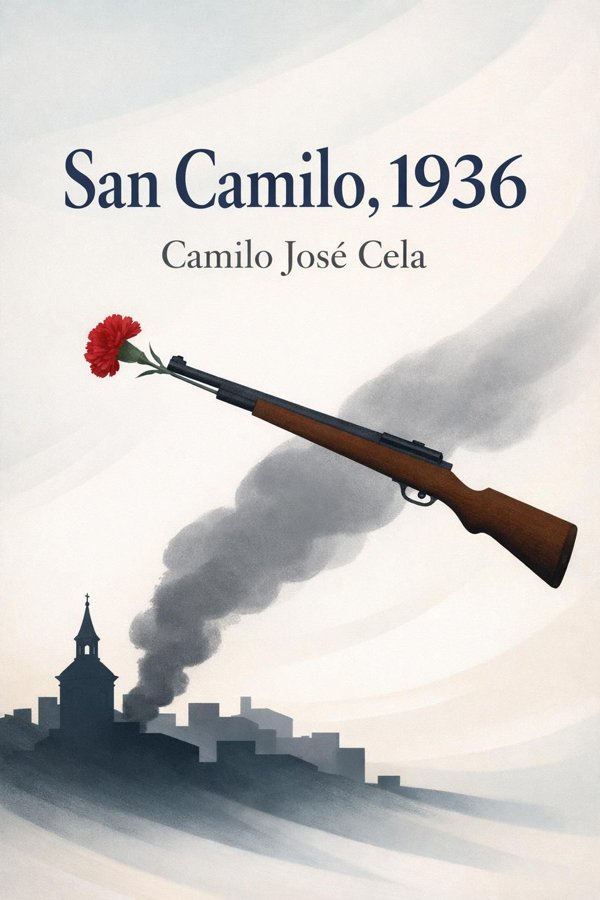
San Camilo, 1936: Summary & Key Insights
 10 min5 chaptersAudio available
What Is San Camilo, 1936 About?
San Camilo, 1936 by Camilo José Cela is a classics book spanning 5 pages. Set on the eve of the Spanish Civil War, this novel follows a twenty-year-old student's attempts to sort out his private affairs—sex, money, and career—amid the chaos and moral confusion of Madrid in July 1936. Through a stream-of-consciousness narrative, Cela captures the disintegration of social order and the loss of collective innocence as Spain descends into conflict.
This FizzRead summary covers all 5 key chapters of San Camilo, 1936 in approximately 10 minutes, distilling the most important ideas, arguments, and takeaways from Camilo José Cela's work. Also available as an audio summary and Key Quotes Podcast.
San Camilo, 1936
Set on the eve of the Spanish Civil War, this novel follows a twenty-year-old student's attempts to sort out his private affairs—sex, money, and career—amid the chaos and moral confusion of Madrid in July 1936. Through a stream-of-consciousness narrative, Cela captures the disintegration of social order and the loss of collective innocence as Spain descends into conflict.
Who Should Read San Camilo, 1936?
This book is perfect for anyone interested in classics and looking to gain actionable insights in a short read. Whether you're a student, professional, or lifelong learner, the key ideas from San Camilo, 1936 by Camilo José Cela will help you think differently.
- ✓Readers who enjoy classics and want practical takeaways
- ✓Professionals looking to apply new ideas to their work and life
- ✓Anyone who wants the core insights of San Camilo, 1936 in just 10 minutes
Want the full summary?
Get instant access to this book summary and 100K+ more with Fizz Moment.
Get Free SummaryAvailable on App Store • Free to download
Key Chapters
The novel opens on the eve of July 18, 1936, when Madrid still breathes uneasily under the summer heat but already trembles beneath rumors of revolt. My unnamed narrator is twenty years old, restless, and tormented by petty concerns—his love affairs, his lack of money, his uncertain future. Yet all around him, Spain prepares to tear itself apart. I chose to begin with this collision between the trivial and the tremendous to demonstrate how private blindness mirrors national catastrophe. The stream of consciousness flows without mercy, revealing thoughts, desires, complaints, and impressions as they erupt. There is no well-behaved sequence; the narrative itself shakes under the same instability that overtakes the city.
The reader hears the murmur of Madrid’s streets—the taxi drivers, the priests, the beggars, the gossip of cafés. This polyphonic voice was essential; I wanted to portray a collective mind sliding toward madness. Through overlapping reflections, the reader senses that language itself begins to disintegrate. Every conversation is infected by fear, every silence charged with the tension of something about to happen. The narrator moves through this atmosphere like a sleepwalker, unable to separate his own confusion from the spreading chaos. What he glimpses is not yet bombs or soldiers—it is the moral decomposition of ordinary life.
Through his eyes we perceive a city that has lost its rhythm. Old certainties—religion, honor, political doctrine—have become inadequate. Faith is replaced by superstition, ideology by rumor. I wanted this mosaic of voices to feel suffocating, as if the narrator’s consciousness itself were the battlefield. His own words betray him; he cannot speak without contradicting himself. That’s the essence of this opening act: to show a society where the possibility of truth has already vanished, replaced by fragments of emotion, gossip, and despair.
As Madrid simmered on that July night, the young man’s reflections twist between private lust and dread of history. He may convince himself that he is separate from politics, but every intimate gesture is already political in an era when the body itself becomes contested territory. Through his restless wandering and inner dialogue, the reader stands inside a heart and a city both waiting for the explosion that will end their innocence.
At the core of *San Camilo, 1936* lies the restless inquiry into moral turbulence. My narrator’s thoughts dwell obsessively on his sexual escapades, his family’s hypocrisy, and his inability to find meaning. I used eroticism here not to shock, but to reveal the body as the battlefield of conscience. His experiences with prostitutes, his fantasies of pure love, and his guilt after pleasure mirror the spiritual corrosion of his generation. Spain, in those days, was a country torn between Catholic morality and anarchic rebellion. I wanted the young man’s flesh to tell the story of that conflict—the way physical desire coexists with moral shame, producing paralysis rather than liberation.
The internal monologue turns relentlessly inward. He speaks of women with frustration and admiration, of his mother’s silence, of church sermons that no longer hold conviction. Every recollection drips with ambiguity: is this confession, or obsession? In times of despair, sexuality becomes both refuge and accusation. By exposing his confusion, I meant to strip away the false purity that had dominated Spain’s public life. The narrator’s inability to love sincerely reflects a society incapable of believing sincerely.
What I wanted to portray most intensely is the sensation of moral vertigo: the feeling of living without reliable codes, of floating among lies and desires. He wanders through Madrid’s cafés and brothels, encounters men and women who speak of politics only to mask their own emptiness. Their conversations resemble prayers to gods that have already failed. Through the intimate disintegration of my narrator, I describe the moral collapse of the entire community. What is most frightening is that everyone senses this decay but continues as before, muttering jokes and pursuing pleasure while the abyss opens beneath them.
The reader begins to feel that Spain’s tragedy was not born in ideological discourse but in the everyday corruption of spirit. My narrator’s lust and guilt are Spain’s lust and guilt. His inability to act morally becomes emblematic of a nation paralysed between opposing absolutes—between revolution and conservatism, faith and disbelief. His suffering reveals that when inner ethics crumble, politics only accelerates the descent. I wanted his voice to become the confession of an entire generation that had lost its innocence not through war, but through self-deception.
+ 3 more chapters — available in the FizzRead app
All Chapters in San Camilo, 1936
About the Author
Camilo José Cela (1916–2002) was a Spanish novelist, essayist, and Nobel laureate in Literature (1989). Known for his innovative style and deep exploration of human nature, his major works include 'The Family of Pascual Duarte' and 'The Hive'.
Get This Summary in Your Preferred Format
Read or listen to the San Camilo, 1936 summary by Camilo José Cela anytime, anywhere. FizzRead offers multiple formats so you can learn on your terms — all free.
Available formats: App · Audio · PDF · EPUB — All included free with FizzRead
Download San Camilo, 1936 PDF and EPUB Summary
Key Quotes from San Camilo, 1936
“The novel opens on the eve of July 18, 1936, when Madrid still breathes uneasily under the summer heat but already trembles beneath rumors of revolt.”
“At the core of *San Camilo, 1936* lies the restless inquiry into moral turbulence.”
Frequently Asked Questions about San Camilo, 1936
San Camilo, 1936 by Camilo José Cela is a classics book that explores key ideas across 5 chapters. Set on the eve of the Spanish Civil War, this novel follows a twenty-year-old student's attempts to sort out his private affairs—sex, money, and career—amid the chaos and moral confusion of Madrid in July 1936. Through a stream-of-consciousness narrative, Cela captures the disintegration of social order and the loss of collective innocence as Spain descends into conflict.
More by Camilo José Cela
You Might Also Like






Browse by Category
Ready to read San Camilo, 1936?
Get the full summary and 100K+ more books with Fizz Moment.