
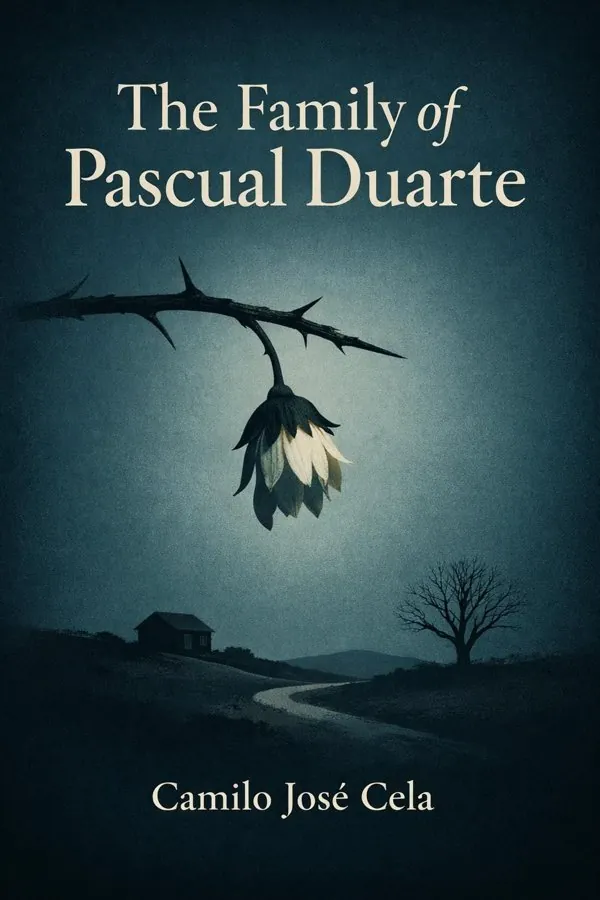
The Family of Pascual Duarte: Summary & Key Insights
 10 min9 chaptersAudio available
Key Takeaways from The Family of Pascual Duarte
Place is never just background in this novel; it acts almost like destiny.
Some people inherit money or stability; Pascual inherits chaos.
For a brief moment, marriage seems to promise Pascual another future.
The most frightening thing about violence is not a single outburst but its tendency to become habitual.
Loss in this novel is never gentle; it arrives as another blow in a life already bruised.
What Is The Family of Pascual Duarte About?
The Family of Pascual Duarte by Camilo José Cela is a classics book spanning 8 pages. The Family of Pascual Duarte is a dark, unsettling, and unforgettable novel about a man who tells the story of his own ruin. Presented as a prison confession, the book follows Pascual Duarte, a poor peasant from rural Extremadura, as he looks back on a life shaped by cruelty, humiliation, grief, and repeated acts of violence. What emerges is not a simple tale of crime, but a chilling portrait of how misery, family brutality, and a belief in inescapable fate can deform a human life from within. First published in 1942, the novel became one of the defining works of Spanish tremendismo, a literary mode marked by stark realism, emotional intensity, and an unflinching focus on suffering. Camilo José Cela, later awarded the Nobel Prize in Literature, wrote with a force and precision that made this slim novel one of the most important works of 20th-century Spanish fiction. It still matters because it asks a disturbing question that never grows old: when violence becomes the air someone breathes, how much freedom do they truly have to choose another life?
This FizzRead summary covers all 9 key chapters of The Family of Pascual Duarte in approximately 10 minutes, distilling the most important ideas, arguments, and takeaways from Camilo José Cela's work. Also available as an audio summary and Key Quotes Podcast.
The Family of Pascual Duarte
The Family of Pascual Duarte is a dark, unsettling, and unforgettable novel about a man who tells the story of his own ruin. Presented as a prison confession, the book follows Pascual Duarte, a poor peasant from rural Extremadura, as he looks back on a life shaped by cruelty, humiliation, grief, and repeated acts of violence. What emerges is not a simple tale of crime, but a chilling portrait of how misery, family brutality, and a belief in inescapable fate can deform a human life from within. First published in 1942, the novel became one of the defining works of Spanish tremendismo, a literary mode marked by stark realism, emotional intensity, and an unflinching focus on suffering. Camilo José Cela, later awarded the Nobel Prize in Literature, wrote with a force and precision that made this slim novel one of the most important works of 20th-century Spanish fiction. It still matters because it asks a disturbing question that never grows old: when violence becomes the air someone breathes, how much freedom do they truly have to choose another life?
Who Should Read The Family of Pascual Duarte?
This book is perfect for anyone interested in classics and looking to gain actionable insights in a short read. Whether you're a student, professional, or lifelong learner, the key ideas from The Family of Pascual Duarte by Camilo José Cela will help you think differently.
- ✓Readers who enjoy classics and want practical takeaways
- ✓Professionals looking to apply new ideas to their work and life
- ✓Anyone who wants the core insights of The Family of Pascual Duarte in just 10 minutes
Want the full summary?
Get instant access to this book summary and 100K+ more with Fizz Moment.
Get Free SummaryAvailable on App Store • Free to download
Key Chapters
Place is never just background in this novel; it acts almost like destiny. Pascual is born in Extremadura, a dry, impoverished, unforgiving region whose physical bleakness mirrors the emotional climate of his life. The landscape is barren, the villages are isolated, and daily existence is defined by scarcity, labor, and endurance. From the beginning, Cela suggests that people are not formed in a vacuum. The world around them enters their character, their expectations, and even their sense of what is possible. Pascual does not grow up in a setting that encourages tenderness, imagination, or mobility. He grows up in one that teaches hardness.
This matters because the novel refuses to present violence as a sudden moral failure detached from context. Instead, it shows how certain environments normalize brutality. When life is experienced as a constant struggle against deprivation and humiliation, emotional life can shrink into fear, resentment, and instinctive aggression. Pascual learns early that gentleness has little place in the world he knows. The soil is hard, and so are the people.
Modern readers can apply this insight beyond the novel. Social conditions still shape behavior in powerful ways. Communities marked by poverty, neglect, or trauma often produce not only material suffering but emotional distortion. That does not erase personal responsibility, but it complicates simplistic judgment. In schools, families, and workplaces, understanding context can lead to wiser responses than condemnation alone.
Actionable takeaway: when assessing a person’s behavior, look first at the environment that formed it. Context does not excuse harm, but it often explains how harm becomes imaginable.
Some people inherit money or stability; Pascual inherits chaos. His family is the first school he attends, and what it teaches him is despair. His mother is cruel, volatile, and degrading. His father is weak, alcoholic, and emotionally absent. The household offers neither safety nor moral clarity. Instead of learning trust, Pascual learns fear. Instead of discovering that adults protect the vulnerable, he sees that power often humiliates the weak. This domestic world becomes the template through which he understands all later relationships.
One of Cela’s most unsettling achievements is showing how fatalism grows inside such a family structure. Pascual does not simply suffer abuse; he gradually comes to believe that suffering is the natural condition of life. In that mental universe, violence no longer appears as a shocking interruption but as the expected outcome of conflict. If every bond is corrupted, then hope begins to feel childish. This is the moral atmosphere in which Pascual’s later decisions take shape.
The novel invites readers to think about how early family dynamics influence adult behavior. People raised in instability may struggle to imagine alternatives because they have never seen healthy authority, love, or restraint modeled in practice. This remains relevant in contemporary discussions of trauma, intergenerational harm, and emotional inheritance. A damaged family can become a factory of damaged expectations.
Yet the book also challenges readers not to romanticize suffering. Trauma may explain destructive impulses, but it does not transform them into virtue. The tragedy lies precisely in how injury reproduces injury.
Actionable takeaway: examine the emotional patterns inherited from family life, and consciously question which ones deserve to end rather than continue.
For a brief moment, marriage seems to promise Pascual another future. His relationship with Lola introduces the possibility that life might become ordinary, stable, and human in a way his childhood never was. He seeks not grand happiness but something simpler: companionship, domestic order, and the feeling that he might belong to a life not ruled entirely by misery. This hope matters because it reveals that Pascual is not born as a monster detached from normal feeling. He wants what many people want: a home, recognition, and a reason to continue.
But Cela does not allow marriage to function as a sentimental cure. Pascual carries himself into the marriage, along with his history, insecurity, and instability. The external conditions around him also remain harsh. Misfortune, jealousy, emotional volatility, and grief begin to poison what could have been a sanctuary. The novel suggests a difficult truth: love can soften suffering, but it cannot by itself erase deep wounds or social brutality. Without inner change and supportive conditions, hope remains fragile.
This idea has broad application. People often expect relationships to rescue them from personal chaos. The novel warns against that illusion. A partner can offer affection, loyalty, and support, but cannot single-handedly heal trauma or rebuild a shattered moral framework. When unresolved pain enters intimacy, it distorts trust and magnifies conflict.
What makes Pascual’s marriage tragic is that it contains a real human longing for redemption. He is not incapable of attachment. He is incapable of sustaining it against the forces he has never learned to master.
Actionable takeaway: do not expect love alone to save a troubled life; pair emotional connection with self-examination, accountability, and real support.
The most frightening thing about violence is not a single outburst but its tendency to become habitual. In Pascual’s life, violence appears first as something done around him and to him, but gradually it becomes one of the main languages through which he responds to the world. Anger, humiliation, frustration, and fear are repeatedly converted into physical acts. Cela shows how this process works: each eruption seems tied to a specific grievance, yet over time the pattern becomes larger than any single incident. Violence stops being exceptional and starts feeling inevitable.
This is central to the novel’s power. Pascual often presents himself as someone cornered by fate, and there is truth in that perception. But the narrative also reveals how repeated actions harden into identity. The more he uses violence, the less imaginable nonviolence becomes. He acts, suffers consequences, feels trapped, and then acts again. This circular structure creates the suffocating sense that his life is moving toward catastrophe long before the final crimes occur.
In practical terms, the book illustrates something still recognized in psychology and social life: repeated reactions become reinforced pathways. Whether in families, institutions, or individuals, destructive habits grow stronger when they are not interrupted early. A person who learns to answer shame with aggression may continue doing so until the pattern destroys everything around them.
Cela’s achievement is that he neither glamorizes violence nor explains it away. He presents it as ugly, tragic, and contagious. The cycle survives because it feels momentarily powerful even as it guarantees long-term ruin.
Actionable takeaway: identify recurring destructive responses in your own life early, because patterns become far harder to break once they begin to define who you believe you are.
Loss in this novel is never gentle; it arrives as another blow in a life already bruised. The death of Pascual’s second child is especially devastating because it strikes at one of the few remaining sources of meaning available to him. Fatherhood offers the possibility of continuity, tenderness, and renewal. A child can represent a future unlike the past. When that future is taken away, grief does more than create sadness. It destroys a fragile bridge between suffering and hope.
Cela portrays grief not as a noble or clarifying emotion but as something that can darken the whole field of perception. Pascual’s losses intensify his sense that life is hostile and that happiness is always temporary, always vulnerable to sudden destruction. This deepens his fatalism. If every attachment ends in pain, detachment or aggression can begin to feel safer than love. That logic is tragic but recognizable: many people respond to repeated disappointment by hardening themselves against further vulnerability.
The novel also shows that grief rarely occurs in isolation. It interacts with poverty, unstable relationships, previous trauma, and social loneliness. Without a supportive community or emotional language to process sorrow, suffering can mutate into rage. Pascual does not know how to mourn constructively; he only knows how to endure, resent, and eventually lash out.
Readers can apply this insight in their own lives by recognizing that unresolved grief often appears in disguised forms. Irritability, withdrawal, numbness, and explosive anger may all conceal sorrow that has never been named. Compassion, therapy, ritual, or trusted conversation can interrupt that conversion of grief into harm.
Actionable takeaway: when anger feels disproportionate, ask whether unprocessed grief may be speaking through it.
The murder of Pascual’s mother is the novel’s most shocking and symbolically charged act. On the surface, it is a brutal personal crime. At a deeper level, it represents an attempt to destroy the source of his lifelong humiliation, fear, and moral poisoning. Pascual’s mother is more than an individual antagonist. She embodies the household from which he emerged: abusive, degrading, chaotic, and emotionally barren. In killing her, Pascual seems to believe he can cut himself free from the root of his misery.
Yet the act solves nothing. Cela’s point is not that Pascual’s hatred is incomprehensible. On the contrary, the reader understands the buildup of resentment all too well. The horror lies in the fact that his search for liberation takes the exact form of the corruption he wants to escape. He does not transcend his origins; he reenacts them at their most extreme. The murder becomes the clearest proof that violence has colonized his inner life.
This scene is crucial for understanding the novel’s moral complexity. Cela does not ask readers to approve of Pascual, but neither does he reduce him to a simple villain. The mother-son relationship reveals how abuse can create fantasies of total rupture. People sometimes imagine that one decisive act will erase years of degradation. In reality, external destruction rarely heals internal damage.
The episode also invites reflection on the danger of defining one’s entire life against a hated figure. When identity is built around resentment, even rebellion can become another form of bondage.
Actionable takeaway: breaking from a destructive past requires more than rejecting what hurt you; it requires building a different way of being so you do not reproduce the very harm you oppose.
Confinement does something paradoxical in this novel: it limits Pascual physically while opening a space for narrative and reflection. Writing from prison, he tries to make sense of the life that led him there. This confessional structure is one of the book’s greatest strengths. It creates intimacy, unreliability, defensiveness, regret, and revelation all at once. Pascual wants to explain himself, perhaps justify himself, perhaps simply leave behind a record that proves he was more than the sum of his crimes.
Cela uses confession not to produce clean moral redemption but to expose the ambiguity of self-narration. Pascual is candid in some moments and evasive in others. He acknowledges brutality, yet often frames events as if they were pushed upon him by circumstance. This tension forces readers into an active role. We must ask where explanation becomes excuse, where honesty becomes self-dramatization, and how much any person truly understands their own motives.
The novel therefore becomes not just the story of a violent life but a meditation on memory and self-judgment. People do not simply recall the past; they arrange it, interpret it, and use it to construct a version of themselves. That remains deeply relevant today. Personal narratives shape identity, whether in diaries, therapy, legal testimony, or everyday conversation. The stories we tell about what happened to us can either deepen accountability or help us avoid it.
Pascual’s prison manuscript matters because it preserves both impulses at once. He seeks comprehension, but comprehension never fully absolves him.
Actionable takeaway: when reflecting on your own past, aim not only to explain your actions but to identify where your self-story may be protecting you from difficult truths.
The novel’s ending transforms everything before it. Because Pascual writes under the shadow of execution, each episode carries the weight of finality. We are not reading a life in progress but a life already judged, closing in on its irreversible end. This structure creates a powerful tragic effect. Every small hope, every angry impulse, every loss is illuminated by what we already know: none of it will lead to renewal. It will lead to death sanctioned by the state.
Execution also enlarges the novel’s moral horizon. Pascual is guilty of terrible acts, yet Cela does not present his death as a neat restoration of order. Instead, the ending leaves readers with discomfort. The legal sentence may conclude the story, but it does not resolve the deeper questions the book raises about social cruelty, moral responsibility, and the making of violence. If society kills the man it helped deform, has justice truly been done, or has violence simply changed hands?
This ambiguity is one reason the novel has endured. It resists easy consolation. The epilogue-like framing materials intensify that effect by adding layers of mediation and distance, reminding us that lives are often reduced to documents, rumors, and official verdicts. Yet beneath those records lies an irreducible human tragedy.
Readers today can apply this insight to any situation where punishment is mistaken for understanding. Consequences matter, but they are not the same as comprehension. A society that responds to brokenness only after it turns criminal remains morally compromised.
Actionable takeaway: when judging wrongdoing, ask not only what punishment fits the act, but what conditions allowed the act to emerge in the first place.
The shock of The Family of Pascual Duarte is not gratuitous; it is aesthetic and moral strategy. Cela became associated with tremendismo, a literary tendency marked by stark violence, grotesque suffering, and emotional extremity. But the purpose is not simply to horrify. By intensifying brutality, the novel strips away comforting illusions about rural innocence, family sanctity, and moral simplicity. It forces readers to confront the raw underside of social life that polite culture often hides.
This style matters because it changes how the story works. A softer, more sentimental version of Pascual’s life might encourage pity without disturbance. Cela wants more than pity. He wants unease. He wants the reader to inhabit a world where cruelty feels ordinary and to experience the resulting moral suffocation. The terse, forceful prose and the accumulation of grim events create a pressure that becomes part of the book’s meaning. Form and content support each other.
For modern readers, tremendismo offers an important lesson about art. Difficult literature can expand moral perception precisely by refusing comfort. Stories that unsettle us may reveal realities we would otherwise avoid, whether about class, abuse, psychological damage, or social neglect. The value of such work lies not in darkness for its own sake, but in its ability to make denial impossible.
Cela’s novel remains important because it uses literary intensity to explore the human cost of environments that crush dignity. It asks the reader not to look away.
Actionable takeaway: when a work of art makes you uncomfortable, resist dismissing it immediately; ask what truth that discomfort might be trying to make visible.
All Chapters in The Family of Pascual Duarte
About the Author
Camilo José Cela (1916–2002) was one of the most influential Spanish writers of the 20th century. Born in Galicia, he lived through the upheavals of the Spanish Civil War and the Franco era, experiences that shaped the darkness, irony, and social sharpness of his work. He wrote novels, essays, travel books, memoirs, and experimental prose, earning a reputation for stylistic boldness and an uncompromising view of human behavior. His 1942 novel The Family of Pascual Duarte established him as a major literary force and became a landmark of postwar Spanish fiction. Later works, including The Hive, confirmed his range and ambition. In 1989, Cela received the Nobel Prize in Literature for a body of work noted for its rich invention and powerful vision of human vulnerability, violence, and endurance.
Get This Summary in Your Preferred Format
Read or listen to the The Family of Pascual Duarte summary by Camilo José Cela anytime, anywhere. FizzRead offers multiple formats so you can learn on your terms — all free.
Available formats: App · Audio · PDF · EPUB — All included free with FizzRead
Download The Family of Pascual Duarte PDF and EPUB Summary
Key Quotes from The Family of Pascual Duarte
“Place is never just background in this novel; it acts almost like destiny.”
“Some people inherit money or stability; Pascual inherits chaos.”
“For a brief moment, marriage seems to promise Pascual another future.”
“The most frightening thing about violence is not a single outburst but its tendency to become habitual.”
“Loss in this novel is never gentle; it arrives as another blow in a life already bruised.”
Frequently Asked Questions about The Family of Pascual Duarte
The Family of Pascual Duarte by Camilo José Cela is a classics book that explores key ideas across 9 chapters. The Family of Pascual Duarte is a dark, unsettling, and unforgettable novel about a man who tells the story of his own ruin. Presented as a prison confession, the book follows Pascual Duarte, a poor peasant from rural Extremadura, as he looks back on a life shaped by cruelty, humiliation, grief, and repeated acts of violence. What emerges is not a simple tale of crime, but a chilling portrait of how misery, family brutality, and a belief in inescapable fate can deform a human life from within. First published in 1942, the novel became one of the defining works of Spanish tremendismo, a literary mode marked by stark realism, emotional intensity, and an unflinching focus on suffering. Camilo José Cela, later awarded the Nobel Prize in Literature, wrote with a force and precision that made this slim novel one of the most important works of 20th-century Spanish fiction. It still matters because it asks a disturbing question that never grows old: when violence becomes the air someone breathes, how much freedom do they truly have to choose another life?
More by Camilo José Cela
You Might Also Like


Browse by Category
Ready to read The Family of Pascual Duarte?
Get the full summary and 100K+ more books with Fizz Moment.