
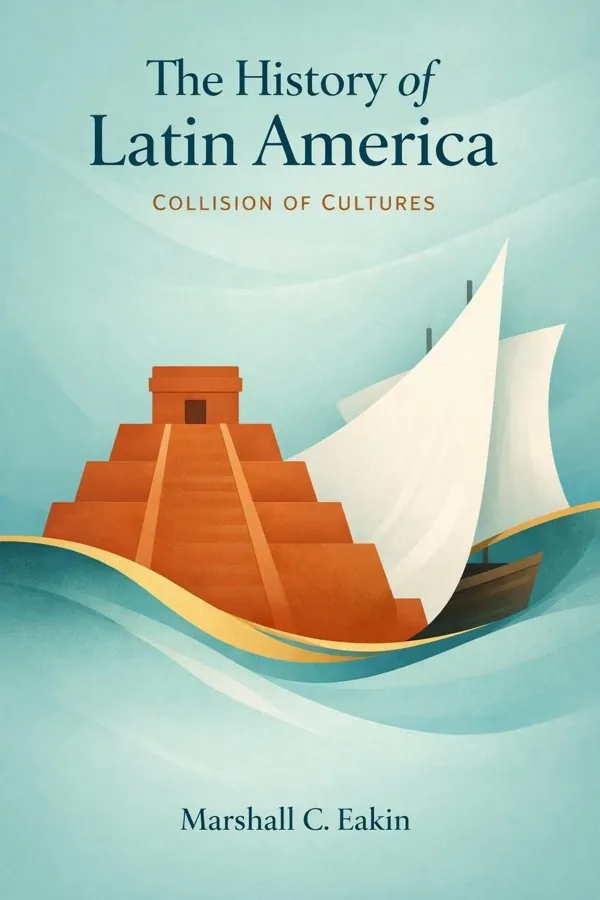
The History of Latin America: Collision of Cultures: Summary & Key Insights
 10 min12 chaptersAudio available
What Is The History of Latin America: Collision of Cultures About?
The History of Latin America: Collision of Cultures by Marshall C. Eakin is a world_history book spanning 12 pages. This book offers a comprehensive overview of Latin America's complex history, from pre-Columbian civilizations through European colonization, independence movements, and modern political and social transformations. Eakin explores the cultural, economic, and political forces that have shaped the region, emphasizing the interactions between indigenous, African, and European peoples that created a unique and diverse cultural landscape.
This FizzRead summary covers all 12 key chapters of The History of Latin America: Collision of Cultures in approximately 10 minutes, distilling the most important ideas, arguments, and takeaways from Marshall C. Eakin's work. Also available as an audio summary and Key Quotes Podcast.
The History of Latin America: Collision of Cultures
This book offers a comprehensive overview of Latin America's complex history, from pre-Columbian civilizations through European colonization, independence movements, and modern political and social transformations. Eakin explores the cultural, economic, and political forces that have shaped the region, emphasizing the interactions between indigenous, African, and European peoples that created a unique and diverse cultural landscape.
Who Should Read The History of Latin America: Collision of Cultures?
This book is perfect for anyone interested in world_history and looking to gain actionable insights in a short read. Whether you're a student, professional, or lifelong learner, the key ideas from The History of Latin America: Collision of Cultures by Marshall C. Eakin will help you think differently.
- ✓Readers who enjoy world_history and want practical takeaways
- ✓Professionals looking to apply new ideas to their work and life
- ✓Anyone who wants the core insights of The History of Latin America: Collision of Cultures in just 10 minutes
Want the full summary?
Get instant access to this book summary and 100K+ more with Fizz Moment.
Get Free SummaryAvailable on App Store • Free to download
Key Chapters
Before Columbus ever crossed the Atlantic, vast civilizations flourished across Latin America. The Maya built cities of stone rising from tropical jungles, their astronomers charting celestial movements and their scribes composing intricate glyphs. To the north, the Aztecs created one of the most formidable empires of the Americas, a network of alliances centered on Tenochtitlan, combining military might with spiritual ritual. In the Andes, the Inca wove a mountainous realm of roads and terraces that connected millions, sustained by sophisticated agricultural and administrative systems.
What fascinates me most about these societies is their capability to integrate economy, religion, and governance into an organic whole. The land itself was sacred—mountains, rivers, maize, and sun—all were expressions of divine energy. Power was not purely political; it was spiritual stewardship. The Inca emperor was seen as a child of the sun; the Maya kings, as mediators between the cosmos and humanity. These visions created civilizations that valued balance between nature and community.
Yet these societies were not utopias. They practiced coercion, ritual warfare, and hierarchy, but each developed mechanisms of redistribution and reciprocity that sustained social coherence. The Mesoamerican tribute system and the Andean mita expressed collective responsibility, binding individuals to the welfare of the whole. When Europeans arrived, they encountered not isolated tribes but deeply organized civilizations, capable of monumental art and complex mathematics. Recognizing this depth is essential: Latin American culture began with civilizations fully able to define their own modernity.
The European arrival in the late fifteenth and early sixteenth centuries brought upheaval on a scale unprecedented in human history. Driven by desire for land, wealth, and spiritual conquest, Spain and Portugal launched expeditions that altered multiple continents. Columbus’s voyages opened pathways for empire and exchange, but they also initiated pandemics, slavery, and systemic exploitation.
From my perspective as a historian, the conquest is both tragedy and transformation. The Spaniards, armed with steel and gunpowder, encountered unfamiliar worlds where divine right seemed to justify domination. Cortés’s defeat of the Aztecs and Pizarro’s capture of the Inca emperor were acts of audacity intertwined with violence, diplomacy, and mythmaking. Yet behind these conquests lay a larger European vision—the merging of Christianity and mercantilism, the belief that the New World was both mission field and market.
What followed was profound cultural disruption. Whole populations fell to disease, sacred temples became churches, and native social orders collapsed. Still, conquest also triggered enduring exchanges. European crops and animals transformed agriculture, while native foods—maize, potatoes, cacao—altered the global diet. The history of conquest thus reads as both exploitation and integration, a collision that reshaped the Earth itself.
+ 10 more chapters — available in the FizzRead app
All Chapters in The History of Latin America: Collision of Cultures
About the Author
Marshall C. Eakin is a professor of history at Vanderbilt University specializing in Latin American history, particularly Brazil. His research focuses on modernization, national identity, and the cultural and political development of Latin America.
Get This Summary in Your Preferred Format
Read or listen to the The History of Latin America: Collision of Cultures summary by Marshall C. Eakin anytime, anywhere. FizzRead offers multiple formats so you can learn on your terms — all free.
Available formats: App · Audio · PDF · EPUB — All included free with FizzRead
Download The History of Latin America: Collision of Cultures PDF and EPUB Summary
Key Quotes from The History of Latin America: Collision of Cultures
“Before Columbus ever crossed the Atlantic, vast civilizations flourished across Latin America.”
“The European arrival in the late fifteenth and early sixteenth centuries brought upheaval on a scale unprecedented in human history.”
Frequently Asked Questions about The History of Latin America: Collision of Cultures
The History of Latin America: Collision of Cultures by Marshall C. Eakin is a world_history book that explores key ideas across 12 chapters. This book offers a comprehensive overview of Latin America's complex history, from pre-Columbian civilizations through European colonization, independence movements, and modern political and social transformations. Eakin explores the cultural, economic, and political forces that have shaped the region, emphasizing the interactions between indigenous, African, and European peoples that created a unique and diverse cultural landscape.
You Might Also Like
The Age of Capital
Eric Hobsbawm
10 min
The Gulag Archipelago
Aleksandr Solzhenitsyn
10 min
Jerusalem: The Biography
Simon Sebag Montefiore
10 min
The Anglo-Saxons
James Campbell
10 min
The Boer War
Thomas Pakenham
10 min
The Industrial Revolutionaries: The Making of the Modern World 1776–1914
Gavin Weightman
10 minBrowse by Category
Ready to read The History of Latin America: Collision of Cultures?
Get the full summary and 100K+ more books with Fizz Moment.