
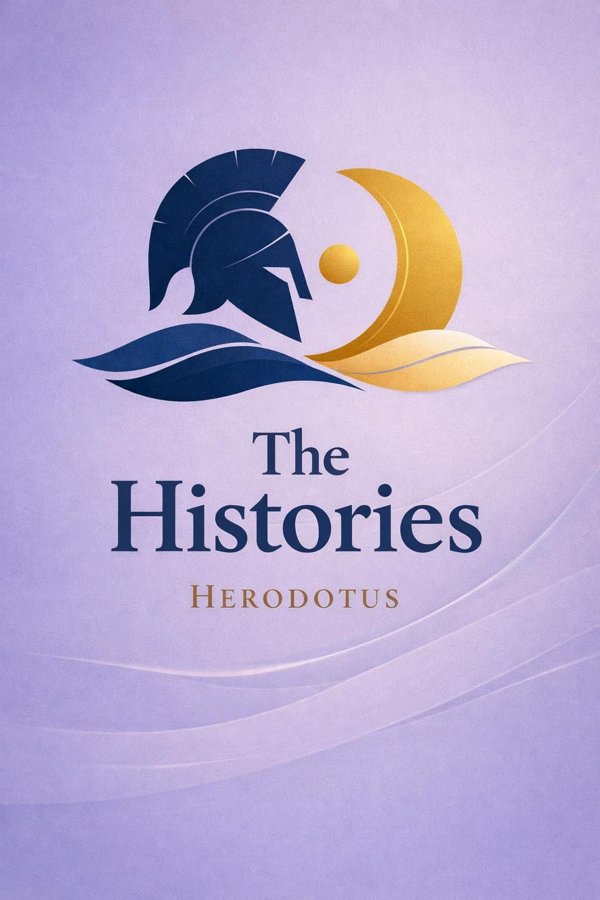
The Histories: Summary & Key Insights
by Herodotus
 10 min10 chaptersAudio available
Key Takeaways from The Histories
Great conflicts rarely begin with a single event; they grow from pride, injury, ambition, and misunderstanding accumulated over time.
What seems strange to outsiders often feels natural to those who live within it.
An empire appears strongest when it is growing, yet expansion often exposes the weaknesses that growth conceals.
The farther power travels from its center, the less predictable the world becomes.
History often turns on moments that seem local before they become global.
What Is The Histories About?
The Histories by Herodotus is a world_history book spanning 10 pages. The Histories is one of the most influential books ever written about the human past. Composed in the 5th century BCE by Herodotus of Halicarnassus, it recounts the rise of the Persian Empire, the clash between Persia and the Greek city-states, and the dramatic wars that culminated in battles such as Marathon, Thermopylae, Salamis, and Plataea. But this is far more than a military chronicle. Herodotus moves across Egypt, Scythia, Lydia, Persia, and the Greek world, gathering stories, customs, geography, political lessons, and moral reflections into a sweeping account of how power grows, overreaches, and collapses. What makes the book endure is not just its scale, but its method: Herodotus asks questions, compares versions of events, preserves multiple voices, and tries to understand foreign peoples on their own terms. For that reason, he is often called the “Father of History.” The Histories still matters because it shows that history is not merely a record of facts. It is an inquiry into ambition, culture, memory, leadership, and the recurring pattern by which human success can become the seed of human ruin.
This FizzRead summary covers all 10 key chapters of The Histories in approximately 10 minutes, distilling the most important ideas, arguments, and takeaways from Herodotus's work. Also available as an audio summary and Key Quotes Podcast.
The Histories
The Histories is one of the most influential books ever written about the human past. Composed in the 5th century BCE by Herodotus of Halicarnassus, it recounts the rise of the Persian Empire, the clash between Persia and the Greek city-states, and the dramatic wars that culminated in battles such as Marathon, Thermopylae, Salamis, and Plataea. But this is far more than a military chronicle. Herodotus moves across Egypt, Scythia, Lydia, Persia, and the Greek world, gathering stories, customs, geography, political lessons, and moral reflections into a sweeping account of how power grows, overreaches, and collapses. What makes the book endure is not just its scale, but its method: Herodotus asks questions, compares versions of events, preserves multiple voices, and tries to understand foreign peoples on their own terms. For that reason, he is often called the “Father of History.” The Histories still matters because it shows that history is not merely a record of facts. It is an inquiry into ambition, culture, memory, leadership, and the recurring pattern by which human success can become the seed of human ruin.
Who Should Read The Histories?
This book is perfect for anyone interested in world_history and looking to gain actionable insights in a short read. Whether you're a student, professional, or lifelong learner, the key ideas from The Histories by Herodotus will help you think differently.
- ✓Readers who enjoy world_history and want practical takeaways
- ✓Professionals looking to apply new ideas to their work and life
- ✓Anyone who wants the core insights of The Histories in just 10 minutes
Want the full summary?
Get instant access to this book summary and 100K+ more with Fizz Moment.
Get Free SummaryAvailable on App Store • Free to download
Key Chapters
Great conflicts rarely begin with a single event; they grow from pride, injury, ambition, and misunderstanding accumulated over time. Herodotus opens The Histories not with the famous Persian invasions, but with the deeper chain of causes that led Greeks and Persians into hostility. He starts with myths of abduction and retaliation, then moves into the historical rise of Lydia under Croesus and Persia under Cyrus. This choice is important: Herodotus wants readers to see that wars are the end point of long moral and political processes.
Croesus, king of Lydia, becomes one of the earliest case studies in the book. Rich, powerful, and self-assured, he tests his fortune and seeks certainty from oracles, only to misread what he hears. His downfall illustrates one of Herodotus’s central lessons: success often blinds rulers to limits. Cyrus, by contrast, rises through boldness, strategy, and the ability to harness discontent, showing how empires are built not only by force but by timing and political intelligence.
This section also introduces a major theme that runs through the whole work: human beings mistake temporary prosperity for permanent security. Herodotus repeatedly shows that wealth, military power, and fame can vanish quickly when leaders act without humility.
In modern terms, the lesson applies to politics, business, and even personal life. Organizations often fail not at their weakest moment, but at their strongest, when confidence turns into overreach and warning signs are ignored. Herodotus’s opening reminds us to study origins, not just outcomes.
Actionable takeaway: When analyzing any crisis, ask what earlier assumptions, habits, and unchecked ambitions made it possible long before the visible breaking point.
What seems strange to outsiders often feels natural to those who live within it. In Book II, Herodotus turns away from the Persian-Greek conflict to describe Egypt in remarkable detail. He discusses the Nile, religious practices, burial customs, animal cults, kings, architecture, and everyday habits. To modern readers, these long digressions may seem surprising, but they reveal one of Herodotus’s most original insights: understanding history requires understanding culture.
Herodotus is fascinated by the Egyptians because many of their customs appear to reverse Greek norms. Women may trade while men weave; priests shave their bodies; mourning, sacrifice, and ritual follow patterns unfamiliar to Greek audiences. Rather than dismiss these differences, Herodotus records them carefully. This gives The Histories an ethnographic quality uncommon in ancient literature. He suggests that every society regards its own customs as best, and that cultural confidence shapes how people live, govern, worship, and fight.
Egypt also matters strategically. It was a wealthy, ancient civilization whose conquest by Persia altered the balance of power in the eastern Mediterranean. By explaining Egypt’s traditions and political history, Herodotus helps readers see what Persia absorbed into its empire and why imperial expansion involved not only territory, but peoples with deep-rooted identities.
Today, this section remains relevant because it teaches intellectual humility. Leaders, analysts, and citizens often misunderstand others by assuming their own norms are universal. Herodotus’s curiosity offers a corrective: before judging behavior, learn the system of meaning behind it.
Actionable takeaway: When encountering a foreign culture, workplace, or community, first ask what internal values make its practices coherent before deciding whether they are reasonable or not.
An empire appears strongest when it is growing, yet expansion often exposes the weaknesses that growth conceals. In Book III, Herodotus follows the Persian Empire after Cyrus, focusing especially on Cambyses and Darius. Cambyses’ conquest of Egypt demonstrates Persia’s extraordinary reach, but Herodotus also portrays the instability of absolute power. Cambyses becomes increasingly erratic, violating norms, alienating subjects, and revealing how imperial authority can tip into self-destruction when restraint disappears.
The dramatic episode of the false Smerdis and the conspiracy of the Persian nobles shows another side of political power: legitimacy matters as much as force. A kingdom can command armies and wealth, yet still become vulnerable if its ruler lacks recognized right to rule. Darius’s eventual rise is significant not only because he takes the throne, but because he reorganizes the empire through administration, tribute, and roads. Herodotus shows that conquest alone does not sustain empires; systems do.
This section deepens one of the book’s major political arguments. Strong states are built on more than battlefield victories. They require communication, taxation, law, and narratives of legitimacy that subjects can accept or fear enough to obey. Herodotus admires Persian capacity while also warning that size creates tension. The more territory a ruler controls, the more difficult it becomes to govern diverse peoples without error, revolt, or resentment.
The practical relevance is clear. Modern institutions, whether governments or corporations, often focus on scaling up before they have durable structures. Growth without governance produces chaos. Herodotus’s Persia shows that administration is itself a form of power, but one that must be disciplined by prudence.
Actionable takeaway: If you are leading a growing organization, strengthen legitimacy, systems, and accountability before pursuing further expansion.
The farther power travels from its center, the less predictable the world becomes. In Book IV, Herodotus examines Scythia and Libya, using these regions to challenge the assumption that imperial armies can easily subdue all peoples. The Scythians in particular become a lesson in strategic asymmetry. Nomadic, mobile, and difficult to pin down, they refuse the kind of confrontation that great empires prefer. Darius invades, but the Scythians deny him decisive battle, stretch supply lines, and turn geography into a weapon.
Herodotus uses this episode to illustrate that military superiority is context-dependent. Persia’s strength lies in scale, organization, and overwhelming force. But those advantages weaken in lands without fixed cities, dependable provisions, or enemies willing to fight on Persian terms. The Scythians win not by crushing Persia in a conventional showdown, but by refusing the logic of empire.
The Libyan material broadens the point. Herodotus catalogues tribes, landscapes, and customs, showing again that local knowledge matters. Different peoples cannot be governed, fought, or understood through one universal model. Geography shapes politics, and way of life shapes military possibility.
This remains a highly modern insight. Powerful states and large organizations often fail when they assume their proven methods will work unchanged in unfamiliar conditions. Competitors with fewer resources can prevail by being more adaptive, more local, and less bound by established expectations.
Actionable takeaway: When entering a new market, region, or conflict, do not rely only on your strengths; study how local conditions may turn those strengths into liabilities and adjust your strategy accordingly.
History often turns on moments that seem local before they become global. In Book V, Herodotus narrates the Ionian Revolt, when Greek cities in Asia Minor rose against Persian rule. The revolt was not initially a grand civilizational struggle. It grew out of regional grievances, political ambition, unstable alliances, and miscalculation. Aristagoras, one of the central figures, helps trigger events that neither he nor others can fully control. Herodotus shows how limited decisions, made under pressure or self-interest, can ignite consequences far beyond their original scope.
The Athenians and Eretrians provide modest support to the rebels, including participation in the burning of Sardis. That act becomes symbolically important because it captures Persian attention and contributes to future imperial retaliation. Here Herodotus reveals a recurring pattern: empires remember insult as well as rebellion, and symbolic injuries can have strategic consequences.
The revolt ultimately fails, yet it transforms the relationship between Persia and mainland Greece. It hardens Persian resolve and draws the Greek city-states into a confrontation from which there will be no easy retreat. In this way, Herodotus emphasizes that failure in the short term may still alter the historical landscape in lasting ways.
For modern readers, the episode offers lessons about escalation. Local disputes, public gestures, and seemingly limited interventions can trigger broad chains of response. Leaders often underestimate how far a conflict may spread once honor, reputation, and alliance commitments are involved.
Actionable takeaway: Before making a symbolic move in a tense situation, consider not only its immediate effect but how it may be remembered, interpreted, and escalated by larger powers.
When people believe they are defending their own political order, they may fight with extraordinary intensity. In Book VI, Herodotus describes the first Persian invasion of Greece and the Battle of Marathon. The Persian campaign demonstrates imperial reach and punitive intent, but Marathon becomes a defining example of what disciplined citizens can achieve against a stronger and more famous power.
Herodotus links Athenian strength to political transformation. He suggests that freedom and participation helped make the Athenians more formidable after the fall of tyranny. This is not a simplistic claim that democracy automatically wins wars, but a sharper insight: people invested in their community may display more initiative, resilience, and shared purpose than subjects acting only from compulsion.
Marathon also shows the importance of timing, leadership, and morale. The Greeks do not win through numbers, but through cohesion and decisive action. Herodotus presents the battle as both a military success and a psychological turning point. It proves Persia is not invincible and gives the Greeks a model of collective resistance.
In practical terms, the lesson reaches beyond warfare. Teams perform better when members feel ownership, trust leadership, and believe the mission is genuinely theirs. Systems that cultivate agency can unlock forms of effort that command alone cannot produce.
Herodotus does not romanticize struggle, but he does suggest that political arrangements shape human energy. Communities that value participation often generate stronger commitment in moments of danger.
Actionable takeaway: If you want a group to perform under pressure, create real ownership and shared purpose rather than relying only on hierarchy, fear, or external incentives.
The most dangerous moment for a ruler may be when he can command almost everything except his own appetite for greatness. In Book VII, Herodotus turns to Xerxes’ massive invasion of Greece, one of the most memorable sections of The Histories. Xerxes inherits a vast empire and is urged toward war by ambition, advisers, dynastic expectations, and the desire to punish Greece. Herodotus depicts him as powerful, emotional, theatrical, and capable of both generosity and terrifying excess.
The famous scenes surrounding the bridging of the Hellespont and the mustering of an immense multinational army underscore a core theme: scale can create the illusion of inevitability. Xerxes believes quantity itself will secure victory. Yet Herodotus carefully plants warnings. Wise advisers such as Artabanus raise doubts, dreams and omens complicate certainty, and the very logistics of moving such a force reveal the burden of imperial magnitude.
The stand at Thermopylae, while a defeat for the Greeks in immediate terms, becomes morally and politically significant because it represents principled resistance to overwhelming power. Herodotus uses it to contrast brute scale with disciplined resolve. Xerxes can command submission, but he cannot guarantee admiration or obedience of spirit.
Modern readers can see in Xerxes the classic failure of overreach: leaders confuse capacity with wisdom. The ability to mobilize huge resources does not remove strategic constraints, and the refusal to hear dissent often accelerates disaster.
Actionable takeaway: When planning a bold expansion or major initiative, actively seek serious dissent and test whether your scale is solving problems or merely masking unexamined risks.
A single dramatic success rarely ends a great struggle; durable victory demands follow-through, discipline, and clarity about what comes next. In Book IX, Herodotus recounts the final major battles of the Persian Wars, especially Plataea and Mycale. These engagements complete the reversal that began at Marathon and Salamis. Persian power remains formidable, but the Greeks, through persistence and improved coordination, secure victories that make further conquest of mainland Greece far less likely.
Herodotus presents these battles as the culmination of multiple forces: courage, leadership, alliance management, favorable decisions, and Persian misjudgment. Yet he also underscores that success does not erase complexity. Greek rivalries remain. The coalition that defended Greece is never perfectly harmonious, and the political future after military triumph remains uncertain. This realism is crucial. Herodotus is not writing a simplistic tale of good defeating evil. He is showing how historical outcomes emerge from unstable cooperation among imperfect actors.
The aftermath matters because it raises the question of what victors do with victory. Defensive necessity can easily become new ambition. The Greeks survive Persian domination, but they do not escape the temptations of power themselves. In this sense, Herodotus closes the military arc while leaving open the moral arc. Human beings do not graduate from history after one triumph.
For contemporary readers, the lesson is plain. Winning the crisis is only phase one. Institutions must plan for aftermath, prevent internal fragmentation, and resist becoming what they once opposed.
Actionable takeaway: After any major win, immediately shift from celebration to consolidation by asking how to preserve unity, manage new power responsibly, and prevent success from breeding the next conflict.
To remember well is not merely to praise victors, but to examine human action in all its brilliance and contradiction. The final and overarching idea of The Histories lies in Herodotus’s purpose itself. He states that he writes so that great deeds, Greek and non-Greek alike, will not fade with time. This is a radical commitment. He does not write only to glorify his own side. He preserves Persian achievements, foreign customs, conflicting testimonies, and stories that reveal uncertainty rather than perfect clarity.
This method makes The Histories foundational for historical thinking. Herodotus is interested in causes, not just events; in culture, not just combat; in character, not just chronology. He asks why powerful people act as they do, how customs shape societies, and what patterns link prosperity to arrogance and downfall. At the same time, he often presents more than one version of a story, signaling that inquiry requires judgment and that certainty is not always available.
That combination of curiosity and caution is the book’s deepest legacy. Herodotus teaches readers to be intellectually open without becoming gullible, morally engaged without reducing history to propaganda, and attentive to human diversity without losing sight of recurring traits such as fear, ambition, honor, and pride.
In everyday life, this means approaching narratives critically. Whether consuming news, organizational history, or political messaging, we should ask who is speaking, what is omitted, and which larger patterns give events meaning.
Actionable takeaway: Practice history as inquiry: compare sources, seek context, and resist simple stories that flatten complex people into heroes or villains.
All Chapters in The Histories
About the Author
Herodotus of Halicarnassus, who lived around 484-425 BCE, was an ancient Greek historian from a city on the southwestern coast of Asia Minor. Writing in the aftermath of the Greco-Persian Wars, he produced The Histories, a monumental work that explored not only battles and rulers but also geography, religion, customs, and the lives of foreign peoples. He traveled extensively through parts of the eastern Mediterranean and Near East, gathering stories and observations from different regions. Although some of his reports mix firsthand inquiry with hearsay, his effort to investigate causes and compare accounts was revolutionary. For that reason, later generations called him the “Father of History.” His work remains foundational because it treats history as an inquiry into human action, cultural difference, political power, and the rise and fall of empires.
Get This Summary in Your Preferred Format
Read or listen to the The Histories summary by Herodotus anytime, anywhere. FizzRead offers multiple formats so you can learn on your terms — all free.
Available formats: App · Audio · PDF · EPUB — All included free with FizzRead
Download The Histories PDF and EPUB Summary
Key Quotes from The Histories
“Great conflicts rarely begin with a single event; they grow from pride, injury, ambition, and misunderstanding accumulated over time.”
“What seems strange to outsiders often feels natural to those who live within it.”
“An empire appears strongest when it is growing, yet expansion often exposes the weaknesses that growth conceals.”
“The farther power travels from its center, the less predictable the world becomes.”
“History often turns on moments that seem local before they become global.”
Frequently Asked Questions about The Histories
The Histories by Herodotus is a world_history book that explores key ideas across 10 chapters. The Histories is one of the most influential books ever written about the human past. Composed in the 5th century BCE by Herodotus of Halicarnassus, it recounts the rise of the Persian Empire, the clash between Persia and the Greek city-states, and the dramatic wars that culminated in battles such as Marathon, Thermopylae, Salamis, and Plataea. But this is far more than a military chronicle. Herodotus moves across Egypt, Scythia, Lydia, Persia, and the Greek world, gathering stories, customs, geography, political lessons, and moral reflections into a sweeping account of how power grows, overreaches, and collapses. What makes the book endure is not just its scale, but its method: Herodotus asks questions, compares versions of events, preserves multiple voices, and tries to understand foreign peoples on their own terms. For that reason, he is often called the “Father of History.” The Histories still matters because it shows that history is not merely a record of facts. It is an inquiry into ambition, culture, memory, leadership, and the recurring pattern by which human success can become the seed of human ruin.
You Might Also Like
The Age of Capital
Eric Hobsbawm
10 min
The Gulag Archipelago
Aleksandr Solzhenitsyn
10 min
Jerusalem: The Biography
Simon Sebag Montefiore
10 min
The Anglo-Saxons
James Campbell
10 min
The Boer War
Thomas Pakenham
10 min
The Industrial Revolutionaries: The Making of the Modern World 1776–1914
Gavin Weightman
10 minBrowse by Category
Ready to read The Histories?
Get the full summary and 100K+ more books with Fizz Moment.