
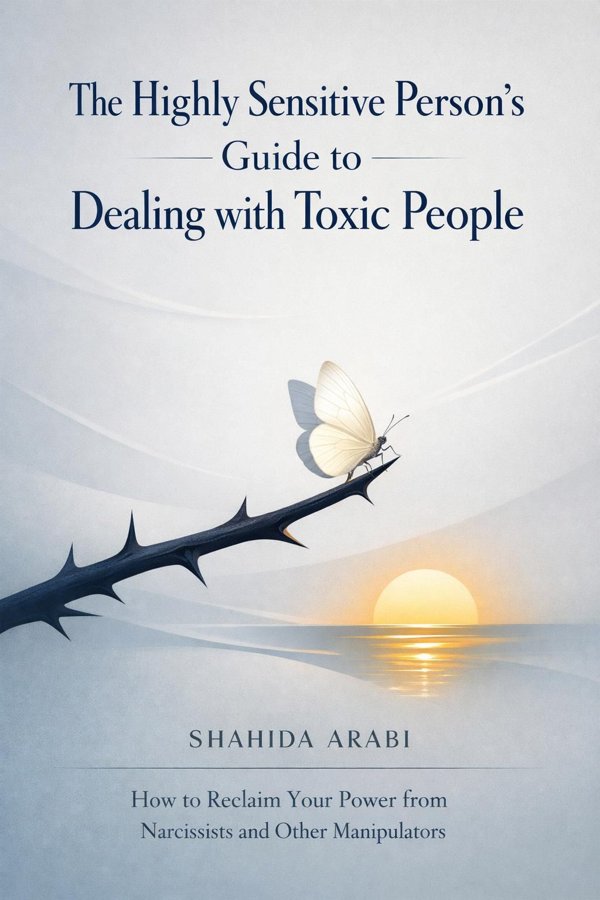
The Highly Sensitive Person's Guide to Dealing with Toxic People: How to Reclaim Your Power from Narcissists and Other Manipulators: Summary & Key Insights
 10 min8 chaptersAudio available
Key Takeaways from The Highly Sensitive Person's Guide to Dealing with Toxic People: How to Reclaim Your Power from Narcissists and Other Manipulators
What makes you deeply compassionate can also make you dangerously accommodating.
Toxic control rarely begins with obvious cruelty; it begins with confusion.
Many sensitive people confuse boundaries with rejection, but boundaries are actually a form of self-respect.
Before the mind can explain what is wrong, the body often already knows.
People do not stay in toxic relationships simply because they are naïve; they often stay because they are bonded through cycles of pain and relief.
What Is The Highly Sensitive Person's Guide to Dealing with Toxic People: How to Reclaim Your Power from Narcissists and Other Manipulators About?
The Highly Sensitive Person's Guide to Dealing with Toxic People: How to Reclaim Your Power from Narcissists and Other Manipulators by Shahida Arabi is a mental_health book spanning 5 pages. Highly sensitive people often possess a rare combination of empathy, intuition, and emotional depth. They notice subtle shifts in tone, absorb the atmosphere of a room, and care deeply about relationships. Yet those same strengths can make them especially vulnerable to toxic people who exploit compassion, blur boundaries, and weaponize guilt. In The Highly Sensitive Person's Guide to Dealing with Toxic People, Shahida Arabi offers a practical, validating roadmap for anyone who has felt trapped in draining, manipulative, or emotionally abusive dynamics. This book matters because it reframes sensitivity as a strength rather than a weakness while showing how narcissists, manipulators, and other exploitative personalities often target conscientious, caring individuals. Arabi explains the patterns of emotional abuse in clear language and pairs insight with tools for protection, recovery, and self-trust. Drawing on her work in trauma recovery and narcissistic abuse education, she helps readers understand not only what toxic people do, but why highly sensitive people may struggle to disengage. The result is an empowering guide to recognizing red flags, setting boundaries, healing from harm, and reclaiming personal power without giving up empathy.
This FizzRead summary covers all 8 key chapters of The Highly Sensitive Person's Guide to Dealing with Toxic People: How to Reclaim Your Power from Narcissists and Other Manipulators in approximately 10 minutes, distilling the most important ideas, arguments, and takeaways from Shahida Arabi's work. Also available as an audio summary and Key Quotes Podcast.
The Highly Sensitive Person's Guide to Dealing with Toxic People: How to Reclaim Your Power from Narcissists and Other Manipulators
Highly sensitive people often possess a rare combination of empathy, intuition, and emotional depth. They notice subtle shifts in tone, absorb the atmosphere of a room, and care deeply about relationships. Yet those same strengths can make them especially vulnerable to toxic people who exploit compassion, blur boundaries, and weaponize guilt. In The Highly Sensitive Person's Guide to Dealing with Toxic People, Shahida Arabi offers a practical, validating roadmap for anyone who has felt trapped in draining, manipulative, or emotionally abusive dynamics.
This book matters because it reframes sensitivity as a strength rather than a weakness while showing how narcissists, manipulators, and other exploitative personalities often target conscientious, caring individuals. Arabi explains the patterns of emotional abuse in clear language and pairs insight with tools for protection, recovery, and self-trust. Drawing on her work in trauma recovery and narcissistic abuse education, she helps readers understand not only what toxic people do, but why highly sensitive people may struggle to disengage. The result is an empowering guide to recognizing red flags, setting boundaries, healing from harm, and reclaiming personal power without giving up empathy.
Who Should Read The Highly Sensitive Person's Guide to Dealing with Toxic People: How to Reclaim Your Power from Narcissists and Other Manipulators?
This book is perfect for anyone interested in mental_health and looking to gain actionable insights in a short read. Whether you're a student, professional, or lifelong learner, the key ideas from The Highly Sensitive Person's Guide to Dealing with Toxic People: How to Reclaim Your Power from Narcissists and Other Manipulators by Shahida Arabi will help you think differently.
- ✓Readers who enjoy mental_health and want practical takeaways
- ✓Professionals looking to apply new ideas to their work and life
- ✓Anyone who wants the core insights of The Highly Sensitive Person's Guide to Dealing with Toxic People: How to Reclaim Your Power from Narcissists and Other Manipulators in just 10 minutes
Want the full summary?
Get instant access to this book summary and 100K+ more with Fizz Moment.
Get Free SummaryAvailable on App Store • Free to download
Key Chapters
What makes you deeply compassionate can also make you dangerously accommodating. One of the book’s central insights is that highly sensitive people, or HSPs, are not weak; they are perceptive, emotionally responsive, and often strongly motivated to preserve harmony. But these strengths can be exploited by people who seek attention, control, admiration, or access to emotional labor.
Arabi explains that HSPs tend to notice subtle distress in others, give second chances, and look beneath difficult behavior for hidden pain. In healthy relationships, this creates intimacy and trust. In toxic relationships, however, it can trap someone in cycles of overexplaining, forgiving repeated harm, and confusing empathy with obligation. A manipulator may present as wounded, misunderstood, or uniquely connected to you, knowing that your sensitivity makes you more likely to stay engaged and try to help.
This dynamic becomes especially harmful when an HSP ignores their own bodily cues. That knot in the stomach, mental exhaustion after a conversation, or sense of walking on eggshells is often early evidence that something is wrong. Yet many sensitive people are taught to dismiss discomfort as overreacting. Arabi urges readers to do the opposite: treat their sensitivity as accurate information.
A practical example is the friend who repeatedly unloads emotional chaos onto you but disappears when you need support. Another is the romantic partner who praises your kindness while gradually demanding more access, more patience, and more tolerance for disrespect. In both cases, your empathy is being used, not honored.
Actionable takeaway: Stop asking only, “What does this person need from me?” and start asking, “How do I feel after interacting with them, and what is that feeling trying to tell me?”
Toxic control rarely begins with obvious cruelty; it begins with confusion. Arabi emphasizes that manipulators succeed not just because they lie, but because they create emotional fog. Highly sensitive people, who naturally search for meaning and nuance, may spend enormous energy trying to decode mixed signals instead of naming the pattern directly.
The book outlines common tactics such as love bombing, future faking, gaslighting, projection, triangulation, silent treatment, and intermittent reinforcement. Love bombing overwhelms you with praise, intimacy, or attention so that trust forms before real character is revealed. Future faking makes promises about commitment, change, or a better future that never materializes. Gaslighting causes you to question your memory and perception. Intermittent reinforcement alternates warmth and coldness, creating an addictive bond because you keep chasing the return of the “good” version of the person.
For HSPs, these tactics can be especially destabilizing because they feel emotional shifts intensely. A manipulator’s inconsistency may trigger anxiety, hypervigilance, and self-blame. Instead of recognizing a pattern of control, the sensitive person may think, “If I communicate better, they’ll return to how they were at the beginning.” Arabi shows that this hope often keeps people stuck.
Consider a dating scenario where someone texts constantly, calls you their soulmate, then suddenly withdraws and blames your neediness when you ask what changed. Or a boss who praises your work publicly but privately undermines your confidence and pits colleagues against each other. The tactic is different, but the result is the same: destabilization and dependency.
Actionable takeaway: Make a list of manipulative behaviors you have experienced, and evaluate people by patterns over time rather than by isolated moments of charm or remorse.
Many sensitive people confuse boundaries with rejection, but boundaries are actually a form of self-respect. Arabi argues that HSPs often hesitate to set limits because they fear appearing cold, selfish, or unkind. Toxic people capitalize on that fear. They treat your access, time, and emotional attention as if those resources belong to them, and they react negatively the moment you begin to reclaim ownership.
The book reframes boundaries as necessary protections for your nervous system, not acts of hostility. A boundary can be as simple as refusing late-night emotional dumping, declining to justify your decisions, limiting contact, or ending a conversation when disrespect begins. Healthy people may not love every limit you set, but they can usually respect it. Toxic people often respond with rage, guilt-tripping, accusations, or victimhood because your boundary interferes with their control.
This is why boundary-setting can feel so emotionally intense. The discomfort does not mean the boundary is wrong; it often means the old dynamic depended on your overfunctioning. If a family member says, “You’ve changed,” after you stop tolerating insults, what they may really mean is, “You no longer make this easy for me.” Arabi encourages readers to expect pushback and not interpret it as evidence that they are doing harm.
Practical boundary tools include short scripts like, “I’m not available for this conversation right now,” “That does not work for me,” or “If you continue speaking to me that way, I will leave.” The key is not perfect wording but consistent follow-through.
Actionable takeaway: Choose one recurring draining interaction and set one clear, specific limit this week, then observe who respects it and who resists it.
Before the mind can explain what is wrong, the body often already knows. One of Arabi’s most useful themes is that highly sensitive people frequently receive early warning signals through fatigue, anxiety, dread, insomnia, muscle tension, or a sudden drop in energy around certain individuals. Because HSPs are highly attuned, their nervous systems can register danger before their conscious mind has gathered enough evidence to make a case.
The problem is that many people have been trained to override those sensations. They tell themselves they are too sensitive, too suspicious, or unfairly judgmental. Arabi challenges this conditioning by encouraging readers to see somatic cues as data. You do not need a courtroom-level argument before honoring discomfort. If someone consistently leaves you dysregulated, confused, or emotionally depleted, that is significant information.
This does not mean every uncomfortable moment indicates abuse. Sometimes stress, trauma history, or unfamiliarity can create false alarms. But the answer is not to dismiss the body; it is to investigate with curiosity. You can ask: Do I feel safe being honest with this person? Do I relax after spending time with them, or do I replay every word? Do they respond to my vulnerability with care, or do they use it later?
For example, an HSP may notice headaches before family gatherings where a certain relative mocks them, or feel stomach tension every time a partner’s name appears on their phone. These are not trivial reactions. They may reflect an accumulated history of subtle intimidation or unpredictability.
Actionable takeaway: Start a body-awareness journal for two weeks, tracking which interactions leave you calm, energized, tense, or depleted, and use those patterns to guide decisions about trust and contact.
People do not stay in toxic relationships simply because they are naïve; they often stay because they are bonded through cycles of pain and relief. Arabi explores trauma bonding as a powerful attachment process in which intermittent kindness, fear, hope, and emotional dependency create a relationship that is hard to leave even when it is clearly harmful.
For highly sensitive people, trauma bonds can feel especially intense. Because HSPs process emotional experiences deeply, both the highs and lows of the relationship leave a strong imprint. The manipulator’s occasional tenderness may feel meaningful and redemptive, while the cruelty feels like a puzzle to solve. This creates a loop: hurt, confusion, apology, reconnection, and renewed hope. Over time, the nervous system becomes conditioned to equate instability with love.
Arabi stresses that healing begins when you stop measuring the relationship by the rare moments of closeness and start evaluating the full pattern. Did the apology lead to changed behavior, or just another cycle? Were you loved, or were you periodically rewarded for staying available? These are painful questions, but they loosen the emotional hold of the bond.
Recovery often requires practical distance: reducing contact, blocking channels of communication, removing reminders, and seeking support from people who understand abuse dynamics. It also requires grieving not only the person but the fantasy of who you hoped they would become. That grief is real, and it deserves compassion.
Actionable takeaway: Write two lists, one of the relationship’s promises and one of its repeated realities, and use the contrast to ground yourself whenever nostalgia pulls you back into the trauma bond.
Emotional abuse does more than hurt feelings; it rewrites identity. Arabi shows how toxic people chip away at self-worth through criticism, comparison, neglect, blame-shifting, and strategic invalidation. Over time, highly sensitive people may internalize the idea that they are too much, too needy, too emotional, or impossible to love unless they become smaller and easier to manage.
This erosion of self-trust is one of the deepest wounds abuse leaves behind. You may no longer know whether your reactions are reasonable, whether your standards are fair, or whether your memories can be believed. The manipulator’s voice becomes internalized as self-doubt. That is why healing is not just about leaving the relationship; it is about reclaiming the right to define yourself again.
Arabi encourages practices that restore a stable sense of self. These include naming the abuse accurately, reconnecting with supportive communities, tracking strengths you once minimized, and replacing self-criticism with reality-based self-validation. Therapy, trauma-informed education, journaling, and creative expression can all help. For HSPs especially, healing also means building a life that honors sensitivity instead of pathologizing it.
A practical example is challenging internalized messages. If you hear, “I’m too sensitive,” ask, “Or was I reacting normally to repeated disrespect?” If you think, “I should have known better,” try, “I was manipulated by someone skilled at creating confusion.” This shift reduces shame and restores dignity.
Actionable takeaway: Create a self-worth inventory of ten qualities, values, and strengths that existed before the toxic relationship, and revisit it daily until your own voice becomes louder than the abuser’s conditioning.
Empathy without discernment can become self-abandonment. Arabi does not tell highly sensitive people to become hardened or cynical; instead, she urges them to pair compassion with clear evaluation. Understanding why someone behaves destructively does not require you to stay available for the damage they cause.
This distinction is crucial because many HSPs pride themselves on seeing the wounded child behind the difficult adult. While that insight may be true, it can also become a trap. You may justify repeated violations by focusing on the other person’s trauma, insecurity, or unmet needs. But explanation is not the same as accountability. A person can be suffering and still be unsafe.
Discernment means asking different questions. Not “Could this person change?” but “Are they consistently choosing accountability now?” Not “Do they mean well deep down?” but “What is the impact of their behavior on my wellbeing?” Arabi’s framework helps readers evaluate relationships by reciprocity, respect, repair, and responsibility rather than chemistry, intensity, or pity.
In practice, this may mean recognizing that a charismatic friend who constantly competes with you is not a safe confidant, even if they had a painful childhood. Or accepting that a partner’s jealousy is not proof of deep love when it leads to control and surveillance. Sensitivity helps you perceive complexity; discernment helps you act on reality.
Actionable takeaway: The next time you feel tempted to excuse harmful behavior, complete this sentence: “Their pain may explain their behavior, but it does not require my continued access, trust, or tolerance.”
Many survivors of toxic dynamics mistake intensity for intimacy because chaos has trained them to associate unpredictability with emotional significance. Arabi helps readers redefine what healthy connection actually looks like, especially for highly sensitive people who may have become accustomed to overgiving, anticipating moods, and earning scraps of validation.
A supportive relationship does not require constant emotional labor. It allows honesty without punishment, difference without contempt, and boundaries without retaliation. You feel seen rather than scanned for weakness. There is room for your sensitivity, not pressure to mute it. Mutuality becomes the key test: both people invest, both repair, both respect limits, and both care about the impact of their behavior.
This can feel unfamiliar at first. Calm may seem boring if your nervous system has adapted to emotional roller coasters. A trustworthy person may not generate the same adrenaline rush as a manipulator. That does not mean the connection lacks depth. It may mean it is safe enough for your system to finally rest.
Examples of healthy dynamics include friends who check in without prying, partners who clarify misunderstandings instead of escalating them, and colleagues who collaborate without undermining you. These relationships leave you feeling more like yourself, not less. They expand your world instead of shrinking it.
Arabi makes an important point: healing is not only about avoiding toxic people; it is also about intentionally choosing environments and relationships that nourish you. Protection and connection must grow together.
Actionable takeaway: Identify three qualities of relationships that regulate rather than deplete you, and use those qualities as your new standard for friendship, dating, family contact, and professional boundaries.
All Chapters in The Highly Sensitive Person's Guide to Dealing with Toxic People: How to Reclaim Your Power from Narcissists and Other Manipulators
About the Author
Shahida Arabi is an author and researcher known for her work on trauma recovery, narcissistic abuse, emotional resilience, and the lived experience of highly sensitive people. Her writing focuses on helping survivors of manipulation and emotional abuse understand the patterns that kept them trapped and develop practical strategies for healing. Arabi holds a master’s degree from Columbia University and has written several widely read books on self-worth, recovery, and empowerment after toxic relationships. She is especially respected for translating complex abuse dynamics into accessible language that validates survivors without oversimplifying their pain. Through her books and educational work, she has become an influential voice for readers seeking to reclaim clarity, boundaries, and personal power.
Get This Summary in Your Preferred Format
Read or listen to the The Highly Sensitive Person's Guide to Dealing with Toxic People: How to Reclaim Your Power from Narcissists and Other Manipulators summary by Shahida Arabi anytime, anywhere. FizzRead offers multiple formats so you can learn on your terms — all free.
Available formats: App · Audio · PDF · EPUB — All included free with FizzRead
Download The Highly Sensitive Person's Guide to Dealing with Toxic People: How to Reclaim Your Power from Narcissists and Other Manipulators PDF and EPUB Summary
Key Quotes from The Highly Sensitive Person's Guide to Dealing with Toxic People: How to Reclaim Your Power from Narcissists and Other Manipulators
“What makes you deeply compassionate can also make you dangerously accommodating.”
“Toxic control rarely begins with obvious cruelty; it begins with confusion.”
“Many sensitive people confuse boundaries with rejection, but boundaries are actually a form of self-respect.”
“Before the mind can explain what is wrong, the body often already knows.”
“People do not stay in toxic relationships simply because they are naïve; they often stay because they are bonded through cycles of pain and relief.”
Frequently Asked Questions about The Highly Sensitive Person's Guide to Dealing with Toxic People: How to Reclaim Your Power from Narcissists and Other Manipulators
The Highly Sensitive Person's Guide to Dealing with Toxic People: How to Reclaim Your Power from Narcissists and Other Manipulators by Shahida Arabi is a mental_health book that explores key ideas across 8 chapters. Highly sensitive people often possess a rare combination of empathy, intuition, and emotional depth. They notice subtle shifts in tone, absorb the atmosphere of a room, and care deeply about relationships. Yet those same strengths can make them especially vulnerable to toxic people who exploit compassion, blur boundaries, and weaponize guilt. In The Highly Sensitive Person's Guide to Dealing with Toxic People, Shahida Arabi offers a practical, validating roadmap for anyone who has felt trapped in draining, manipulative, or emotionally abusive dynamics. This book matters because it reframes sensitivity as a strength rather than a weakness while showing how narcissists, manipulators, and other exploitative personalities often target conscientious, caring individuals. Arabi explains the patterns of emotional abuse in clear language and pairs insight with tools for protection, recovery, and self-trust. Drawing on her work in trauma recovery and narcissistic abuse education, she helps readers understand not only what toxic people do, but why highly sensitive people may struggle to disengage. The result is an empowering guide to recognizing red flags, setting boundaries, healing from harm, and reclaiming personal power without giving up empathy.
You Might Also Like
Big Feelings: How to Be Okay When Things Are Not Okay
Liz Fosslien, Mollie West Duffy
10 min
Creative Arts Therapies Handbook: Art, Music and Dance Therapy Practices for Wellbeing
Susan I. Buchalter
10 min
Emotional First Aid: Healing Rejection, Guilt, Failure, and Other Everyday Hurts
Guy Winch
10 min
Lost Connections: Why You're Depressed and How to Find Hope
Johann Hari
10 min
No Time to Panic: How to Stop Worrying and Embrace Life
Matt Gutman
10 min
Overcoming Mobbing: A Recovery Guide for Workplace Aggression and Bullying
Maureen Duffy, Len Sperry
10 minBrowse by Category
Ready to read The Highly Sensitive Person's Guide to Dealing with Toxic People: How to Reclaim Your Power from Narcissists and Other Manipulators?
Get the full summary and 100K+ more books with Fizz Moment.