
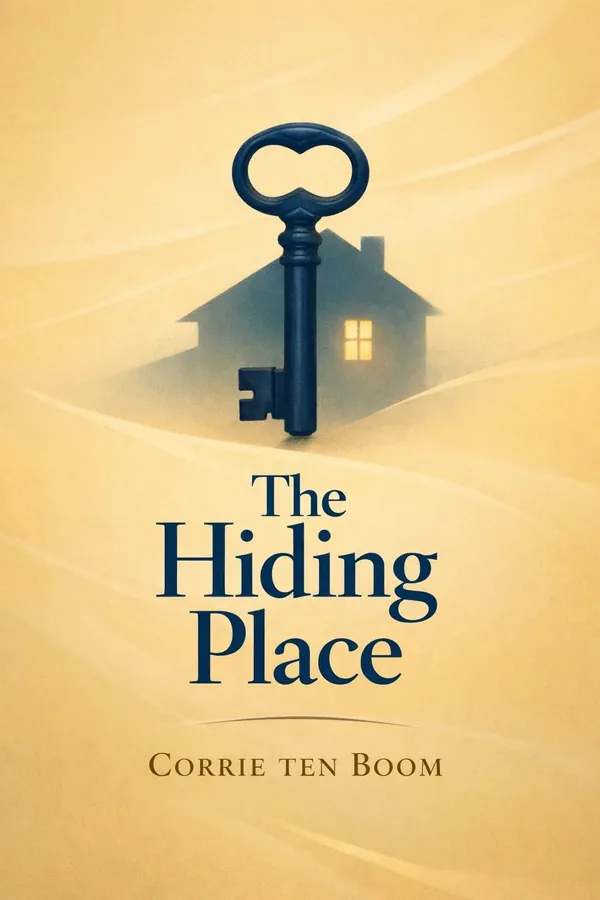
The Hiding Place: Summary & Key Insights
 10 min9 chaptersAudio available
Key Takeaways from The Hiding Place
What if the most important moral decisions of your life began in the middle of an ordinary workday?
A strong moral life is often built long before it is visibly tested.
Evil rarely arrives at full strength all at once; more often, it advances step by step while people try to adjust.
Kindness becomes morally significant when it costs something.
When people lose freedom, comfort, and certainty, what remains of the self?
What Is The Hiding Place About?
The Hiding Place by Corrie Ten Boom is a biographies book. What do ordinary people do when evil becomes law? In The Hiding Place, Corrie Ten Boom answers that question not with theory, but with lived courage. This unforgettable memoir tells the true story of the Ten Boom family, Dutch Christians who risked their lives to shelter Jews during the Nazi occupation of the Netherlands. From the family’s modest watch shop in Haarlem to the horrors of prison and the Ravensbrück concentration camp, Corrie traces a journey marked by fear, loss, endurance, and astonishing faith. What makes the book so enduring is not only its historical value, but its moral clarity: it shows how small acts of compassion can become powerful resistance. Corrie writes not as a distant commentator, but as a survivor who witnessed cruelty at its worst and still chose forgiveness over hatred. Her authority comes from experience, her perspective from deep spiritual conviction, and her message from tested suffering. The Hiding Place matters because it reminds readers that bravery often begins quietly, in homes, habits, and decisions that seem small until history puts them to the test.
This FizzRead summary covers all 9 key chapters of The Hiding Place in approximately 10 minutes, distilling the most important ideas, arguments, and takeaways from Corrie Ten Boom's work. Also available as an audio summary and Key Quotes Podcast.
The Hiding Place
What do ordinary people do when evil becomes law? In The Hiding Place, Corrie Ten Boom answers that question not with theory, but with lived courage. This unforgettable memoir tells the true story of the Ten Boom family, Dutch Christians who risked their lives to shelter Jews during the Nazi occupation of the Netherlands. From the family’s modest watch shop in Haarlem to the horrors of prison and the Ravensbrück concentration camp, Corrie traces a journey marked by fear, loss, endurance, and astonishing faith. What makes the book so enduring is not only its historical value, but its moral clarity: it shows how small acts of compassion can become powerful resistance. Corrie writes not as a distant commentator, but as a survivor who witnessed cruelty at its worst and still chose forgiveness over hatred. Her authority comes from experience, her perspective from deep spiritual conviction, and her message from tested suffering. The Hiding Place matters because it reminds readers that bravery often begins quietly, in homes, habits, and decisions that seem small until history puts them to the test.
Who Should Read The Hiding Place?
This book is perfect for anyone interested in biographies and looking to gain actionable insights in a short read. Whether you're a student, professional, or lifelong learner, the key ideas from The Hiding Place by Corrie Ten Boom will help you think differently.
- ✓Readers who enjoy biographies and want practical takeaways
- ✓Professionals looking to apply new ideas to their work and life
- ✓Anyone who wants the core insights of The Hiding Place in just 10 minutes
Want the full summary?
Get instant access to this book summary and 100K+ more with Fizz Moment.
Get Free SummaryAvailable on App Store • Free to download
Key Chapters
What if the most important moral decisions of your life began in the middle of an ordinary workday? One of the most striking lessons in The Hiding Place is that heroism does not usually start with dramatic speeches or grand plans. It begins in familiar places, among ordinary people, with small choices repeated over time. Corrie Ten Boom invites us into the small Dutch town of Haarlem, into the narrow watch shop where her family lived and worked, and shows that the setting of extraordinary courage was not a battlefield but a household shaped by faith, hospitality, and duty.
The Ten Boom family did not become rescuers overnight. Long before the war, their home was a place where neighbors, the poor, and the vulnerable were welcomed. Corrie’s father, Casper, treated every person as bearing the image of God. That daily pattern of kindness prepared the family for a moment when kindness would become dangerous. When Jews needed protection, the Ten Booms did not suddenly invent a moral code; they lived out the one they had practiced for years.
This idea matters because many readers imagine courage as something reserved for exceptional people. Corrie’s story says otherwise. The habits you build in peaceful times shape what you do in crisis. The way you treat coworkers, strangers, family members, and those with less power than you is not separate from moral courage; it is its training ground. A welcoming home, a disciplined conscience, and a commitment to truth can become the foundation for lifesaving action.
In practical terms, this means building values into daily routines. Speak up when something is unfair. Make room for people who are overlooked. Practice generosity before it is costly. When pressure comes, you will draw from what you have already become.
Actionable takeaway: Treat your daily life as preparation for bigger tests by practicing courage, compassion, and integrity in small, consistent ways.
A strong moral life is often built long before it is visibly tested. Before the Nazis invaded the Netherlands, life in Haarlem seemed simple, structured, and full of familiar rhythms. The watch shop on Barteljorisstraat was filled with clocks, customers, repairs, and conversation. Yet beneath that ordinary routine was something deeper: a home anchored in Christian faith, family loyalty, and service. The Hiding Place shows that what looked like a modest life was actually a deeply formed one.
Corrie’s father, Casper Ten Boom, played a central role in creating that atmosphere. He was humble, gentle, and unwavering in his belief that all people mattered to God. The family read Scripture, prayed together, welcomed guests, and served people in need. Corrie, her sister Betsie, and the rest of the household learned that faith was not abstract doctrine. It was expressed in work, relationships, generosity, and trust. Their home became a place of refuge long before it literally became one.
This prewar picture is important because it explains why the Ten Booms responded as they did when danger arrived. Their convictions were not improvised under pressure. They had been formed over years of discipline and devotion. In modern life, people often separate beliefs from habits, assuming values will somehow appear when needed. Corrie’s story shows the opposite. The inner life must be cultivated in advance.
There is a practical lesson here for anyone trying to live with principle in unstable times. The routines you establish now matter. Shared meals, honest work, prayer or reflection, service to others, and a household culture of respect can prepare people to stand firm later. Character is not built in a single dramatic moment; it is shaped by repeated choices.
Actionable takeaway: Create daily habits that align with your deepest values, because crisis will reveal the strength of the character you have quietly built.
Evil rarely arrives at full strength all at once; more often, it advances step by step while people try to adjust. One of the clearest insights from The Hiding Place is how occupation in the Netherlands began with a slow tightening of control. German invasion did not instantly produce the most visible horrors. Instead, there were regulations, curfews, identity checks, restrictions, confiscations, and growing fear. Rights disappeared in increments, and each new rule attempted to normalize the next.
Corrie describes how familiar streets filled with soldiers and suspicion. Jewish friends and neighbors were increasingly isolated through official policies and social pressure. What had once seemed unthinkable became administrative routine. This is how moral numbness can spread: people accommodate the first injustice because it seems limited, then the next because resistance feels riskier, until cruelty has become ordinary.
The Ten Booms chose a different response. As the pressure increased, they recognized that neutrality was impossible. Their resistance began not as political ideology but as moral clarity. If innocent people were being hunted, then helping them was not optional. The family’s home was adapted to hide fugitives, including a secret room built for emergencies. They also entered wider resistance networks, securing ration cards and coordinating shelter.
For today’s reader, this section offers a serious warning. Pay attention to the small erosions of dignity, truth, and freedom. In workplaces, communities, and nations, harmful systems often depend on silence during the early stages. The right moment to care is before the damage becomes irreversible.
Practical application means learning to notice patterns: scapegoating language, rules that dehumanize certain groups, pressure to stay quiet, and the bureaucratic masking of cruelty. Moral alertness is a civic duty.
Actionable takeaway: Do not wait for injustice to become extreme before responding; recognize and resist harmful patterns while they still appear manageable.
Kindness becomes morally significant when it costs something. In The Hiding Place, the Ten Boom family’s decision to shelter Jews was not an act of sentimental goodwill; it was a deliberate acceptance of danger. They knew discovery could lead to arrest, imprisonment, or death, yet they chose to help anyway. Corrie’s memoir reveals that true compassion is not merely feeling sympathy for suffering people. It is taking meaningful action on their behalf, even when comfort and safety are threatened.
The family transformed their home into a center of concealment and rescue. A false wall created a hidden room where Jews and resistance workers could hide during raids. Drills were practiced so that those in danger could disappear quickly if officers arrived. Corrie also participated in obtaining ration cards and in building the practical infrastructure needed to keep people alive. Compassion in this book is logistical, disciplined, and brave.
This matters because many people admire goodness in theory but hesitate when generosity becomes inconvenient. Corrie’s story pushes readers to ask difficult questions: What am I willing to risk for another person’s dignity? Do I help only when it is easy, visible, or socially rewarded? Moral love often requires planning, sacrifice, and perseverance.
In everyday life, most readers will not face the same scale of danger, but the principle still applies. Standing by a targeted coworker, supporting an immigrant family, protecting someone from abuse, donating time and resources, or speaking truth in a hostile environment all involve forms of risk. The cost may be reputation, comfort, time, or approval.
Corrie shows that love without action remains incomplete. Compassion matures when it moves beyond emotion into embodied service. Courage is not the absence of fear; it is obedience to conscience despite fear.
Actionable takeaway: Choose one concrete way to protect or support a vulnerable person this week, even if it requires inconvenience, sacrifice, or social discomfort.
Hope is most powerful when it exists where optimism seems impossible. In Ravensbrück, Corrie and Betsie lived amid overcrowding, filth, abuse, and constant uncertainty. Under such conditions, hope could easily sound naive. Yet The Hiding Place shows that hope is not denial of reality; it is the refusal to let evil have the final word over reality. Corrie’s faith did not blind her to suffering. It gave her a framework in which suffering was real but not ultimate.
One of the most memorable examples is the way Corrie and Betsie used a smuggled Bible to encourage women in the barracks. In a place designed to destroy identity and crush spirit, they created moments of worship, conversation, and human connection. Even the lice in their barracks, which seemed purely miserable, unexpectedly kept guards away and gave the women more freedom to gather. Corrie learns that meaning can appear in places she would never have chosen and often cannot understand in advance.
This lesson has practical value beyond wartime history. People today face burnout, family crises, social instability, and personal grief. In such moments, hope rarely arrives as confidence that everything will be easy. More often, it appears as the decision to keep loving, serving, praying, building, or speaking truth despite uncertainty. Hope is sustained by purpose, not predictions.
Readers can apply this by looking for sources of meaning within hardship rather than waiting for hardship to disappear first. A support group, a journal, a spiritual practice, a routine of service, or simply one trustworthy friendship can become a shelter for hope. Corrie’s example reminds us that even small acts of light matter in dark systems.
Actionable takeaway: Identify one practice that helps you preserve hope under pressure, and commit to it consistently rather than relying on changing emotions.
Few ideas in The Hiding Place are more challenging than this: forgiveness is not excusing evil, but refusing to let evil rule your heart forever. After the war, Corrie became known not only as a survivor but as a witness to forgiveness. This message was not cheap or abstract. She had seen cruelty firsthand. She had lost family members. She carried memories of humiliation, terror, and grief. Yet she came to believe that hatred, even when understandable, imprisons the wounded long after the oppressor is gone.
One of the most powerful moments associated with Corrie’s story comes when she encounters a former Ravensbrück guard after the war. Faced with the man’s outstretched hand, she feels revulsion and resistance. Forgiveness does not come naturally. It arrives first as obedience, then as action, and only later as feeling. This is a crucial insight. Many people wait to feel forgiving before they forgive. Corrie suggests that forgiveness often begins as a decision to release vengeance and entrust justice to God.
This principle has broad application. In personal life, unresolved resentment can shape identity, relationships, and emotional health. Forgiveness does not mean denying harm, reconciling without accountability, or abandoning boundaries. It means choosing not to be spiritually or emotionally governed by revenge. It creates room for healing, even when trust cannot be restored.
Practically, forgiveness may involve naming the hurt honestly, grieving it fully, seeking wise counsel, and deciding repeatedly not to rehearse retaliation. For severe wounds, this process may take time. Corrie’s witness is valuable precisely because she does not present forgiveness as easy.
Actionable takeaway: Begin forgiveness as a deliberate practice—name one resentment you are carrying and take one step toward releasing its hold, whether through prayer, reflection, or conversation.
Many people expect divine help to appear as escape, but The Hiding Place repeatedly suggests that God’s presence is often most visible in endurance. Corrie’s memoir is saturated with the belief that providence operates not only through dramatic deliverance, but through strength given in weakness, peace in fear, and unexpected meaning in suffering. This does not erase tragedy. Corrie’s father dies. Betsie dies. Countless prisoners do not survive. Yet the book insists that spiritual reality can be experienced even when circumstances remain terrible.
Betsie embodies this perspective most vividly. She sees beyond the immediate brutality of Ravensbrück and imagines places of healing that could exist after the war. She urges Corrie to give thanks even for difficult things, trusting that God’s purposes may exceed human understanding. Corrie often struggles with this, which makes the account more believable. Faith here is not cheerful denial; it is contested trust.
For readers, whether religious or not, the deeper insight is that meaning and strength often emerge where human control ends. People discover courage when they can no longer rely on status, plans, or comfort. They learn dependence, humility, and attention. Even secular readers can appreciate the practical dimension: when life becomes unmanageable, inner grounding matters more than external certainty.
This can be applied through reflective practices that keep you anchored when outcomes are unclear. Prayer, meditation, gratitude, community support, and acts of service all help shift focus from total control to faithful presence. Corrie’s experience suggests that peace is not always found by changing circumstances first, but by changing how one inhabits them.
Actionable takeaway: When facing uncertainty, stop asking only for immediate solutions and also ask what source of inner grounding can help you remain steady and purposeful now.
Survival creates an obligation: to remember truthfully and to speak for those who cannot. The Hiding Place is more than a personal memoir; it is an act of witness. Corrie tells her family’s story not to elevate herself, but to preserve the reality of what happened and to testify that ordinary people can choose courage. Memory in this book is not passive recollection. It is a moral responsibility aimed at shaping the conscience of future generations.
By recounting life before the war, the tightening of occupation, the rescue efforts, the betrayal, the camps, and the struggle to forgive, Corrie resists two dangers: forgetting evil and sentimentalizing goodness. She shows that the past was complex, painful, and costly. Such memory matters because societies quickly lose moral clarity when history becomes abstract. Statistics can numb; stories can awaken.
This lesson is especially relevant in a world saturated with information but often thin in moral attention. Historical memory helps readers recognize warning signs in the present, value human dignity, and understand the cost of indifference. It also honors those whose suffering would otherwise be buried by time. Corrie’s testimony preserves not only horror, but examples of faithfulness, solidarity, and resistance.
In practical life, memory can be cultivated through reading survivor accounts, discussing history honestly, visiting memorials, recording family stories, and refusing to ignore uncomfortable truths. On a personal level, remembering your own hard-won lessons can keep you from drifting into passivity or self-deception.
The book ultimately asks readers not just to admire the Ten Booms, but to become more responsible witnesses in their own time. Remembering well is part of living well.
Actionable takeaway: Turn memory into action by learning one difficult historical story in depth and asking how it should influence your choices, speech, and responsibilities today.
All Chapters in The Hiding Place
About the Author
Corrie Ten Boom (1892–1983) was a Dutch watchmaker, Holocaust survivor, and Christian author best known for her memoir The Hiding Place. Born into a devout family in Haarlem, Netherlands, she became one of the first licensed female watchmakers in her country. During World War II, Corrie and her family sheltered Jews and worked with the Dutch resistance, helping many escape Nazi persecution. After their arrest, she was imprisoned and later sent to Ravensbrück concentration camp, where her sister Betsie died. Corrie survived and, after the war, traveled internationally as a speaker, sharing a message centered on faith, forgiveness, and spiritual resilience. Her life and writing made her one of the most recognized Christian witnesses to the moral courage and suffering of the wartime era.
Get This Summary in Your Preferred Format
Read or listen to the The Hiding Place summary by Corrie Ten Boom anytime, anywhere. FizzRead offers multiple formats so you can learn on your terms — all free.
Available formats: App · Audio · PDF · EPUB — All included free with FizzRead
Download The Hiding Place PDF and EPUB Summary
Key Quotes from The Hiding Place
“What if the most important moral decisions of your life began in the middle of an ordinary workday?”
“A strong moral life is often built long before it is visibly tested.”
“Evil rarely arrives at full strength all at once; more often, it advances step by step while people try to adjust.”
“Kindness becomes morally significant when it costs something.”
“When people lose freedom, comfort, and certainty, what remains of the self?”
Frequently Asked Questions about The Hiding Place
The Hiding Place by Corrie Ten Boom is a biographies book that explores key ideas across 9 chapters. What do ordinary people do when evil becomes law? In The Hiding Place, Corrie Ten Boom answers that question not with theory, but with lived courage. This unforgettable memoir tells the true story of the Ten Boom family, Dutch Christians who risked their lives to shelter Jews during the Nazi occupation of the Netherlands. From the family’s modest watch shop in Haarlem to the horrors of prison and the Ravensbrück concentration camp, Corrie traces a journey marked by fear, loss, endurance, and astonishing faith. What makes the book so enduring is not only its historical value, but its moral clarity: it shows how small acts of compassion can become powerful resistance. Corrie writes not as a distant commentator, but as a survivor who witnessed cruelty at its worst and still chose forgiveness over hatred. Her authority comes from experience, her perspective from deep spiritual conviction, and her message from tested suffering. The Hiding Place matters because it reminds readers that bravery often begins quietly, in homes, habits, and decisions that seem small until history puts them to the test.
You Might Also Like

An American Marriage
Tayari Jones
10 min
Benjamin Franklin: An American Life
Walter Isaacson
10 min
I Know Why The Caged Bird Sings
Maya Angelou
10 min
Long Walk to Freedom
Nelson Mandela
10 min
Persepolis
Marjane Satrapi
10 min
Surely You're Joking, Mr. Feynman!
Richard P. Feynman
10 minBrowse by Category
Ready to read The Hiding Place?
Get the full summary and 100K+ more books with Fizz Moment.