
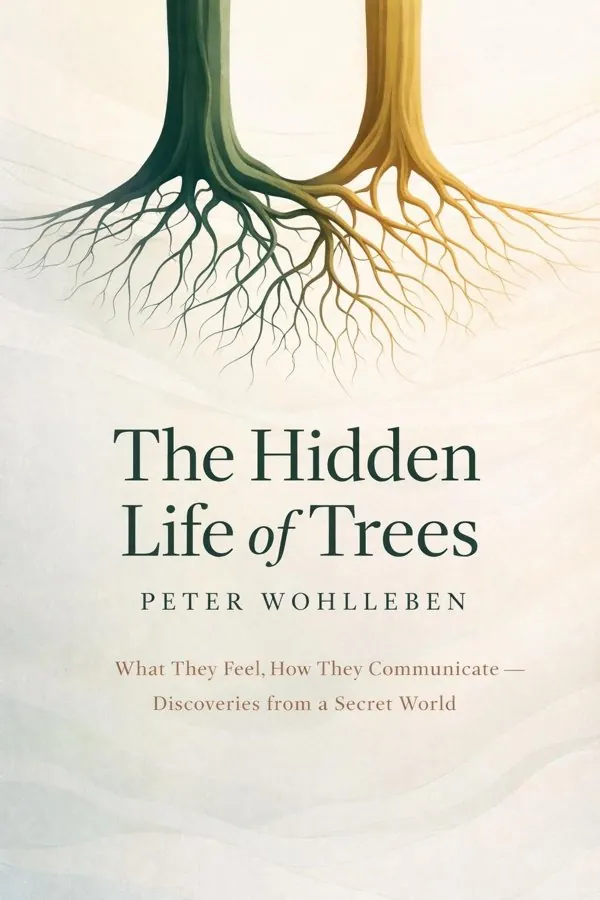
The Hidden Life of Trees: What They Feel, How They Communicate – Discoveries from a Secret World: Summary & Key Insights
 10 min9 chaptersAudio available
Key Takeaways from The Hidden Life of Trees: What They Feel, How They Communicate – Discoveries from a Secret World
A forest is not silent just because humans cannot hear its language.
What if a forest is less like a warehouse and more like a family neighborhood?
We are used to hearing that nature is ruled by ruthless competition, but Wohlleben argues that forests tell a more nuanced story.
A tree has no eyes, ears, or nervous system like ours, yet it is far from unaware.
Intelligence in nature does not always look like a brain making decisions.
What Is The Hidden Life of Trees: What They Feel, How They Communicate – Discoveries from a Secret World About?
The Hidden Life of Trees: What They Feel, How They Communicate – Discoveries from a Secret World by Peter Wohlleben is a environment book spanning 11 pages. Peter Wohlleben’s The Hidden Life of Trees invites readers to look at forests with fresh eyes. What appears at first to be a quiet landscape of stationary plants becomes, in Wohlleben’s telling, a living society filled with communication, cooperation, memory, struggle, and care. Drawing on both modern ecological research and decades of firsthand experience as a German forester, Wohlleben argues that trees are far more dynamic and interconnected than conventional forestry has long assumed. They do not merely grow in isolation; they exchange nutrients, signal danger, support weaker neighbors, and participate in relationships that can last for centuries. What makes this book so compelling is its blend of scientific insight and wonder. Wohlleben translates complex ecological processes into vivid, accessible language without losing the seriousness of his subject. His perspective matters because it challenges the industrial view of forests as timber inventories and asks us to see them instead as communities worthy of respect. For anyone interested in nature, climate, conservation, or the intelligence embedded in living systems, this book offers a memorable and often transformative way of understanding the natural world.
This FizzRead summary covers all 9 key chapters of The Hidden Life of Trees: What They Feel, How They Communicate – Discoveries from a Secret World in approximately 10 minutes, distilling the most important ideas, arguments, and takeaways from Peter Wohlleben's work. Also available as an audio summary and Key Quotes Podcast.
The Hidden Life of Trees: What They Feel, How They Communicate – Discoveries from a Secret World
Peter Wohlleben’s The Hidden Life of Trees invites readers to look at forests with fresh eyes. What appears at first to be a quiet landscape of stationary plants becomes, in Wohlleben’s telling, a living society filled with communication, cooperation, memory, struggle, and care. Drawing on both modern ecological research and decades of firsthand experience as a German forester, Wohlleben argues that trees are far more dynamic and interconnected than conventional forestry has long assumed. They do not merely grow in isolation; they exchange nutrients, signal danger, support weaker neighbors, and participate in relationships that can last for centuries.
What makes this book so compelling is its blend of scientific insight and wonder. Wohlleben translates complex ecological processes into vivid, accessible language without losing the seriousness of his subject. His perspective matters because it challenges the industrial view of forests as timber inventories and asks us to see them instead as communities worthy of respect. For anyone interested in nature, climate, conservation, or the intelligence embedded in living systems, this book offers a memorable and often transformative way of understanding the natural world.
Who Should Read The Hidden Life of Trees: What They Feel, How They Communicate – Discoveries from a Secret World?
This book is perfect for anyone interested in environment and looking to gain actionable insights in a short read. Whether you're a student, professional, or lifelong learner, the key ideas from The Hidden Life of Trees: What They Feel, How They Communicate – Discoveries from a Secret World by Peter Wohlleben will help you think differently.
- ✓Readers who enjoy environment and want practical takeaways
- ✓Professionals looking to apply new ideas to their work and life
- ✓Anyone who wants the core insights of The Hidden Life of Trees: What They Feel, How They Communicate – Discoveries from a Secret World in just 10 minutes
Want the full summary?
Get instant access to this book summary and 100K+ more with Fizz Moment.
Get Free SummaryAvailable on App Store • Free to download
Key Chapters
A forest is not silent just because humans cannot hear its language. One of Wohlleben’s central insights is that trees constantly exchange information, both through the air and through the soil. When insects attack a tree, it may release chemical compounds that warn nearby trees of danger. In response, neighboring trees can alter their internal chemistry, producing defensive substances that make their leaves less appetizing. Underground, roots and fungal networks form another communication channel, often described as a kind of forest internet. Through these systems, trees can pass along nutrients, stress signals, and warnings.
This idea changes how we think about plant life. Instead of isolated organisms passively reacting to the environment, trees emerge as responsive participants in a shared system. A beech tree under attack is not simply a victim; it is also a messenger. A healthy older tree does not merely absorb resources; it may redirect some of them to a struggling sapling nearby. The forest, then, behaves less like a random gathering of trunks and more like a networked community.
In practical terms, this has implications for forestry, gardening, and conservation. Clearing large areas, compacting soil with heavy machinery, or disrupting fungal networks can destroy the invisible infrastructure that keeps forests healthy. Even in urban design, preserving clusters of trees rather than isolated specimens may support resilience.
Actionable takeaway: When thinking about trees, focus not just on individual trunks but on the relationships beneath and around them. Protect the network, not only the tree.
What if a forest is less like a warehouse and more like a family neighborhood? Wohlleben suggests that trees of the same species often form close social bonds, especially in old, undisturbed forests. Parent trees can help their offspring survive by directing sugars and nutrients through root systems and fungal partnerships. These transfers are not acts of sentiment in the human sense, but they do reveal a pattern of mutual support that resembles kinship.
Young saplings growing in the deep shade of mature trees may appear stunted, yet this slow growth can be a survival strategy. The canopy protects them from drought, temperature extremes, and rapid, fragile development. In a natural forest, not every tree races upward immediately. Instead, some wait patiently for decades until a gap in the canopy opens. During that long apprenticeship, they may receive support from older trees that stabilize the ecosystem around them.
This insight helps explain why monoculture plantations feel so different from ancient forests. Plantations are often designed for efficiency, with trees spaced and managed as units of production. Natural forests, by contrast, contain layered relationships built over time. Disturbing those relationships weakens the whole community.
For readers, the lesson extends beyond ecology. Resilience often depends on interdependence, not rugged isolation. Healthy systems, whether natural or human, allow the strong to stabilize the vulnerable.
Actionable takeaway: Support conservation models that preserve mature forests and mixed-age stands, because the oldest trees are not just survivors; they are caregivers and anchors of the forest community.
We are used to hearing that nature is ruled by ruthless competition, but Wohlleben argues that forests tell a more nuanced story. Trees certainly compete for light, water, and space, yet they also cooperate in ways that improve the chances of collective survival. In stable forests, competition is tempered by long-term interdependence. Trees that grow too quickly may become structurally weak, while those that develop slowly within a community often become sturdier and longer-lived.
Wohlleben shows that when trees are connected through roots and fungal networks, they can balance resources across the forest. A tree in a favorable position may share sugars with one in shade. Stumps of long-felled trees have even been found alive for years, nourished by surrounding neighbors. Such examples suggest that forest health cannot be understood only through individual success. Sometimes the best strategy is not to outgrow your neighbors but to grow with them.
This matters because many industrial forestry practices are based on maximizing short-term output. Trees are thinned aggressively, forced into rapid growth, and treated as competitors to be sorted and harvested efficiently. Yet forests managed this way may lose resilience, biodiversity, and ecological memory.
The broader application is striking: systems endure when they include feedback, moderation, and support. Cooperation is not a sentimental alternative to competition; it is often the basis of durable life.
Actionable takeaway: Whether in land management or everyday decisions, favor long-term resilience over short-term optimization. In forests, that means protecting diversity, density, and relationships instead of rewarding only the fastest growth.
A tree has no eyes, ears, or nervous system like ours, yet it is far from unaware. Wohlleben describes trees as highly sensitive organisms that detect changes in light, moisture, gravity, temperature, touch, chemical cues, and seasonal timing. This sensory perception allows them to make remarkably precise adjustments. Roots can grow toward water-rich areas and avoid toxic soil conditions. Branches angle themselves to maximize light exposure. Leaves respond to weather, and bark records stress over time.
One of the most fascinating examples is how trees register threat. When grazing animals or insects damage leaves, chemical signals can trigger defensive responses. Some trees alter the taste or toxicity of their tissues; others send warning compounds into the air. Trees also seem able to distinguish between regular environmental variation and unusual danger, responding selectively rather than mechanically.
Seeing trees as sensing beings transforms our moral and practical relationship with them. It does not mean they feel exactly as humans do, but it does mean they are active interpreters of their environment. A street tree boxed into pavement, exposed to heat, salt, pollution, and root confinement, is not merely standing there. It is constantly struggling to process and survive those pressures.
This perspective can influence landscaping, urban planning, and personal habits. The more we understand the conditions trees actually experience, the better we can design environments that support them.
Actionable takeaway: Treat trees as responsive living organisms with environmental needs. Give them adequate soil, water access, root space, and species-appropriate surroundings rather than assuming they can tolerate any setting.
Intelligence in nature does not always look like a brain making decisions. Wohlleben highlights that trees display forms of memory and learning through long-term physiological change. A tree that experiences drought may alter its growth patterns, root development, or leaf behavior in future dry periods. Seasonal timing is another example: trees do not simply react instantly to warm weather. They rely on accumulated cues from temperature, daylight, and internal chemical states, reducing the risk of budding too early and being damaged by frost.
Memory in trees is stored materially, in tissues, signaling pathways, and growth strategies. This kind of memory allows forests to adapt over decades and centuries. A population that has endured recurring local conditions may become deeply tuned to its habitat. That is one reason why moving tree species or planting nonlocal stock without care can create problems. What looks genetically similar on paper may be poorly adapted to a region’s subtle rhythms.
Wohlleben’s discussion also reframes old forests as repositories of wisdom. Mature ecosystems contain living records of past droughts, storms, pests, and recoveries. When these systems are destroyed, we lose more than biomass; we lose accumulated ecological experience.
For conservationists and land managers, this argues for patience and humility. Nature often contains knowledge that cannot be rebuilt quickly once erased. For ordinary readers, it offers a powerful reminder that adaptation is often slow, embodied, and rooted in place.
Actionable takeaway: Value local, mature ecosystems as carriers of ecological memory. In restoration or planting projects, prioritize native species and long-term suitability over quick, cosmetic results.
A sick tree is not simply a failed organism; it is often a signal that something in the surrounding system is out of balance. Wohlleben explains that tree health depends on a complex web of factors including soil life, water availability, air quality, biodiversity, age structure, and social connection. Pests and diseases do harm, but they frequently exploit trees already weakened by drought, injury, compaction, heat stress, or poor forestry practices.
This is an important distinction. Modern management often treats disease as an isolated enemy to eliminate, yet forest illness is often systemic. A plantation of same-aged trees, all genetically similar and growing in disturbed soil, can become highly vulnerable to infestation. By contrast, a diverse natural forest may better absorb stress because different species and age groups respond differently to threats. Diversity functions like an insurance policy.
Wohlleben also reminds readers that death is not always a catastrophe in ecological terms. Fallen trees feed fungi, insects, mosses, birds, and future plant life. Decay is part of renewal. Problems arise when stress and death occur unnaturally fast or on a massive scale because human systems have stripped forests of resilience.
This insight applies beyond woodland. In many systems, visible breakdown is the final stage of longer hidden damage. Addressing symptoms without changing conditions rarely works for long.
Actionable takeaway: When you see tree decline, ask about root causes rather than just immediate symptoms. Support forest practices that improve soil health, species diversity, and habitat complexity instead of relying only on reactive interventions.
To live for centuries, a tree must master time. Wohlleben emphasizes that trees are exquisitely synchronized with seasonal rhythms, especially in temperate climates. Spring budding, summer growth, autumn leaf drop, and winter dormancy are not simple habits; they are high-stakes survival strategies. Bud too early and frost can destroy delicate new growth. Hold leaves too long in autumn and a sudden freeze can cause damage. Enter dormancy too late or wake too soon, and a tree may exhaust valuable energy reserves.
This seasonal intelligence is coordinated through temperature, daylight, moisture, and internal chemical signaling. Different species use these cues in different ways, which is why climate change is so disruptive. Warmer winters, false springs, prolonged droughts, and erratic storms scramble the timing systems trees have evolved over long periods. A tree may respond to heat only to be punished by a later freeze. Pollinators, insects, fungi, and bird species can also fall out of sync with one another.
Understanding these rhythms deepens our appreciation of seemingly ordinary events. A leafless winter forest is not dead; it is conserving energy and waiting with precision. A slow spring may actually protect life. For gardeners and land stewards, respecting these cycles means pruning, planting, and intervention at appropriate times.
On a human level, the chapter suggests that endurance depends on rhythm as much as effort. Rest is not inactivity; it is preparation.
Actionable takeaway: Align tree care and land management with natural seasonal cycles, and recognize that climate stability is essential for the timing systems forests depend on.
In a healthy forest, death is not the opposite of life but one of its engines. Wohlleben presents decay as a creative force. Fallen trunks become moisture reservoirs, nurse logs, insect habitat, fungal food, and seedbeds for the next generation. Standing deadwood supports birds, bats, and countless smaller organisms. Even the gradual collapse of an old tree opens gaps in the canopy that allow waiting saplings to rise.
This perspective challenges the human impulse to tidy nature. Managed landscapes often remove deadwood because it looks messy or unproductive. Yet what appears useless from a commercial or aesthetic point of view may be ecologically essential. Forest continuity depends on these transitions. Nutrients locked in one generation are released to sustain another. Life is not organized in neat categories of living versus dead; it moves through cycles of transformation.
Wohlleben’s broader point is that durability comes from allowing these cycles to unfold. A forest stripped of old trees, fallen logs, rotting stumps, and natural succession loses much of its complexity. It may still contain trees, but it no longer functions as a rich ecosystem.
There is also an ethical lesson here. Human culture often values youth, productivity, and visible vitality while overlooking the importance of aging, decline, and return. Forests show that endings can nourish beginnings.
Actionable takeaway: Support conservation areas and park policies that leave some deadwood and natural debris in place. If safety allows, let forests retain the materials that regeneration depends on.
The deepest shift this book asks of readers is conceptual: stop seeing a forest as a collection of harvestable trees and start seeing it as a living community. Wohlleben widens the frame beyond trunks and branches to include fungi, mosses, insects, mammals, birds, microbes, moisture cycles, and soil structure. Trees shape and are shaped by all of these relationships. The forest creates its own microclimate, moderates heat, stores water, builds soil, and supports biodiversity on scales that single trees cannot.
This community perspective has major consequences for how humans intervene. Clear-cutting, monoculture planting, and heavy mechanized management do more than remove wood. They fracture ecological relationships, alter humidity and temperature, damage soils, and weaken the system’s capacity to recover. By contrast, close-to-nature forestry and protected old-growth areas preserve the interactions that make forests resilient over time.
Wohlleben also invites an emotional and ethical response. Once readers understand forests as communities, it becomes harder to justify treating them purely as resources. Respect does not require romanticizing nature. It requires recognizing complexity and limits. Forests offer timber, yes, but also climate regulation, water protection, habitat, beauty, and a model of interdependence.
For modern societies facing biodiversity loss and climate instability, this view is urgently practical. Protecting forests is not a luxury; it is a survival strategy.
Actionable takeaway: Evaluate forest policies by ecosystem health, not just wood yield. Support management approaches that preserve biodiversity, soil integrity, mature trees, and long-term ecological function.
All Chapters in The Hidden Life of Trees: What They Feel, How They Communicate – Discoveries from a Secret World
About the Author
Peter Wohlleben is a German forester and author best known for bringing the hidden complexity of forest life to a global audience. After studying forestry, he worked for the state forestry administration in Germany, where he became increasingly critical of conventional practices that prioritized timber production over ecological health. He later managed woodland with a more conservation-oriented approach, emphasizing biodiversity, natural processes, and sustainable stewardship. Wohlleben’s writing blends practical experience in the forest with accessible explanations of ecological science, helping general readers understand how trees and ecosystems function. His international bestseller The Hidden Life of Trees made him one of the most recognizable voices in popular environmental writing. Through his books, lectures, and advocacy, he has encouraged a more respectful and interconnected view of the natural world.
Get This Summary in Your Preferred Format
Read or listen to the The Hidden Life of Trees: What They Feel, How They Communicate – Discoveries from a Secret World summary by Peter Wohlleben anytime, anywhere. FizzRead offers multiple formats so you can learn on your terms — all free.
Available formats: App · Audio · PDF · EPUB — All included free with FizzRead
Download The Hidden Life of Trees: What They Feel, How They Communicate – Discoveries from a Secret World PDF and EPUB Summary
Key Quotes from The Hidden Life of Trees: What They Feel, How They Communicate – Discoveries from a Secret World
“A forest is not silent just because humans cannot hear its language.”
“What if a forest is less like a warehouse and more like a family neighborhood?”
“We are used to hearing that nature is ruled by ruthless competition, but Wohlleben argues that forests tell a more nuanced story.”
“A tree has no eyes, ears, or nervous system like ours, yet it is far from unaware.”
“Intelligence in nature does not always look like a brain making decisions.”
Frequently Asked Questions about The Hidden Life of Trees: What They Feel, How They Communicate – Discoveries from a Secret World
The Hidden Life of Trees: What They Feel, How They Communicate – Discoveries from a Secret World by Peter Wohlleben is a environment book that explores key ideas across 9 chapters. Peter Wohlleben’s The Hidden Life of Trees invites readers to look at forests with fresh eyes. What appears at first to be a quiet landscape of stationary plants becomes, in Wohlleben’s telling, a living society filled with communication, cooperation, memory, struggle, and care. Drawing on both modern ecological research and decades of firsthand experience as a German forester, Wohlleben argues that trees are far more dynamic and interconnected than conventional forestry has long assumed. They do not merely grow in isolation; they exchange nutrients, signal danger, support weaker neighbors, and participate in relationships that can last for centuries. What makes this book so compelling is its blend of scientific insight and wonder. Wohlleben translates complex ecological processes into vivid, accessible language without losing the seriousness of his subject. His perspective matters because it challenges the industrial view of forests as timber inventories and asks us to see them instead as communities worthy of respect. For anyone interested in nature, climate, conservation, or the intelligence embedded in living systems, this book offers a memorable and often transformative way of understanding the natural world.
More by Peter Wohlleben



You Might Also Like

A Life on Our Planet: My Witness Statement and a Vision for the Future
David Attenborough
10 min
A Sky Full Of Birds
Matt Merritt
10 min
Carbon Zero: Imagining Cities That Can Save the Planet
Alex Steffen
10 min
Eaarth: Making a Life on a Tough New Planet
Bill McKibben
10 min
The Social Contract and Environmental Governance
Various Editors
10 min
The Wild Places
Robert Macfarlane
10 minBrowse by Category
Ready to read The Hidden Life of Trees: What They Feel, How They Communicate – Discoveries from a Secret World?
Get the full summary and 100K+ more books with Fizz Moment.