
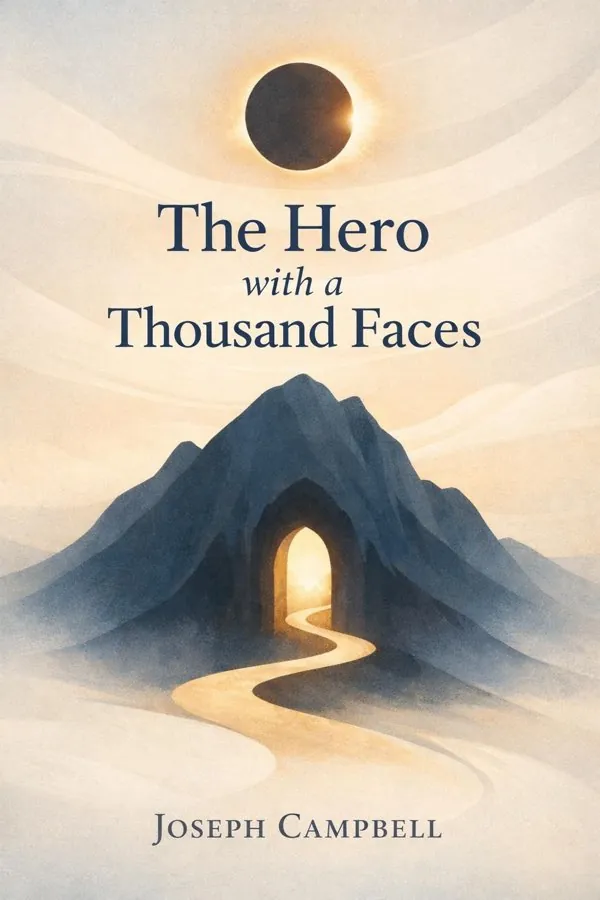
The Hero with a Thousand Faces: Summary & Key Insights
 10 min7 chaptersAudio available
What Is The Hero with a Thousand Faces About?
The Hero with a Thousand Faces by Joseph Campbell is a civilization book spanning 7 pages. In this seminal work of comparative mythology, Joseph Campbell explores the archetypal hero’s journey that recurs across cultures and eras. Drawing from myths, legends, and religious traditions worldwide, Campbell identifies a universal pattern of adventure, initiation, and return that underlies countless narratives. His analysis reveals how these timeless stories reflect the psychological and spiritual development of humanity.
This FizzRead summary covers all 7 key chapters of The Hero with a Thousand Faces in approximately 10 minutes, distilling the most important ideas, arguments, and takeaways from Joseph Campbell's work. Also available as an audio summary and Key Quotes Podcast.
The Hero with a Thousand Faces
In this seminal work of comparative mythology, Joseph Campbell explores the archetypal hero’s journey that recurs across cultures and eras. Drawing from myths, legends, and religious traditions worldwide, Campbell identifies a universal pattern of adventure, initiation, and return that underlies countless narratives. His analysis reveals how these timeless stories reflect the psychological and spiritual development of humanity.
Who Should Read The Hero with a Thousand Faces?
This book is perfect for anyone interested in civilization and looking to gain actionable insights in a short read. Whether you're a student, professional, or lifelong learner, the key ideas from The Hero with a Thousand Faces by Joseph Campbell will help you think differently.
- ✓Readers who enjoy civilization and want practical takeaways
- ✓Professionals looking to apply new ideas to their work and life
- ✓Anyone who wants the core insights of The Hero with a Thousand Faces in just 10 minutes
Want the full summary?
Get instant access to this book summary and 100K+ more with Fizz Moment.
Get Free SummaryAvailable on App Store • Free to download
Key Chapters
At the heart of my work lies what I call the monomyth—the single, universal story found behind every myth. From the creation myths of the Pacific islands to the legends of Arthurian Britain, from Hindu epics to Norse sagas, the same pattern repeats: the hero is called, ventures forth, meets trials, gains a boon, and returns transformed. My purpose is not to reduce myth to a formula, but to reveal that all myths express one fundamental truth: life itself is a journey of separation, initiation, and return.
This structure is not an invention of culture; it arises from the depths of the psyche. Drawing upon Jung’s notions of archetypes, I show how mythic symbolism manifests the same psychological processes we experience in dream and imagination. The hero’s journey, therefore, mirrors the dynamics of individuation—the movement from unconscious ignorance toward conscious integration. Every dragon the hero faces is an image of inner resistance; every magical guide signifies the voice of intuition or wisdom from within.
When myths are viewed in this way, their function becomes transformative rather than decorative. Ancient societies told myths to help individuals undergo the difficult transitions of life—birth, maturity, death, renewal. Modern society often forgets these guiding images, which is why so many feel lost amid material abundance. To understand the monomyth is to restore meaning: we rediscover that every human life, no matter how ordinary, follows the same structure of adventure as do the tales of gods and heroes.
The first stage of the journey begins in the ordinary world—the realm of comfort, habit, and familiarity. Yet something disturbs the equilibrium: a summons, a call, often appearing in symbolic form. It may arrive as an event, a messenger, or even a dream—a whisper from destiny that calls the hero to step beyond what he knows. The hero seldom welcomes this invitation; it threatens the security of the known world. In myths, this hesitation appears as the refusal of the call. Jonah flees from God’s mission; the Buddha’s contemporaries resist enlightenment; the fairy-tale protagonists hesitate at the edge of the dark forest.
Psychologically, the call represents the emergence of the unconscious into consciousness—the invitation to growth. Refusal of the call, meanwhile, reveals our fear of transformation. The hero, like every human being, must learn that remaining within the comfort zone leads to stagnation. In refusing the call, one risks the diminishment of life’s potential. Yet mythology assures us that the call is persistent. Life itself will press forward until we accept the adventure. Once the call is heeded, the hero steps out of the ordinary world and prepares to enter mystery—and the true process of transformation begins.
+ 5 more chapters — available in the FizzRead app
All Chapters in The Hero with a Thousand Faces
About the Author
Joseph Campbell (1904–1987) was an American professor of literature, writer, and orator best known for his work in comparative mythology and comparative religion. His ideas on the monomyth and the hero’s journey have profoundly influenced literature, film, and psychology.
Get This Summary in Your Preferred Format
Read or listen to the The Hero with a Thousand Faces summary by Joseph Campbell anytime, anywhere. FizzRead offers multiple formats so you can learn on your terms — all free.
Available formats: App · Audio · PDF · EPUB — All included free with FizzRead
Download The Hero with a Thousand Faces PDF and EPUB Summary
Key Quotes from The Hero with a Thousand Faces
“At the heart of my work lies what I call the monomyth—the single, universal story found behind every myth.”
“The first stage of the journey begins in the ordinary world—the realm of comfort, habit, and familiarity.”
Frequently Asked Questions about The Hero with a Thousand Faces
The Hero with a Thousand Faces by Joseph Campbell is a civilization book that explores key ideas across 7 chapters. In this seminal work of comparative mythology, Joseph Campbell explores the archetypal hero’s journey that recurs across cultures and eras. Drawing from myths, legends, and religious traditions worldwide, Campbell identifies a universal pattern of adventure, initiation, and return that underlies countless narratives. His analysis reveals how these timeless stories reflect the psychological and spiritual development of humanity.
You Might Also Like

The Structure of Scientific Revolutions
Thomas S. Kuhn
10 min
Genius
Harold Bloom
10 min
A Cultural History of the Medieval Age
Various Editors
10 min
A History of God: The 4,000-Year Quest of Judaism, Christianity and Islam
Karen Armstrong
10 min
A History of the World in 10½ Chapters
Julian Barnes
10 min
A Short History of Progress
Ronald Wright
10 minBrowse by Category
Ready to read The Hero with a Thousand Faces?
Get the full summary and 100K+ more books with Fizz Moment.