
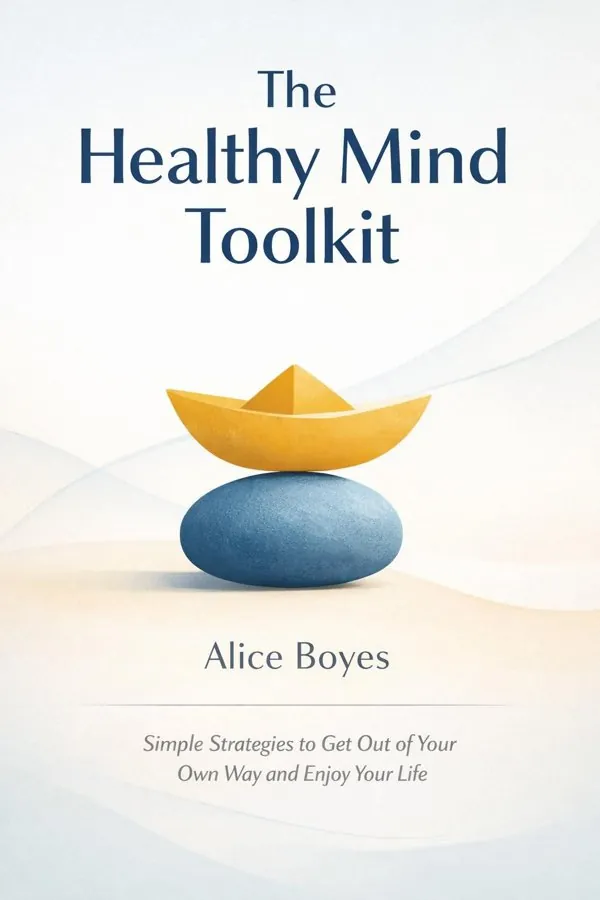
The Healthy Mind Toolkit: Simple Strategies to Get Out of Your Own Way and Enjoy Your Life: Summary & Key Insights
by Alice Boyes
 10 min11 chaptersAudio available
What Is The Healthy Mind Toolkit: Simple Strategies to Get Out of Your Own Way and Enjoy Your Life About?
The Healthy Mind Toolkit: Simple Strategies to Get Out of Your Own Way and Enjoy Your Life by Alice Boyes is a mental_health book spanning 11 pages. The Healthy Mind Toolkit offers practical cognitive-behavioral techniques to help readers overcome self-defeating habits and improve emotional well-being. Drawing on psychological research and clinical experience, Alice Boyes provides actionable strategies for managing anxiety, perfectionism, and procrastination, fostering self-compassion and resilience.
This FizzRead summary covers all 11 key chapters of The Healthy Mind Toolkit: Simple Strategies to Get Out of Your Own Way and Enjoy Your Life in approximately 10 minutes, distilling the most important ideas, arguments, and takeaways from Alice Boyes's work. Also available as an audio summary and Key Quotes Podcast.
The Healthy Mind Toolkit: Simple Strategies to Get Out of Your Own Way and Enjoy Your Life
The Healthy Mind Toolkit offers practical cognitive-behavioral techniques to help readers overcome self-defeating habits and improve emotional well-being. Drawing on psychological research and clinical experience, Alice Boyes provides actionable strategies for managing anxiety, perfectionism, and procrastination, fostering self-compassion and resilience.
Who Should Read The Healthy Mind Toolkit: Simple Strategies to Get Out of Your Own Way and Enjoy Your Life?
This book is perfect for anyone interested in mental_health and looking to gain actionable insights in a short read. Whether you're a student, professional, or lifelong learner, the key ideas from The Healthy Mind Toolkit: Simple Strategies to Get Out of Your Own Way and Enjoy Your Life by Alice Boyes will help you think differently.
- ✓Readers who enjoy mental_health and want practical takeaways
- ✓Professionals looking to apply new ideas to their work and life
- ✓Anyone who wants the core insights of The Healthy Mind Toolkit: Simple Strategies to Get Out of Your Own Way and Enjoy Your Life in just 10 minutes
Want the full summary?
Get instant access to this book summary and 100K+ more with Fizz Moment.
Get Free SummaryAvailable on App Store • Free to download
Key Chapters
Self-sabotage often begins as self-protection. That’s the paradox I’ve seen so often in my work: the very instincts that evolve to keep us safe—protecting us from failure, rejection, or disappointment—can end up shrinking the space in which we live our lives. Perhaps perfectionism keeps you working until midnight so no one can criticize you, or maybe avoidance protects you from facing a project you fear you might botch. These patterns aren’t random; they’re coping strategies that have outlived their usefulness.
In this chapter, I invite you to trace the roots of your own unhelpful habits. Perfectionism, procrastination, self-criticism, people-pleasing—each is an attempt at control in an unpredictable world. Cognitive-behavioral theory shows us that our thoughts, emotions, and behaviors constantly loop together. A self-critical thought (“I can never do this right”) sparks anxiety, which leads to avoidance (“I’ll tackle it later”), which produces guilt and further self-criticism. The mind’s intention is good—reduce discomfort—but the outcome is less confidence, less progress, and more internal noise.
Understanding self-sabotage means seeing the pattern and recognizing it as a pattern—something learned, not innate. That recognition is profoundly liberating, because what has been learned can be unlearned. Each person’s pattern is unique, shaped by temperament, experience, and even culture, but the basic mechanism—distress → avoidance → temporary relief → long-term cost—remains universal. As we explore the next chapters, we’ll dismantle this loop piece by piece until what remains is a clearer, kinder mental environment.
Cognitive distortions are the mind’s optical illusions. They’re habitual, exaggerated ways of interpreting the world that feel absolutely true while subtly distorting reality. You might notice yourself catastrophizing, jumping to conclusions, or disqualifying your successes. These distortions act like colored lenses, tinting how you interpret your experiences.
In therapy terms, we describe them as automatic thoughts—those quick, silent sentences that flash in your head before you even realize they’ve appeared. “She didn’t reply—she must be annoyed with me.” “If I can’t do it perfectly, there’s no point.” Each distortion feeds anxiety, guilt, or overwhelm, often without your conscious consent.
What helps is naming them. Labeling a distortion is like turning on a light in a dark room; suddenly you can see that the shapes aren’t monsters but shadows. Cognitive-behavioral tools like thought monitoring and reframing help you pause the automatic reaction and examine alternatives. When you ask yourself, “What’s another way to interpret this?” you challenge the tyranny of your first thought.
Building this awareness takes patience, but it’s deeply empowering. Over time, your goal isn’t to eradicate negative thoughts—they’re part of being human—but to stop fusing with them. You’ll begin responding from choice rather than compulsion, which creates a powerful sense of freedom.
+ 9 more chapters — available in the FizzRead app
All Chapters in The Healthy Mind Toolkit: Simple Strategies to Get Out of Your Own Way and Enjoy Your Life
About the Author
Alice Boyes, PhD, is a former clinical psychologist and author known for translating psychological science into practical advice. She writes for Psychology Today and has published several books on emotional intelligence and self-improvement.
Get This Summary in Your Preferred Format
Read or listen to the The Healthy Mind Toolkit: Simple Strategies to Get Out of Your Own Way and Enjoy Your Life summary by Alice Boyes anytime, anywhere. FizzRead offers multiple formats so you can learn on your terms — all free.
Available formats: App · Audio · PDF · EPUB — All included free with FizzRead
Download The Healthy Mind Toolkit: Simple Strategies to Get Out of Your Own Way and Enjoy Your Life PDF and EPUB Summary
Key Quotes from The Healthy Mind Toolkit: Simple Strategies to Get Out of Your Own Way and Enjoy Your Life
“Self-sabotage often begins as self-protection.”
“Cognitive distortions are the mind’s optical illusions.”
Frequently Asked Questions about The Healthy Mind Toolkit: Simple Strategies to Get Out of Your Own Way and Enjoy Your Life
The Healthy Mind Toolkit: Simple Strategies to Get Out of Your Own Way and Enjoy Your Life by Alice Boyes is a mental_health book that explores key ideas across 11 chapters. The Healthy Mind Toolkit offers practical cognitive-behavioral techniques to help readers overcome self-defeating habits and improve emotional well-being. Drawing on psychological research and clinical experience, Alice Boyes provides actionable strategies for managing anxiety, perfectionism, and procrastination, fostering self-compassion and resilience.
More by Alice Boyes

You Might Also Like

Big Feelings: How to Be Okay When Things Are Not Okay
Liz Fosslien, Mollie West Duffy
10 min
Creative Arts Therapies Handbook: Art, Music and Dance Therapy Practices for Wellbeing
Susan I. Buchalter
10 min
Emotional First Aid: Healing Rejection, Guilt, Failure, and Other Everyday Hurts
Guy Winch
10 min
Lost Connections: Why You're Depressed and How to Find Hope
Johann Hari
10 min
No Time to Panic: How to Stop Worrying and Embrace Life
Matt Gutman
10 min
Overcoming Mobbing: A Recovery Guide for Workplace Aggression and Bullying
Maureen Duffy, Len Sperry
10 minBrowse by Category
Ready to read The Healthy Mind Toolkit: Simple Strategies to Get Out of Your Own Way and Enjoy Your Life?
Get the full summary and 100K+ more books with Fizz Moment.